Category Archives: Food Illness

USA – USDA Launches New Effort to Reduce Salmonella Illnesses Linked to Poultry

USDA

he U.S. Department of Agriculture’s Food Safety and Inspection Service (FSIS) today announced that it is mobilizing a stronger, and more comprehensive effort to reduce Salmonella illnesses associated with poultry products. The agency is initiating several key activities to gather the data and information necessary to support future action and move closer to the national target of a 25% reduction in Salmonella illnesses.

“Far too many consumers become ill every year from poultry contaminated by Salmonella,” said Agriculture Secretary Tom Vilsack. “We need to be constantly evolving in our efforts to prevent foodborne illness to stay one step ahead of the bad bugs. Today we’re taking action to help prevent Salmonella contamination throughout the poultry supply chain and production system to protect public health.”

Despite consistent reductions in the occurrence of Salmonella in poultry products, more than 1 million consumer illnesses due to Salmonella occur annually, and it is estimated (PDF, 1.4 MB) that over 23% of those illnesses are due to consumption of chicken and turkey.

“Reducing Salmonella infections attributable to poultry is one of the Department’s top priorities,” said USDA Deputy Under Secretary Sandra Eskin, who is leading the initiative. “Time has shown that our current policies are not moving us closer to our public health goal. It’s time to rethink our approach.”

USDA intends to seek stakeholder feedback on specific Salmonella control and measurement strategies, including pilot projects, in poultry slaughter and processing establishments. A key component of this approach is encouraging preharvest controls to reduce Salmonella contamination coming into the slaughterhouse. The data generated from these pilots will be used to determine if a different approach could result in a reduction of Salmonella illness in consumers.

The effort will leverage USDA’s strong research capabilities and strengthen FSIS’ partnership with the Research, Education and Economics (REE) mission area to address data gaps and develop new laboratory methods to guide future Salmonella policy. Meanwhile, the National Advisory Committee for Microbiological Criteria in Foods, an independent federal advisory committee, will be asked to advise on how FSIS can build on the latest science to improve its approach to Salmonella control. Since it is not just the presence or absence of Salmonella, but the quantity of bacteria that can impact the likelihood of illness, FSIS will examine how quantification can be incorporated into this approach. Moreover, with emerging science suggesting that not all Salmonella are equally likely to cause human illness, FSIS will focus on the Salmonella serotypes and the virulence factors that pose the greatest public health risk.

Moving forward, this initiative will require collaboration and ongoing dialogue with stakeholders — industry, consumer groups, and researchers alike. USDA looks forward to working closely with stakeholders on informing and implementing key activities of this framework in the very near future.

USDA touches the lives of all Americans each day in so many positive ways. In the Biden-Harris Administration, USDA is transforming America’s food system with a greater focus on more resilient local and regional food production, fairer markets for all producers, ensuring access to safe, healthy and nutritious food in all communities, building new markets and streams of income for farmers and producers using climate smart food and forestry practices, making historic investments in infrastructure and clean energy capabilities in rural America, and committing to equity across the Department by removing systemic barriers and building a workforce more representative of America. To learn more, visit www.usda.gov.

USA – U.S. and Canada part of Salmonella outbreak linked to tahini and halva

Food Safety News

The United States and Canada are part of an outbreak affecting Europe because of Salmonella in tahini and halva from Syria.

The United States has reported six Salmonella Mbandaka cases, one in 2020 and the rest this year.

Interviews were conducted with two people: both report shopping at international markets that stock mostly Arabic and Middle Eastern foods and ingredients, and ate items containing tahini. Interviews are pending on the remaining ill people. Two have traveled to Syria and have not been reachable by public health officials.

Ill people range from less than one to 57 years old, with a median age of 19.5 years. Illness onset dates are from Nov. 19, 2020 to Sept. 5, 2021.

Canada has eight confirmed cases: five of Salmonella Mbandaka, two of Salmonella Havana and one of Salmonella Orion from 2019 to 2021.

USA – Patient dies in hepatitis A outbreak traced to restaurants in Virginia

Food Safety News

One person has died in a hepatitis A outbreak associated with three restaurants in the Roanoke, VA, area, according to state officials, and two more people have been added to the patient list.

“We don’t believe there is an ongoing threat to the public,” said Christ Wills of the Roanoke City and Alleghany Health Districts, which is a subagency of the Virginia health department.

However, Wills told Food Safety News today there will likely be more sick people than the 37 who have been identified because of the long incubation time for the virus. As of today, 26 of the patients have been so sick they had to be admitted to hospitals. The age range of patients is now trending to include younger patients with people from 31 to 79 years old now infected. 

USA – Salmonella Outbreak Linked to Raw Frozen Breaded Stuffed Chicken Products is over.

CDC

CDC, public health and regulatory officials in several states, and the U.S. Department of Agriculture’s Food Safety and Inspection Service (USDA-FSIS) investigated a multistate outbreak of Salmonella Enteritidis infections.

Epidemiologic, laboratory, and traceback data showed that raw frozen breaded stuffed chicken products produced at the P-2375 Serenade Foods facility in Milford, Indiana, made people sick.

As of October 13, 2021, this outbreak is over.

Epidemiologic Data

A total of 36 people infected with the outbreak strain of Salmonella Enteritidis were reported from 11 states (see map). The true number of sick people in an outbreak is likely much higher than the number reported, and the outbreak may not be limited to the states with known illnesses. This is because many people recover without medical care and are not tested for Salmonella.

Illnesses started on dates ranging from February 21, 2021, to August 16, 2021 (see timeline). Sick people ranged in age from 1 to 83 years, with a median age of 38 years, and 57% were female. Of 32 people with information available, 12 were hospitalized. No deaths were reported.

State and local public health officials interviewed people about the foods they ate in the week before they got sick. Of the 27 people interviewed, 14 (52%) reported preparing and eating frozen breaded stuffed chicken products. They bought different brands of raw frozen breaded stuffed chicken products from multiple stores.

Jordan – Shigella outbreak rises to 80, Source still not identified

Outbreak News Today

Shigella - kswfoodworld

Image CDC

In a follow-up on the shigella outbreak in Jerash, Jordan, the Director of Jerash Governmental Hospital, Sadiq Al-Atoum, said the number of shigellosis cases recorded in Jerash has risen by 22 cases, bringing the total number to 80.

At least 16 people are still being treated.

The Director of Communicable Diseases, Ali Zitawi, said that all of the patients are under the age of 12 and suffered from the same symptoms: abdominal pain, fever, diarrhea and vomiting.

Health authorities in Jordan continue to collect samples from water sources, restaurants and bakeries in Jerash and Ajloun to determine the source of the Shigella bacteria.

Research – Healthcare-associated foodborne outbreaks in high-income countries: a literature review and surveillance study, 16 OEDC countries, 2001 to 2019

Eurosurveillance

Yearly, 23 million foodborne disease illnesses and 5,000 deaths are estimated in the World Health Organization (WHO) European Region, and 41 foodborne Disability Adjusted Life Years (DALYs) per 100,000 population were estimated for the WHO Sub-Region EUR A in 2010 [1]. In Europe, a total of 5,146 foodborne and waterborne outbreaks, including 48,365 cases of illness and 40 deaths were reported to the European Food Safety Authority (EFSA) in 2018 [2]. Vulnerable populations, including elderly patients, immunocompromised patients, children younger than five years old and pregnant women are more susceptible to foodborne infections and are more prone to develop severe courses of disease compared with healthy people [3]. Therefore, healthcare is a setting where foodborne outbreaks (FBO) can cause considerable morbidity and mortality. In 2020, 20.6% of the European Union (EU) population was aged 65 years and older [4]. As the proportion of elderly people is projected to further increase, the share of the vulnerable population as patients in healthcare facilities (HCF) is likely to increase and thereby the risk associated with healthcare-associated foodborne outbreaks (HA-FBO). Personnel (medical and non-medical staff, food handlers etc) of HCF may also be at risk for HA-FBO and be a source of further spread in healthcare settings and elsewhere. This can cause major disruption of services [5].

So far, literature reviews have covered pathogens responsible for HA-FBO, including  [6],  [79] and norovirus [10,11] and focused on microbiological food safety issues in healthcare settings [5,12]. Between 2014 and 2019, a listeriosis outbreak in Germany affected 13 cases who had an inpatient stay in 12 different HCF during the incubation period [13]. In the United Kingdom (UK) in 2019, nine listeriosis cases of which seven died, had consumed sandwiches in seven HCF during the incubation period [14].

We conducted a literature review to describe the causative agents including bacteria, viruses, parasites and fungi, the incriminated food vehicles and other outbreak characteristics of HA-FBO in 37 countries that are members of the Organisation for Economic Cooperation and Development (OECD) [15]. Furthermore, we analysed German surveillance data and data from the EFSA on HA-FBO. The aim of this article is to describe the current status of HA-FBO in order to improve surveillance and provide public health recommendations for prevention.

USA – Investigation Details -Salmonella Oranienburg Outbreak

October 14, 2021

CDC and public health and regulatory officials in several states are collecting different types of data to investigate a multistate outbreak of Salmonella Oranienburg infections. The investigation has not yet identified a food linked to illness.

Epidemiologic Data

As of October 14, 2021, 592 people infected with the outbreak strain of Salmonella Oranienburg have been reported from 36 states (see map). Illnesses started on dates ranging from May 31, 2021, to September 29, 2021 (see timeline).

Sick people range in age from less than 1 year to 97 years, with a median age of 36, and 57% are female. Of 363 people with information available, 116 (32%) have been hospitalized and no deaths have been reported.

The true number of sick people in an outbreak is likely much higher than the number reported, and the outbreak may not be limited to the states with known illnesses. This is because many people recover without medical care and are not tested for Salmonella. In addition, recent illnesses may not yet be reported as it usually takes 3 to 4 weeks to determine if a sick person is part of an outbreak.

State and local public health officials continue to interview people about the foods they ate in the week before they got sick. CDC is analyzing the data and has not identified a specific food item as a potential source of this outbreak.

Laboratory Data

Whole genome sequencing of bacteria from 556 people’s samples did not predict any antibiotic resistance. Three people’s samples were predicted to be resistant to one or more of the following antibiotics: amoxicillin-clavulanic acid, ampicillin, cefoxitin, and ceftriaxone, gentamicin, streptomycin, sulfamethoxazole, and tetracycline. Standard antibiotic susceptibility testing by CDC’s National Antimicrobial Resistance Monitoring System (NARMS) laboratory is currently underway. Most people with Salmonella illness recover without antibiotics. However, if antibiotics are needed, this resistance is unlikely to affect the choice of antibiotic used to treat most people because it is rare.

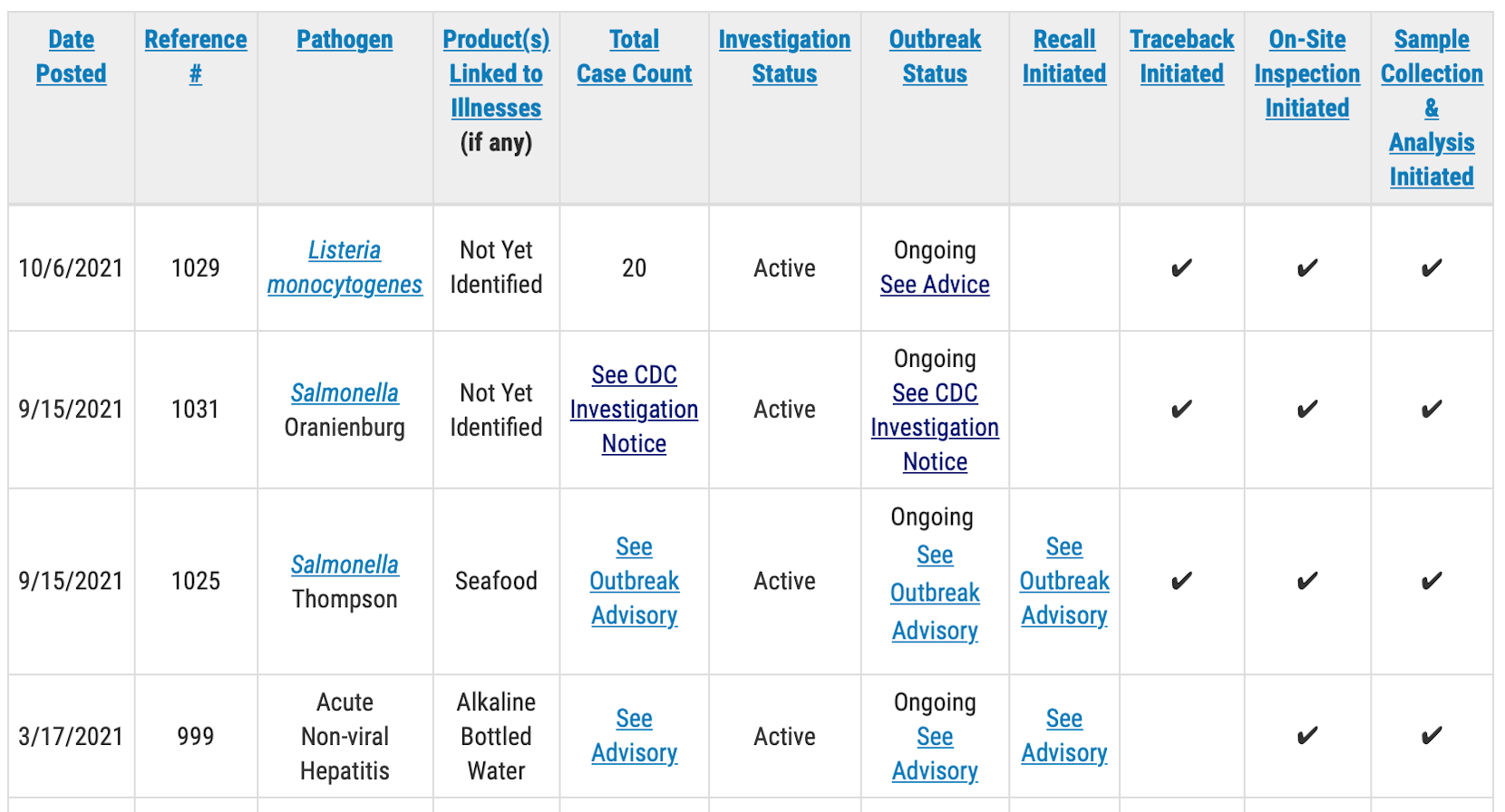
USA – Core Investigations Table Update

FDA

New Listeria Outbreak- no real information

Ongoing Salmonella Oranienburg and Salmonella Thompson investigations

RASFF Alert – E.coli – Oysters

RASFF

Presenza di E. coli oltre i limiti di legge in ostriche//too high count of E. coli in oysters from France and Italy, in France, Italy and Monaco

EU – Salmonellosis outbreak linked to imported sesame-based products

EFSA

Five European countries have reported salmonellosis infections linked to the consumption of sesame-based products such as tahini and halva imported from Syria.

Up to 121 people have been affected since January 2019 in Denmark, Germany, the Netherlands, Norway, and Sweden. Several types of Salmonella are linked to the outbreak – S. Mbandaka, S. Havana, S. Orion, S. Amsterdam, S. Senftenberg, and S. Kintambo.

The products are sealed and ready to be consumed, which suggests that contamination occurred before they reached the European market.

Control measures on the involved batches have been implemented since August 2020. Nevertheless, cases were still being reported as recently as September 2021. This could be because the products have a long shelf life and are being stored in people’s homes.

EFSA and ECDC scientists concluded that there is still a risk of new Salmonella infections related to these products in the EU/EEA.