Category Archives: Death

USA – Outbreak Investigation of Listeria monocytogenes: Dole Packaged Salad (December 2021)

FDA

FDA, along with CDC and state and local partners, is investigating a multistate outbreak of Listeria monocytogenes infections linked to Dole packaged leafy greens by epidemiologic, laboratory, and traceback data. According to the CDC, as of February 1, 2022, 17 people infected with the outbreak strain of Listeria monocytogenes have been reported from 13 states. Illnesses started on dates ranging from August 16, 2014 to December 30, 2021 (one case occurred in 2014 and the remaining cases occurred between 2018 and 2021). CDC investigated this outbreak in 2019 and 2020 but was unable to gather enough data to identify the source in the past. CDC reopened the investigation in November 2021 after reports of new illnesses.

FDA sent investigators to multiple Dole processing facilities to conduct on-site inspections while at the same time Dole initiated their own investigation. On December 22, 2021, Dole voluntarily recalled all products and brands from their Bessemer City, NC, and Yuma, AZ, facilities. On January 7, 2022, as a result of continued investigations, Dole issued a voluntary recall of additional products after Dole detected the presence of Listeria monocytogenes on equipment used in the harvesting of the raw iceberg lettuce also used in finished products processed in the Dole Springfield, OH, and Soledad, CA, facilities. These products were shipped throughout the United States and several provinces in Canada. FDA analyzed the positive sample collected by Dole from the harvesting equipment. Results from FDA’s WGS analysis showed that the strain of Listeria monocytogenes found on the harvesting equipment matches the strain causing illnesses in this outbreak.

In addition to this outbreak of listeriosis linked to packaged salads produced by Dole, FDA and CDC are currently investigating a separate Listeria outbreak linked to packaged salads produced by Fresh Express. These investigations are ongoing and additional information will be provided as it becomes available.

Recommendation

FDA recommends that anyone who received recalled products use extra vigilance in cleaning and sanitizing any surfaces and containers that may have come in contact with these products to reduce the risk of cross-contamination. Listeria can survive at refrigeration temperatures and can easily spread to other foods and surfaces.

All recalled products are now past their “Best if Used By” dates of November 30, 2021 to January 9, 2022. If consumers have expired recalled Dole salads in their homes, they should throw them away. The initial list of recalled products and the second list of recalled products are available on FDA’s website.


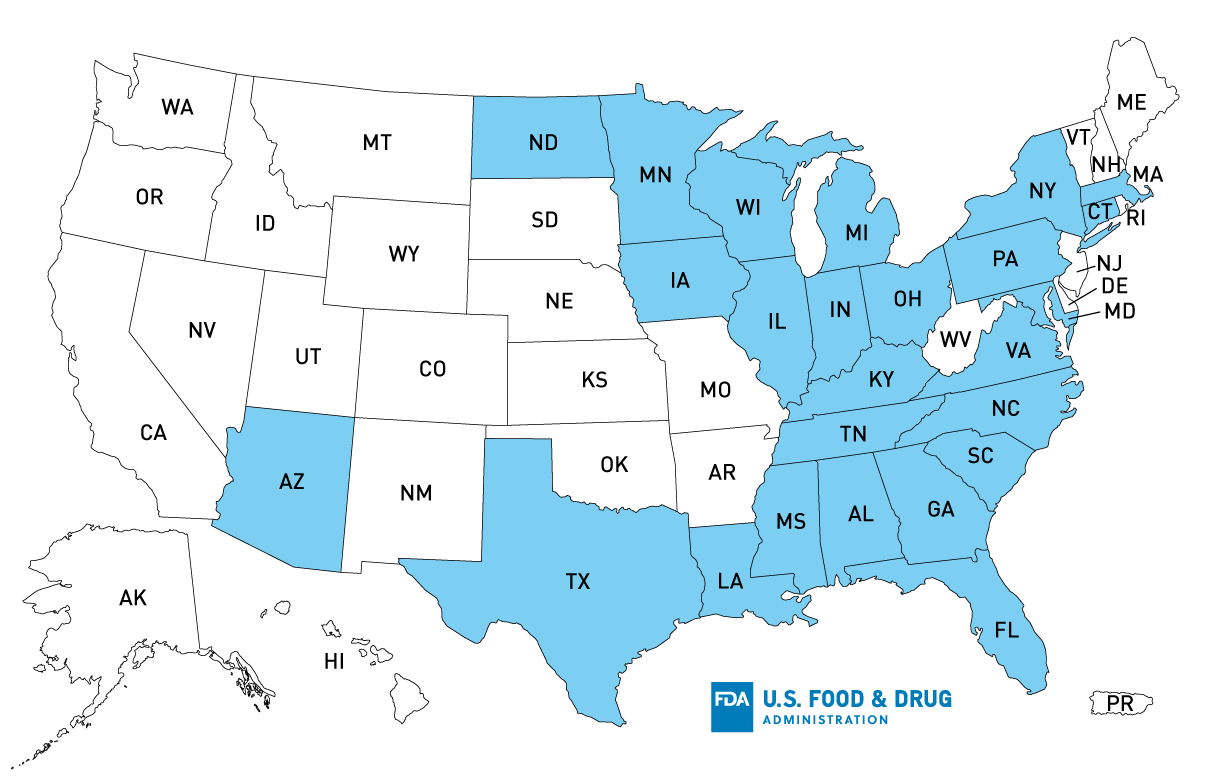
Map of U.S. Distribution of Recalled Packaged Salad
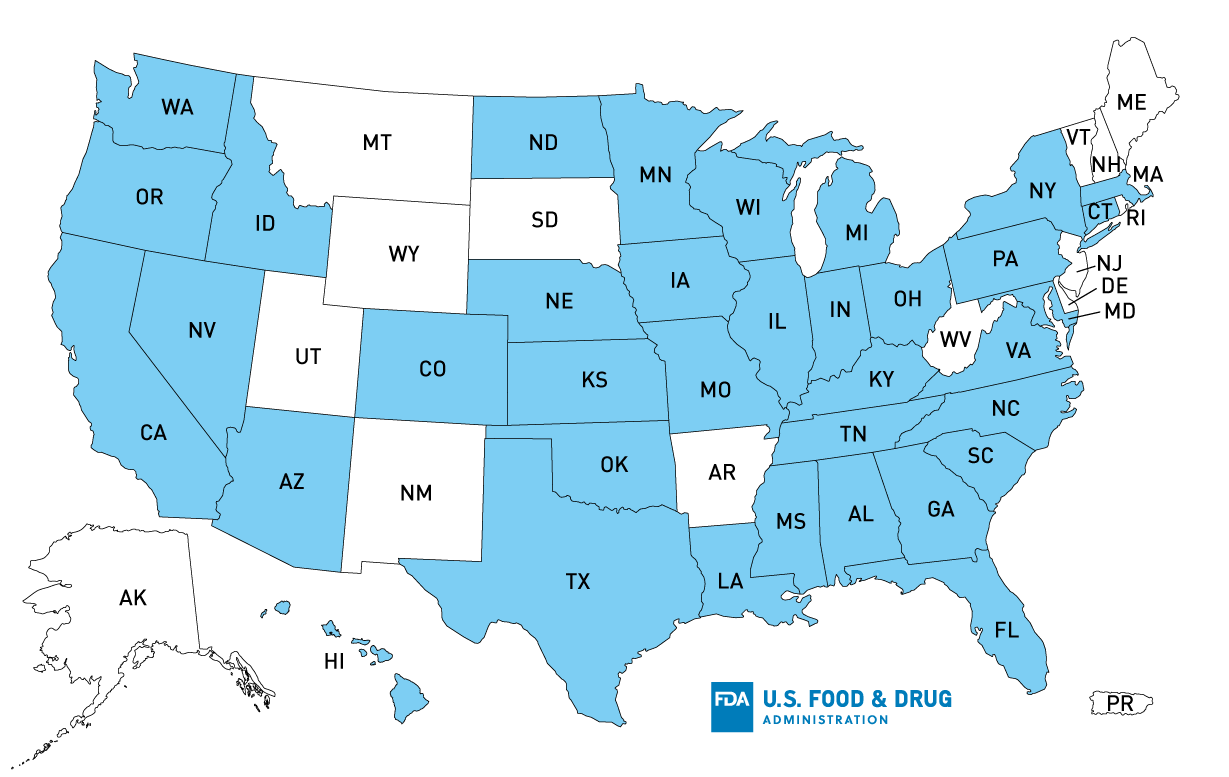
Outbreak Investigation of Listeria monocytogenes from Dole Packaged Salad - Map of U.S. Distribution of Recalled Packaged Salad (February 1, 2022)

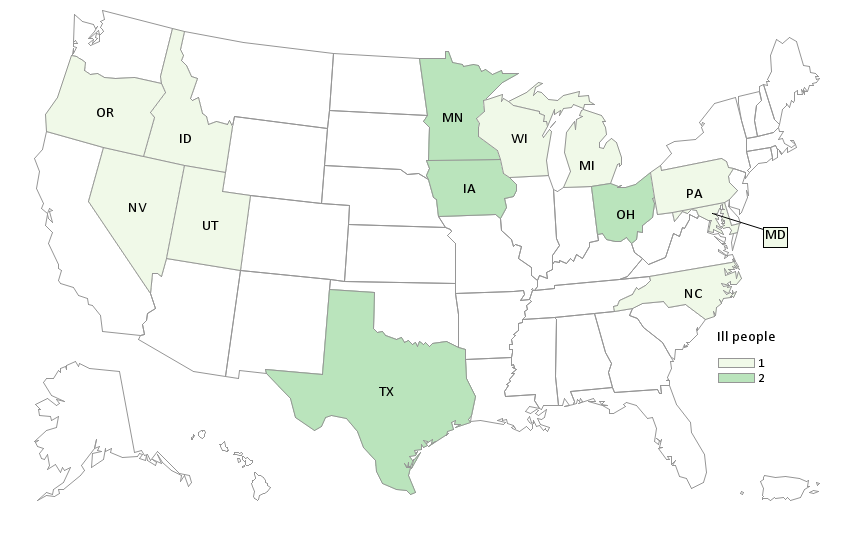
Case Count Map Provided by CDC

Outbreak Investigation of Listeria monocytogenes from Dole Packaged Salad - CDC Case Count Map (January 31, 2022)

Case Counts

Total Illnesses: 17
Hospitalizations: 13
Deaths: 2
Last illness onset: December 30, 2021
States with Cases: IA, ID, MD, MI, MN, NC, NV, OH, OR, PA, TX, UT, WI
Product Distribution*: AL, AZ, CA, CO, CT, FL, GA, HI,  IA, ID, IL, IN, KS, KY, LA, MA, MD, MI, MN, MO, MS, NC, ND, NE, NV, NY, OH, OK, OR, PA, SC, TN, TX, VA, WA, WI

*Distribution has been confirmed for states listed, but product could have been distributed further, reaching additional states

Research – The 7 Worst Food Recalls of All Time

Eat This

Food safety issues occur more frequently than you might think, especially in recent times, with an increase of 125% in grocery recalls in recent years. And while the risks may be fairly benign (think: a gluten-free product that may have come into contact with wheat during manufacturing) some contaminants can have devastating—even deadly—consequences for consumers. The Center for Disease Control and Prevention (CDC) estimates that foodborne illness from infectious pathogens or harmful chemicals causes 48 million people to get sick each year, with 148,000 hospitalizations and 3,000 deaths on average.

The Food and Drug Administration (FDA) categorizes product recalls based on the potential severity of effects. The least serious is a Class III recall, with minimal risk for adverse health consequences. Class II means that the effects of exposure or use can lead to temporary or reversible health consequences. Class I is the most severe, marked when “there is a reasonable probability that the use of, or exposure to, a violative product will cause serious adverse health consequences or death.”

The upside is that these incidents have called companies to higher scrutiny of their production processes, has led to stricter rules and regulations, such as granting the FDA the ability to authorize mandatory recalls in 2018, and fueled a larger effort to educate the public on how to practice safer food preparation.

But tragically, there have been dozens of Class I product recalls in the past decades that caused hundreds of illnesses and some deaths to consumers. These are seven of the most catastrophic food recalls in grocery history.

Research – Publisher’s Platform: The World’s Largest and Deadliest Listeria Outbreak is turning 4 in March

Food Safety News

In March of this year it will be 4 years since I boarded a flight from Seattle to Johannesburg (20 plus hour flight) to speak at a food safety conference just days after the South African health authorities announced that a Listeria outbreak had been linked to a product named polony manufactured by the largest food manufacturer in Africa.

I recall how similar it felt to the early days of the Jack-in-the-Box E. coli outbreak of 1993– how everyone seemed honestly shocked that such a tragedy could happen.

I have spent the last 4 years working (being 10 hours behind has required far too many late nights and early morning calls) with a cadre of amazing lawyers and more amazing staff moving forward in the first foodborne illness class action in Africa.  We have much to do to find justice to the more than 1,000 sickened and their families.  I am saddened by the pace of the litigation, but determined to take care of our class members – we have to work harder.

USA – The latest on Gino’s Ristorante & Pizzeria Hepatitis A outbreak in Norristown Montgomery County Pennsylvania

Food Poison Journal

NORRISTOWN, PA – The Montgomery County Office of Public Health(OPH) announced today the temporary closure of Gino’s Ristorante & Pizzeria in West Norriton in relation to a Hepatitis A Virus (HAV) outbreak in the county. The restaurant will be closed until further notice while the investigation continues.

Per standard public health protocols, OPH coordinated with the Pennsylvania Department of Health to issue a health advisory on Wednesday. As a result, OPH continues to receive additional information to support its investigation and identify additional potential cases. Investigation conducted to date suggests the exposure occurred in late November no longer presents a risk. However, additional investigation into probable cases resulting from the health advisory associated with this outbreak are underway. In the interest of public health, the restaurant has been shut down until further notice.

At this time, 11 total cases are under investigation, with 9 confirmed cases of Hepatitis A and 2 potential cases of Hepatitis A. Of the 9 confirmed cases, 7 people were hospitalized. To date, one death is confirmed and one additional death is under investigation.

The source of the outbreak remains under investigation. Anyone experiencing symptoms of Hepatitis A should contact their doctor.

USA – Former Blue Bell president’s trial delayed until summer – Listeria Outbreak

Food Safety News

The trial of Paul Kruse, a scion of the family that has run Blue Bell Creameries since 1919, has again been postponed.

Federal Judge Robert Pitman signed an order delaying jury selection by 140 days, now setting it on Aug. 1 immediately before the trial begins.    The U.S. District Court for the Western District of Texas in Austin has jurisdiction over the case.

Kruse headed the company in 2015 when an outbreak of Listeria infections traced to the firm’s ice cream sickened 10 and killed three.

Federal felony charges of conspiracy and fraud have been pending against Kruse since October 2020. This past year, his defense attorneys asked to delay the trial to 2022 because of their obligations for other clients.

USA – One death confirmed, another under investigation in Pennsylvania hepatitis A outbreak; officials name restaurant

Food Safety News

The Montgomery County Office of Public Health in Pennsylvania announced today the temporary closure of Gino’s Ristorante & Pizzeria in West Norriton in relation to a deadly hepatitis A virus outbreak.

County officials say the restaurant will be closed until further notice while the investigation continues.

Authorities believe the outbreak began in late November, and current data suggests that the outbreak “no longer presents a risk.” However, officials are continuing to look into the situation.

Per standard public health protocols, the county health department coordinated with the Pennsylvania Department of Health to issue a health advisory on Wednesday, but the restaurant was not named at that time. The county continues to receive additional information to support its investigation and identify additional potential cases.

Investigation conducted to date suggests the exposure occurred in late November and no longer presents a risk. However, additional investigation into probable cases resulting from the health advisory associated with this outbreak are underway.

USA – Fourth person dies in hepatitis A outbreak traced to Virginia restaurants

Food Safety News

A fourth person has died in a hepatitis A outbreak traced to Famous Anthony’s restaurants in Roanoke Valley in Virginia.

Larry Vest died on Christmas after fighting the liver disease for months. His wife Diane, who was also infected, died in the fall of 2021. 

More than 50 people were infected with the hepatitis A virus in relation to an infected employee who worked at three Famous Anthony’s locations at Grandin Road Extension, Williamson Road and Crystal Spring Avenue, according to public health officials. Infected people may not show symptoms for up to two weeks while they are contagious.

James Hamlin, a Roanoke County man, died Oct. 8. The name of the other person who died has not been released. About 30 people have been so sick from the virus that they had to be admitted to hospitals.

Hepatitis A can be prevented with a vaccine. Vaccines are generally available from primary care providers, occupational health care clinics or health departments.

UK – Estimating deaths from foodborne disease in the UK for 11 key pathogens

NCBI

Objective

To estimate the number of deaths from foodborne disease in the UK from 11 key pathogens.

Design

Four different models were developed using data from a range of sources. These included enhanced surveillance, outbreaks, death certificates and hospital episode statistics data. For each model, median estimates were produced with 95% credible intervals (CrI). The results from the different models were compared.

Results

The estimates for foodborne deaths for each pathogen from the different models were consistent, with CrIs largely overlapping. Based on the preferred model for each pathogen, foodborne norovirus is estimated to cause 56 deaths per year (95% CrI 32 to 92), foodborne Salmonella 33 deaths (95% CrI 7 to 159), foodborne Listeria monocytogenes 26 deaths (95% CrI 24 to 28), foodborne Clostridium perfringens 25 deaths (95% CrI 1 to 163) and foodborne Campylobacter 21 deaths (95% CrI 8 to 47). The considerable overlap in the CrIs means it is not possible to make any firm conclusions on ranking. Most of these deaths occur in those aged over 75 years. Foodborne deaths from ShigellaCryptosporidiumGiardia, adenovirus, astrovirus and rotavirus are all rare.

Conclusions

We estimate that there are 180 deaths per year in the UK (95% CrI 113 to 359) caused by foodborne disease based on these 11 pathogens. While this is a small fraction of the estimated 2.4 million cases of foodborne illness per year it still illustrates the potential severity of these illnesses demonstrating the importance in continuing efforts to reduce these infections.

Keywords: infectious disease, CampylobacterSalmonella

Summary box

What is already known about this subject?

  • Foodborne disease is a common illness in the UK.

  • Previous research has estimated that there are 566 000 cases, 74 000 general practitioner presentations and 7600 hospital admissions related to foodborne disease from 13 known pathogens in UK; no estimate was made for deaths.

  • Campylobacter and norovirus are the most common foodborne pathogens in the UK.

  • Other common foodborne pathogens include Clostridium perfringens and Salmonella.

What are the new findings?

  • This study provides updated estimates of deaths for each of the 11 key foodborne pathogens considered; in total, these 11 pathogens cause 180 deaths per year in the UK (95% credible interval (CrI) 113 to 359).

  • Among them, Campylobacter, C. perfringens, Listeria monocytogenes, Salmonella and norovirus pathogens are responsible for over 98% of these deaths.

  • Ranking between these five is difficult due to overlapping CrIs.

How might it impact on clinical practice in the foreseeable future?

  • This highlights the potential severity of Salmonella, L. monocytogenesC. perfringensCampylobacter and norovirus, particularly in comparison with other infectious intestinal diseases that have a food source.

USA – FDA Core Outbreak Table – 5 Active Outbreaks

FDA

Date
Posted
Reference
#
Pathogen
Product(s)
Linked to
Illnesses

(if any)
12/20/2021 1039 Listeria
monocytogenes
Packaged Salad
12/15/2021 1048 Listeria
monocytogenes
Packaged Salad
11/24/2021 1044 Salmonella Javiana Not Yet
Identified
11/17/2021 1043 E. coli
O157:H7
Spinach

USA – Outbreak Investigation of Listeria monocytogenes: Dole Packaged Salad (December 2021)

FDA

The FDA, along with CDC and state and local partners, is investigating a multistate outbreak of Listeria monocytogenes infections potentially linked to Dole packaged leafy greens. According to the CDC, as of December 22, 2021, 16 people infected with the outbreak strain of Listeria monocytogenes have been reported from 13 states. Illnesses started on dates ranging from August 16, 2014 to October 17, 2021 (one case occurred in 2014 and the remaining cases occurred between 2018 and 2021).

CDC investigated this outbreak in 2019 and 2020 but was unable to gather enough data to identify the source in the past. CDC reopened the investigation in November 2021 when four new illnesses were reported since the end of August.

In October 2021, as a part of routine retail sampling, the Georgia Department of Agriculture collected a product sample of prepackaged salad mix from a grocery store for testing. The sample tested positive for Listeria monocytogenes. In response to the sample results, Dole initiated a recall of packaged garden salads in October 2021. These products are now past their “Best if Used By” dates. The positive sample was later sent for whole genome sequencing (WGS) analysis; and in December 2021, WGS analysis was completed. The results show that the Listeria monocytogenes in the product sample was a match to the outbreak strain. FDA is conducting an inspection at the facility that produced the product that tested positive for Listeria monocytogenes.

The Michigan Department of Agriculture and Rural Development also recently initiated retail sampling of Dole products in their state as part of this investigation. One product containing lettuce from the Dole facility in Yuma, AZ, tested positive for Listeria monocytogenes. WGS analysis showed that the Listeria monocytogenes in the product sample is also a match to the outbreak strain.

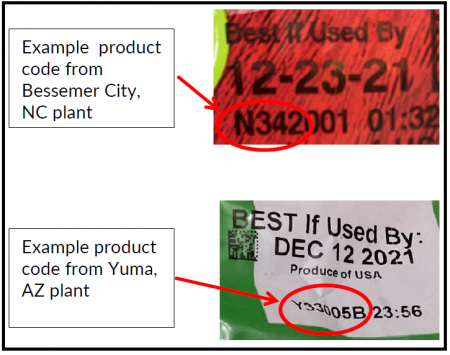
In response to the sample analyses and the ongoing outbreak investigation, Dole has agreed to voluntarily suspend operations at both the Bessemer City, NC, facility and Yuma, AZ, facility and has voluntarily recalled all products and brands from those facilities. Those products have production lot codes beginning with either the letter “N” or “Y” in the upper right-hand corner of the package and Best if Used By dates from November 30, 2021 to January 8, 2022.

This recall does not include whole head packaged lettuce. A full list of recalled products is available on FDA’s website.

This investigation is ongoing, and additional information will be provided as it becomes available.

Recommendation

Consumers, restaurants, and retailers, should not eat, sell, or serve recalled Dole packaged salads. A full list of recalled products is available on FDA’s website.

FDA recommends that anyone who received recalled products use extra vigilance in cleaning and sanitizing any surfaces and containers that may have come in contact with these products to reduce the risk of cross-contamination. Listeria can survive at refrigeration temperatures and can easily spread to other foods and surfaces.

Recall Information

In response to the sample analyses and the ongoing outbreak investigation, Dole has agreed to voluntarily suspend operations at both the Bessemer City, NC, facility and Yuma, AZ, facility and has voluntarily recalled all products and brands from those facilities. Those products have production lot codes beginning with either the letter “N” or “Y” in the upper right-hand corner of the package and Best if Used By dates from November 30, 2021 to January 8, 2022.

This recall does not include whole head packaged lettuce.

The following images are of example labels from recalled products highlighting where to find product codes. View a full list of recalled products

Outbreak Investigation of Listeria monocytogenes from Dole Packaged Salad - Sample Product Codes (December 22, 2021)

Map of U.S. Distribution of Recalled Packaged Salad

Outbreak Investigation of Listeria monocytogenes from Dole Packaged Salad - Map of U.S. Distribution of Recalled Packaged Salas (December 22, 2021)

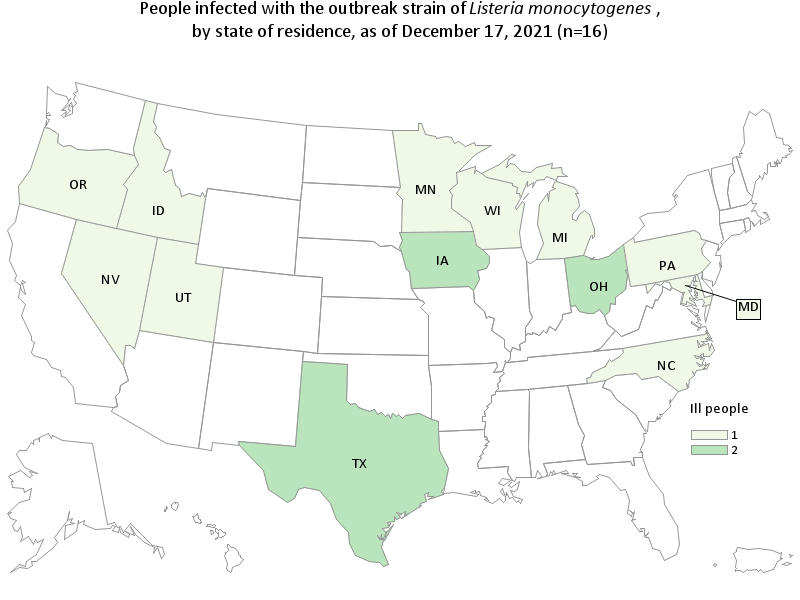
Case Count Map Provided by CDC

Outbreak Investigation of Listeria monocytogenes from Dole Packaged Salad - CDC Case Count Map (December 22, 2021)

Case Counts

Total Illnesses: 16
Hospitalizations: 12
Deaths: 2
Last Illness Onset: October 17, 2021
States with Cases: IA, ID, MD, MI, MN, NC, NV, OH, OR, PA, TX, UT, WI
Product Distribution*: AL, AZ, CT, FL, GA, IA, IL, IN, KY, LA, MA, MD, MI, MN, MS, NC, ND, NY, OH, PA, SC, TN, TX, VA, WI

*Distribution has been confirmed for states listed, but product could have been distributed further, reaching additional states