Author Archives: KSW

USA – Summary of Possible Multistate Enteric (Intestinal) Disease Outbreaks in 2021

CDC

Outbreak Investigations At A Glance

Possible Multistate Outbreaks
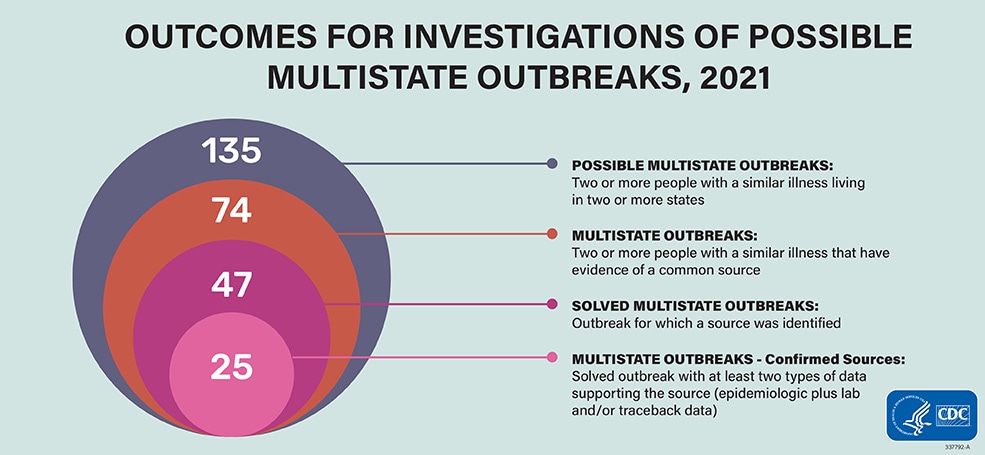
This analysis includes 135 possible multistate outbreak investigations during 2021.

This analysis includes 135 investigations of possible multistate enteric (intestinal) outbreaks during 2021. Some possible outbreaks were excluded from this report because they were determined to be single state or because they were linked to international travel. After investigation, 74 (55%) of these were determined to be multistate outbreaks, and investigators solved 47 (64%) of these outbreaks.

Multistate Outbreaks
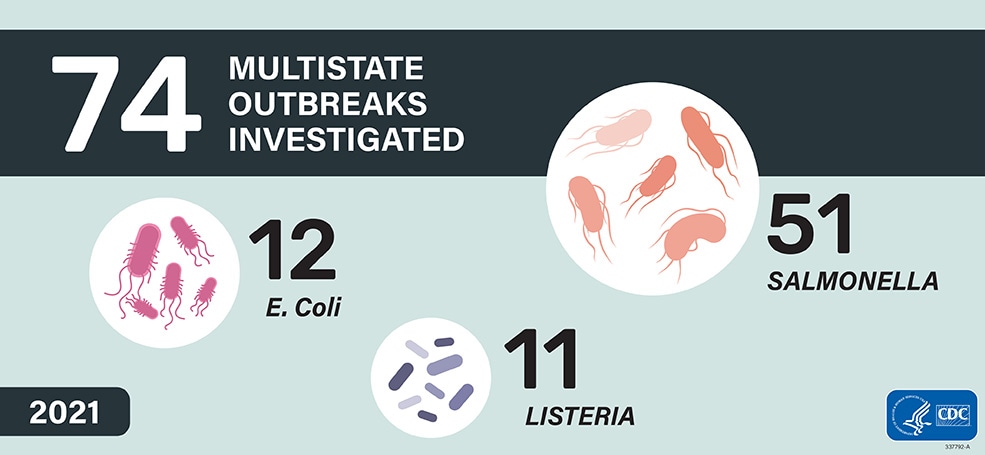
74 (55%) of the 135 investigations were determined to be multistate outbreaks.

The number of outbreaks increased from 2020 but was lower than the 82 investigated outbreaks in 2019. The number of outbreaks investigated in 2021 was likely lower than that in 2019 due in part to continued effects of the COVID-19 pandemic on enteric disease outbreak detection and investigation (e.g., decreased resources at local, state, and federal public health agencies, changes in healthcare-seeking behavior, and changed restaurant dining and grocery shopping patterns.) Additionally, changing diagnostic testing practices likely continued to affect enteric disease surveillance and the ability to identify possible outbreaks.
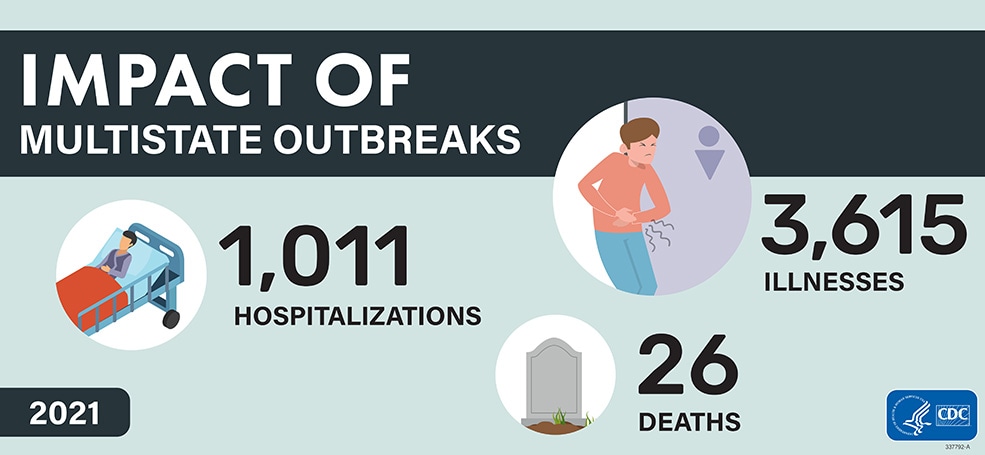
The 74 investigated multistate outbreaks resulted in 3,615 illnesses, 1,011 hospitalizations, and 26 deaths

Solved Multistate Outbreaks

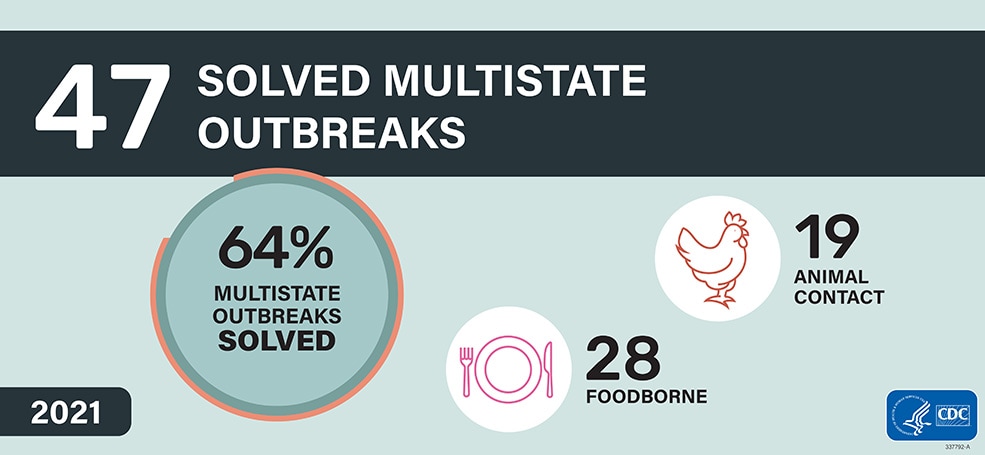
Among the 74 investigated multistate outbreaks, 47 (64%) were solved, including 25 outbreaks with confirmed sources and 22 with suspected sources.

Among the 74 multistate outbreaks, 47 (64%) were solved, meaning a confirmed or suspected source of the outbreak was identified, including 25 (53%) outbreaks with confirmed sources and 22 (47%) with suspected sources. Among the 47 solved outbreaks, 28 (60%) were linked to contaminated foods, and 19 (40%) were linked to animal contact.

Solved multistate outbreaks caused at least 2,047 illnesses. Solved multistate outbreaks linked to contaminated food caused 1,740 illnesses, 496 hospitalizations, and 15 deaths, while multistate outbreaks linked to animal contact caused 1,307 illnesses, 329 hospitalizations, and 3 deaths.

Information – Safer Food Choices for Pregnant People

CDC

If you are pregnant, you are more likely than other people to get sick from certain germs.

To prevent food poisoning, some foods are safer choices than others. That’s because some foods—such as undercooked meat and eggs, unwashed fruits and vegetables, and unpasteurized milk — are more often associated with foodborne illnesses. Use the table at the link above as a guide to safer food choices.

Information – Safer Food Choices for People With Weakened Immune Systems

CDC

People with weakened immune systems have a higher risk of food poisoning. That’s because a weakened immune system may make it more difficult for your body to fight germs and sickness effectively. Weakened immune systems may be due to diabetes, liver disease, kidney disease, alcoholism, HIV, autoimmune disorders (such as lupus), or receiving chemotherapy or radiation therapy.

To prevent food poisoning, some foods are safer choices than others. That’s because some foods—such as undercooked meat and eggs, unwashed fruits and vegetables, and unpasteurized milk — are more often associated with foodborne illnesses. Use the table at the link above as a guide to safer food choices.

Information – Safer Food Choices for Children Under 5 Years Old

CDC

Young children have a higher risk of food poisoning. Their immune systems are still developing, so their bodies aren’t able to fight germs and sickness as well as adults. Food poisoning can be particularly dangerous for them because it can lead to diarrhea and dehydration.

To prevent food poisoning, some foods are safer choices than others. That’s because some foods—such as undercooked meat and eggs, unwashed fruits and vegetables, and unpasteurized milk — are more often associated with foodborne illnesses. Use the table in the link above as a guide to safer food choices.

Information – Safer Food Choices for Adults 65 Years or Older

CDC

Older adults have a higher risk of getting sick from food poisoning and having a more serious illness.

To prevent food poisoning, some foods are safer choices than others. That’s because some foods—such as undercooked meat and eggs, unwashed fruits and vegetables, and unpasteurized milk — are more often associated with foodborne illnesses. Use the table at the link above as a guide

UK – Mogul Restaurant in Bagshot prosecuted for food safety failures.

Surrey Heath

Surrey Heath Borough Council has successfully prosecuted the previous operator of Mogul Restaurant for failing to comply with food safety regulations following a significant food poisoning outbreak amongst customers at the end of 2022.

The company has been ordered to pay a fine of £25,000, a victim surcharge of £2,000 and the Council’s costs of £14,116.

This prosecution is in addition to the restaurant being temporarily shut under Emergency Prohibition provisions to protect further risk of ill health to the public at the time of the outbreak whilst the necessary improvements were made.

USA – Cheese curds sold in Iowa recalled because of elevated Coliform count and E. coli

Food Safety News

Moore Family Farms Creamery of Maquoketa, IA, is recalling various cheese curds because they may contain an elevated coliform count and generic E. coli.

According to the details posted by the FDA, the recall was initiated on July 28, 2023 is ongoing.

Though products are past their expiration dates, there is always concern consumers have already consumed the product and become ill or they could have product in their freezers.

Hong Kong – Not to consume a kind of goat cheese imported from France suspected to be contaminated with Listeria monocytogenes

CFS

Issue Date 29.8.2023
Source of Information The Rapid Alert System for Food and Feed (RASFF) of the European Commission
Food Product Goat cheese
Product Name and Description Product name: PALET DU BERRY

Brand: XAVIER

Place of origin: France

Pack size: 150 grams

Lot number: 3288624, 3319239, 3319293

Best-before date: August 10, 2023; August 25, 2023 and August 31, 2023

Importer: GOURMET EN PROVENCE LIMITED

Reason For Issuing Alert The CFS received a notification from the RASFF of the European Commission that the above-mentioned batches of product might have been contaminated with Listeria monocytogenes and are being recalled.

Listeria monocytogenes can be easily destroyed by cooking but can survive and multiply at refrigerator temperature. Most healthy individuals do not develop symptoms or only have mild symptoms like fever, muscle pain, headache, nausea, vomiting or diarrhoea when infected. However, severe complications such as septicaemia, meningitis or even death may occur in newborns, the elderly and those with a weaker immune system. Although infected pregnant women may just experience mild symptoms generally, the infection of Listeria monocytogenes may cause miscarriage, infant death, preterm birth, or severe infection in newborns.

In order to reduce the risk of listeriosis, susceptible populations such as pregnant women should consume freshly prepared hot food where possible, reheat chilled food until it is hot all the way through, and avoid high-risk foods, including ready-to-eat food such as cold cuts, cold smoked seafood, soft cheeses, salads, etc, or cook them thoroughly before consumption, even if they are presented as part of a dish.

Action Taken by the Centre for Food Safety Upon learning of the incident, the CFS immediately contacted the concerned local importer for follow-up. A preliminary investigation found that the above-mentioned importer had imported into Hong Kong the affected batches of the product concerned. The importer concerned has stopped sales, has removed the affected product from shelves and has initiated a recall according to the CFS’s instructions.
Advice to the Trade The trade should stop using or selling the affected batch of products immediately if they possess it.
Advice to Consumers Not to consume the affected products if they have bought any.
Further Information The CFS press release

Members of the public may call the hotline of the importer at 3113 1314 during office hours for enquiries about the recall of the product concerned.

Czech Republic – Hot dog sausages, a heat-treated meat product – Visible Mold/Mould

Potravinynapranyri

Illustrative photo #1

Place of inspection:
Chrudim ( Slovak National Uprising 1081, 53705 Chrudim )
ID: 25110161
Food group: Meat and meat products / Heat-treated perishable products

Hot dog sausages, a heat-treated meat product
Category: Dangerous foods
Invalid parameter:

surface appearance
fungi visible to the eye
scent

The surface of the product was slimy and sticky. The food smelled rotten. Food is not considered safe if it shows signs of spoilage.

Unsuitable storage temperatures of this product were not detected during the inspection. The food did not have an expiration date set by the manufacturer on the original packaging.

Expiration date: 14/08/2023
Packaging: welded foil
Quantity of the product in the package: 1.52 kg
Manufacturer: Uzeniny Příbram, as, Antala Staška 1670/80, Prague
Country of origin:  Czechia
Date of sample collection: 1/8/2023
Reference number: 23-000563-SZPI-CZ
The sample was detected by the official control of the State Agricultural and Food Inspection.

USA – Dean & Peeler Meatworks, LLC, Recalls Fresh Ground Beef Products Due to Possible E. Coli O157:H7 Contamination

FSIS USDA

WASHINGTON, Aug. 29, 2023 – Dean & Peeler Meatworks, LLC, a Poth, Texas establishment, is recalling approximately 1,835 pounds of fresh ground beef products that may be contaminated with E. coli O157:H7, the U.S. Department of Agriculture’s Food Safety and Inspection Service (FSIS) announced today.

The fresh ground beef products were produced on August 22, 2023. The following products are subject to recall [view labels]:

  • 1-lb., 5-lb., and 10-lb. vacuum-sealed plastic bags containing “Peeler Farms WAGYU BEEF GROUND BEEF” with lot code 17836 represented on the label.
  • 5-lb. vacuum-sealed plastic bags containing “R-C RANCH TEXAS CRAFT MEATS WAGYU RC13610 STEAKHOUSE BLEND – GROUND BEEF 5 lb” with lot code 17816 represented on the label.
  • 8-oz. vacuum-sealed plastic bags containing “R-C RANCH TEXAS CRAFT MEATS WAGYU RC13603 – GROUND BEEF PATTIES 8 oz” with lot code 17816 represented on the label.

The products subject to recall bear establishment number “EST. 51283” inside the USDA mark of inspection. These items were shipped to restaurant locations in the greater San Antonio, Texas, area.

The issue was reported to FSIS after the ground beef product was submitted to a third-party laboratory for microbiological analysis and the sample tested presumptive positive for E. coli O157:H7. There have been no confirmed reports of adverse reactions due to consumption of these products.

Anyone concerned about an injury or illness should contact a healthcare provider. E. coli O157:H7 is a potentially deadly bacterium that can cause dehydration, bloody diarrhea and abdominal cramps 2-8 days (3-4 days, on average) after exposure the organism. While most people recover within a week, some develop a type of kidney failure called hemolytic uremic syndrome (HUS). This condition can occur among persons of any age but is most common in children under 5-years old and older adults. It is marked by easy bruising, pallor, and decreased urine output. Persons who experience these symptoms should seek emergency medical care immediately.

FSIS is concerned that some product may be in restaurant refrigerators or freezers. Restaurants are urged not to serve these products. These products should be thrown away or returned to the place of purchase.