Author Archives: KSW

USA – Kerry, Inc. recalls bulk bags of various food ingredients because of potential Salmonella contamination

Food Safety News

Kerry, Inc of Beloit, WI is recalling over 1,000 bags and totes of various food ingredients because of potential Salmonella contamination.

According to the details posted online by the Food and Drugs Administration (FDA), the recall was initiated on May 3, 2024 and is ongoing.

The recalled products were distributed in Arizona, California, Georgia, Idaho, Illinois, Indiana, Kansas, Maryland and outside the U.S. in Canada.

Research – Salmonella Typhimurium caused an unprecedentedly large foodborne outbreak in Finland in 2021 – Mixed Veg

Wiley Online

Aims

Salmonella infections are significant causes of foodborne outbreaks in the European Union. This study investigates a sudden increase in gastroenteritis patients in the hospital district of Central Finland in June 2021. The primary aim was to study the outbreak’s magnitude and source of the outbreak.

Methods and Results

Epidemiological, microbiological, environmental and traceback investigations were conducted. Over 700 persons fell ill during the outbreak caused by Salmonella Typhimurium associated with a daycare lunch. Similar S. Typhimurium was found in the patients and a vegetable mix containing iceberg lettuce, cucumber and peas served during lunch. The traceback investigation revealed that the batch information of vegetables from the wholesaler was not complete. The wholesaler had received quality complaints about the iceberg lettuce from the central kitchen. The manufacturer did not test the suspected batch for Salmonella since the production plant had given a certificate declaring it Salmonella negative.

Conclusions

The most suspect ingredient was one batch of iceberg lettuce due to quality complaints. The lettuce had not been served in two daycare centres without cases. We recommend that in order to enable thorough microbiological investigation, institutional kitchens store the food samples separately as part of the internal quality control and that food items should always be tested when Salmonella contamination in an outbreak is suspected.

Impacts

  • The largest Salmonella Typhimurium outbreak in the European Union in 2021 was linked to a vegetable mix served at daycare centres in Finland.
  • Food samples should be stored separately for possible outbreak investigation and tested when an outbreak is suspected.
  • Collaboration between healthcare and environmental health authorities in investigating and managing outbreaks is vital.

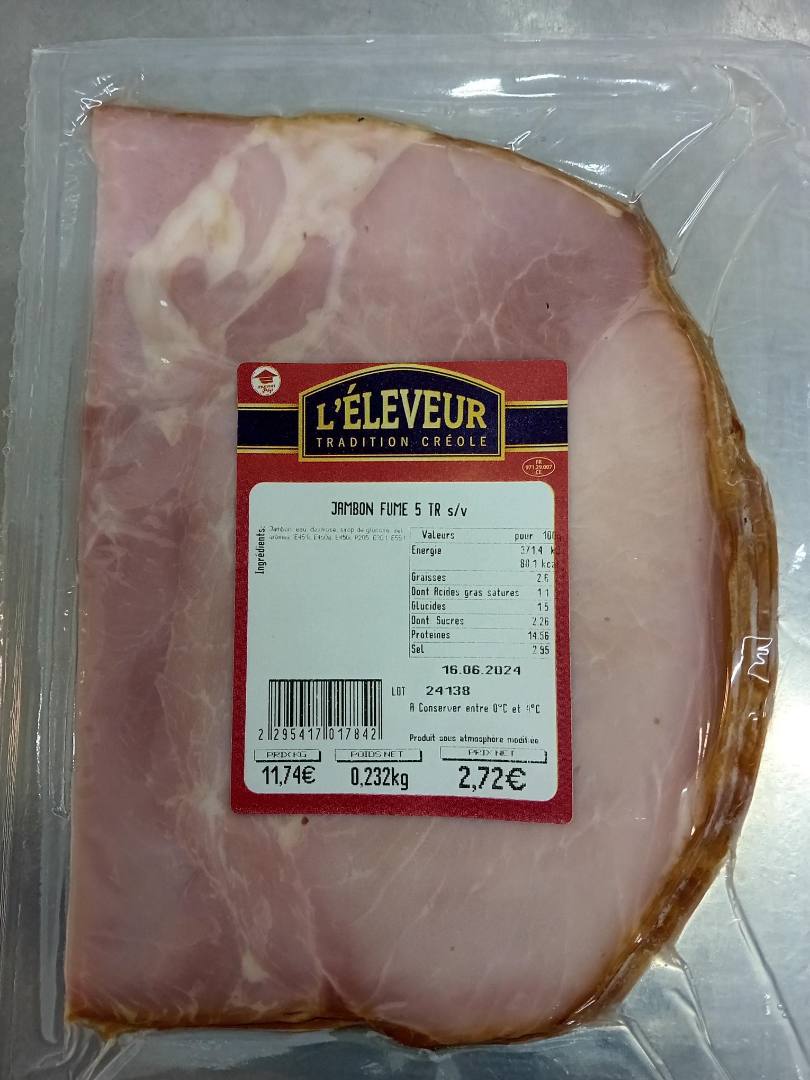
France – LS smoked ham – E.coli

Gov France

Product category
Food
Product subcategory
Meats
Product brand name
The Breeder
Model names or references
Sliced ​​smoked ham
Product identification
Batch Date
24138 Use-by date 06/16/2024
Packaging
Under a vacuum
Start/end date of marketing
From 05/17/2024 to 05/31/2024
Storage temperature
Product to keep in the refrigerator
Geographical sales area
Regions: Guadeloupe
Distributors
Carrefour, Auchan, Super U, Sodex, Bioche SARL, Champion

France- Corsican sheep’s tome – Listeria monocytogenes

Gov France

Product category
Food
Product subcategory
Milk and dairy products
Product brand name
SCHOEPFER
Model names or references
Corsican sheep’s tome
Product identification
GTIN Batch Date
3252540952692 25025040 Use-by date 06/29/2024
Products List
Stat_Traceability_of_lots_SALES_on_lot_24024050.pdfAttachment
Packaging
Clear plastic film
Start/end date of marketing
From 06/05/2024 to 06/10/2024
Storage temperature
Product to keep in the refrigerator
Health mark
FR 84 007 011 CE
Further information
Portion of cheese in transparent film of approximately 200g (variable weight) – Schoepfer sales reference 95269
Geographical sales area
Whole France
Distributors
The vegetable market, Spar, U Express, Le Petit Casino, Intermarché, Lecasud, Leclerc

USA – Newly Weds Foods Seasoning Recall Due to Potential Salmonella Contamination Continues

Food Poisoning News

A voluntary recall first initiated by Chicago, Illinois-based Newly Weds Foods, Inc. on May 2, 2024 has been updated and is still ongoing.  The recall of nearly 60,000 pounds of seasoning is due to potential Salmonella contamination.  Salmonella is a bacterium that can cause serious infections, especially in vulnerable populations such as young children, the elderly, and individuals with compromised immune systems.

USA – More than 350 patients confirmed in outbreaks linked to fresh cucumbers – Salmonella

Food Safety News

Federal officials say 381 people are now confirmed as patients in two Salmonella outbreaks linked to fresh cucumbers.

The Centers for Disease Control and Prevention reported that 75 percent of patients interviewed reported eating fresh cucumbers in the days before becoming ill. 

“Epidemiologic data show that cucumbers may be contaminated with Salmonella and may be making people sick,” according to an outbreak update from the CDC.


New Zealand – Shellfish biotoxin warning for Christchurch and Lyttelton – DSP

MPI

New Zealand Food Safety is advising the public not to collect or consume shellfish gathered from the Christchurch beaches and Lyttelton Harbour due to the presence of diarrhetic shellfish toxins.

“Routine tests on greenshell mussels from Sumner have shown levels of diarrhetic shellfish toxin over the safe limit,” says New Zealand Food Safety deputy director-general Vincent Arbuckle.

The warning extends from Waimairi Beach to the southern head of Lyttelton Harbour (Adderley Head). The affected area includes Lyttelton Harbour and the Avon and Heathcote River Estuary.

“Please do not gather and eat shellfish from this area because anyone doing so could get sick. Affected shellfish include bivalve shellfish such as mussels, oysters, tuatua, pipi, toheroa, cockles and scallops, as well as pūpū (cat’s eyes), Cook’s turban and kina (sea urchin).”

“Cooking the shellfish does not remove the toxin, so shellfish from this area should not be eaten.”

Symptoms of diarrhetic shellfish poisoning usually appear within 30 minutes of eating and last for about a day. Symptoms may include diarrhoea, vomiting, nausea and abdominal cramps.

Pāua, crab and crayfish may still be eaten if the gut has been completely removed prior to cooking, as toxins accumulate in the gut. If the gut is not removed, its contents could contaminate the meat during the cooking process.

Finfish are not affected by this public health warning, but we advise gutting the fish and discarding the liver before cooking.

New Zealand Food Safety has had no notifications of associated illness.

If anyone becomes ill after eating shellfish from an area where a public health warning has been issued, phone Healthline for advice on 0800 61 11 16, or seek medical attention immediately. You are also advised to contact your nearest public health unit and keep any leftover shellfish in case it can be tested.

“New Zealand Food Safety is monitoring shellfish in the region and will notify the public of any changes to the situation,” says Mr Arbuckle.

Commercially harvested shellfish – sold in shops and supermarkets or exported – is subject to strict water and flesh monitoring programmes by New Zealand Food Safety to ensure they are safe to eat.

For further information and general enquiries, call MPI on 0800 00 83 33 or email info@mpi.govt.nz

For media enquiries, contact the media team on 029 894 0328.

RASFF Alert- Bacillus cereus – Chilli Sauce

RASFF

Bacillus cereus in chilli sauce, from China in  Austria, Belgium, China, Finland, France, Germany, Hong Kong, Ireland, Malta, Netherlands, Romania, Sweden.

RASFF Alert- Ochratoxin A – Aflatoxin- Rice

RASFF

Ochratoxin A and Aflatoxins in rice from Pakistan in Spain

RASFF Alerts – Listeria monocytogenes – Smoked Salmon –

RASFF

Listeria monocytogenes in a batch of smoked salmon from Ireland in UK and USA

RASFF

Listeria monocytogenes in mozzarella cheese from Italy in France and Belgium

RASFF

Listeria in chocolate éclair from France in Belgium