Monthly Archives: September 2020

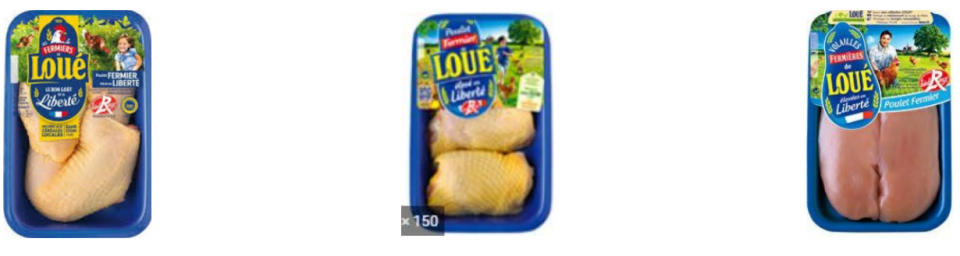
Luxembourg – TRAY OF 2 YELLOW CHICKEN THIGHS, TRAY OF 2 WHITE CHICKEN FILLETS, TRAY OF 3 HIGH CHICKEN THIGHS FROM THE LDC BRAND – PRESENCE OF SALMONELLA

SAP

Last name Tray of 2 yellow chicken thighs
Mark LDC
Bar code 0217823000000
Best before date (DLC) 09/09/2020
Lot 2020037392
Last name Tray of 2 white chicken fillets
Mark LDC
Bar code 3266980282882
Best before date (DLC) 09/08/2020 & 09/09/2020
Lot 2020037371
Last name Tray of 3 tall chicken thighs
Mark LDC
Bar code 3266980006969
Best before date (DLC) 09/11/2020
Lot 2020037371

Danger: Presence of salmonella


Salmonella can cause symptoms such as nausea, vomiting, abdominal cramps, diarrhea, fever and headache within 6 to 72 hours after consumption. These symptoms may be aggravated in young children, immunocompromised individuals and the elderly. People who have consumed these products and who present these symptoms are advised to consult a doctor, notifying him of this consumption.


Sale in Luxembourg by: Auchan

A sale by other operators cannot be excluded.

Source of information: Auchan recall notification.


Communicated by: Government Commission for Quality, Fraud and Food Safety .


USA -US rejects 26 farmed shrimp lines from India over Salmonella discoveries

Intrafish

Salmonella kswfoodworld

The US Food and Drug Administration (FDA) refused entry to 26 shrimp lines in August by the 25th of last month.

None of the refusals were for entry lines of shrimp for reasons related to banned antibiotics. Two of the 26 entry lines denied entry were for shrimp from India refused for the presence of salmonella and for being insanitary.

The low number of total seafood entry lines refused in August continues an unprecedented trend over the four previous straight months.


USA – Giant Food recalls squash noodle medley due to Listeria concerns

Giant Food is recalling Giant Food brand squash noodle medley because of possible Listeria contamination.

The product was sold in stores from Aug. 8 – 19. Giant Food officials encourage customers who may have purchased the product not to consume it.

The recalled product is:

UPC #68826718585 with an Aug. 19 “best enjoyed by” date.

Giant removed the product from stores after being notified by the supplier that a regulatory sample of the product tested positive for Listeria. Giant did not report what supplier or ingredient is involved.

Again, customers who purchased the affected product should not consume it and may return it to their local Giant Food store for a full refund. Customers may also contact Giant Food’s Customer Support Center at 888-469-4426.

Possible Listeria contamination prompts recall of squash noodle medley


South Korea – Increase in Vibrio vulnificus Cases

Outbreak News today

KSWFOODWORLD

The Korea Centers for Disease Control and Prevention (KCDC) has reported an increase in Vibrio vulnificus infections in the first eight months of 2020.

Epidemiological investigations of five patients who died from Vibrio vulnificus infection found that all of them were at high risk for the illness, with underlying conditions such as alcoholism, diabetes and liver disease, The Korea Times reports.

Vibrio vulnificus can cause disease in those who eat contaminated seafood or have an open wound that is exposed to warm seawater containing the bacteria. Ingestion of Vibrio vulnificus can cause vomiting, diarrhea and abdominal pain. Vibrio vulnificus can also cause an infection of the skin when open wounds are exposed to warm seawater; these infections may lead to skin breakdown and ulcers.

Research – Campylobacter infections expected to increase due to climate change in Northern Europe

Nature.com

Campylobacter kswfoodworld

Global climate change is predicted to alter precipitation and temperature patterns across the world, affecting a range of infectious diseases and particularly foodborne infections such as Campylobacter. In this study, we used national surveillance data to analyse the relationship between climate and campylobacteriosis in Denmark, Finland, Norway and Sweden and estimate the impact of climate changes on future disease patterns. We show that Campylobacter incidences are linked to increases in temperature and especially precipitation in the week before illness, suggesting a non-food transmission route. These four countries may experience a doubling of Campylobacter cases by the end of the 2080s, corresponding to around 6,000 excess cases per year caused only by climate changes. Considering the strong worldwide burden of campylobacteriosis, it is important to assess local and regional impacts of climate change in order to initiate timely public health management and adaptation strategies.

Research – Modeling the Effects of Product Temperature, Product Moisture, and Process Humidity on Thermal Inactivation of Salmonella in Pistachios during Hot-Air Heating

JFP

Prior efforts to model bacterial thermal inactivation in/on low-moisture foods generally have been based on isothermal and iso-moisture experiments and rarely included dynamic product and process variables. Therefore, the objective of this study was to test appropriate secondary models to quantify the effect of product temperature, product moisture, and process humidity on thermal inactivation of Salmonella Enteritidis PT30 on pistachios subjected to dynamic dry- or moist-air heating. In-shell pistachios were inoculated with S. Enteritidis PT30, equilibrated in controlled-humidity chambers (to target water activities, aw, of 0.45 or 0.65), and, in some cases, subjected to a presoak treatment prior to heating in a laboratory-scale, moist-air convection oven at multiple combinations (in duplicate) of dry bulb (104.4 or 118.3ºC) and dew point (~23.8, 54.4, or 69.4ºC) temperatures, with air speed of ~1.3 m/s. Salmonella survivors, pistachio moisture content, and aw were quantified at six time points for each condition, targeting cumulative lethality of ~3-5 log. The resulting data were used to estimate parameters for five candidate secondary models that included combinations of product temperature, product moisture, aw, and/or process dew point (coupled with a log-linear primary model). A model describing the D-value as a function of temperature and dew point fit the data well (RMSE 0.86 log CFU/g); however, adding a term to account for dynamic product moisture improved the fit (RMSE = 0.83 log CFU/g). In addition, product moisture content yielded better model outcomes, as compared to aw, particularly in the case of the presoaked pistachios. When validated at the pilot scale, the model was conservative, always under-predicting the experimental log reductions. Both dynamic product moisture and process humidity were critical factors in modeling thermal inactivation of Salmonella in a low-moisture product heated in an air-convection system.

Research – Evaluation of UVC Radiation and a UVC-Ozone Combination as Fresh Beef Interventions against Shiga Toxin–Producing Escherichia coli, Salmonella, and Listeria monocytogenes and Their Effects on Beef Quality

JFP

ABSTRACT

This research study was conducted to evaluate treatments with UVC light and a combination of UVC and ozone that have recently received attention from the beef processing industry as antimicrobial interventions that leave no chemical residues on products. The effectiveness of UVC and UVC plus gaseous ozone treatments was evaluated for inactivation of pathogenic bacteria on fresh beef and for any impact on fresh beef quality. Fresh beef tissues were inoculated with cocktails of Shiga toxin–producing Escherichia coli (STEC) strains (serotypes O26, O45, O103, O111, O121, O145, and O157:H7), Salmonella, and Listeria monocytogenes. Inoculated fresh beef tissues were subjected to UVC or UVC-ozone treatments at 106 to 590 mJ/cm2. UVC treatment alone or in combination with ozone reduced populations of STEC, Salmonella, L. monocytogenes, and aerobic bacteria from 0.86 to 1.49, 0.76 to 1.33, 0.5 to 1.14, and 0.64 to 1.23 log CFU, respectively. Gaseous ozone alone reduced populations of E. coli O157:H7, Salmonella, and L. monocytogenes by 0.65, 0.70, and 0.33 log CFU, respectively. Decimal reduction times (D-values) for STEC serotypes, Salmonella, and L. monocytogenes on surfaces of fresh beef indicated that the UVC-ozone treatment was more effective (P ≤ 0.05) than UVC light alone for reducing pathogens on the surface of fresh beef. Exposure to UVC or UVC plus gaseous ozone did not have a deleterious effect on fresh meat color and did not accelerate the formation of oxidative rancidity. These findings suggest that UVC and UVC in combination with gaseous ozone can be useful for enhancing the microbial safety of fresh beef without impairing fresh beef quality.

Research – Mycotoxins: A Threat To Poultry Sector

Technology Times

Campylobacter kswfoodworld

Wheat, maize, barley and peanuts are different sources of mycotoxins. If toxins invade crops before harvesting these are called as field fungi. If it invades post- harvest, they are called storage fungi. Mycotoxins cause heavy economic losses. These are common in tropical and sub-tropical countries in and around Asia.The highest occurring mycotoxin in Asia was FUM (fumonisins), detected in 85% of the samples at an average concentration of 1,354 ppb(parts per billion) .

The highest occurrence of FUM in Asia was detected in a Chinese corn sample (169,500 ppb). DON (deoxynivalenol) prevalence and average concentration in Asia were 77% and 735 ppb, respectively. ZEN (Zearalenone) was the third highest occurring mycotoxin in Asian samples, detected in 49% of tested samples at an average concentration of 201 ppb. In Asia, the highest ZEN value was detected in a Chinese grass sample (8,113 ppb). Aflatoxin was found in 38% of the samples at the highest average concentration worldwide (58 ppb).

Research – Outbreaks, Germination, and Inactivation of Bacillus cereus in Food Products: A Review

JFP

ABSTRACT

Bacillus cereus has been reported as a foodborne pathogen worldwide. Although food processing technologies to inactivate the pathogen have been developed for decades, foodborne outbreaks related to B. cereus have occurred. In the present review, foodborne outbreaks, germination, inactivation, and detection of B. cereus are discussed, along with inactivation mechanisms. B. cereus outbreaks from 2003 to 2016 are reported based on food commodity, number of cases, and consequent illnesses. Germination before sporicidal treatments is highlighted as an effective way to inactivate B. cereus, because the resistance of the pathogen increases significantly following sporulation. Several germinants used for B. cereus are listed, and their efficacies are compared. Finally, recently used interventions with sporicidal mechanisms are identified, and rapid detection methods that have been developed are discussed. Combining two or more interventions, known as the hurdle technology concept, is suggested to maximize the sporicidal effect. Further study is needed to ensure food safety and to understand germination mechanisms and sporicidal resistance of B. cereus.

HIGHLIGHTS
  • Bacillus cereus has been associated with several foodborne outbreaks.
  • Several germinants have been used to induce Bacillus cereus germination.
  • Resistance of Bacillus cereus may depend on the germination method.
  • Sporicidal effect of interventions can be maximized by hurdle technology.

USA – Brazil Nuts Cause Salmonella Outbreak in UK; America Could be Next

Brazil Nuts Cause Salmonella Outbreak in UK; America Could be Next