Monthly Archives: November 2019

Kenya – What Must Be Done to Get Toxin Out of Kenya’s Food Supply – Aflatoxin

All Africa

An exposé in Kenya has revealed that there are high amounts of a poisonous substance, known as aflatoxin, in many of Kenya’s popular maize flour brands. This is particularly worrying as maize flour is a staple food for most Kenyans. Part of the problem is in how maize is processed and distributed in the country. Vivian Hoffmann shares her insights on this and what must be done to prevent it.

What are aflatoxins and how do they get into our food?

Aflatoxins are toxic chemicals produced by a fungus, Aspergillus flavus. The fungus occurs naturally in soils, but under hot, dry conditions, it can grow and spread to a variety of crops. Maize and groundnut are two crops that are especially susceptible to contamination with aflatoxins.

While aflatoxin is a known carcinogen, and can be fatal to people in large doses, some of the other potential health impacts of consuming moderate amounts of aflatoxin over long periods of time are less well understood.

USA -Cruise outbreak: 133 sickened on Norwegian Cruises’, Norwegian Joy

Outbreak New Today

Federal health officials are reported a gastrointestinal outbreak of yet unknown etiology onboard a recent voyage of the Norwegian Cruise Lines vessel, Norwegian Joy.

According to officials, 127 passengers and six crew members have been stricken with symptoms of diarrhea on a recent November 8–24, 2019 voyage.

UK – Darwin’s Dairy recalls milk and cream products because of a potential breakdown in pasteurisation procedures

FSA

Darwin’s Dairy is recalling all of its milk and cream product range because the products may not have been effectively pasteurised. This means the products may contain harmful bacteria such as E. coli. Products are sold in glass bottles, plastic bottles and cartons in a range of sizes.

Product details

Darwin’s Dairy Double Cream

Pack size All
Darwin’s Dairy Whipping Cream

Pack size All
Darwin’s Dairy Semi-Skimmed Milk

Pack size All
Darwin’s Dairy Skimmed Milk

Pack size All
Darwin’s Dairy Whole Milk

Pack size All
NP and DJ Darwin Ltd Double Cream

Pack size All
NP and DJ Darwin Ltd Whipping Cream

Pack size All
NP and DJ Darwin Ltd Semi Skimmed Milk

Pack size All
NP and DJ Darwin Ltd Skimmed Milk

Pack size All
NP and DJ Darwin Ltd Whole Milk

Pack size All

No other Darwin’s Dairy products are known to be affected.

Risk statement

The possible presence of harmful bacteria such as E. coli in the products listed above.

Symptoms caused by E. coli include diarrhoea, abdominal pain, bloody diarrhoea, and haemolytic uremic syndrome, a serious condition that can lead to kidney failure and can be fatal. Other harmful bacteria may be present that may cause other symptoms. If you have consumed these products and feel unwell, you are advised to seek medical advice.

Action taken by the company

Darwin’s Dairy is recalling the above products. Point-of-sale notices will be displayed in all retail stores that are selling these products. These notices explain to customers why the products are being recalled and tell them what to do if they have bought the products. Darwin’s Dairy have contacted delivery customers to advise them of the product recall.

Our advice to consumers

If you have bought any of the above products, do not eat or drink them. Instead, dispose of the product.

Research -Gut microbes alter characteristics of norovirus infection

Science Daily

The highly contagious norovirus causes diarrhea and vomiting and is notorious for spreading rapidly through densely populated spaces, such as cruise ships, nursing homes, schools and day care centers. There are no treatments for this intestinal virus. A new study has shown that gut microbes can tamp down or boost the severity of norovirus infection based on where along the intestine the virus takes hold.

USA -California-based food manufacturer agrees to stop production after repeated food safety violations – Listeria monocytogenes

FDA

The U.S. Food and Drug Administration announced that recently Golden Gate Soy Products, a California-based food manufacturer, has agreed to discontinue selling food products until the company complies with federal regulations and other requirements. This action follows several inspections conducted by the FDA, which found Listeria monocytogenes (L. mono) in the company’s food preparation area and that the company was holding food for distribution in insanitary conditions.

U.S. Magistrate Judge Jacqueline Scott Corley for the Northern District of California entered a consent decree of permanent injunction on Nov. 22, 2019, between the U.S. and Golden Gate Soy Products Inc., and the company’s representatives, Yong Li Chen and Ling Hong Tang. Golden Gate Soy Products specializes in manufacturing a variety of tofu and soy-based products, including soy milk.

“The FDA takes its role to protect our food supply very seriously. The inappropriate and unsafe practices of Golden Gate Soy Products not only violated the law, but also put consumers in harm’s way,” said FDA Associate Commissioner for Regulatory Affairs Melinda K. Plaisier. “This type of behavior is unacceptable and is why we took action to prevent the defendants from introducing contaminated or potentially contaminated food products into the marketplace.”

The consent decree prohibits the defendants from receiving, preparing, processing, packing, holding, labeling and/or distributing foods at or from their facility, or any other facility, until certain requirements are met. If the defendants choose to resume operations, the consent decree requires them to notify the FDA and take corrective actions before resuming operations.

L. mono is a species of disease-causing bacteria. When people eat food contaminated with L. mono., they may develop a disease called listeriosis. This infection can have serious adverse effects for consumers, particularly women who are or may become pregnant, the elderly and people with weakened immune systems.

According to the complaint, filed by the U.S. Department of Justice on behalf of the agency, the FDA inspected the facility several times since 2017 and found L. mono in the facility during two separate inspections. The inspections also documented multiple violations of the Federal Food, Drug, and Cosmetic Act where the defendants were processing food under insanitary conditions.

The FDA issued the defendants inspection observations noting the violations during each inspection through the use of FDA Form 483s. On Mar. 5, 2019, the defendants responded to the FDA in writing with promised corrective actions. However, the FDA’s follow up inspection found that none of these promised actions were adequate, resulting in today’s injunction.

The FDA is not aware of any confirmed illnesses related to these products. However, consumers who think they may have been sickened by these products should seek the assistance of a health care professional and contact the FDA to report problems with any FDA-regulated products.

The FDA, an agency within the U.S. Department of Health and Human Services, protects the public health by assuring the safety, effectiveness, and security of human and veterinary drugs, vaccines and other biological products for human use, and medical devices. The agency also is responsible for the safety and security of our nation’s food supply, cosmetics, dietary supplements, products that give off electronic radiation, and for regulating tobacco products.

USA -Outbreak Investigation of Hepatitis A Potentially Linked to Fresh Conventional Blackberries from Fresh Thyme Farmers Market, Fall 2019

FDA

November 26, 2019

The U.S. Food and Drug Administration (FDA), along with the Centers for Disease Control and Prevention (CDC), and state and local partners, are investigating a multistate outbreak of hepatitis A illnesses in Indiana, Michigan, Minnesota, Nebraska, and Wisconsin potentially linked to fresh conventional (non-organic) blackberries from the grocery store, Fresh Thyme Farmers Market.

CDC has updated their case counts to 14 illnesses, with the most recent illness onset date on November 15, 2019.

Based on the epidemiological information collected in the investigation thus far, ill patients reported consuming fresh conventional blackberries from Fresh Thyme Farmers Market stores in five states: Indiana, Michigan, Minnesota, Nebraska, and Wisconsin.

However, traceback information to date shows that these berries came from a distribution center that ships fresh berries to Fresh Thyme Farmers Market stores in 11 states: IA, IL, IN, KY, MI, MO, MN, NE, OH, PA, and WI. As this investigation continues, the FDA will work with our federal and state partners to obtain additional information during the traceback investigation and will update this advisory as more information becomes available.

Recommendation

The FDA is urging consumers to not eat any fresh conventional blackberries if purchased between September 9 and September 30, 2019, from Fresh Thyme Farmers Market stores in the 11 states mentioned above. People who purchased the fresh blackberries and then froze those berries for later consumption should not eat these berries. They should be thrown away.

If consumers purchased fresh conventional blackberries from Fresh Thyme Farmers Market stores in the 11 states listed above between September 9-30, ate those berries in the last two weeks, and have not been vaccinated for the hepatitis A virus (HAV), they should consult with their healthcare professional to determine whether post exposure prophylaxis (PEP) is indicated. PEP is recommended for unvaccinated people who have been exposed to HAV in the last two weeks. Those with evidence of previous hepatitis A vaccination or previous hepatitis A infection do not require PEP.

Contact your healthcare provider if you think you may have become ill from eating these blackberries, or if you believe that you have eaten these berries in the last two weeks.

Case Counts

Total Illnesses: 14
Hospitalizations: 8
Deaths: 0
Last illness onset: November 15, 2019
States with Cases: IN, MI, MN, NE, WI

What is Hepatitis A virus?

USA -Salmonella Outbreak Doug Saul’s Bar-B-Que in Nashville, NC Sickens 14

Food Poisoning Bulletin

Salmonella outbreak Doug Saul’s Bar-B-Que & Seafood restaurant located in Nashville, North Carolina has sickened at least 14 people, according to the Nash County Health Department. Ten of those people named the restaurant as a source of some of the food they ate before they got sick. That facility is located at 813 Western Avenue in Nashville.

Research -The nature of salmonella is changing — and it’s meaner

Science Daily

Salmonella is acting up in Michigan, and it could be a model for what’s happening in other states, according to a new Michigan State University study.

The study, appearing in Frontiers in Medicine, documents a substantial uptick in antibiotic resistant strains, and consequently, longer hospital stays as doctors work to treat the increasing virulent pathogens.

“If you get a salmonella infection that is resistant to antibiotics today, you are more likely to be hospitalized longer, and it will take you longer to recover,” said Shannon Manning, MSU Foundation professor in the Department of Microbiology and Molecular Genetics and senior author of the study. “We need better detection methods at the clinical level to identify resistant pathogens earlier so we can treat them with the right drugs the first time.”

Losing a day or more to misdiagnosis or improper treatment allows symptoms to get worse. Doctors might kill off a subpopulation of bacteria that are susceptible, but the ones that are resistant grow stronger, she added.

Salmonella is a diverse group of bacterial pathogens that causes foodborne infections. Infected patients often develop diarrhea, nausea, vomiting and abdominal pain, though some infections are more severe and can be life threatening.

When it comes to treatments, each strain reacts differently to the range of antibiotics available for prescription by doctors. So getting it right the first time is crucial.

Specifically in Michigan, doctors are seeing more strains that are resistant to ampicillin, a common antibiotic prescribed to treat salmonella. Multidrug resistance, or resistance to more than three classes of antibiotics, has also increased in Michigan and could further complicate patient treatment plans.

“We’re still uncertain as to why this is happening; it could be that these antibiotics have been overprescribed in human and veterinary medicine and that possessing genes for resistance has allowed these bacteria to grow and thrive in the presence of antibiotics,” Manning said. “Each state has its own antibiotic-resistance issues. It’s important that the medical profession remains vigilant to ever-changing patterns of resistance in salmonella and other foodborne pathogens, rather than look for a blanket national solution.”

Historically, salmonella has affected young children and the elderly, but now there’s been a rise in adult cases, suggesting that the epidemiology of the infections has changed in Michigan.

Diving into individual strains of salmonella, the team of scientists found that patients with Typhimurium were more likely to have resistant infections as were patients infected during the fall, winter or spring months.

Another distinction was revealed between the strains affecting people living in rural and urban areas. Enteritis infections tend to be higher in rural areas. This may be attributed to rural residents’ exposure to farm animals or untreated sources of water.

Each state’s salmonella population has its own personality; so every state’s approach to identifying disease drivers and effective treatments should be modified to reflect these traits.

“Our results show the importance of surveillance, monitoring resistance frequencies and identifying risk factors specific to each state and region,” Manning said. “The trends that are revealed can lead to new prevention strategies.”

USA -Investigation of E. coli O157:H7 Outbreak Linked to Romaine from Salinas, California, November 2019

FDA

November 26, 2019

Recommendation

FDA, CDC, and state health authorities are investigating an outbreak of illnesses caused by E. coli O157:H7 in the United States. Epidemiologic, laboratory, and traceback evidence indicates that romaine lettuce from the Salinas, California growing region is a likely source of this outbreak. The CDC is reporting an increase in the case count to 67 and that the most recent illness onset date is November 14, 2019.

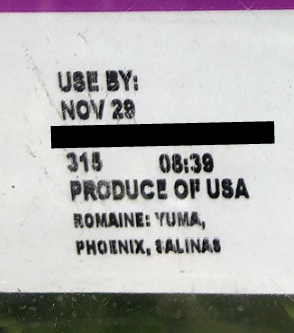
Romaine from Salinas, California Label Enjoy By December 2, 2019


Romaine from Salinas, California Label Use By November 29, 2019

Consumers: Consumers should not eat romaine lettuce harvested from Salinas, California. Additionally, consumers should not eat products identified in the recall announced by the USDA on November 21, 2019.

Romaine lettuce may be voluntarily labeled with a harvest region. If this voluntary label indicates that the romaine lettuce was grown in “Salinas” (whether alone or with the name of another location) do not eat it. Throw it away or return it to the place of purchase.  If romaine lettuce does not have information about harvest region or does not indicate that it has been grown indoors (i.e., hydroponically- and greenhouse-grown), throw it away or return it to the place of purchase. Consumers ordering salad containing romaine at a restaurant or at a salad bar should ask the staff whether the romaine came from Salinas.  If it did, or they do not know, do not eat it.

At this time, romaine lettuce that was harvested outside of the Salinas region has not been implicated in this outbreak investigation. Hydroponically- and greenhouse-grown romaine, which is voluntarily labeled as “indoor grown,” from any region does not appear to be related to the current outbreak. There is no recommendation for consumers to avoid using romaine harvested from these other sources.

Restaurants and Retailers: Restaurants and retailers should not serve or sell romaine harvested from Salinas, California.  If you do not know the source of your romaine lettuce, and if you cannot obtain that information from your supplier, you should not serve, nor sell it.

Suppliers and Distributors: Suppliers, distributors and others in the supply chain should not ship or sell romaine harvested in Salinas, California. If the source of the romaine lettuce is unknown, you should not ship, nor sell the product.

For Restaurants, Retailers, Suppliers and Distributors: Currently, the FDA does not have enough traceback information to identify the specific source of the contamination that would allow us to request a targeted recall from specific growers. At this stage in the investigation, the most efficient way to ensure that contaminated romaine is off the market would be for industry to voluntarily withdraw product grown in Salinas, and to withhold distribution of Salinas romaine for the remainder of the growing season in Salinas. FDA has made this request of industry.

At this time, romaine lettuce that was harvested outside of the Salinas region has not been implicated in this outbreak investigation. Hydroponically- and greenhouse-grown romaine, which is voluntarily labeled as “indoor grown,” from any region does not appear to be related to the current outbreak. There is no recommendation for consumers or retailers to avoid using romaine harvested from these other sources.

Background

According to the CDC, as of November 25, 2019, 67 people infected with the outbreak strain of E. coli O157:H7 have been reported from 19 states. The case patients report that illnesses started on dates ranging from September 24, 2019 to November 14, 2019.

The Maryland Department of Health identified E. coli O157:H7 in an unopened package of Ready Pac Bistro® Chicken Caesar Salad collected from an ill person’s home in Maryland. Analysis of this salad, through Whole Genome Sequencing (WGS), has linked strain E. coli O157:H7 to three Maryland cases and the multi-state outbreak.

The FDA and state partners are conducting a traceback investigation to trace romaine exposures to the source. Preliminary information indicates that ill people in Maryland were exposed to romaine lettuce harvested in Salinas, California.

FDA has deployed investigators to the farms in question to try to determine the source and extent of the contamination. More information will be forthcoming as the investigation proceeds.

Additionally, state partners are conducting laboratory analyses of romaine lettuce samples from case patients potentially linked to the outbreak.

The Salinas region as defined by the United Fresh Produce Association and the Produce Marketing Association Romaine Taskforce ReportExternal Link Disclaimer includes: Santa Cruz, Santa Clara, San Benito, and Monterey counties in California.

Genetic analysis of the E. coli O157:H7 strains from patients in this current outbreak are similar to strains of E. coli O157:H7 associated with a previous outbreak from the Fall of 2017 and the Fall of 2018 that affected consumers in both Canada and the U.S. The 2017 outbreak of E. coli O157:H7 was associated with leafy greens in the U.S. and romaine in Canada. The 2018 outbreak of E. coli O157:H7 was associated with romaine in both countries.

Hong Kong -Not to consume batch of prepackaged Spanish chorizo suspected to be contaminated with Listeria monocytogenes

CFS

Issue Date 25.11.2019
Source of Information Rapid Alert System for Food and Feed (RASFF) of the European Commission
Food Product Prepackaged chorizo imported from Spain
Product Name and Description Product name: Chorizo Picante
Brand: la alegria
Place of origin: Spain
Net weight: 200 grams per pack
Lot No.: 37, 38 and 39
Best-before date: April 30, 2020
Reason For Issuing Alert
  • The Centre for Food Safety (CFS) received a notification from the RASFF of the European Commission that the above-mentioned batch of the product might have been contaminated with Listeria monocytogenes and was being recalled.
  • According to the information provided by the RASFF, a local importer, Gourmet Cuisine Hong Kong Limited, had imported some of the affected batch of the product into Hong Kong,” a spokesman for the CFS said.
Action Taken by the Centre for Food Safety
  • The CFS immediately contacted the importer concerned for follow-up.  Preliminary investigation found that the importer had imported 450 packs of the affected batch of the product, of which 26 packs had been sold while the others were disposed of. The importer has initiated a recall according to the CFS’ instructions.
  • The CFS will alert the trade to the incident, and will continue to follow up and take appropriate action. Investigation is ongoing.
Advice to the Trade
  • Stop using or selling the batch of the product concerned immediately if they possess it.
Advice to Consumers
  • Not to consume the affected batch of the product if they have bought any.
Further Information The CFS press release

Enquiries about the recall can be made to the importer’s hotline at 2439 1977 during office hours.