Category Archives: STEC E.coli

RASFF Alerts – STEC E.coli – Sheep Meat

RASFF

E.Coli STEC sheep meet from New Zealand in Italy

France – French prosecutors raid Buitoni Fraich’UP pizza factory and Nestlé following E. coli Outbreak

Food Poison Journal

The inspections “revealed a deterioration of food hygiene controls”, the presence of “rodents” and “insufficient measures to prevent pests from contaminating a food production site.”

E. coli O26 and E. coli O103 appear to be serotypes linked to this outbreak.

According to press reports, French prosecutors on Wednesday last week searched a Buitoni frozen pizza factory in northern France, the suspected source of an E. coli outbreak that has left dozens of children sick, as well as the headquarters of its owner Nestle France, authorities told AFP .

An investigation into involuntary manslaughter and deceitful practices was opened on 1 April after authorities learned of more than 70 infections, which may have caused the deaths of a one-year-old and an 18-year-old. Over two dozen have developed hemolytic uremic syndrome (HUS).

The search at the Caudry factory operated by Buitoni, which is owned by the Swiss food conglomerate Nestle, was confirmed by a police source and the Paris prosecutor’s office, which is leading the investigation.

Nestle France, whose headquarters outside Paris were also raided, announced a recall of the affected Fraich’UP pizzas on March 18, and authorities ordered a halt of their production at Caudry after carrying out two hygiene inspections.

USA – E. coli infections from unknown source under investigation in Alabama

Food Safety News

The Alabama Department of Public Health is investigating four cases of E. coli O157:H7 and two cases of Rotavirus in younger children in Northeastern Alabama. 

As of today the department had not reported what the possible sources of the pathogens might be. It is unknown if the sources involve foods or beverages, although food is the usual source of E. Coli infections.

The department regularly investigates clusters and outbreaks of communicable diseases as required by Notifiable Disease Rules in Alabama.

In 2021, ADPH investigated 113 cases of E. coli, shiga toxin-producing illness including O157:H7.

France – Investigation of grouped cases of haemolytic-uremic syndrome (HUS) and shiga-toxin-producing E. coli (STEC) infections linked to the consumption of Buitoni® brand Fraîch’Up pizzas. 

Sante Publique

Public Health France and the National Reference Center (CNR) E. coli and its associated laboratory (Institut Pasteur, Paris, and Microbiology Laboratory of the Robert Debré Hospital, Paris), in conjunction with the Directorate General for Food, the Directorate General for Competition, Consumer Affairs and Fraud Prevention, and in coordination with the Directorate General for Health, have been investigating since 02/10/2022 an increase in the number of cases of haemolytic uremic syndrome (HUS) pediatric infections and Shiga toxin-producing Escherichia coli (STEC) infections.

The epidemiological, microbiological and traceability investigations carried out since that date have confirmed a link between the occurrence of these grouped cases and the consumption of frozen pizzas from the Buitoni brand Fraîch’Up range contaminated with STEC bacteria. On 03/18/2022, the company proceeded with the withdrawal-recall of all the pizzas in the Fraîch’Up range, marketed since June 2021 and the authorities asked the people who hold these pizzas not to consume them and to destroy them.

The total number of HUS cases linked to the consumption of these pizzas seems to have stabilized since the withdrawal-recall.

Case of SHU in France: update on 04/13/22

As of 04/13/2022, 53 confirmed cases have been identified, of which 51 are linked to STEC O26 strains, and 2 to STEC O103 strains. For 26 other cases of HUS and STEC infections notified to Public Health France, investigations are ongoing.

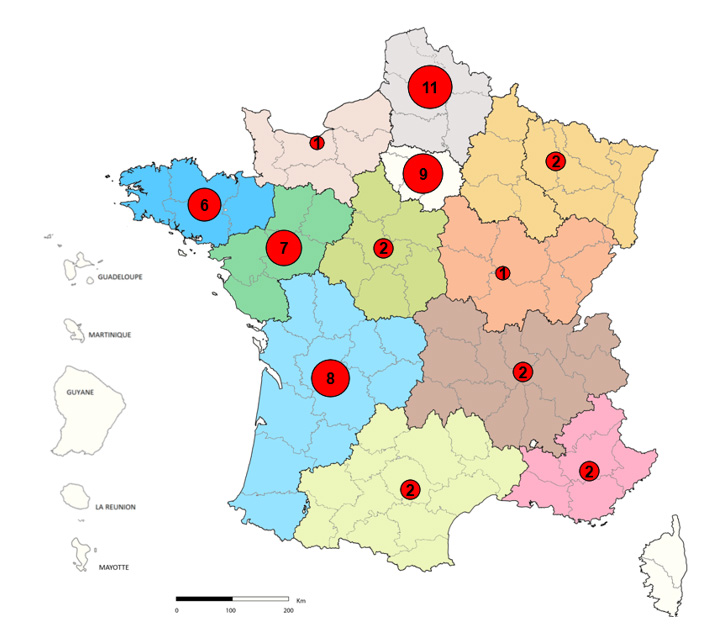
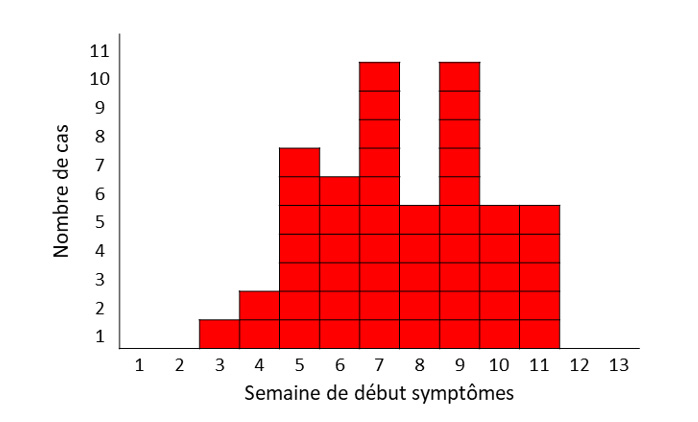
These 53 cases occurred in 52 children and 1 adult, who presented symptoms between 18/01/2022 (week 3) and 16/03/2022 (week 11) (Figure 1). The epidemic peak is in week 7 (14/02 to 20/02) and week 9 (28/02 to 06/03), with 10 cases each of these weeks. These 53 cases occurred in 12 regions of metropolitan France: Hauts-de-France (11 cases), Ile-de-France (9 cases), New Aquitaine (8 cases), Pays de la Loire (7 cases), Brittany ( 6 cases), Auvergne-Rhône-Alpes (2 cases) [-1 case since the situation update of 06/04/2022 after additional result], Grand Est (2 cases), Occitanie (2 cases), Provence-Alpes- Côte d’Azur (2 cases) and Center Val-de-Loire (2 cases), Bourgogne Franche-Comté (1 case) [-1 case since the situation update of 04/06/2022 after additional result], Normandy ( 1 case) (Figure 2).

The 52 sick children are aged from 1 to 17 years with a median age of 7 years; 23 (44%) are female; 46 (88%) presented with HUS, 6 (12%) with STEC gastroenteritis. Two children died. The adult did not present with HUS [an adult previously reported in the situation update of 06/04/2022 was finally invalidated after additional results].

Figure 1: Epidemic curve: number of confirmed cases of HUS and STEC infections (N=51), by week of onset of symptoms – metropolitan France, weeks 3 to 11, 2022
Figure 1: Epidemic curve: number of confirmed cases of HUS and STEC infections (N=51), by week of onset of symptoms - metropolitan France, weeks 3 to 11, 2022
Figure 2: Geographical distribution of confirmed cases of HUS and STEC infections (N=53) linked to the consumption of Buitoni® brand Fraîch’Up pizzas, by region of residence in metropolitan France, weeks 3 to 11, 2022
Figure 2: Geographical distribution of confirmed cases of HUS and STEC infections (N=53) linked to the consumption of Buitoni® brand Fraîch'Up pizzas, by region of residence in metropolitan France, weeks 3 to 11, 2022
Research – Preservation of cut fruit and use of a technological adjuvant for washing certain vegetables

ACSA

The Spanish Agency for Food Safety and Nutrition has published two new reports from its Scientific Committee:

  • Report on the storage conditions of fruit cut in half in retail establishments.
  • Report on the safety of the use of an aqueous solution of sodium lauryl ether sulfate as a processing aid for washing apples, peaches, bananas, tomatoes, peppers and citrus in processing plants .      

Report on the storage conditions of fruit cut in half in retail establishments

The AESAN Scientific Committee has assessed whether it is possible to keep melon, watermelon, pineapple and papaya cut in half at room temperature in retail establishments for a limited time, ensuring consumer safety.

The Scientific Committee has concluded that, on the basis of the information

  • Storage at room temperature of melon, watermelon, papaya and pineapple cut in half can pose a health risk as the physicochemical conditions (pH, water activity, total soluble solids, nutrient availability, etc.) are compatible with growth. of foodborne pathogens, such as Salmonella , E. coli verotoxigenic or L. monocytogenes .
  • In order to make the storage conditions of melon, watermelon, papaya and pineapple cut in half more flexible, temperatures below 25 ºC for a time of less than 3 may be allowed, as they do not pose a significant microbiological risk. hours in a place sufficiently ventilated and preserved from sunlight, followed by continuous refrigerated storage at temperatures below 5 ºC.
  • To minimize the health risk that these practices may pose, it is recommended to discard for cutting fruits with an excessive degree of ripeness, or that have wounds or cracks on their surface, as they can be a source of contamination.

Report on the safety of the use of an aqueous solution of sodium lauryl ether sulfate as a processing aid for washing apples, peaches, bananas, tomatoes, peppers and citrus in processing plants

The AESAN Scientific Committee has evaluated the safety of using an aqueous solution of sodium lauryl ether sulfate (27%) as a technological aid for washing apples, peaches, bananas, tomatoes, peppers and citrus in processing plants. request of a company request.

Sodium lauryl ether sulfate (LESS) is not authorized for human consumption.

As the presence of residues in the final products (fruits and vegetables) after the use of this aqueous solution cannot be ruled out, the technology adjuvant is classified as an unauthorized substance in human food whose Admissible Daily Intake (ADI) is not established and whose use may lead to the presence of technically unavoidable waste.

The Scientific Committee concludes that, based on the information provided by the applicant and taking into account the proposed composition and conditions of use, the use of the technology adjuvant does not imply a risk to the health of the consumer.

The conclusions of this report refer exclusively to the solution under evaluation as a technological aid in the proposed conditions of use and its composition, and may not be extended to formulations or conditions other than those evaluated, including joint use with other substances.

This evaluation does not imply an authorization for use or affect uses other than use as a technological aid in the process of washing apples, peaches, bananas, tomatoes, peppers and citrus in the processing plants. This use involves a final rinsing with drinking water, following the application of the washing water with the technological adjuvant, so that the possible residues in the fruits and vegetables are eliminated.

Click to access FRUTAS_CORTADAS.pdf

Click to access COADYUVANTE_LAURIL_ETER.PDF

Research – The epidemiology of Shiga toxin-producing Escherichia coli serogroup O157 in England, 2009–2019

Cambridge Org

Shiga toxin-producing Escherichia coli (STEC) serogroup O157 is a zoonotic, foodborne gastrointestinal pathogen of major public health concern. We describe the epidemiology of STEC O157 infection in England by exploring the microbiological and clinical characteristics, the demographic and geographical distribution of cases, and examining changes in environmental exposures over 11 years of enhanced surveillance. Enhanced surveillance data including microbiological subtyping, clinical presentations and exposures were extracted for all cases resident in England with evidence of STEC O157 infection, either due to faecal culture or serology detection. Incidence rates were calculated based on mid-year population estimates from the Office of National Statistics (ONS). Demographics, geography, severity and environmental exposures were compared across the time periods 2009–2014 and 2015–2019. The number of cases reported to national surveillance decreased, with the mean cases per year dropping from 887 for the period 2009–2014 to 595 for the period 2015–2019. The decline in STEC O157 infections appears to be mirrored by the decrease in cases infected with phage type 21/28. Although the percentage of cases that developed HUS decreased, the percentage of cases reporting bloody diarrhoea and hospitalisation remained stable. The number of outbreaks declined over time, although more refined typing methods linked more cases to each outbreak. Integration of epidemiological data with microbiological typing data is essential to understanding the changes in the burden of STEC infection, assessment of the risks to public health, and the prediction and mitigation of emerging threats.

Research – Viability of Shiga Toxin-Producing Escherichia coli, Salmonella spp., and Listeria monocytogenes During Preparation and Storage of Fuet, a Traditional Dry-Cured Spanish Pork Sausage

Journal of Food Protection

We monitored viability of Shiga toxin-producing Escherichia coli (STEC), Salmonella spp., and Listeria monocytogenes during preparation and storage of fuet. Coarse ground pork (ca. 35% fat) was mixed with salt (2.5%), dextrose (0.3%), starter culture (ca. 7.0 log CFU/g), celery powder (0.5%), and ground black pepper (0.3%), and then separately inoculated with a multi-strain cocktail (ca. 7.0 log CFU/g) of each pathogen. The batter was stuffed into a ca. 42-mm natural swine casing and fermented at 23°C and ca. 95% relative humidity (RH) to ≤pH 5.3 (≤ 48 h). Sausage were then dried at 12°C and ca. 80% RH to a w 0.89 (within 33 days) or a w  0.86 (within 60 days). A portion of each batch of fuet was subjected to high pressure processing (HPP; 600 MPa/3 min) before chubs were vacuum-packaged and stored for 30 days at 20°C. After fermentation, pathogen numbers remained relatively unchanged (≤0.35 log CFU/g reduction), whereas reductions of ca. 0.8 to 3.2 log CFU/g were achieved after drying fuet to a w 0.89 or 0.86. Regardless if fuet was or was not pressure treated, additional reductions of ca. 2.2 to ≥5.3 log CFU/g after drying were achieved following 30 days of storage at 20°C. For non-HPP treated fuet dried to a w 0.89 and stored for 30 days at 20°C, total reductions of ≥5.3 log CFU/g in levels of STEC or Salmonella spp. were achieved, whereas levels of L. monocytogenes were reduced by ca. 3.6 log CFU/g. Total reductions of ≥5.3 log CFU/g in levels of all three pathogens were achieved after drying non-HPP treated fuet to a w 0.86. For fuet dried to a w 0.89 or   0.86, pressure treated, and then stored for 30 days at 20°C, total reductions of >6.2 log CFU/g in levels of all three pathogens were achieved. The processing parameters tested herein, with or without application of HPP, validated reductions of ≥2.0- or ≥5.0-log CFU/g in levels of STEC, Salmonella spp., and L. monocytogenes were achieved during preparation and storage of fuet.

USA – A Decade of E. coli Outbreaks in Leafy Greens in the U.S. and Canada – Podcast

CDC

Katherine Marshall, an epidemiologist at CDC, and Sarah Gregory discuss E. coli outbreaks in leafy greens in the United States and Canada from 2009 to 2018.

More info on this topic
Topics: E. coli InfectionFoodborne DiseasePodcasts
Published: 9/24/2020
Last Updated: 9/24/2020

This podcast belongs to the Emerging Infectious Diseases series.

Subscribe to this Series

Press Play to listen to this CDC Podcast

Running time = 28:10
To save the Podcast, right click the “Save this file” link below and select the “Save Target As…” option.
Save This File (25.8 MB) [right click]

Other Formats: https://tools.cdc.gov/podcasts/media/pdf/EID_10_20_EcoliLeafyGreens.pdf

Norway – Analyzes of Pathogenic Escherichia coli in bacon sausages 2022

Mattilsynet

On behalf of the Norwegian Food Safety Authority, the Norwegian Veterinary Institute has examined 137 Norwegian bacon sausages for pathogenic E. coli bacteria (STEC). There was a discovery of such bacteria, but this type does not usually cause serious illness in humans. Although the sample was small, the conclusion is that the prevalence of STEC in Norwegian bacon sausages is low.

Mattilsynet

What we investigated: 137 Norwegian bacon sausages
Period: The samples were obtained in 2020 and analyzed in 2021
What we were looking for: E. coli and pathogenic STEC variants
What we found: A positive E. coli sample. This was not the type that usually causes serious illness in people, ie good results.
Who carried out the assignment: Veterinary Institute
Escherichia coli is present in the gastro intestinal tract of humans and warm-blooded animals, and are usually harmless. However, some groups of E.coli may cause infections in humans. Shiga toxin-producing E. coli (STEC) is one of the groups of pathogenic E. coli. Ruminants, in particular cattle, are assumed to be the main reservoir for STEC.
The results from previous surveys of cattle and sheep in Norway for the occurrence of STEC of the serogroups most often associated with infection, have indicated a low occurrence. Similar results were observed in a survey of minced meat from cattle, on the Norwegian market. The Norwegian Food Safety Authority commissioned a survey of STEC in domestically produced fermented sausages. The samples were collected in 2020 with subsequent analysis in 2021.
A total of 137 samples of domestically produced fermented sausage were collected and analysed. Enriched samples were examined for the presence of the genetic markers stx1, stx2 and eae. Attempts of isolation were carried out from samples that were positive for one or more of the virulence markers. Isolates identified as STEC were further characterized using whole genome sequencing.
STEC was isolated from only one sample, and the isolate was characterized as STEC O76:H19 harbouring stx1c, but did not carry eae. In the primary screening of enriched samples, only a few samples were positive for the virulence markers. The results from this study indicates that the occurrence of STEC in
Norwegian fermented sausages is low.
Although STEC was isolated, none of the serogroups associated with severe infections were isolated. It must be taken into account that a low number of samples were analysed. Since this type of products has not been analysed previously, the present survey provides knowledge for the industry, authorities and knowledge institutions. It is important to carry out similar surveys regularly to generate updated Norwegian data.

RASFF Alert – STEC E.coli – Cow Carcass

RASFF

STEC (stx+;eae+) in cow carcass from Belgium in France and the Netherlands