Category Archives: Research

China – Mostly children sick in Chinese Salmonella egg outbreak – 2019

Food Safety News

A Salmonella outbreak that mainly sickened children in China was caused by contaminated kitchen-made mayonnaise used in egg sandwiches, according to a study.

In September 2019, the Shenzhen and Dongguan Centers for Disease Control and Prevention were notified of a large cluster of suspected gastroenteritis involving primarily children who sought medical care at hospitals in the two cities.

A total of 254 cases were reported in Shenzhen and Dongguan, Guangdong province, found the study published in the journal Frontiers in Microbiology.

Research – Public Health Risk of Foodborne Pathogens in Edible African Land Snails, Cameroon

CDC

In tropical countries, land snails are an important food source; however, foodborne disease risks are poorly quantified. We detected Campylobacter spp., Yersinia spp., Listeria spp., Salmonella spp., or Shiga-toxigenic Escherichia coli in 57%–86% of snails in Cameroon. Snail meat is a likely vector for enteric diseases in sub-Saharan Africa countries.

Research – A 3-year multi-food study of the presence and persistence of Listeria monocytogenes in 54 small food businesses in Ireland

Academia Edu

The problem of assessing the occurrence of the food-borne pathogen Listeria monocytogenes in the food chain, and therefore the risk of exposure of the human population, is often challenging because of the limited scope of some studies.

In this study the occurrence of L. monocytogenes in food from four major food groups, dairy products,
meats, seafood and vegetables, and associated food processing environments in Ireland was studied over a three-year period. Fifty-four small food businesses participated in the study and sent both food and environmental samples every 2 months between 2013 and 2015. L.monocytogenes was isolated using the ISO11290 standard method.

Confirmation of L. monocytogenes and identification of serogroups were achieved using a multiplex PCR
assay, and for some isolates serotype was determined using commercial antisera. Pulsed- field gel electrophoresis (PFGE) analysis was performed on all isolates allowing the relatedness of isolates from different food businesses
to be compared nationwide. In total, 86 distinct pulsotypes were identified. The overall occurrence of L.
monocytogenes in food samples was 4.2%, while in environmental samples it was 3.8%. In general, the occurrence of L. monocytogenes in food businesses decreased over the course of the study, presumably reflecting increased awareness and vigilance.

The majority of the pulsotypes detected were unique to a particular food group (63/
86), while only three pulsotypes were found in all four food groups investigated. The highest occurrence in food was found in the meat category (7.5%) while seafood had the lowest rate of occurrence (1.8%). Seventeen of the pulsotypes detected in the study were persistent, where persistence was defined as repeated isolation from a single facility with a minimum time interval of 6 months. Using PFGE, 11 of the pulsotypes identified in this study were indistinguishable from those of 11 clinical isolates obtained from patients in Ireland over the last 4 years, highlighting the fact that these pulsotypes are capable of causing disease.

Overall, the study shows the diversity of L. monocytogenes strains in the Irish food chain and highlights the ability of many of these strains to persist in food processing environments. The finding that a significant proportion of these pulsotypes are also found in clinical settings highlights the need for continued vigilance by food producers, including frequent sampling and typing of isolates detected.

Research – Listeria: What you need to know

Medical News Today

Listeriosis is a food-borne infection caused by Listeria bacteria. The majority of people who become infected might barely notice the illness. However, those at risk can be severely affected, and mortality rates are relatively high.

Listeriosis, also called Listeria, can be a serious infection; it strikes pregnant women, newborns, the elderly, and anyone with a weakened immune system.

In this article, we will look at the symptoms, diagnosis, and treatment of listeriosis. We will also discuss how the bacteria works, the best ways to avoid infection, and recent research into preventing the disease.

Fast facts on listeriosis

  • Listeriosis is an infection caused by Listeria monocytogenes
  • An estimated 260 Americans die of listeriosis yearly.
  • Only immunosuppressed individuals and pregnant women are at risk of a serious case of listeriosis.
  • Listeriosis can lead to septicemia or meningitis.
  • Pregnant women are 10 times more likely to be infected with Listeria than the general population.

Read more at the link above.

China – Research – Vital Surveillances: Epidemiological Analysis of Foodborne Botulism Outbreaks — China, 2004–2020

China CDC

kswfoodworld

Abstract

IntroductionFoodborne botulism is a rare, potentially fatal illness resulting from the ingestion of foods contaminated with preformed botulinum neurotoxin types A, B, E, or F, produced by Clostridium botulinum. The descriptive epidemiology of foodborne botulism outbreaks in China during 2004−2020 was performed to inform public health response strategies.

Results

During 2004−2020, a total of 80 foodborne botulism outbreaks occurred in China, involving 386 illnesses and 55 deaths; most outbreaks were reported between June and August, with a sharp peak in January; 22 out of 31 PLADs reported foodborne botulism outbreaks, Xinjiang reported the largest number of outbreaks (20), followed by Qinghai (13); the most commonly implicated food was home-prepared traditional processed stinky tofu and dried beef, accounting for 51.25% events. Improper processing and improper storage in contributing factors accounted for 77.50% outbreaks. Initial misdiagnosis occurred in 27.50% of cases.

Conclusions

Outbreaks of foodborne botulism had a high case-fatality rate. Targeted food safety and popularization education to farmers and herdsmen in Xinjiang and Qinghai related to botulism prevention should be carried out, and timely outbreak investigation and hospital surge capacity should be improved.

Luxembourg – Luxembourg to set up new food agency

Food Safety News

Luxembourg is to get a single agency in charge of official controls in the food chain.

Legislators in the country voted this past week to create the Luxembourg Veterinary and Food Administration (ALVA).

The new authority will bring together all official controls relating to the food supply chain under the remit of the Minister of Agriculture, Viticulture and Rural Development.

Minister of Consumer Protection and Health Paulette Lenert said the reform would bring together services currently under the supervision of three different ministries and involve 100 people.

USA – Collaborating on Culture in the New Era of Smarter Food Safety – August 3rd Webinar

FDA

Date:
August 3, 2022
Time:
12:15 PM – 1:15 PM ET

The U.S. Food and Drug Administration and Stop Foodborne Illness External Link Disclaimer, a non-profit public health organization, are collaborating on a webinar series that explores food safety culture, one of the core elements in FDA’s New Era of Smarter Food Safety initiative.

The fourth webinar, called “What More Do You Want to Know About Food Safety Culture?,” will be broadcast live from the International Association for Food Protection 2022 Annual Meeting on August 3, 2022, at 12:15 p.m. ET. Speakers and attendees will engage in a question-and-answer session on an array of food safety culture topics. Registration is available for both in-person and virtual attendance.

The series, entitled “Collaborating on Culture in the New Era of Smarter Food Safety,” began on Thursday, November 4, 2021, with the session entitled “Key Concepts in Addressing Food Safety Culture as a Science – Not a Slogan.”

The second webinar in the series, called “Making Leaders Risk Aware and Push to Reduce Risk,” took place on Wednesday, February 16, 2022.

The third webinar, called “Building a Coalition of Food Safety Culture Champions Across Your Organization,” took place on May 18, 2022.

The New Era of Smarter Food Safety blueprint states that dramatic improvements in reducing the burden of foodborne illness cannot be made without doing more to influence the beliefs, attitudes, and, most importantly, the behaviours of people and the actions of organizations.

The webinar series will engage experts from the public and private sectors in a collaborative exchange of ideas and experiences related to the importance of a robust food safety culture in helping to ensure safe food production.

The series will have valuable information for both those well-versed on, and those just learning about, food safety culture.

Register Here External Link Disclaimer

Registration is required; a recording will be available after the event.

Research – Safe Handling and Serving of Soft Ice-cream

FSAI

Poor practices by the food handler can result in the ice-cream becoming unsafe to eat and this can lead to food poisoning. Food poisoning is an unpleasant illness.

For young children, pregnant women, the elderly and the sick, it can be serious and sometimes fatal. Typical symptoms of food poisoning include:

• Nausea/vomiting

• Diarrhoea

• Stomach pains

• Headaches

All food businesses have a legal obligation to:

• Produce food in a hygienic manner

• Implement a food safety management system based on the principles of HACCP (Hazard Analysis and Critical Control Point)

• Implement a traceability and recall system

• Ensure that staff are supervised and instructed in food hygiene matters

USA – New Era of Smarter Food Safety Blueprint

FDA

New Era for Smarter Food Safety Blueprint

The New Era of Smarter Food Safety Blueprint is centered around four core elements:

  1. Tech-enabled Traceability
  2. Smarter Tools and Approaches for Prevention and Outbreak Response
  3. New Business Models and Retail Modernization
  4. Food Safety Culture

These are the foundational pillars of the New Era of Smarter Food Safety, covering the range of technologies, analytics, business models, modernization and values that are its building blocks. These elements, working together, will help create a safer and more digital, traceable food system.

Research – Marine Harmful Algal Bloom (HAB)-Related Illness Tracking

OEHHA

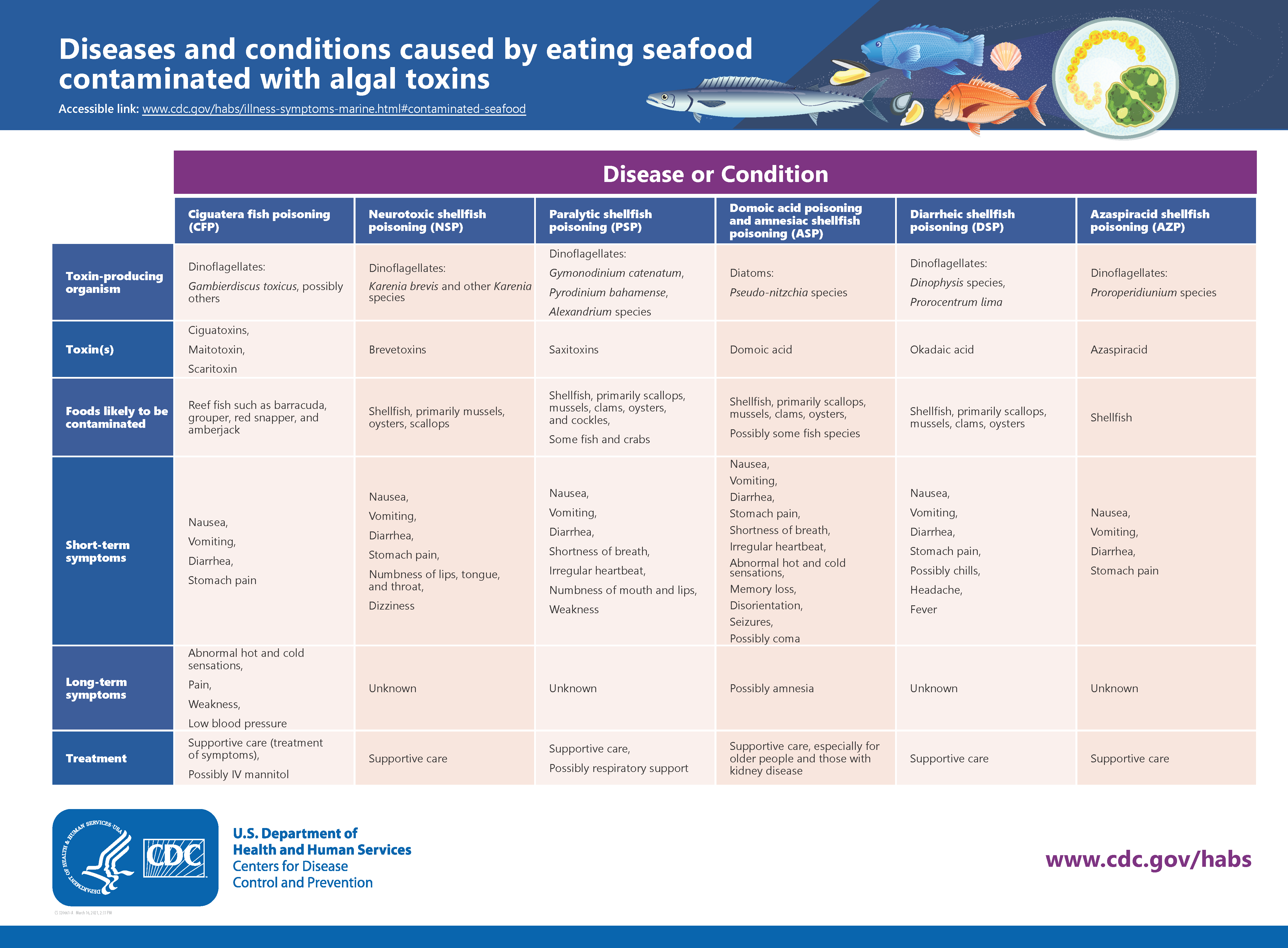
Diseases and conditions caused by eating seafood contaminated with algal toxins

What are marine harmful algal bloom (HAB)-related illnesses?

When phytoplankton and algae in marine waters occur at levels that pose a health risk to humans, animals, and the environment, they are referred to as marine harmful algal blooms (HABs). The US Centers for Disease Control and Prevention (CDC) provide resources on potential human and animal exposures to marine HABs or associated marine biotoxins via skin contact or inhalation, or consumption of fish and shellfish.