Category Archives: Research

Research – Pre-growth conditions and strain diversity affect nisin treatment efficacy against Listeria monocytogenes on cold-smoked salmon

Science Direct

Listeria monocytogenes is a human pathogen that is commonly found in environments associated with cold-smoked salmon. Nisin is a natural antimicrobial that can be used as a food preservative. While nisin is active against a number of Gram-positive bacteria, including L. monocytogenes, environmental stresses encountered in cold-smoked salmon processing facilities might affect L. monocytogenes‘ nisin susceptibility. The objective of this study was to investigate the effect of seafood-relevant pre-growth conditions and L. monocytogenes strain diversity on nisin treatment efficacy on cold-smoked salmon. Six L. monocytogenes strains representing serotypes most commonly associated with cold-smoked salmon (1/2a, 1/2b, and 4b) were initially pre-grown under a number of seafood-relevant conditions and challenged with nisin in growth media modified to represent the characteristics of cold-smoked salmon. The pre-growth conditions with the lowest mean log reduction due to nisin and the highest strain-to-strain variability were selected for experiments on cold-smoked salmon; these included: (i) 4.65% w.p. NaCl (“NaCl”); (ii) pH = 6.1 (“pH”); (iii) 0.5 μg/ml benzalkonium chloride (“Quat”); and a control (“BHI”). Cold-smoked salmon slices with or without nisin were inoculated with L. monocytogenes pre-grown in one of the conditions above, vacuum-packed, and incubated at 7 °C. L. monocytogenes were enumerated on days 1, 15, and 30. A linear mixed effects model was constructed to investigate the effect of pre-growth condition, day in storage, serotype, source of isolation as well as their interactions on nisin efficacy against L. monocytogenes. Compared to pre-growth in “BHI”, significant reduction (P < 0.05) in nisin efficacy was induced by pre-growth in “pH” and “Quat” on both days 15 and 30, and by pre-growth in “NaCl” on day 30, indicating a time-dependent cross-protection effect. Additionally, an effect of L. monocytogenes‘ serotype on the cross-protection to nisin was observed; pre-growth in “pH” significantly reduced nisin efficacy against serotype 1/2a and 4b strains, but not against 1/2b strains. In conclusion, pre-exposure to mildly acidic environment, high salt content, and sublethal concentrations of quaternary ammonium compounds, is likely to provide cross-protection against a subsequent nisin treatment of L. monocytogenes on cold-smoked salmon. Therefore, challenge studies that use pre-growth in “BHI”, as well as more susceptible L. monocytogenes strains, may overestimate the efficacy of nisin as a control strategy for cold-smoked salmon.
Research – SSEL, a selective enrichment broth for simultaneous growth of Salmonella enterica, Staphylococcus aureus, Escherichia coli O157: H7, and Listeria monocytogenes

Wiley Online

Salmonella entericaStaphylococcus aureusEscherichia coli O157: H7, and Listeria monocytogenes may contaminate similar types of food and cause foodborne disease. The objective of this study was to develop a selective enrichment broth for simultaneous enrichment of Salmonella entericaStaphylococcus aureusEscherichia coli O157: H7, and Listeria monocytogenes (SSEL) using nalidixic acid, acriflavine, lithium chloride, and sodium cholate as selective agents. Developed SSEL broth not only enriched the target pathogens to 5 log10 CFU/ml after 18 hr incubation at 37°C with 10–100 CFU/mL of inoculation concentration, but also could successfully support the simultaneous enrichment of target pathogens with similar growth rates and inhibit the growth of most nontarget bacteria effectively. The enrichment effect of SSEL was confirmed by artificial contamination test coupled with multiplex PCR. In summary, SSEL has been shown to be a promising multiplex selective enrichment broth for the detection of the four pathogens on a single‐assay platform.

Australia – Inquiry criticizes handling of I Cook Foods Listeria case

Food Safety News

A parliamentary inquiry into the closure of an Australian catering business has found the council failed in its role as a regulator.

I Cook Foods, which provided pre-packed meals to hospitals and the aged care sector, was temporarily closed in February 2019 during attempts to find the source of infection after an 86-year-old woman with listeriosis died.

The investigation led to a closure order which ultimately resulted in the loss of contracts and clients, employees being made redundant, and shutting down the business. Witnesses told the inquiry it was not normal for a site to remain shut under a closure order for a month. I Cook Foods was charged with 48 breaches of the Food Act but these were later dropped by the City of Greater Dandenong.

Research – Restaurant towels can carry pathogenic bacteria for weeks in simulated lab conditions

Healio

Commercial restaurant workers often use sponges and microfiber towels to clean food contact surfaces, but these types of absorbent materials were found to harbour potentially pathogenic organisms for more than 2 weeks, researchers said.

“The hypothesis of our study was that cleaning tools such as sponges and wiping cloths may become contaminated with bacterial pathogens and cross-contaminate other surfaces over time,” Sujata A. Sirsat, PhDan assistant professor at the Conrad N. Hilton College of Hotel and Restaurant Management at the University of Houston, told Healio. “There is some literature about this in the domestic kitchen context; however, there is a paucity of literature in food service settings.”

UK – Three of four UK Listeria outbreaks unsolved in 2018

Food Safety News

The source of infection was not found for three of four Listeria outbreaks in England in 2018.

The one which was solved was an international outbreak that involved 12 cases in England from 2015 to 2018 and was traced to frozen sweetcorn and vegetables produced by Greenyard in Hungary.

The company found the cause of contamination, a persistent presence of Listeria monocytogenes in one of the freezing tunnels, and closed down this tunnel at the plant. In June 2019, the factory was sold to Roger & Roger, a producer of potato and corn snacks.

This multi-country incident included 54 clinical cases of listeriosis in Australia, Finland, Sweden, Denmark, Austria, and the UK with 10 deaths. The outbreak was detected in Finland using whole-genome sequencing (WGS).

Traceability information indicated that frozen corn was produced in Hungary and packed in Poland. It was found that people had eaten the frozen sweetcorn uncooked, although instructions on the packaging told consumers to cook it. Implicated frozen products were distributed to 116 countries.

The second incident involved four people with illness onset in 2017 and 2018. The third outbreak sickened three people and the final one had five reported cases all in 2018.

Research – Effects of smoke produced from smoldering plants on the Aspergillus flavus growth and production of aflatoxin in pistachio

Wiley Online

Aflatoxin (AF) contamination of the Iranian exporting pistachio has become a major problem in the last decades. In this study, the antifungal effects of smoke produced from the smoldering of several herbal plants were investigated. Four different ratios of plant weight/exposure time (5/5, 10/15, 15/30, and 20 g/45 min) were used from each plant material to smoke two isolates of Aspergillus flavus (A47 and A3), grown in potato dextrose agar (PDA). The results showed that the 20 g/45 min treatment using smoldering cinnamon bark, neem leaves, and clove flowers had efficient inhibitions of 100, 85, and 75%, respectively. Furthermore, the smoking of pistachio inoculated with a spore concentration of 1 × 106 / ml using 30 g of cinnamon bark, neem leaves, and clove flowers for 75 min was capable of preventing the production of different types of AF, that is, B1, B2, G1, and G2 in the treated products. There is a good potential to smoke pistachio with these three herbal plants and prevent the production of AF in pistachio during the handling, storage, and transportation.

Research – Synergistic antibacterial effect of nisin, ethylenediaminetetraacetic acid, and sulfite on native microflora of fresh white shrimp during ice storage

Wiley Online

This study aims to investigate the effectiveness of using nisin, ethylenediaminetetraacetic acid (EDTA), and sulfite alone or in combination in reducing Vibrio parahaemolyticus Salmonella enterica , and Pseudomonas fluorescens in broth and native microflora on raw Pacific white shrimp during ice storage. Nisin (50 ppm), EDTA (20 mM), alone or in combination were used to test on the growth of parahaemolyticus enterica , and fluorescens in broth. Nisin (50 ppm), EDTA (20 mM), sodium metabisulfite (1.25 and 0.625%), ice; alone or in combination were used on shrimps during 1°C storage for 10 days. Microbial and chemical changes were analyzed during shrimp storage. First, the combination of nisin and EDTA exhibited antibacterial effects against parahaemolyticus enterica , and fluorescens in broth. Second, in shrimp preservation, the combination of nisin, EDTA, and sulfite at a low dose of 0.625% exhibited higher antimicrobial activity than did a high dose of sulfite (1.25%). Based on aerobic bacteria counts, psychrotrophic bacteria, and TVB‐N, shrimp treatment with combination of nisin, EDTA, and low‐dose sulfite were still acceptable within 10 days of storage. Based on our findings, nisin and EDTA can be used to reduce uses of sulfite for shrimp preservation in the future.

Italy – Italy records nearly 80 HUS cases in 12 months

Food Safety News

Almost 80 hemolytic uremic syndrome (HUS) cases were registered between July 2019 and June 2020 in Italy.

The 77 patients came from 17 regions in the country while one person contracted HUS while abroad. Notification rates varied by region but were highest in Aosta Valley and higher than 1 case per 100,000 in Basilicata, Calabria, Liguria, Lombardy, Marche, Trento, and Bolzano.

Seventy of those affected were under 15 years of age. The median age of patients at the clinical onset of the disease was 2 years and 7 months for the past 12 months and the past decade.

Research – Survival of Staphylococcus aureus and Salmonella enteritidis on salted sardines (Sardina pilchardus) during ripening

PubMed

The ripening period for salted sardines ranges from 4 to 6 months, depending on the season. Sometimes producing industries need to distribute the product earlier owing to market needs, and when this happens the product’s safety needs to be assured. The purpose of this work was to study the survival of Staphylococcus aureus and Salmonella Enteritidis on salted sardines during a ripening period of 115 days. Salted sardines were inoculated with pure cultures of S. aureus and Salmonella Enteritidis (10(5) CFU/g of fish on day 0). After 5 days of ripening, the water activity value for the sardines decreased from 0.93 to 0.69. The survival of both pathogens and that of total viable cells were evaluated during the ripening process. Total viable counts decreased by 2 log units over the 115-day ripening period. Salmonella Enteritidis and S. aureus survived for 60 and 90 days, respectively. Therefore, the use of a 90-day ripening period could be effective in assuring the safety of the final product.

Research – Cold-sensitive staphylococci reveal a weakness

Science Daily

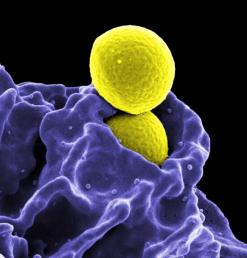
MRSA Staphylococcus KSW Food World

Image CDC

Staphylococcus aureus” — also known as “golden staph” — has the ability to develop in highly variable environmental conditions (on the skin, in the nose, on sterile surfaces, and so forth). Its great adaptability depends especially on a protein (an RNA helicase) involved in the degradation of RNA messengers that have become useless. In their attempts to have a better understanding of how this helicase works, scientists from the University of Geneva (UNIGE) discovered that it contributes to another physiological process, without any apparent link to the first: the synthesis of the fatty acids that are the essential constituents of the bacterial membrane. This advance, to be published in the journal PLoS Genetics, offers an interesting insight since fatty acid synthesis is precisely one of the targets favoured by numerous laboratories to fight this pathogen that is difficult to treat due to its resistance to antibiotics.

Golden staph (Staphylococcus aureus) is an opportunistic pathogenic bacterium that is capable of adapting to highly variable environments. It can be found in the nostrils of 25 to 30% of the population, although this is generally not a problem. However, the bacterium can take advantage of a drop in immunity or a surgical operation to trigger a real infection. And the problem with golden staph is its ability to develop resistance to antibiotic drugs, which often makes it difficult — sometimes impossible — to treat.

“My laboratory studies a protein, RNA helicase, which plays an important role in golden staph’s ability to adapt to very different environments,” begins Patrick Linder, a professor in the Department of Microbiology and Molecular Medicine in UNIGE’s Faculty of Medicine. “When the environment changes, the bacterium has to be able to synthesise new proteins that are more suitable and stop the production of others that are no longer useful. The helicase we’re interested in — called CshA — is involved in the degradation of the RNA, those molecules derived from the DNA and used in protein synthesis.”

Cold-sensitive bacteria

Oddly enough, when the helicase is absent (due, for example, to a genetic mutation), the researchers found that the cultured bacteria could no longer form colonies if the temperature dropped below a certain threshold (around 25°C).

The Geneva-based biologists undertook a series of experiments designed to improve our understanding of the link between golden staph’s sensitivity to cold, the degradation of the RNA and the adaptation capacity. They discovered that the same helicase is probably also required in another physiological process, namely the synthesis of fatty acids, which are the constituents of bacterial membranes.

“Using cultured golden staph stripped of helicases, we succeeded in isolating 82 gene mutations (appearing spontaneously in many different bacteria), which meant that their holders regained the ability to form colonies at 25°C,” continues Vanessa Khemici, a researcher in Patrick Linder’s laboratory and the article’s first author. “We identified almost all the affected genes, and no less than two thirds of them are involved in the fatty acid synthesis.”

The findings also helped the researchers understand that the lack of the helicase has the effect of deregulating the fatty acid synthesis and decreasing the flexibility of the membrane when the temperature drops. This prevents the membrane from fulfilling its functions properly and the bacterium from growing. In a second step, each of the 82 mutations succeeded in its own way in restoring the initial balance by acting on the different genetic levers involved in fatty acid synthesis.

Scientific controversy

“A section of the scientific community supports the idea that a future treatment against staphylococcus will involve a drug capable of inhibiting fatty acid synthesis,” notes Professor Linder, “but there is a controversy about it because some studies contradict this point of view.”

The results of the Geneva scientists do not provide a clear-cut answer or make it possible to directly develop a drug against these bacteria. Nevertheless, they fit into this context and provide a better understanding of golden staph’s fundamental mechanisms. The discovery of this unprecedented link between the fluidity of the membrane and adaptation to environmental change represents an important step in the fight against the bacterium. It is undoubtedly for these reasons that the journal decided to publish an overview in parallel with the article.


Story Source:

Materials provided by Université de GenèveNote: Content may be edited for style and length.


Journal Reference:

  1. Vanessa Khemici, Julien Prados, Bianca Petrignani, Benjamin Di Nolfi, Elodie Bergé, Caroline Manzano, Caroline Giraud, Patrick Linder. The DEAD-box RNA helicase CshA is required for fatty acid homeostasis in Staphylococcus aureusPLOS Genetics, 2020; 16 (7): e1008779 DOI: 10.1371/journal.pgen.1008779