Category Archives: Research

Research – What lives inside the chicken gut?

Phys Org

In a recently published study, investigators from Norwich and Surrey have more than doubled the number of microbial species known to live in the chicken gut. As the health and wealth of humans is tied to the health and productivity of chickens, this lays down a key resource for all future studies on the gut microbiome of this important food animal.

With three times as many chickens as people on our planet, this ubiquitous food animal underpins human nutrition and health across the globe—whether through subsistence farming or intensive production, chickens supply more of our food than any other animal. Chicken meat is surging in popularity as a lower-carbon alternative to meat from other livestock, whilst eggs remain an important and affordable source of nutrition worldwide. However, poultry are also a source of antimicrobial resistance and of pathogens such as Campylobacter, Salmonella and E. coli that threaten human health.

Research – Bacterial Spore Inactivation in Orange Juice and Orange Peel by Ultraviolet-C Light

MDPI

Spore-forming bacteria are a great concern for fruit juice processors as they can resist the thermal pasteurization and the high hydrostatic pressure treatments that fruit juices receive during their processing, thus reducing their microbiological quality and safety. In this context, our objective was to evaluate the efficacy of Ultraviolet-C (UV-C) light at 254 nm on reducing bacterial spores of Alicyclobacillus acidoterrestrisBacillus coagulans and Bacillus cereus at two stages of orange juice production. To simulate fruit disinfection before processing, the orange peel was artificially inoculated with each of the bacterial spores and submitted to UV-C light (97.8–100.1 W/m2) with treatment times between 3 s and 10 min. The obtained product, the orange juice, was also tested by exposing the artificially inoculated juice to UV-C light (100.9–107.9 W/m2) between 5 and 60 min. A three-minute treatment (18.0 kJ/m2) reduced spore numbers on orange peel around 2 log units, while more than 45 min (278.8 kJ/m2) were needed to achieve the same reduction in orange juice for all evaluated bacterial spores. As raw fruits are the main source of bacterial spores in fruit juices, reducing bacterial spores on fruit peels could help fruit juice processors to enhance the microbiological quality and safety of fruit juices. View Full-Text

Research – Effect of the Dry-Cured Fermented Sausage “Salchichón” Processing with a Selected Lactobacillus sakei in Listeria monocytogenes and Microbial Population

MDPI

In the present work, the effect of processing of dry-cured fermented sausage “salchichón” spiked with the selected Lactobacillus sakei 205 was challenge-tested with low and high levels of L. monocytogenes. The evolution of the natural microbial population throughout the “salchichón” ripening was also evaluated. For this, a total of 150 “salchichón” were elaborated and divided into six equal cases which were inoculated with different levels of L. monocytogenes, and L. sakei 205. Afterwards, sausages were ripened for 90 days according to a typical industrial process. Moisture content (%) and water activity (aw) decreased throughout the ripening up to values around 26% and 0.78, respectively. No differences for moisture content, aw, pH, NaCl and nitrite concentration were observed between the analyzed cases. Lactic acid bacteria counts in the L. sakei 205 inoculated cases were always higher than 6 log CFU g−1 during ripening. Enterobacteriaceae counts were reduced during ripening until non-detectable levels at the end of processing. Reductions in L. monocytogenes counts ranged from 1.6 to 2.2 log CFU g−1; therefore, the processing of “salchichón” itself did not allow the growth of this pathogen. Reduction in L. monocytogenes was significantly higher in the cases inoculated with L. sakei 205. View Full-Text

USA – Investigation Details – Multistate outbreak of Salmonella Hadar infections linked to raw ground turkey

CDC

Epidemiologic Data

As of April 12, 2021, 28 people infected with the outbreak strain of Salmonella Hadar have been reported from 12 states (see map). Illnesses started on dates ranging from December 28, 2020, to March 4, 2021 (see timeline).

Sick people range in age from less than 1 to 92 years, with a median age of 49, and 68% are female. Of 19 people with information available, 2 have been hospitalized. No deaths have been reported.

The true number of sick people in an outbreak is likely much higher than the number reported, and the outbreak may not be limited to the states with known illnesses. This is because many people recover without medical care and are not tested for Salmonella. In addition, recent illnesses may not yet be reported as it usually takes 2 to 4 weeks to determine if a sick person is part of an outbreak.

State and local public health officials are interviewing people about the foods they ate in the week before they got sick. Of the 10 people interviewed, 6 (60%) reported eating ground turkey. This percentage was significantly higher than results from a survey of healthy people in which 13% of respondents reported eating ground turkey in the week before they were interviewed. This suggests that people in this outbreak got sick from eating ground turkey.

Research – Evaluation of ceftazidime as an antibiotic supplement of mannitol-yolk-polymyxin B agar used for the enumeration of Bacillus cereus in ready-to-eat vegetables

Journal of Food Protection

bacillus

Bacillus cereus, which causes foodborne disease, is detected using selective media. However, competing flora is the most common factor preventing the correct enumeration of B. cereus on selective agars. In this study, we aimed to improve the selectivity of mannitol-yolk-polymyxin B agar (MYPA) and its modified version containing trimethoprim (mMYPA) developed in our previous study by supplementation with ceftazidime (16 μg/mL). Ceftazidime-supplemented MYPA (C-MYPA16) and mMYPA (C-mMYPA16) were evaluated for bacteria recoverability and selectivity using three types of ready-to-eat vegetables. Four B. cereus and one B. thuringiensis strains were mixed and artificially inoculated into vegetable salad, radish sprouts, and sprout mix, and then recovered using MYPA, mMYPA, C-MYPA16, and C-mMYPA16. In all tested vegetables, mMYPA, C-MYPA16, and C-mMYPA16 exhibited similar recoverability of B. cereus / thuringiensis ( p > 0.05), whereas MYPA showed undistinguishable colonies in case of radish sprouts and sprout mix. At the same time, C-mMYPA16 provided the best selectivity compared with the other agars because it eliminated most of competing flora in the tested vegetables, especially in sprouts, without negatively affecting the recovery of B. cereus / thuringiensis . Our results indicate that the supplementation of mMYPA with ceftazidime may improve medium selectivity for B. cereus / thuringiensis in food testing.

Research – Climate change emerges as another culprit in leafy green food poisoning outbreaks

The Counter

The last decade has been particularly rough on the leafy greens industry. If you’ve followed lettuce news, you’re certainly aware of the multiple outbreaks of foodborne pathogens like E. coli, which have killed hundreds and sickened thousands more. Cattle feedlots have emerged as a major source of contamination for leafy green contamination but over at Eater, Jenny Zhang homes in on another culprit: climate change. Though it’s an emergent field of study and many unknowns remain, some early observations include: Rising temperatures can help E. coli and salmonella proliferate; those same hot temps provoke cattle into shedding pathogens more readily; and climate change-related flooding can rapidly spread contamination into water supplies used in irrigation. “Think of climate change as both an amplification of existing hazards, as well as a potential trigger for things we can’t foresee,” writes Zhang.

Research – Pulsed light treatment of dried parsley: reduction of artificially inoculated Salmonella spp. and impact in given quality parameters

Journal of Food Protection

Dried parsley is regularly contaminated with foodborne pathogens, especially Salmonella (S.) spp. Application of contaminated ingredients in ready-to-eat dishes without further thermal treatment represents a considerable health risk. This study examines the suitability of pulsed light as a novel decontamination method of Salmonella spp. in dried parsley, the impact on selected quality parameters (chlorophyll content, phenolic compounds, color, odor) and product characters (temperature, aw-value). Samples were inoculated with one of three Salmonella isolates (S. Cerro or one of two isolates of S. Agona) at two contamination levels of 103 or 107 CFU/g and treated under various experimental factors, including distance to the light source and exposure time, resulting in fluences in the range of 1.8 – 19.9 J/cm2. At selected parameter settings (9.8 and 13.3 J/cm2), the effect of prolonged storage time (48 h) of inoculated samples prior to treatment on the reduction of S. Cerro was examined. Samples treated at the same fluences were also stored for 35 days at 22 – 25 °C. The three Salmonella isolates were significantly reduced by pulsed light (p < 0.05). Reduction factors ranged between 0.3 – 5.2 log CFU with varying sensitivities of the isolates. In general, increasing fluences (depending on exposure time and distance to the light source) resulted in increasing reductions of Salmonella spp. However, on closer examination, exposure time and distance to the light source in detail had a varying influence on the reduction of the different Salmonella isolates. Decreasing reduction factors were observed by increasing the contamination level and prolonging storage time of inoculated samples prior to treatment. No undesirable changes in quality parameters and sensory analysis were detectable at fluences of 9.8 and 13.3 J/cm2, indicating that pulsed light may be a suitable alternative for the decontamination of dried parsley.

Research – Staphylococcal (Staph) Food Poisoning

CDC

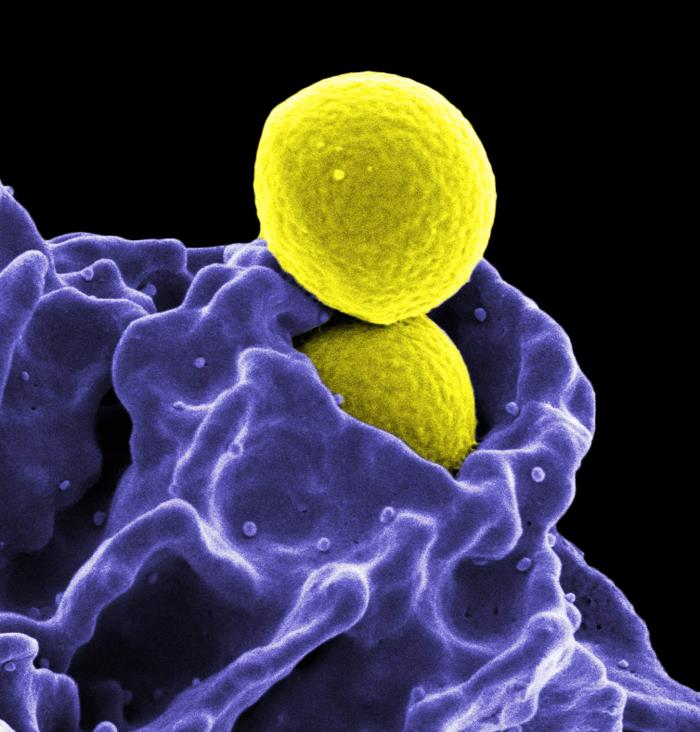
MRSA Staphylococcus KSW Food World

Staph food poisoning is a gastrointestinal illness caused by eating foods contaminated with toxins produced by the bacterium Staphylococcus aureus (Staph) bacteria.

About 25% of people and animals have Staph on their skin and in their nose. It usually does not cause illness in healthy people, but Staph has the ability to make toxins that can cause food poisoning.

People who carry Staph can contaminate food if they don’t wash their hands before touching it. If food is contaminated with Staph, the bacteria can multiply in the food and produce toxins that can make people ill. Staph bacteria are killed by cooking, but the toxins are not destroyed and will still be able to cause illness.

Foods that are not cooked after handling, such as sliced meats, puddings, pastries, and sandwiches, are especially risky if contaminated with Staph.

Food contaminated with Staph toxin may not smell bad or look spoiled.

What are the symptoms of Staph food poisoning?

  • Staph food poisoning is characterized by a sudden start of nausea, vomiting, and stomach cramps. Most people also have diarrhea.
  • Symptoms usually develop within 30 minutes to 8 hours after eating or drinking an item containing Staph toxin, and last no longer than 1 day. Severe illness is rare.
  • The illness cannot be passed from one person to another.

How do I know if I have Staph food poisoning?

You can suspect Staph food poisoning based on the type of symptoms and their fast resolution. Although laboratory tests can detect toxin-producing Staph in stool, vomit, and foods, these tests are usually not ordered except during an outbreak. If you think you might have Staph food poisoning and are experiencing severe symptoms, contact your health care provider.

Research – Resistance levels still high in bacteria causing foodborne infections

EFSA

A sizeable proportion of Salmonella and Campylobacter bacteria is still resistant to antibiotics commonly used in humans and animals, as in previous years, says a report released today by the European Centre for Disease Prevention and Control (ECDC) and the European Food Safety Authority (EFSA).

In humans, high proportions of resistance to ciprofloxacin, an antibiotic commonly used to treat several types of infections, were reported in a specific Salmonella type known as S. Kentucky (82.1%). In recent years, S. Enteritidis resistant to nalidixic acid and/or ciprofloxacin has been increasingly reported in several countries. The increasing occurrence of fluoroquinolone and/or quinolone resistance in these types of Salmonella probably reflects the spread of particularly resistant strains.

In Campylobacter, resistance to ciprofloxacin is now so common in most countries that this antimicrobial has limited use in treatment of Campylobacter infections in humans.

However, the report also includes some positive findings. Over the period 2015-2019, a decline in resistance to ampicillin and tetracyclines has been observed in Salmonella isolates from humans in eight and eleven Member States respectively.

A decreasing trend has also been observed in the prevalence of extended-spectrum β-lactamase (ESBL)- producing E. coli in samples from food producing animals from 13 Member States between 2015 and 2019. This is an important finding as particular strains of ESBL-producing E. coli are responsible for serious infections in humans.

Combined resistance to two critically important antimicrobials – fluoroquinolones and third generation cephalosporines in Salmonella and fluoroquinolones and macrolides in Campylobacter – remains low. These critically important antimicrobials are commonly used to treat serious infections from Salmonella and Campylobacter in humans.

The rate of E. coli bacteria in samples from food producing animals that respond to all antimicrobials tested also increased. This was observed in nine Member States over the period 2014-2019.

The report was based on antimicrobial resistance monitoring data collected by Member States as part of their EU regulatory obligations and jointly analysed by EFSA and ECDC with the assistance of external contractors.

Research – A cross-border outbreak of Salmonella Bareilly cases confirmed by whole genome sequencing, Czech Republic and Slovakia, 2017 to 2018

Eurosurveillance

spp. are the third most common cause of bacterial food-borne illnesses worldwide and the second most commonly reported zoonotic agents in the European Union (EU). The bacterial genus  consists of  and  species. More than 2,500 serotypes of  have been identified so far , many of them commonly infecting animals (e.g. poultry, pigs, cattle) and humans. The distribution of predominant serovars in each country are affected by changes in the global food and livestock trade, international travel, and human migration.

 subsp.  serovar Bareilly ( Bareilly) belongs to the C1 serogroup (antigenic formula 6, 7, 14: y: 1,5) and was first identified in India in 1928. In the United Kingdom (UK), 31% of all  Bareilly human cases identified between 2005 and 2009 were attributed to travel from India. Since 2004,  Bareilly has most commonly been isolated from spices. Contaminated mung bean seeds were the likely source of a  Bareilly outbreak in the UK in 2010, with total of 231 cases. In an outbreak of salmonellosis in the United States, which comprised 410 cases of  Bareilly across 28 states and the District of Columbia, tuna scrape imported from India was identified to be the source using whole genome sequencing (WGS)-based methods.

Since 2016,  Bareilly has been among the top 20  serotypes associated with human diseases in the European Union/European Economic Area (EU/EEA) . Between 2006 and 2016,  Bareilly was among the top 25 serotypes detected in humans in the Czech Republic, with the annual incidence ranging from 0.04 to 0.23 per 100,000 inhabitants (data from the Czech national electronic communicable diseases notification system). According to data from the Czech national control programme for  in poultry,  Bareilly was identified in broiler flocks with a prevalence of up to 0.06%.

Salmonellosis has been a mandatory notifiable disease in both the Czech Republic and Slovakia since 1951. Regional public health officers notify case-based data to the national electronic communicable diseases notification system (EpiDat/ISIN in the Czech Republic and the Epidemic Intelligence Information System (EPIS) in Slovakia). Both systems record data on all cases that meet the definition of a confirmed case in accordance with the European Commission Implementing Decision 2119/98/EC. The information on  serovar, which is provided by routine microbiological laboratories handling human samples, is included in the reporting systems. These laboratories typically test for a limited spectrum of serovars only, and  Bareilly is usually not included. The Czech and Slovak National Reference Laboratories (NRLs) (the Czech NRL is a part of the National Institute of Public Health in Prague, the Slovak NRL is part of the Public Health Authority in Bratislava) provide serotyping of less common serovars and confirm results from routine microbiological laboratories on request.

There are several options to confirm the relatedness of  isolates in laboratories. Macro-restriction analysis followed by pulsed-field gel electrophoresis (PFGE) is usually a suitable method for the detection and investigation of  outbreaks. However, in some cases, it does not provide sufficient discriminatory power to distinguish outbreak isolates. Therefore, WGS-based typing methods are now increasingly applied as molecular epidemiology tools to assist in outbreak investigations.