Category Archives: Microbiology

Norway – The rules for selling raw milk remain unchanged

Mattilsynet

The Ministry of Health and Care Services (HOD) has decided not to change the regulations for the sale of raw milk for human consumption. The background is to have a high level of protection of consumer health.

In the autumn of 2017, the Ministry of Health and Care Services commissioned the Norwegian Food Safety Authority to prepare a draft regulation that allows a limited sale of raw milk and raw cream for consumption.

The proposed change in the regulations was that the farm or farms can sell up to 5000 liters of raw milk or raw cream per year if certain conditions are met, such as satisfactory hygiene, unbroken cold chain, warning marking and that the turnover was from the farm or farm.

The draft regulation was out for consultation . The Norwegian Food Safety Authority carried out a compilation of the consultation statements which were submitted to the Ministry of Health and Care Services. In its decision not to change the regulations, the Ministry of Health and Care Services has, among other things, emphasized the warnings from the Norwegian Institute of Public Health, the Norwegian Veterinary Institute and the Norwegian University of Life Sciences. All three agencies opposed liberalization in the consultation statement, out of consideration for the risk of infection and the risk of serious illness.

-From a public health perspective, restrictive regulations will be the most important risk-reducing measure to avoid illness in connection with the consumption of raw milk. This is ensured, among other things, through heat treatment of all raw milk and a ban on turnover, says senior adviser Margrethe Hovda Røed in the Norwegian Food Safety Authority.
Netherlands – DEEN Surinamese chicken salad – Listeria monocytogenes

NVWA

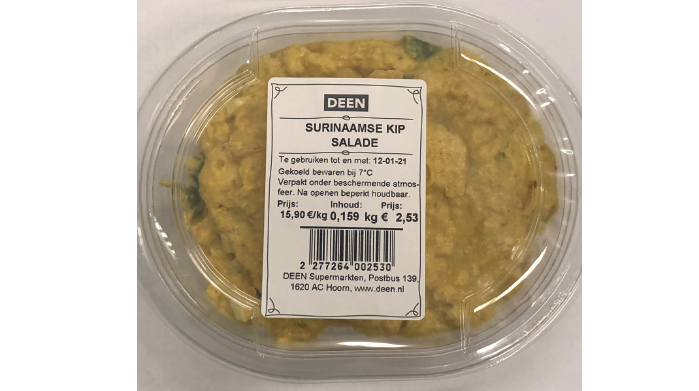
As a precautionary measure, DEEN supermarkets is recalling the following product with immediate effect:

  • DEEN Surinamese chicken salad, 160 gram tray with best before 12-01

During a quality check in the DEEN butcher’s shop it was found that this product can contain the bacteria listeria. Consumption of this product can cause gastrointestinal complaints and can be harmful to health, especially for children, the elderly, people with a weakened immune system and pregnant women.

If you have this product with a stated expiration date at home, DEEN advises you not to consume the above product.

You can return the above products to the store, you will then be refunded the purchase amount. For questions, you can contact DEEN customer service on working days between 08:00 and 17:00 on telephone number 0229-259259.

See also website Deen .

Download ‘Important safety warning DEEN Surinamese chicken salad’

PDF document | 1 page | 414 KB

Warning | 05-01-2021

DEEN Surinamese chicken salad

Italy – FORMAI DE MUT DELL’ALTA VALLE BREMBANA – Microbiological Risk

Salute

Brand : IT03994CE PAGANONI GIANFRANCO ALPE TORRAGELLA MOIO DE CALVI BG

Name : FORMAI DE MUT DELL’ALTA VALLE BREMBANA

Reason for reporting : Recall due to microbiological risk

Publication date : 5 January 2021

Documentation

Documentation

Israel – Frozen Ground Chicken – Salmonella

Click to access RCL_28122020_EN.pdf

France – Product recall: Salaisonniers du Pilat brand straight sausage

Oulah

Product recall: Salaisonniers du Pilat brand straight sausage

ENCOUNTERED PROBLEM

Presence of Listeria monocytogenes

PROPOSED SOLUTION

Those in possession of this product are asked not to consume it and to return it to the point of sale where it was purchased.

People who have consumed this product and who have a fever, isolated or accompanied by headaches, are invited to consult their attending physician, notifying them of this consumption.
Pregnant women should pay special attention to these symptoms, as well as immunocompromised people and the elderly. These symptoms may suggest listeriosis, a disease that can be serious and can take up to eight weeks to incubate.

FURTHER INFORMATION

▸ Barcode
3595570001726

▸ Lot
2031406


Best before From 01/31/21 to 02/07/21

▸ Consumer service contact
La Salaison du Mont Pilat is available to consumers to answer their questions at the telephone number: “04.77.20.97.23 or by email contact@salaisons-mont-pilat.fr”.

▸ Source
https://www.auchan.fr/

Lithuania – Lithuania orders destruction of eggs contaminated by Salmonella

Food Safety News

Lithuanian authorities have ordered the destruction of some eggs from Ukraine because of the detection of Salmonella.

The State Food and Veterinary Service (VMVT) prohibited the sale of medium sized white eggs in packs of 10 with a shelf life until Dec. 26, 2020. More than 38,000 cartons of eggs were affected.

An investigation into the marketing of potentially unsafe products was started after a notification on the European Union’s Rapid Alert System for Food and Feed (RASFF) and based on information from the retailer Lidl Lietuva.

Italy- SALAM D’LA TRADISSION – Microbiological Contamination

Salute

Brand : I SALAM ‘D GIORS

Name : SALAM D’LA TRADISSION

Reason for reporting : Recall due to microbiological risk

Publication date : 31 December 2020

Documentation

Documentation

Research – Living with Legionella and Other Waterborne Pathogens

MDPI

Legionella spp. and other opportunistic premise plumbing pathogens (OPPPs), including Pseudomonas aeruginosaMycobacterium aviumStenotrophomonas maltophilia, and Acinetobacter baumannii, are normal inhabitants of natural waters, drinking water distribution systems and premise plumbing. Thus, humans are regularly exposed to these pathogens. Unfortunately, Legionella spp. and the other OPPPs share a number of features that allow them to grow and persist in premise plumbing. They form biofilms and are also relatively disinfectant-resistant, able to grow at low organic matter concentrations, and able to grow under stagnant conditions. Infections have been traced to exposure to premise plumbing or aerosols generated in showers. A number of measures can lead to reduction in OPPP numbers in premise plumbing, including elevation of water heater temperatures.

Research – Validation of simulated commercial manufacturing of flour tortillas to control Salmonella contamination

Wiley Online

Salm2

This study validated a typical batch commercial flour tortilla cooking process against Salmonella contamination. Tortilla dough prepared from flour inoculated with a 7‐serovar Salmonella cocktail was pressed in a dough press (preset at 200 °F [93.3°C]) for 3 s, then heated on a griddle (preheated to 221.1°C [430 °F]) for 30, 45 or 60 s on each side, followed by ~8 min of ambient air cooling. The maximum internal temperature of tortillas during cooking was >97°C for all cooking times. The Salmonella counts in tortillas decreased >6‐log at all cooking times; however, tortillas cooked for 30 and 45 s had an undercooked appearance. The water activity and pH of cooked tortillas after 60 s of heating on both sides followed by cooling were 0.934 and 6.62, respectively. The D‐values of the Salmonella cocktail in raw tortilla dough were 22.2, 13.4, and 4.6 min at 55, 58, and 61°C, respectively, and the z‐value was 8.9°C.

Research – Influence of Light and Water Activity on Growth and Mycotoxin Formation of Selected Isolates of Aspergillus flavus and Aspergillus parasiticus

MDPI

kswfoodworld

Image CDC

Aspergillus flavus and A. parasiticus are the main causes of aflatoxin contamination in various foods, particularly grains, as they can thrive in environments with lower water activity and higher temperatures. The growth of Aspergillus and the formation of the mycotoxins aflatoxin and cyclopiazonic acid are strongly influenced by environmental stimuli and can be reduced by modulating parameters such as water activity, pH, temperature and light during the storage. This study has two objectives—on the one hand, to assess how global warming and an increase in exposure to sunlight affect growth and mycotoxin formation, and on the other hand, how the findings from these experiments can be used to reduce fungal growth and mycotoxin formation in stored foods. Using growth substrates with two different water activities (aw 0.95, aw 0.98), together with a light incubation device consisting of different chambers equipped with diodes emitting visible light of five different wavelengths (455 nm, 470 nm, 530 nm, 590 nm, 627 nm) plus white light, we analyzed the growth and mycotoxin formation of selected Aspergillus flavus and A. parasiticus isolates. It was shown that light with a wavelength of 455/470 nm alone, but especially in combination with a lower water activity of aw 0.95, leads to a significant reduction in growth and mycotoxin formation, which was accompanied by reduced transcriptional activity of the responsible mycotoxin biosynthetic genes. Therefore, these results can be used to significantly reduce the growth and the mycotoxin formation of the analyzed fungi during storage and to estimate the trend of fungal infestation by Aspergillus flavus and A. parasiticus in water activity- and light exposure-equivalent climate change scenarios. Mycotoxin-producing aspergilli can be effective and sustainably inhibited using a combination of short-wave light and lowered water activity in the substrate. A higher annual mean temperature accompanying climate change may lead to an increased spread of aflatoxin-producing fungi in areas that were previously too cold for them. On the other hand, there will be regions in the world where contamination with aflatoxin-producing fungi will be reduced due to increased drought and sun exposure.