Category Archives: Microbiology

Canada – Food Recall Warning – Belle Grove brand Whole White Mushrooms recalled due to potential presence of dangerous bacteria – Clostridia botulinum

CFIA

Recall details

Ottawa, January 9, 2021 – Monaghan Mushrooms Ltd. is recalling Belle Grove brand Whole White Mushrooms from the marketplace because they may permit the growth of Clostridium botulinum. Consumers should not consume the recalled product described below.

Recalled product

Brand Product Size UPC Codes
Belle Grove Whole White Mushrooms 227 g 8 87462 00000 3 Best Before 15 Jan

What you should do

If you think you became sick from consuming a recalled product, call your doctor.

Check to see if you have the recalled product in your home. Recalled products should be thrown out or returned to the store where they were purchased.

Food contaminated with Clostridium botulinum toxin may not look or smell spoiled but can still make you sick.

Symptoms in adults can include facial paralysis or loss of facial expression, unreactive or fixed pupils, difficulty swallowing, drooping eyelids, blurred or double vision, difficulty speaking, including slurred speech, and a change in sound of voice, including hoarseness.

Symptoms of foodborne botulism in children can include difficulty swallowing, slurred speech, generalized weakness and paralysis. In all cases, botulism does not cause a fever. In severe cases of illness, people may die.

Background

This recall was triggered by the company. The Canadian Food Inspection Agency (CFIA) is conducting a food safety investigation, which may lead to the recall of other products. If other high-risk products are recalled, the CFIA will notify the public through updated Food Recall Warnings.

The CFIA is verifying that industry is removing the recalled product from the marketplace.

Illnesses

There have been no reported illnesses associated with the consumption of this product.

Product photos

Printer ready version of photos
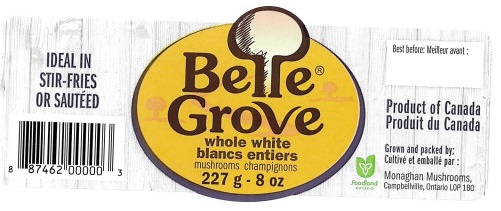
  • Belle Grove - Whole White Mushrooms

Public enquiries and media

Public enquiries
Toll-free: 1-800-442-2342 (Canada and U.S.)
Telephone: 1-613-773-2342 (local or international)
Email: cfia.enquiries-demandederenseignements.acia@canada.ca
Media relations
Telephone: 613-773-6600
Email: cfia.media.acia@canada.ca

Research – Application of a Novel Lytic Podoviridae Phage Pu20 for Biological Control of Drug-Resistant Salmonella in Liquid Eggs

MDPI

kswfoodworld Salmonella

Salmonella is a globally distributed zoonotic pathogen. Among them, S. Pullorum is a host-specific pathogen that seriously affects the development of the poultry breeding industry in China. It mainly infects chickens and can cause white scabs, and the mortality rate after infection is almost 100%. As antibiotics are widely used in animal feed and other production processes, Salmonella resistance has gradually increased. Therefore, there is an increasing need to develop new technologies to control multi-drug resistant (MDR) pathogens and confirm their actual effectiveness in the target food matrix. Bacteriophage can efficiently and specifically lyse bacteria, and will be a potential bactericide to replace antibiotics. In this study, 34 strains of Salmonella bacteriophages were isolated from environmental resources. Therein, phage Pu20 with the widest host spectrum had the strongest ability to lyse tested Salmonella strains. Further studies showed that Pu20 had high pH tolerance and heat resistance, short incubation period. Pu20 can effectively inhibit the growth of two strains of MDR Salmonella in liquid egg white and yolk at 4 ℃ and 25 ℃, respectively. According to morphological and phylogenetic analysis, Pu20 belongs to the Podoviridae family. Genomic analysis of Pu20 indicates a linear 59435 bp dsDNA sequence with no homology to virulence or antibiotic resistance-related genes. Together, these results sheds light on the potential biocontrol application value of Pu20 in food products.

Research – Basil Essential Oil: Composition, Antimicrobial Properties, and Microencapsulation to Produce Active Chitosan Films for Food Packaging

MDPI

The essential oil (EO) from basil—Ocimum basilicum—was characterized, microencapsulated by vibration technology, and used to prepare a new type of packaging system designed to extend the food shelf life. The basil essential oil (BEO) chemical composition and antimicrobial activity were analyzed, as well as the morphological and biological properties of the derived BEO microcapsules (BEOMC). Analysis of BEO by gas chromatography demonstrated that the main component was linalool, whereas the study of its antimicrobial activity showed a significant inhibitory effect against all the microorganisms tested, mostly Gram-positive bacteria. Moreover, the prepared BEOMC showed a spheroidal shape and retained the EO antimicrobial activity. Finally, chitosan-based edible films were produced, grafted with BEOMC, and characterized for their physicochemical and biological properties. Since their effective antimicrobial activity was demonstrated, these films were tested as packaging system by wrapping cooked ham samples during 10 days of storage, with the aim of their possible use to extend the shelf life of the product. It was demonstrated that the obtained active film can both control the bacterial growth of the cooked ham and markedly inhibit the pH increase of the packaged food. View Full-Text

Research – A Methodology for Classifying Root Causes of Outbreaks of Legionnaires’ Disease: Deficiencies in Environmental Control and Water Management

MDPI

CDC legionella

Image CDC

We piloted a methodology for collecting and interpreting root cause—or environmental deficiency (ED)—information from Legionnaires’ disease (LD) outbreak investigation reports. The methodology included a classification framework to assess common failures observed in the implementation of water management programs (WMPs). We reviewed reports from fourteen CDC-led investigations between 1 January 2015 and 21 June 2019 to identify EDs associated with outbreaks of LD. We developed an abstraction guide to standardize data collection from outbreak reports and define relevant parameters. We categorized each ED according to three criteria: ED type, WMP-deficiency type, and source of deficiency. We calculated the prevalence of EDs among facilities and explored differences between facilities with and without WMPs. A majority of EDs identified (81%) were classified as process failures. Facilities with WMPs (n = 8) had lower prevalence of EDs attributed to plumbed devices (9.1%) and infrastructure design (0%) than facilities without WMPs (n = 6; 33.3% and 24.2%, respectively). About three quarters (72%) of LD cases and 81% of the fatalities in our sample originated at facilities without a WMP. This report highlights the importance of WMPs in preventing and mitigating outbreaks of LD. Building water system process management is a primary obstacle toward limiting the root causes of LD outbreaks. Greater emphasis on the documentation, verification, validation, and continuous program review steps will be important in maximizing the effectiveness of WMPs. View Full-Text

USA – Legionnaires’ disease outbreak in Portland: 1 dead; 4 hospitalised

Outbreak News Today

A bacterial pneumonia outbreak, known as Legionnaires’ disease has hit a Portland-based senior housing complex, leaving 1 dead and 4 hospitalized as more than 100 residents were evacuated from the housing complex.

A report released by the Multnomah County Health Department said that the outbreak is caused by contaminated water that has entered the Rosemont Court senior living complex. Health authorities further say that people that have increased risk, including senior members of the community, have a greater risk for Legionnaires disease, albeit being not contagious in nature.

Belgium – Watermelon Seeds, Roasted & Salted – Aflatoxin – Ochratoxin A

AFSCA

Following a notification via the RASFF system (European Food and Feed rapid alert system), the AFSCA withdraws from sale and recalls the following product to consumers: watermelon seeds “watermelon seeds, roasted & salted” of the brand Ciloglu due to a too high content of aflatoxin B1 and ochratoxin A.

The AFSCA asks not to consume this product and to bring it back to the point of sale where it was purchased.

Product Description:

• Product Category: Watermelon Seeds
• Product Name: watermelon seeds, roasted & salted
• Brand: Ciloglu
• Date of Minimum Durability (DDM)
: 09/28/2021
• Lot: NTX591477 • Weight: 200g

Ce product was sold through several points of sale in Belgium.

For any further information , you can contact the AFSCA contact point for consumers: 0800 / 13.550 or pointdecontact@afsca.be .

RASFF Alert – Listeria monocytogenes – Goat Cheese

European Food Alerts

RASFF

Listeria monocytogenes (<10 CFU/g) in goat cheese from Spain in Spain

RASFF Alerts – Animal Feed -Salmonella – Rapeseed Cake – Sunflower Pellets – Dog Chews

European Food Alerts

RASFF

Salmonella enterica ser. Agona (present /25g) in rapeseed cake from Belgium in Belgium

RASFF

Salmonella (25 /25g) in sunflower pellets from Hungary in Germany

RASFF

Salmonella (positive /25g) in dog chews from Turkey in Germany

RASFF Alert – Animal Feed – Aflatoxins – Groundnuts for Birds

European Food Alerts

RASFF

aflatoxins (B1 = 220 µg/kg – ppb) in groundnuts for birds from Austria in Denmark

New Zealand – Campylobacter Action Plan 2020-2021

MPI

Campylobacter kswfoodworld

The 2020 –2021 Action Plan incorporates a risk-based, whole-of-food chain approach to identification, selection and implementation of new control measures that will significantly reduce the foodborne campylobacteriosis burden in New Zealand.

The Action Plan includes: prioritisation of selected actions for immediate evaluation/implementation; identification of a further list of potential control measures on the basis of current knowledge, and establishing a framework for their systematic evaluation, prioritisation and implementation; setting of a public health improvement goal for the reduction of foodborne campylobacteriosis; and a lead in to medium-term control measures that will likely be implemented in out-years 2022 –2023.

New Zealand Food Safety will be primarily responsible for agreed actions and reporting against the work schedule. Industry will have responsibility for implementing both legislated and non-legislated actions.