Category Archives: Microbiology

CPS – Funded Projects 2022 – Produce Cross Contamination in Dry Environments

CPS

Cross-contamination risks in dry environments

Cross-contamination of fresh produce is a significant risk factor that can contaminate multiple batches of fresh produce and can result in a food safety outbreak. With extensive research, we have developed understanding of the risk factors that promote cross-contamination of fresh produce during wet handling and processing as well as developed tools and technologies to reduce these risk factors. However, there is a lack of knowledge of the risk factors for cross-contamination of fresh produce in a dry environment as well as technologies and tools to reduce these risks. This proposed research plan is aimed at: (a) addressing key gaps in knowledge for managing cross-contamination risks including identification of surface and surface conditions that promote transfer of microbes from a contaminated surface to fresh produce; (b) developing a quantitative risk model to evaluate cross-contamination risks for diverse food contact surfaces and (c) development and validation of novel sanitation technology using food grade light activated antimicrobials. Thus, this comprehensive research approach addresses gaps in knowledge and develop tools and technologies to reduce food safety risks. In addition, development of a novel sanitation technology will address key gaps in sanitation of dry environments for both organic compliant and conventional fresh produce industries.
CPS – Funded Projects 2022 – Survival of Listeria monocytogenes and Salmonella on Surfaces

CPS

Survival of Listeria monocytogenes and Salmonella on surfaces found in the dry packinghouse environment and effectiveness of dry-cleaning processes on pathogen reduction

Salmonella and Listeria monocytogenes are important foodborne pathogen involved in foodborne outbreaks linked to the consumption of produce and fresh fruits. Contamination of fresh produce is problematic since these products are usually consumed without heating. To avoid contamination events, the packing industry must rely on rigorous sanitation practices including in the dry areas of the packinghouse. This study proposes to develop informational tools regarding the die off rates of the pathogens exposed to matric stress. Experiments will reassemble packinghouse conditions. Dried planktonic cells and dried biofilms formed by the packing house microbiota and L. monocytogenes or Salmonella will simulate packing industry surfaces and environmental conditions. Experiments will investigate the conditions that favor transition of the planktonic cells present on surfaces to form attached embedded communities or biofilms, and formation of VBNC cells. Inactivation studies will provide data for best practices regarding dry cleaning/sanitation methodology in the packing house and elimination of the foodborne pathogens. These findings will be validated for practical use in the packing house, in a large pilot plant study to reduce the load of microorganisms on equipment and produce. Results from this study will provide improved pathogen control in addition to basic good agricultural practices.

CPS – Research project Funding 2022 – Salads

CPS

Assessing Romaine lettuce “Forward Processing” for potential impacts on EHEC growth, antimicrobial susceptibility, and infectivity

Consumption of Romaine lettuce has been linked to multiple foodborne illness outbreaks due to contamination of pathogenic Escherichia coli strains. Recently, these outbreaks have occurred in the United States every year since 2016, causing great damage to consumer health and economic wellbeing of the fresh produce industry. The pathogen strains isolated from these outbreaks showed great similarity by genomic analyses. These outbreaks showed a pattern of heavy concentration especially in northeastern USA, prompting questions from the leafy green industry that the practice of “forward processing” could be linked to the outbreaks. “Forward processing” is a practice that the raw lettuce commodity is transported in trucks to facilities far away from the production area for washing and packaging, and regional marketing. We propose to work closely with the leafy green industry to comprehensively assess the forward processing for its effects on the integrity and safety of the raw commodity and the packaged products. In addition, the forward processing conditions will be simulated in the laboratory with the pathogenic E. coli strains. Emphases will be on how these conditions would affect the physiology of the pathogenic strains as well as other microorganisms on the raw commodity and packaged products. The findings in the research could provide important information that can be used by the leafy green industry for improving the forward processing practice and reducing the risks of fresh produce such as Romaine lettuce.

CPS

Quantifying risk associated with changes in EHEC physiology during post-harvest pre-processing stages of leafy green production

The goal of this project is to determine if the time between harvest and end use of romaine lettuce impacts E. coli O157:H7 pathogenicity and detectability resulting in increased health risk. Laboratory scale experiments with inoculated lettuce undergoing simulated harvest and cooling will be used to measure changes in E. coli O157:H7 stress tolerance and virulence. Input from industry partners including temperature data from commercial romaine harvesting and cooling, and details on supply chain logistics, will be combined with the laboratory scale experimental data and used to model risk associated with specific harvest and handling practices. The resulting quantitative tool will be publicly available and allow for growers and producers to determine any practices that should be implemented to reduce the potential for O157 transmission on romaine lettuce.

Research – Impact of the COVID-19 pandemic on human Salmonellosis in the Netherlands

Cambridge Org

The public health measures implemented to control coronavirus disease 2019 (COVID-19) may influence also other infectious diseases. Using national laboratory surveillance data, we assessed the impact of the COVID-19 pandemic on human salmonellosis in the Netherlands until March 2021. Salmonellosis incidence decreased significantly after March 2020: in the second, third and fourth quarters of 2020, and in the first quarter of 2021, the incidence decreased by 55%, 57%, 47% and 37%, respectively, compared to the same quarters of 2016–2019. The decrease was strongest among travel-related cases (94%, 84%, 79% and 93% in the aforementioned quarters, respectively). Other significant changes were: increased proportion of cases among older adults and increased proportion of invasive infections, decreased proportion of trimethoprim resistance and increased proportion of serovar Typhimurium monophasic variant vs. Enteritidis. This led to decreased contributions of laying hens and increased contributions of pigs and cattle as sources of human infections. The observed changes probably reflect a combination of reduced exposure to Salmonella due to restrictions on international travels and gatherings, closure of dine-in restaurants, catering and hospitality sectors at large and changes in healthcare-seeking and diagnostic behaviours.

CPS Funded Projects 2022 – Microbiology of Irrigation Water

CPS

Microbial characterization of irrigation waters using rapid, inexpensive and portable next generation sequencing technologies

New microbial detection approaches utilizing whole genome sequencing are being increasingly applied for tracing microbial contaminants entering the food chain. The produce industry can directly benefit from powerful new methods such as shotgun metagenomics, which allows for the rapid identification of all the bacterial, viral, fungal, and protozoan pathogens in irrigation water, soil, or food samples in a single test. Furthermore, whole genome sequencing technologies are quickly becoming less expensive, and compact sequencing technologies like the Oxford Nanopore MinION device could potentially allow testing directly on-site in produce fields or other processing facilities for food safety surveillance programs. However, the application of these new whole genome sequencing technologies and approaches need to be verified and validated for use by the produce industry. The goal of this project is to investigate two technologies that offer slightly different approaches for pathogen detection, to identify the benefits and limitations of each, verify the results, and validate their applications by the produce industry for use in rapid pathogen detection in agricultural waters. The results of this study will provide recommendations, protocols and guidelines to the produce industry regarding the proper implementation of these technologies for pathogen surveillance.

CPS – Funded Projects 2022 –

CPS

Towards a holistic assessment of the food-safety risks imposed by wild birds

Birds introduce complex food-safety risks, as they carry multiple pathogens, are difficult to exclude from farms, and regularly defecate on crops. Yet very few wild bird species have been studied, and those that have form a minority of farm bird communities. Moreover, existing studies stop at examining pathogen prevalence in birds and do not holistically assess foodsafety risk. For a species to pose a significant risk, it must carry pathogens, visit fields, defecate on crops, and produce feces that support pathogen survival. Here, we propose to first identify species that carry pathogenic E. coliSalmonella, and Campylobacter by coupling existing studies with assays of field-collected feces. Second, we will survey birds and collect feces on 15-20 farms near rangeland, natural habitats, or produce farms to determine which species enter farms and defecate on crops and in which contexts. Third, we will compare E. coli survival between feces placed on different substrates (crops, organic/conventional soils, plastic mulch) and between feces from different species. Finally, we will compile holistic risk assessments for >50 species into a photographic guide to help growers identify and manage birds. Ultimately, we hope to help growers implement practices that bolster beneficial species without compromising food safety.

CPS – Funded Research Projects 2022 – Cyclospora

220px-Cyclospora_cayetanensis_stained

CPS

Cyclospora cayetanensis monitoring in agricultural water

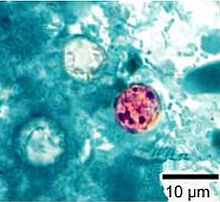
The parasite Cyclospora Cayetanensis is producing illness in people consuming infected produce. Because this pathogen is in very low concentrations on actual produce, which makes it close to impossible to detect, and for prevention reasons, it is more effective to check for its presence in irrigation water, from where it is typically transferred on produce. However, even in water, this parasite is very difficult to detect. It only can be detected by lengthy molecular laboratory procedures such as PCR. One major problem for scientists to develop better and faster detection methods is the fact that there is no antibody or other recognition molecule that would be able to bind to the surface of this intact parasite.

We propose to design and synthesize, for the first time, aptamers, molecules that will be able to bind to intact Cyclospora Cayetanensis oocysts, and use them to design simple paper based colorimetric tests that can detect it in the field without the need of sample preparation or specialized laboratories. The paper based test will turn from pink to purple to indicate the water sample being tested is positive for this parasite, making this a very simple and easy to use detection method for Cyclospora Cayetanensis.

CPS

AFECCT: Assessing filtration efficacy for Cyclospora control

The reputation of growers and the health of consumers suffer when people contract foodborne illness from fresh produce contaminated with Cyclospora cayetanensis. Because filtration has been established as effective in concentrating parasites for environmental surveillance, we propose to establish how effectively filters remove such parasites from irrigation water. To achieve this, we will first conduct a series of filtration experiments using abundant parasites (of chickens) that pose no risk to the study team. We’ll then assess how well these filters reduce water contamination with Cyclospora. We will also determine whether any parasites surviving filtration are harmed in the process. We hope these findings will directly benefit growers seeking tools to mitigate risk, and hasten future research progress by validating a needed surrogate system for studying other interventions against this dangerous and enigmatic human parasite.


India – Couple die of food poisoning in Cuddalore, three kids hospitalised

New Indian Express

CUDDALORE/VILLUPURAM: An elderly man and his wife died and three children, including their grandson, were hospitalised after suffering from food poisoning. According to police from Mangalampettai in Cuddalore district, on December 29, N Subramanian (60) and his wife S Kolanji (55) of Ilangiyanur village near Virudachalam and their grandson V Saravanakrishnan(6) slept after eating sambar rice. Later, Kolanji started vomiting and also suffered from diarrhea.

“The next morning she was admitted in the primary health centre at Kothakudi and shifted to Kallakurichi GH, from where she was sent to Salem GH. She was discharged on Tuesday based on a request from the family and she died on the same day. Meanwhile, Subramanian died at JIPMER on Wednesday,” said police source.

Their grandson and two other children are undergoing treatment in Tiruchy and Cuddalore.
According to the police, the couple had sambar rice on the fateful night and gave some to the neighbours.

USA – Wendy’s patrons may have been exposed to hepatitis A; still time for treatment for some

Food Safety News

The Arkansas Department of Health  is warning of possible hepatitis A exposures after an employee of Wendy’s at 721 North Arkansas, in Russellville tested positive for the virus.

Anyone who ate at the restaurant between Dec. 12, 2021, and Jan. 3, 2022, should seek care immediately if they have never been vaccinated against hepatitis A or are unsure of their vaccine status.

There are no specific treatments once a person contracts the liver virus. However, it can be prevented through vaccination. It can also be prevented from developing in people who have been exposed if a medicine called immune globulin is administered within two weeks of exposure. This medicine contains antibodies from other people who are immune to hepatitis A.

Research – Tracking down the origin of cholera pandemics

Science Direct

Food Illness

The bacterium Vibrio cholerae is the causative agent of the diarrheal disease cholera and is responsible for seven known pandemics. The seventh cholera pandemic began in 1961 and is still active. Unlike previous pandemics, it is caused by cholera strains of a slightly different type. How did the modified cholera strains develop and spread, and what might have contributed to their success? Scientists from the Max Planck Institute for Evolutionary Biology in Plön, Germany, and CAU Kiel, in an international team with colleagues from City College New York and the University of Texas Rio Grande Valley, have now gained new insights into a molecular mechanism that provides insight into the interactions between cholera bacteria and may have played a role in the emergence of the seventh pandemic.

In their natural environment, bacteria are subject to competition with other bacteria for space and nutrients. In this process, molecular mechanisms help them to hold their own. One such mechanism is the so-called “type 6 secretion system” (T6SS), with which a bacterium transports toxic proteins into a neighboring bacterium and thereby kills it. Thus, cholera bacteria of the seventh pandemic use their T6SS to keep other bacteria in check and presumably more easily cause infection.

Researchers now had the special opportunity to study the T6SS of cholera bacteria from previous pandemics. For this purpose, among other things, the T6SS genome sequence of cholera bacteria from the 2nd pandemic was reconstructed from a museum specimen from the 19th century in a complex procedure and recreated in the laboratory.

In the process, the scientists were able to show that 2nd and 6th pandemic cholera bacteria lack a functional T6SS. As a result, the bacteria of earlier pandemics not only lack the ability to attack other bacteria, they are themselves killed by bacterial strains of the seventh pandemic. This may have been one of the reasons that older cholera strains were displaced by modified cholera strains of the seventh pandemic and are now hard to find.

Data from new lab

Daniel Unterweger, one of the study’s authors and a group leader at the Max Planck Institute in Plön, Germany, says: “With these findings, we support the theory that microbial competition between bacteria is very important for understanding pathogens and bacterial pandemics. Our research on the cholera bacterium was made possible by an S2 laboratory newly established at the institute. Here, we can conduct experiments with bacterial pathogens under the necessary safety precautions. The study contains some of the first data from the new laboratory.”

Link to Article