Category Archives: Microbiology Investigations

Research – The Efficacy of Conventional Spray, Electrostatic Spray, and Dip with a Combination of Hydrogen Peroxide and Peroxyacetic Acid to Inactivate Listeria monocytogenes on Apples

Journal of Food Protection

This study aimed to evaluate the efficacy of a and hydrogen peroxide (H 2 O 2 ) and peroxyacetic-acid (PAA) mixer delivered by conventional garden sprayer (GS), electrostatic sprayer (ES) and dip methods to inactivate Listeria monocytogenes on apples. Organic Honey Crisp ( HC ), Fuji ( FJ ), and Pink Lady ( PL ) were dip-inoculated with Listeria monocytogenes (2-strain, serotype 1/2b), which were then kept untreated (control), sprayed with water only, or treated with the H 2 O 2 -PAA mixer (0.0064, 0.1, 0.25 and 0.50%) for 20 s via GS, ES, or dip, followed by draining (2 min) on aluminum foil. Surviving bacteria were recovered on Modified Oxford agar. Atomic force microcopy was used to detect the structural changes of inactivation of L. monocytogenes in broth medium by the H 2 O 2 -PAA mixer solution. Data (2 replicates/6 samples/replicate) were analyzed using the Mixed Model Procedure of SAS ( P =0.05). Initial counts of L. monocytogenes on untreated apples were 6.80 to 6.90 log CFU/apple. The dip method was the most effective treatment (P<0.05) on pathogen reductions (2.31-2.41 log CFU/apple) followed by GS (1.44-1.70 log CFU/apple) and then ES (0.84-1.20 log CFU/apples). Reductions of L. monocytogenes were greatest ( P < 0.05) when apples were treated with H 2 O 2 -PAA mixer -0.25 and -0.50%. Atomic force microscopy analyses indicated that inactivation of L. monocytogenes cells in H2O2-PAA mixer solutions resulted from disruption of the outer membrane. The H 2 O 2 -PAA mixer treated cells had increased width, height and decreased roughness when compared to the untreated cells. Results suggested that applying a H 2 O 2 -PAA mixer by dip or GS methods is better for pathogen reduction than ES on apples.
UK – FSA welcomes UK ban on all feeder rodent imports from Lithuania used as pet food -Salmonella

FSA

The Food Standards Agency (FSA) has welcomed the ban after a link was confirmed between a Salmonella outbreak in people and feeder rodents used for reptile food originating from a premises in Lithuania.

The ban, imposed until further notice by the Department for Environment, Food and Rural Affairs comes after a joint investigation by UKHSA, FSA, DEFRA and APHA into an outbreak of salmonella affecting over 900 people in the UK. The FSA and partners are continuing to urge people to be extra careful when handling any frozen rodents including mice product and packaging due to the risk of salmonella.

People should be extra vigilant, washing hands thoroughly with soap and water immediately after contact, when handling not just the product, but their reptiles and associated equipment and environment, due to the risk of the illness.

Further general advice on reducing the risk of contracting Salmonella (Opens in a new window) (Opens in a new window)is available online.

Tina Potter, Head of Incidents at the Food Standards Agency said:

“As we have continued to see a rise in the number of cases of Salmonella Enteritidis linked to feeder rodents imported from Lithuania over the past number of months, we welcome Defra’s move to ban these products from being imported and sold across the UK.

Even though this ban has been introduced to ensure public health is protected, we cannot emphasise enough the importance of good hygiene practice when handling raw or frozen pet food, as well as the reptile itself”

The feed should be suitably stored, ideally in a dedicated storage compartment or freezer, not in contact with human food and it should always be defrosted naturally at room temperature on newspaper or paper towels away from human food and food preparation surfaces. Any surfaces and equipment used should be thoroughly disinfected.

Handlers and pet owners must always wash their hands thoroughly with soap and warm water immediately after handling the frozen and defrosted feed and handling your reptile and their equipment.”

Advice to reptile owners about feeding their pets

Snake owners and others using frozen mice as food may have concerns about maintaining their animal’s welfare, as the import ban may cause short term shortages. There should be sufficient mice to maintain animal welfare for all snakes and other animals, including birds that need to be fed mice, if owners adapt their current feeding routines. Detailed advice for reptile owners (Opens in a new window) (Opens in a new window)will be published online.

Advice to parents and guardians of children handling reptiles

Children have been particularly affected so we are urging parents and guardians to make sure everyone washes their hands thoroughly with warm soapy water every time they handle and feed mice to their pets and handle their reptiles to reduce risk of becoming ill with Salmonella. Both the vivarium and the areas reptiles are able to roam could be contaminated with Salmonella. Good hygiene should be observed.

If you, or other family members become ill with symptoms such as diarrhoea, abdominal pain and fever, consult your doctor or NHS 111 and inform them that you own/keep a reptile. If you have symptoms, make sure you wash your hands regularly and avoid preparing food for others. Do not go to work or school until 48 hours after symptoms have passed to reduce the chances of passing on the infection.

Research – Aflatoxin Reduction and Retardation of Aflatoxin Production by Microorganisms in Doenjang during a One-Year Fermentation

MDPI

Meju, a raw material for doenjang preparation, is highly vulnerable to aflatoxin-producing fungi. The aim of this study was to evaluate the effect of a one-year fermentation on aflatoxins and aflatoxin-producing fungi in doenjang spiked with aflatoxins B1, G1, B2, and G2 and inoculated with toxigenic Aspergillus flavus. A significant reduction in aflatoxins was observed after a year of fermentation, measuring 92.58%, 100%, 98.69%, and 100% of B1, G1, B2, and G2, respectively. After a year of fermentation, 6.95 ± 3.64 µg/kg of total aflatoxin was detected, which represents a 97.88% reduction in the total aflatoxin compared with the initial value (328.83 ± 36.60 µg/kg). Several aflatoxin-degrading fungi (Aspergillus versicolorCladosporium subcinereumAspergillus ochraceus) and bacteria (Bacillus albusBacillus velezensis) isolated from doenjang were identified as the major contributors to the reduction of aflatoxin. Furthermore, it was observed that most of the aflatoxin contamination in doenjang occurred during the meju stage, and this stage was found to be most susceptible to A. flavus contamination and growth. These findings reveal that native microorganisms mediate aflatoxin clean-up in doenjang during fermentation and support the use of such microorganisms as a starter culture for the preparation of aflatoxin-free doenjang.

Research – Efficacy of Selected Powdered Floor Treatments Against Salmonella, E. coli, and L. monocytogenes on Polyurethane-Concrete Flooring Material Carriers

Journal of Food Protection

Food processing environment flooring can become contaminated with pathogens in many ways including foot and equipment traffic, incoming materials, and floor drain backups.  Natural antimicrobial turmeric and commercially available powdered floor treatments may reduce the levels of pathogens on flooring thereby reducing the risk of cross contamination from the floor to food contact surfaces. These chemicals were evaluated to determine their effectiveness against cocktails of Salmonella , Escherichia coli , and Listeria monocytogenes dried onto the surfaces of carriers made from polyurethane-concrete commercial flooring material.  Aqueous test solutions were prepared from the minimum treatment required per m 2 from the manufacturer’s instructions diluted in sterile water.  Potential synergy between turmeric and a percarbonate based commercial floor treatment was explored with a mixture of turmeric and sodium percarbonate, each at approximately 37g/m 2 application rate.  Each inoculated carrier was exposed to the treatment solutions or a sterile water control for 10 minutes at room temperature, neutralized with Hi-Cap neutralizing broth, the bacteria suspended, enumerated, and log 10 reductions calculated for each treatment and inoculum combination.  Mean log 10 CFU/carrier reductions with standard deviations ranged between 4.29±0.34 for the sodium percarbonate (SPC) based treatment and 0.004±0.23 for turmeric for Salmonella , 4.81±0.16 for SPC based treatment and -0.16±0.62 for turmeric for E. coli , and 4.88±0.6 for SPC based treatment and -0.16±0.15 for turmeric for L. monocytogenes .

Research – Strategies for Biocontrol of Listeria monocytogenes Using Lactic Acid Bacteria and Their Metabolites in Ready-To-Eat Meat- and Dairy-Ripened Products

MDPI

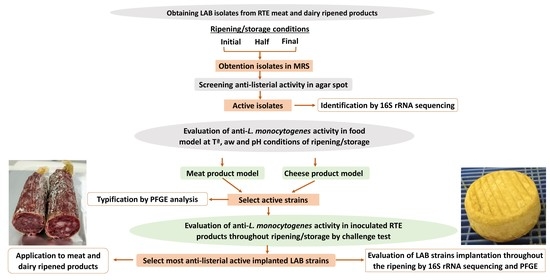
Listeria monocytogenes is one of the most important foodborne pathogens. This microorganism is a serious concern in the ready-to-eat (RTE) meat and dairy-ripened products industries. The use of lactic acid bacteria (LAB)-producing anti-L. monocytogenes peptides (bacteriocins) and/or lactic acid and/or other antimicrobial system could be a promising tool to control this pathogen in RTE meat and dairy products. This review provides an up to date about the strategies of use of LAB and their metabolites in RTE meat products and dairy foods by selecting the most appropriate strains, by analysing the mechanism by which they inhibit L. monocytogenes and methods of effective application of LAB, and their metabolites in these kinds of products to control this pathogen throughout the processing and storage. The selection of LAB with anti-L. monocytogenes activity allows to dispose of effective strains in meat and dairy-ripened products, achieving reductions form 2–5 logarithmic cycles of this pathogen throughout the ripening process. The combination of selected LAB strains with antimicrobial compounds, such as acid/sodium lactate and other strategies, as the active packaging could be the next future innovation for eliminating risk of L. monocytogenes in meat and dairy-ripened products.

Research – Aflatoxin B1 in rice: effects of storage duration, grain type and size, production site and season

Journal of Food Protection

Our study aimed to evaluate the AFB1 levels in packed rice marketed in Lebanon and determine the exposure to this toxin from the rice consumption. A total of 105 packed white, parboiled and brown rice bags were collected. ELISA was used to measure AFB1. A comprehensive FFQ was filled by 500 participants to determine the patterns of rice consumption and subsequently the exposure levels to AFB1 from the rice consumption in Lebanon. AFB1 was detected in all rice samples (100%). The average concentration ± standard deviation of AFB1 was 0.5±0.3μg/kg. Contamination ranged between 0.06 and 2.08μg/kg. Moisture content in all rice samples was below the recommended percentage (14%). Only 1% of the samples had an AFB1 level above the European Union (EU) limit (2μg/kg). Brown rice had a significantly higher AFB1 level than white and parboiled rice (p=0.02), while a significant difference was found between both collections for the same brands (p=0.016). Packing season, packing country, country of origin, presence of a food safety management certification, grain size, and time between packing and purchasing had no significant effect. Exposure to AFB1 from rice consumption in Lebanon was calculated as 0.1-2 ng/kg bodyweight/day.

USA – FDA Enforcement Report – MaryRuth’s Organic Infants Liquid Probiotic; Unflavored, a Dietary Supplement – Pseudomonas aeruginosa.

FDA

Product Description:  Updated

MaryRuth’s Organic Infants Liquid Probiotic; Unflavored, a Dietary Supplement.1 fl. oz. (30 mL)UPC: 8 56645 00858 7Serving size (five drops – start with one and work up to 5)Organic Proprietary Probiotic Blend 250 mg. Bifidobacterium lactis Bifidobacterium infantis Bifidobacterium bifidum Lactobacillus reuteri Other ingredients: A blend of probiotics in an enzyme enriched substrate, extracted with water from a proprietary blend of three organic grasses.

Reason for Recall: Internal testing found the presence of Pseudomonas aeruginosa in the product.

Product Quantity: Lot# 100420218 = 23,223 Lot# 100520218 = 2,450

Recall Number: F-0214-2022

Code Information: lots: 100420218, expiry 4/2023 and 100520218, expiry 5/2023

Classification: Class I

Event ID: 88956

Voluntary / Mandated:

Voluntary: Firm initiated

Product Type: Food

Recalling Firm:

MARY RUTH ORGANICS
1171 S Robertson Blvd #
Los Angeles, CA 90035-1403
United States

Recall Initiation Date: 10/28/2021

Center Classification Date: 11/19/2021

Date Terminated:2/18/2022

USA – Las Vegas – Health district: More than 30 report illness after eating at restaurant

Review Journal

More than 30 people have reported becoming ill after they consumed food and/or drink at a northwest Las Vegas restaurant, according to the Southern Nevada Health District.

Secret of Siam, 5705 Centennial Center, has been closed as the health district investigates.

“The Health District has received reports from more than 30 people whose symptoms included increased heart rate, blurry vision, hallucinations, disorientation or confusion, dizziness or vertigo, loss of consciousness, dry mouth, and numbness and tingling in extremities within hours of consuming food or drink from Secret of Siam,” a health district news release stated.

The incidents occurred in January and February.

Anyone who may have eaten food at the restaurant is asked to take a survey at www.snhd.info/siamsurvey.

UK – Dogs Choice UK recalls frozen raw dog foods because of the presence of Salmonella

FSA

Dogs Choice UK is recalling a number of frozen raw dog foods because Salmonella has been found in the products.

Product details

Frozen Chicken and Beef
Pack size 500g
Batch code 080222+2
Best before 08 August 2022
Frozen Chicken and Beef Ready Meal
Pack size 500g
Batch code 080222+2
Best before 08 August 2022
Frozen Chicken Liver
Pack size 500g
Batch code 080222+2
Best before 08 August 2022

Risk statement

The presence of Salmonella in the products listed above. Salmonella is a bacterium that can cause illness in humans and animals. The product could therefore carry a potential risk, because of the presence of Salmonella, either through direct handling of the pet food, or indirectly, for example from pet feeding bowls, utensils or contact with the faeces of animals. In humans, symptoms caused by Salmonella usually include fever, diarrhoea and abdominal cramps. Infected animals may not necessarily display signs of illness, but symptoms can include diarrhoea.

Action taken by the company

Dogs Choice UK is recalling the above products. Point of sale notices will be displayed in the retail stores that sold these products. The notices explain to customers why the products are being recalled and tell them what to do if they have bought the product.

Our advice to consumers

Research – Antibacterial Properties of TMA against Escherichia coli and Effect of Temperature and Storage Duration on TMA Content, Lysozyme Activity and Content in Eggs

MDPI

Studies on trimethylamine (TMA) in egg yolk have focused on how it impacts the flavor of eggs, but there has been little focus on its other functions. We designed an in vitro antibacterial test of TMA according to TMA concentrations that covered the TMA contents typically found in egg yolk. The change in TMA content in yolk was analyzed at different storage temperatures and for different storage durations. The known antibacterial components of eggs, including the cuticle quality of the eggshell and the lysozyme activity and content in egg white, were also assessed. The total bacterial count (TBC) of different parts of eggs were detected. The results showed that the inhibitory effect of TMA on Escherichia coli (E. coli) growth increased with increasing TMA concentration, and the yolk TMA content significantly increased with storage duration (< 0.05). The cuticle quality and lysozyme content and activity significantly decreased with storage time and increasing temperature, accompanied by a significant increase in the TBC on the eggshell surface and in the egg white (< 0.05). This work reveals a new role for trace TMA in yolks because it reduces the risk of bacterial colonization, especially when the antibacterial function of eggs is gradually weakened during storage.