Category Archives: Microbiological Risk Assessment

Hawaii – DEPARTMENT OF HEALTH WARNS PUBLIC NOT TO DRINK RAW MILK

HHG

DOH embargoes unpasteurized goat milk
from various pet store supply and food retailers

HONOLULU – Hawai‘i Department of Health Food Safety Branch inspectors are visiting pet supply stores and food retailers throughout the state and issuing cease and desist notices to those engaged in the illegal sale of unpasteurized goat milk.

An embargo on raw milk products, which are not safe for human consumption, is now in effect. Pet stores or any other retailer that has raw milk in their possession must remove the product from sale immediately and destroy or return the product to their supplier. Failure to do so may result in seizure and fines of up to $10,000 per day.

As of July 1, there were nearly 20 O‘ahu pet stores that were selling the unpasteurized goat milk product. The health department is continuing its inspections today.

Under Hawai‘i law, only Grade A pasteurized milk and milk products may be sold to the final consumer or to restaurants.

“The goat milk is being advertised as ‘pet food,’ but the sale of any form of raw fluid milk is a risk to public health because it is easily diverted for human consumption,” said Peter Oshiro, chief of the Food Safety Branch. “There are many in our community that mistakenly believe that drinking raw milk is healthy, but this is simply untrue.”

Drinking unpasteurized milk is unsafe because it may result in serious illnesses, hospitalizations and even death. Raw milk has the potential to carry and transmit dangerous pathogens including E. Coli, Salmonella, and a host of other bacteria that can cause disease. It is especially dangerous for our keiki, kupuna, or those with weakened immune systems to drink raw milk because they may not be able to fend off these pathogens as a normal healthy individual would.

Drinking raw milk is particularly dangerous because children infected through consumption of raw milk can spread disease through fecal-oral means and cause a serious disease outbreak among other children with whom they come into contact. Raw milk consumption by a few individuals has the potential to negatively impact our community at large by causing an outbreak of disease.

The Food Safety Branch protects and promotes the health of Hawai‘i residents and visitors through education of food industry workers and regulation of food establishments statewide. The branch conducts routine health inspections of food establishments where food products are prepared, manufactured, distributed, or sold. The branch also investigates the sources of foodborne illnesses and potential adulteration; and is charged with the prevention or mitigation of foodborne outbreaks. Health inspectors work with business owners, food service workers, and the food industry to ensure safe food preparation practices and sanitary conditions.

# # #
PDF: Department of Health warns public not to drink raw milk – unpasteurized goat milk product embargoed

Research – Genetic diversity and pathogenic potential of Shiga toxin-producing Escherichia coli (STEC) derived from German flour

Science Direct

Abstract

Shiga toxin-producing Escherichia coli (STEC) can cause severe human illness, which are frequently linked to the consumption of contaminated beef or dairy products. However, recent outbreaks associated with contaminated flour and undercooked dough in the United States and Canada, highlight the potential of plant based food as transmission routes for STEC. In Germany STEC has been isolated from flour, but no cases of illness have been linked to flour.

In this study, we characterized 123 STEC strains isolated from flour and flour products collected between 2015 and 2019 across Germany. In addition to determination of serotype and Shiga toxin subtype, whole genome sequencing (WGS) was used for isolates collected in 2018 to determine phylogenetic relationships, sequence type (ST), and virulence-associated genes (VAGs).

We found a high diversity of serotypes including those frequently associated with human illness and outbreaks, such as O157:H7 (stx2c/d, eae), O145:H28 (stx2a, eae), O146:H28 (stx2b), and O103:H2 (stx1a, eae). Serotypes O187:H28 (ST200, stx2g) and O154:H31 (ST1892, stx1d) were most prevalent, but are rarely linked to human cases. However, WGS analysis revealed that these strains, as well as, O156:H25 (ST300, stx1a) harbour high numbers of VAGs, including eae, nleB and est1a/sta1.

Although STEC-contaminated flour products have yet not been epidemiologically linked to human clinical cases in Germany, this study revealed that flour can serve as a vector for STEC strains with a high pathogenic potential. Further investigation is needed to determine the sources of STEC contamination in flour and flour products particularly in regards to these rare serotypes.

Research – Behavior of Listeria monocytogenes and Other Microorganisms in Sliced Riojano Chorizo (Spanish Dry-Cured Sausage) during Storage under Modified Atmospheres

MDPI

Sliced ready-to-eat meat products packaged under modified atmospheres are often marketed since they cover consumer demands. The slicing process could be a potential risk for consumers since contamination with Listeria monocytogenes could occur during this stage. The current study evaluated the behavior of L. monocytogenes and other microorganisms in commercial sliced Riojano chorizo. This meat product was sliced and inoculated with L. monocytogenes (3.5 log CFU/g) before packaging under different atmospheres (air, vacuum, 100% N2, 20% CO2/80% N2 and 40% CO2/60% N2) and stored at 4 °C for up to 60 days. Samples were taken on days 0, 7, 21, 28 and 60 of storage. L. monocytogenes, mesophiles, Enterobacteriaceae, lactic acid bacteria, Micrococcaceae, molds and yeast counts were evaluated. Additionally, water activity, humidity and pH were determined. L. monocytogenes counts decreased in inoculated sliced chorizo during storage. Packaging conditions and day of storage influenced microbial counts. After 60 days, a significant reduction (p ≤ 0.05) in the initial Listeria contamination levels (3.5. log CFU/g) between 1.1 and 1.46 logarithmic units was achieved in the sausages packaged in modified atmosphere. The highest reductions were observed in slices packaged in 40% CO2/60% N2 after 60 days of storage at 4 °C. View Full-Text

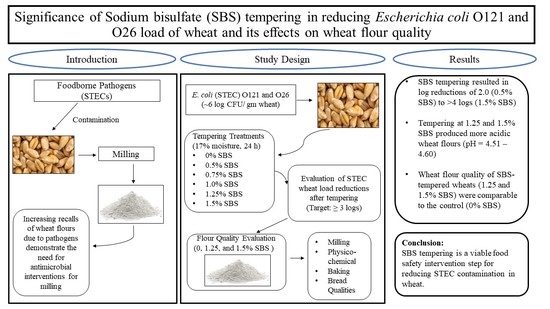
Research – Significance of Sodium Bisulfate (SBS) Tempering in Reducing the Escherichia coli O121 and O26 Load of Wheat and Its Effects on Wheat Flour Quality

MDPI

The occurrence of recalls involving pathogenic Escherichia coli-contaminated wheat flours show the need for incorporating antimicrobial interventions in wheat milling. The objectives of this study were to assess the efficacy of sodium bisulfate (SBS) tempering in reducing E. coli O121 (ATCC 2219) and O26 (ATCC 2196) wheat load and to evaluate the impact of effective (≥3.0 log reductions) SBS treatments on wheat flour quality. Wheat grains were inoculated with E. coli (~6 log CFU/g) and tempered (17% moisture, 24 h) using the following SBS concentrations (%wheat basis): 0, 0.5, 0.75, 1.0, 1.25, and 1.5% SBS. Reductions in E. coli O121 and O26 wheat load at different time intervals (0.5, 2, 6, 12, 18, and 24 h) during tempering were evaluated. The addition of SBS during tempering resulted in E. coli (O121 and O26) log reductions of 2.0 (0.5% SBS) to >4.0 logs (1.5% SBS) (p ≤ 0.05). SBS tempering (1.25 and 1.5% SBS) produced acidic wheat flours (pH = 4.51–4.60) but had comparable wheat flour properties in terms of composition, dough, and bread-making properties relative to the control (0% SBS). SBS tempering reduced the E. coli O121 and O26 load of wheat after tempering with minimal effects on wheat flour quality. View Full-Text

Vietnam Research – Microbiological safety of ready-to-eat foods in hospital and university canteens in Hanoi, Vietnam

Journal of Food Protection

The aim of this study is to analyze and document the microbiological safety and quality of ready-to-eat foods in hospital and university canteens in Hanoi, Vietnam. A total of 420 ready-to-eat food products from 21 canteens were sampled in July 2018 and May 2019. The ratio of samples exceeding the unsatisfactory level for Total Plate Count (TPC) was 31%. Escherichia coli, Listeria and Staphylococcus aureus were detected in 35 (8.3%), 99 (24%), 46 (11%) samples, with 3%, 10% and 0% exceeding the unsatisfactory level, respectively. The Total Plate Count (TPC), Listeria, Bacillus cereus, E. coli, S. aureus ranged from below detection limit to 5×10 9 , 4.6×10 5 , 6.2×10 3 , 3.4×10 3 , 7.6×10 3 CFU/g, respectively. Listeria monocytogenes was isolated from 3/420 samples (0.7%). In addition, there were 21 out of 410 samples (5%) contaminated with Salmonella. Overall, our data indicate frequent problems with the microbiological quality and safety of these canteen foods in Hanoi, and provide a baseline measurement that will allow environmental health officers and food microbiologists to develop targeted intervention strategies to reduce the economical and public health risk associated with these foods.

Hong Kong – High-risk Foods

CFS

Banner

What comes to your mind when you hear the term ‘high-risk foods’? Sushi? Sashimi? Or raw oysters? Raw or undercooked food are generally high-risk foods. You may not notice that some common dishes may contain raw or undercooked ingredients, such as mango pudding made with raw eggs, smoked salmon sandwiches, and congee made with undercooked beef. The CFS would like to share with the public, especially susceptible populations, on how to be vigilant about high-risk foods in their daily diet. At the same time, the CFS would also like to urge the food trade on what efforts can be made for empowering consumers to make informed choices about high-risk foods.

Research – Low-Temperature Virus vB_EcoM_VR26 Shows Potential in Biocontrol of STEC O26:H11

MDPI

Shiga toxin-producing Escherichia coli (STEC) O26:H11 is an emerging foodborne pathogen of growing concern. Since current strategies to control microbial contamination in foodstuffs do not guarantee the elimination of O26:H11, novel approaches are needed. Bacteriophages present an alternative to traditional biocontrol methods used in the food industry. Here, a previously isolated bacteriophage vB_EcoM_VR26 (VR26), adapted to grow at common refrigeration temperatures (4 and 8 °C), has been evaluated for its potential as a biocontrol agent against O26:H11. After 2 h of treatment in broth, VR26 reduced O26:H11 numbers (p < 0.01) by > 2 log10 at 22 °C, and ~3 log10 at 4 °C. No bacterial regrowth was observed after 24 h of treatment at both temperatures. When VR26 was introduced to O26:H11-inoculated lettuce, ~2.0 log10 CFU/piece reduction was observed at 4, 8, and 22 °C. No survivors were detected after 4 and 6 h at 8 and 4 °C, respectively. Although at 22 °C, bacterial regrowth was observed after 6 h of treatment, O26:H11 counts on non-treated samples were >2 log10 CFU/piece higher than on phage-treated ones (p < 0.02). This, and the ability of VR26 to survive over a pH range of 3–11, indicates that VR26 could be used to control STEC O26:H11 in the food industry. View Full-Text

Research – A Microbiological Survey of Minced Beef at Retail in Scotland

FSS

Click to access FSS_Report_Retail_Mince_FINAL.pdf

Research – Seventh external quality assessment scheme for Listeria monocytogenes typing

ECDC

Human listeriosis is a relatively rare but serious foodborne disease with an EU notification rate of 0.47 cases per 100 000 population in 2018 [3]. The number of human listeriosis cases in the EU increased between 2008 and 2016. In 2017-2018, the level of reported cases was stable.

Since 2007, ECDC has been responsible for the EU-wide surveillance of listeriosis, including facilitating detection, and investigation of foodborne outbreaks. Surveillance data, including basic typing parameters for the isolated pathogen, are reported by European Union/European Economic Area (EU/EEA) countries to The European Surveillance System (TESSy), including molecular typing data. This molecular surveillance system relies on the capacity of laboratories to provide comparable data to FWD-Net. In order to ensure the EQA is linked to the development of surveillance methods used by NPHRLs in the EU/EEA, EQAs 5 to 7 featured a molecular typing-based cluster analysis using either pulsed-field gel electrophoresis (PFGE) and/or whole-genome sequencing (WGS)-derived data.

The objectives of the EQA are to assess the quality and comparability of typing data reported by NPHRLs participating in FWD-Net. Test isolates for the EQA were selected to cover isolates currently relevant for public health in the EU and represent a broad range of clinically relevant types for invasive listeriosis. Two sets of 11 test isolates were selected for serotyping and molecular typing-based cluster analysis. Eighteen laboratories signed up and 17 completed the exercise, representing a decrease in participation from 20 laboratories (15%) for EQA-5, but the same level of participation as for EQA-6. The majority of participants (12/17; 71%) completed the full EQA scheme.

In total, 14 (82%) participants participated in the serotyping part. Molecular serogrouping results were provided by 13 of 15 (93%) participants. Three participants performed both conventional serotyping and molecular serogrouping. The performance of molecular serogrouping was highest, with 100% correct results. For the conventional method, 75% of the participants correctly serotyped all test isolates. One new participant mistyped five of the 11 isolates. Since the first EQA in 2012, a trend towards substituting conventional serotyping with molecular serogrouping has been observed.

Of the 17 laboratories participating in EQA-7, 15 (88%) performed molecular typing-based cluster analysis using a method of their choice. The purpose of the cluster analysis part of the EQA was to assess the NPHRL’s ability to identify a cluster of genetically closely related isolates, i.e. to correctly categorise the cluster test isolates regardless of the method used, not to follow a specific procedure.

The cluster of closely related isolates was pre-defined by the EQA provider using WGS-derived data. Therefore, as expected, the correct cluster delineation was difficult to obtain by the use of less discriminatory methods, e.g. PFGE. None of the three participants using PFGE did identify the correct cluster. Thirteen laboratories performed cluster analysis using WGS-derived data. Performance was high, with 100% of the participants correctly identifying the cluster of closely related isolates. An allele-based method was preferred since 84% (11/13) used core genome multilocus sequence type (cgMLST), compared with 16% (2/13) using single nucleotide polymorphism (SNP).

In EQA-7, the EQA provider introduced an additional part to the molecular typing-based cluster analysis: an assessment of four EQA provided genomes. This was designed to mimic an urgent outbreak situation, where sequence data may have been produced in other laboratories and the available sequences must be addressed despite, for example, possible poor quality. The majority of participants successfully identified the different characteristics in the modified genomes, and also correctly concluded one cluster isolate as being part of the cluster defined in the cluster analyses part of the EQA and one non-cluster genome as not being part of the cluster of closely related isolates.

In EQAs 5-7, participants were free to choose their preferred analytical method for the WGS-based cluster identification. The conclusion from EQA-5 was that cgMLST has higher consistency compared to SNP analysis. The conclusion was not as obvious in either EQA-6 or EQA-7, since only a few SNP analyses were reported in these schemes compared with six SNP analyses in EQA-5. One participant changed from SNP analysis to cgMLST and
identified the cluster correctly, unlike in EQA-6.

Research – Feedborne Salmonella enterica Serovar Jerusalem Outbreak in Different Organic Poultry Flocks in Switzerland and Italy Linked to Soya Expeller

MDPI

Poultry feed is a leading source of Salmonella infection in poultry. In Switzerland, heat-treated feed is used to reduce Salmonella incursions into flocks in conventional poultry production. By contrast, organic feed is only treated with organic acids. In 2019, the Swiss National Reference Center for Enteropathogenic Bacteria identified the rare serovar S. Jerusalem from samples of organic soya feed. Further, in July 2020, the European Union’s Rapid Alert System for Food and Feed published a notification of the detection of S. Jerusalem in soya expeller from Italy. During 2020, seven S. Jerusalem isolates from seven different poultry productions distributed over six cantons in Switzerland were reported, providing further evidence of a possible outbreak. Using whole-genome sequencing (WGS), S. Jerusalem isolates from feed and from animals in Switzerland were further characterized and compared to S. Jerusalem from organic poultry farm environments in Italy. WGS results showed that feed isolates and isolates from Swiss and Italian poultry flocks belonged to the sequence type (ST)1028, grouped in a very tight cluster, and were closely related. This outbreak highlights the risk of spreading Salmonella by feed and emphasizes the need for a heat-treatment process for feed, also in organic poultry production.