Category Archives: Histamine

Ireland – Recall of a Further Batch of The Little Milk Co. Organic Irish Cheddar and Organic Sheebeg Raw Milk Cheese due to Elevated Levels of Histamine

FSAI

FOP Little Milk Co.

FOP Sheebeg cheese

Summary
Category 2: For Information
Alert Notification: 2021.110 (Update 2)
Product: The Little Milk Co. Organic Irish Cheddar; Organic Sheebeg Raw Milk Cheese; pack size: 135g; approval number: IE 1987 EC
Batch Code: K103; best before date: 01.03.22
Country Of Origin: Ireland

Message:

Further to FSAI Food Alerts 2021.110 and 2021.110 (update 1), the above additional batch of The Little Milk Co. Organic Irish Cheddar and Organic Sheebeg Raw Milk Cheese is being recalled due to elevated levels of histamine. In some people, elevated levels of histamine can cause symptoms which are similar to those of an allergic reaction. Point-of-sale recall notices will be displayed in stores supplied with the affected products.

Ireland – Recall of an Additional Batch of The Little Milk Co. Organic Irish Cheddar and a Batch of Organic Sheebeg Raw Milk Cheese due to Elevated Levels of Histamine

FSAI

Little milk co. recall.

Sheebeg cheese recall

Summary
Category 2: For Information
Alert Notification: 2021.110 (Update 1)
Product: The Little Milk Co. Organic Irish Cheddar; Organic Sheebeg Raw Milk Cheese; pack size: 135 g; approval number: IE 1987 EC
Batch Code: K93; best before date: 06.04.22
Country Of Origin: Ireland

Message:

Further to the FSAI Food Alert 2021.110, the above additional batch of The Little Milk Co. Organic Irish Cheddar and the above batch of Organic Sheebeg Raw Milk Cheese are being recalled due to elevated levels of histamine. In some people, elevated levels of histamine can cause symptoms which are similar to those of an allergic reaction. Point-of-sale recall notices will be displayed in stores supplied with the implicated products.

RASFF Alert – Histamine – Chilled Mackerel

RASFF

Histamine (980 mg/kg – ppm) in chilled mackerel from the Netherlands in Belgium

USA – DRAFT: Scombrotoxin (Histamine)-forming Fish and Fishery Products – Decomposition and Histamine (CPG 7108.24)

FDA

Submit Comments by 

Although you can comment on any guidance at any time (see 21 CFR 10.115(g)(5)), to ensure that the FDA considers your comment on a draft guidance before it begins work on the final version of the guidance, submit either online or written comments on the draft guidance before the close date.

If unable to submit comments online, please mail written comments to:

Dockets Management
Food and Drug Administration
5630 Fishers Lane, Rm 1061
Rockville, MD 20852

All written comments should be identified with this document’s docket number: FDA-2021-D-0367


Docket Number:
FDA-2021-D-0367
Issued by:
Office of Regulatory Affairs
Center for Food Safety and Applied Nutrition

The purpose of this compliance policy guide (CPG) is to provide guidance for FDA staff on adulteration associated with decomposition and/or histamine identified during surveillance sampling and testing of fish and fishery products susceptible to histamine formation.

The current CPG Sec. 540.525 is being revised to update FDA regulatory action guidance for sensory analysis and histamine levels in scombrotoxin-forming fish and fishery products.

The  contents of this document do not have the force and effect of law and are not meant to bind the public in any way, unless specifically incorporated into a contract.  This document is intended only to provide clarity to the public regarding existing requirements under the law.  FDA guidance documents, including this CPG, should be viewed only as recommendations, unless specific regulatory or statutory requirements are cited.  The use of the word should in FDA guidances means that something is suggested or recommended, but not required.

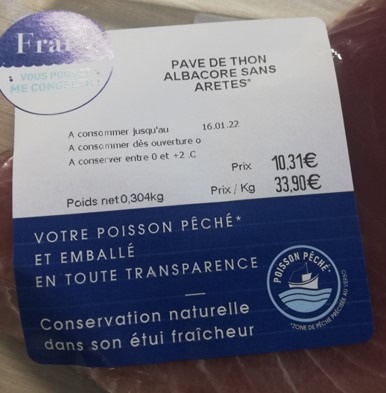
France – Fresh yellowfin tuna steak 250g – Histamine

Gov france

Identifying information for the recalled product

  • Product category Food
  • Product sub-category Fishery and aquaculture products
  • Product brand name Costs
  • Names of models or references Boneless yellowfin tuna steak
  • Product identification
    GTIN Lot Dated
    28696020 1162553 Use-by date 12/01/2022
    28696020 1162554 Use-by date 01/13/2022
    28696020 1162687 Use-by date 01/15/2022
    28696020 1162689 Use-by date 01/15/2022
    28696020 1162556 Use-by date 01/13/2022
    28696020 1162790 Use-by date 01/16/2022
  • Packaging Skin pack 250g vacuum tray
  • Start date / End of marketing From 01/08/2022 to 01/16/2022
  • Storage temperature Product to be stored in the refrigerator
  • Health mark FR 34.336.503 CE
  • Further information DLC on front label – Lot number and DLC on rear label
  • Geographical sales area Whole France
  • Distributors GRAND FRAIS MAREE – WORLD MARECHAL – GRAND FRAIS & FRESH STORES

Practical information regarding the recall

  • Reason for recall Suspected Histamine presence
  • Risks incurred by the consumer Endogenous toxins: histamine (fish, cheese, alcoholic drinks, cold meats)

Sweden – Report on food poisoning in Sweden during 2020. 

Livsmedelsverket

The report describes how many people become ill from the food, which are the most common infectious agents and foods that cause the disease cases, where in the food chain the designated foods are contaminated, which countries of origin were indicated for the designated foods, what contributing factors were identified, seasonal variation and changes in recent years. The results from the report provide information to those who have an interest or need for this type of knowledge in their profession and not least to show and give feedback on the valuable work performed by those who investigate, report and otherwise study food poisoning.

Summary Reported Foodborne Illness in Sweden 2020
This Report compiles food poisonings reported to the Swedish Food Agency in 2020. A new online form for submitting reports to the Swedish Food Agency was launched in January 2020, aiming to raise the quality of reported data. In 2020, the Covid-19 pandemic was ongoing also, which affected the number of food poisoning outbreaks during the year.
By food poisoning is meant here an illness caused by eating food containing harmful bacteria, parasites, viruses or toxins. The main purpose of the compilation is to support food poisoning investigations in several ways:
by giving the present position of the most recent food poisonings;
by presenting data that can be used to connect different pathogens to different kinds of foods.by making it possible to follow the development of different combinations;
by making it possible to implement risk management measures as effectively as possible.
The Swedish Food Agency regulation LIVSFS 2005:7 instructs municipal control authorities, in co-operation with health professionals, the County Administrative Board and the Public Health Agency of Sweden, to conduct epidemiological investigations of foodborne outbreaks.
The results must be reported to the Swedish Food Agency without delay. Health Agency and Swedish Food Agency in consultation supplement the control authorities’ reports with reports on local and national outbreaks.
The Report is based on 173 reported events of suspected or confirmed food poisoning with a total of 1,314 cases of illness. In 160 of the reports it was stated that two or more persons were infected from the same source. When compared to the 2019 compilation, we can note that both the number of reports and cases of illness were almost halved in 2020.
This reduction may be due to the restrictions and recommendations introduced in connection to Covid-19 pandemic. For example, there were fewer people using restaurant services, better hand hygiene among people handling food and the cancellation of major public events where food may have been served.
Most reports indicated that the cause was unknown (71%), however for 44% of the reported cases virus was cited as the cause. This is due to 23 outbreaks with 571 cases of illness where the cause was virus. Norovirus continues to cause major outbreaks (22 food poisoning outbreaks with a total of 513 cases), followed by campylobacter which was reported in 4 outbreaks with 158 cases, Vibrio parahaemolyticus, an unusual foodborne pathogen in Sweden, was associated with one outbreak of 50 cases of illness.
The food categories that had the most reported cases of illness were bakery products (210 cases), chicken (155 cases) and foods from the sea (164 cases).Bakery products were a source of infection in outbreaks where norovirus and STEC (Shigatoxin-producing E. coli) were the cause -200 cases and 10 cases, respectively.

Chicken was a source of infection in outbreaks where Campylobacter was the cause -155 cases.
When the source of infection was food from the sea, norovirus in oysters was the cause most cases of illness (124 cases), followed by Vibrio parahaemolyticus in seagrass (50 cases) and histamine in fish (34 cases).
The number of food poisoning reports was highest during the first quarter: between January to March there were 63 reports in, with a total of 634 cases of illness. This is due to both a number of oyster-related outbreaks early in the year and fewer outbreaks occurred during the rest of the year due to restrictions and hygiene recommendations during the covid-19 pandemic. For almost 65% of the disease cases, the source of contamination was food contaminated early in the production chain, e.g. industrial facilities, from which the food was then widely distributed (industry 30 %, primary production 3% and other 31.5%). In order to reduce the number of food poisonings, it is therefore important to have good systems for food safety in primary production and such facilities.
The most commonly mentioned contributing factor was incorrect storage with respect to time and temperature. This factor was listed in 21 reports. For example, this may refer to inappropriate temperature when keeping food heated, or not low enough temperature in cold storage. The second most common factor was “a contaminated ingredient”, as stated in 11 reports.
There is often no information about the country of origin of the implicated food products. This may be due to the fact that this information is optional in the reporting form. It can be also difficult to know in which country viruses or bacteria contaminated a food product.
The reporting authority usually does not have access to information about whether patients have received hospital care. However in 5 reports, it was stated that a total of 7 people received hospital care. No deaths were reported.

Click to access l-2021-nr-23-rapporterade-misstankta-matforgiftningar-2020.pdf

RASFF Alert – Histamine – Anchovies

RASFF

Histamine (469 mg/kg – ppm) in anchovies from Tunisia in Italy

USA – Relish Foods, Inc Recalls Frozen Tuna Steaks Because of Possible Health Risk – Histamine

FDA

Photo 1 – Labeling, 10 oz Tuna Steak Portions

Summary

Company Announcement Date:
FDA Publish Date:
Product Type:
Food & Beverages
Reason for Announcement:
Elevated levels of histamine
Company Name:
Relish Foods, Inc.
Brand Name:
Frozen Pacific Fusion Brand
Product Description:
Tuna steaks

Company Announcement

On December 27, 2021, Relish Foods, Inc of El Segundo, California voluntarily initiated the recall of Frozen Pacific Fusion Brand 10 oz Tuna Steaks. The recall was the result of a consumer complaint whereafter sampling by FDA revealed that the product has potential to contain elevated levels of histamines which can produce an allergic reaction called scombroid fish poisoning. Symptoms, including a tingling or burning sensation in the mouth, facial swelling, rash, hives and itchy skin, nausea, vomiting or diarrhea, can appear within minutes to several hours after eating the affected fish. If symptoms are severe, an individual should seek immediate medical attention for treatment. Relish Foods Inc is continuing the investigation with FDA as to what caused the problem.

Product was distributed in Northern California and made for sale at Save Mart Supermarkets and Lucky Stores from October 6th, 2021 potentially up to December 27th, 2021. Product was sold to consumers as frozen 10 oz tuna steaks. 10 oz tuna steaks sold individually would have been labeled with the following dates and production code: Production Date : July 2021 Best Before : July 2023 R11G2821D22A D2091A. This information can readily be found on the packaging of the individual tuna steaks in the top right corner:

Products not bearing these codes are not affected by or involved in this recall.

Consumers concerned about whether the tuna steaks they purchased may be part of the recalled product should check with the store from which they purchased the tuna. Currently Relish Foods does not believe that any affected product is still available for purchase by consumers. Apart from initial complaint, Relish Foods has not received any other complaints to date.

Consumers with questions may contact the company at 1-888-301-0881, Mondays through Fridays, 8 A.M. to 5 P.M. (PDT).


Company Contact Information

Consumers:
Relish Foods, Inc.
 1-888-301-0881

RASFF Alerts – Histamine – Raw Milk Cheddar – Yellow Stripe Trevally – Frozen Mackerel

RASFF

Histamine in frozen mackerel (Scomber japonicus) from China in Poland

RASFF

Histamine in dried, frozen yellowstripe trevally (Selaroides leptolepis) from Thailand in Germany

RASFF

Histamine in organic raw milk cheddar cheese from Ireland in the UK

Ireland – Recall of a Batch of The Little Milk Co. Organic Irish Cheddar due to Elevated Levels of Histamine

FSAI

Little Milk Co 1

Little Milk Co 2

Summary
Category 2: For Information
Alert Notification: 2021.110
Product: The Little Milk Co. Organic Irish Cheddar; pack size: 135g; approval number: 1987 EC
Batch Code: K98; best before date: 18.05.22
Country Of Origin: Ireland

Message:

The Little Milk Co. is recalling the above batch of its Organic Irish Cheddar due to elevated levels of histamine. In some people, elevated levels of histamine can cause symptoms which are similar to those of an allergic reaction. Point-of-sale recall notices will be displayed in stores supplied with the implicated batch.