Category Archives: Fusarium Toxin

India – FSSAI issues new manual for analysing aflatoxin in food

FNB News

The apex food regulator, FSSAI, has issued a revised manual for methods of analysis of mycotoxins including aflatoxin in food. FSSAI has stated that the manual shall be used by the laboratories with immediate effect and this manual shall supersede the earlier manual on mycotoxins.

According to the FSSAI all food samples suspected of being contaminated with mycotoxins must be handled with extreme care, as aflatoxins are potent carcinogenic substances.

The manual talks about personal safety precautions, precautions during analysis  and handling of glassware for aflatoxin analysis.

Currently, the regulatory limits for mycotoxins in food as defined by the FSSAI include 15 microgram per kg in cereals, and cereal products, pulses, nuts and nuts for further processing. For Aflatoxins  the limit is prescribed at 10 microgram  per kg for ready to eat products, and dried figs, while 30 microgram per kg for spices and for oilseeds for further processing, the limit is set at 15 microgram per kg.

Similarly, the limit of Aflatoxin M1 in milk is 0.5 microgram per kg, Ochratoxin A in wheat, barley and rye is at 20 microgram per kg, and for Patulin, the limit is 50mcrogram per kg in apple juice and apple juice ingredients in other beverages.

Further, the limit for Deoxynivalenol  in wheat is fixed at 1000ppm.

Mycotoxins—toxic secondary metabolites of filamentous fungi—are biological in origin. Only a few of the thousands of mycotoxins present significant food safety challenges to the farm-to-fork food continuum. The natural fungal flora associated with food safety is dominated by three genres: Aspergillus, Fusarium, and Penicillium.

Aflatoxins are highly toxic secondary metabolites and aflatoxin-producing fungi can contaminate crops in the field, at harvest, and during storage. Some of the more common crops susceptible to contamination with aflatoxins are cereals (e.g. maize, rice and wheat). The husk of these cereals are often used as animal feed.

Deoxynivalenol (DON) Deoxynivalenol (DON) also known as vomitoxin is a trichothecene mycotoxin mainly produced by Fusarium fungi (Fusarium molds). This plant pathogens can cause scab mainly in wheat and barley etc., and damages cereals the most widely by contamination in the field. The main commodities affected are cereals such as wheat, rice, barley, oats and maize etc.

Patulin is a mycotoxin that is produced by certain species of Penicillium, Apergillus, and Byssochylamys molds that may grow on a variety of foods including fruit, grains, and cheese  while Ochratoxin A (OTA) is a naturally occurring foodborne mycotoxin found in a wide variety of agricultural commodities worldwide, ranging from cereal grains to dried fruits to wine and coffee.


RASFF Alert – Mycotoxin -Fumonsins – Organic Corn Waffles

European Food Alerts

RASFF

fumonisins (sum B1+B2: 890; 1130 µg/kg – ppb) in organic corn waffles from Slovakia in Germany

Research – Mycotoxins and food security

EU

eu

Research – Mycotoxins in Beverages

MDPI

Mycotoxins are secondary metabolites produced by fungi that contaminate raw materials such as cereals, fruits, dried fruits, coffee, and grapes when they have been produced or maintained in a temperature and/or humidity conditions that favour fungi growth. In general, mycotoxins are very resistant to temperature and remain stable during food preparation and processing [1].Therefore, food prepared from contaminated raw materials can retain the levels of these compounds.Several beverages are produced based on raw materials prone to be contaminated, such as beer from cereals, wine from grapes, coffee, and more. Moreover, and due to the fact that one fungal speciescan produce various of these metabolites [2], the most likely scenario is the co-occurrence of several mycotoxins in one food product.

Mycotoxins have different toxic effects on human health. They can be divided into acute effects,due to the ingestion of high levels of toxins in a short time period, and into chronic effects, due to the ingestion of low quantities for a long time. These chronic effects are the most common ones and they have been described as hepatotoxicity, immune diseases, carcinogenicity, genotoxicity, endocrine andreproductive effects, mutagenicity, teratogenicity, nausea, vomiting and diarrhea, among others [2].All the above make the presence of these compounds in human foods a global problem regarding food safety and also regarding economics, due to the loss of lots of contaminated raw materials or food products and its impact on global trade [3].In order to protect human health, legislative organisms promote the monitorization of these toxins in raw materials and foods, along with the regulation of maximum levels that can be present in some food products.

This Special Issue “Mycotoxins in Beverages” comprises three research articles and three reviews related to the presence of these toxins in beverages and covers different aspects. The research articles are devoted to the presence of mycotoxins in beer and milk. The reviews collect, on the one hand,information regarding mycotoxin presence in wine and in beverages obtained from tropical crops, and,on the other, new approaches for detecting ochratoxin A and other compounds in beverages.

Research – 5 warning signs of mycotoxin contamination in feed

Farmers Weekly

kswfoodworld

Image CDC

Farmers are being warned to keep their eyes peeled for signs of contamination in feed after sampling has shown high mycotoxin risk levels.

UK-wide sampling carried out by Alltech has shown that 46% of total mixed rations (TMR) produced in spring-summer have a moderate to high mycotoxin risk.

“The most common types of mycotoxin found were the Type A Trichothecenes and the Penicilliums,” explains Bob Kendal, North England ruminant manager at Alltech.

“Penicilliums are found in silages and are of particular concern for ruminants. The mould starts life white in colour before developing a blue/grey/green colour and, as the name suggests, can have an antibiotic effect on rumen bacteria.

“This manifests itself as acidosis-like symptoms, dung consistency and sudden drops in milk.

“Type A Trichothecenes includes T-2 toxin which can have a serious effect on the gut of the cow and reduce intakes and performance.”

Research – Climate Change and Food Poisoning

The Counter

Fungal toxins known as mycotoxins, including some thought lost to history, are claiming new territory as the Earth warms.

Hong Kong – Mycotoxins in Spices

CFS

Food Safety Focus (155th Issue, June 2019) – Food Safety Platform

Mycotoxins in Spices

Reported by Ms. Janny MA, Scientific Officer
Risk Assessment Section, Centre for Food Safety

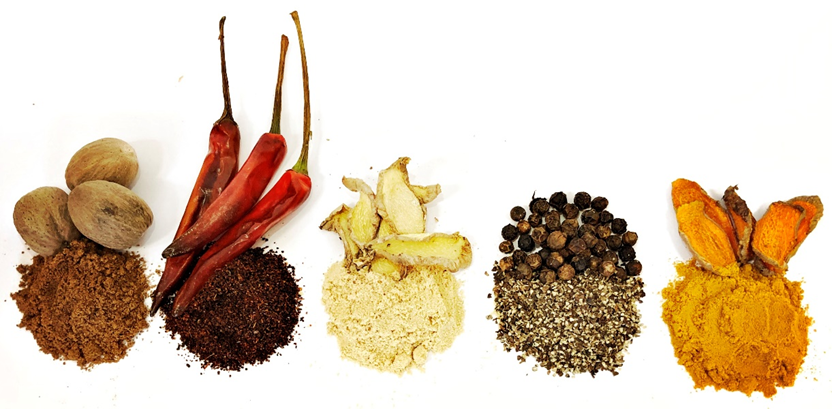
In the last two issues, we touched on several mycotoxins in food that present a health concern in humans, including aflatoxins in tree nuts and oil seeds, deoxynivalenol in cereals as well as patulin in apple juices.  This time, we will focus on the contamination of mycotoxins in some other food ingredients that are often used in small quantities but can enhance flavours of our food – spices.

Research – Animal Health – Mycotoxin – Beauvericin a Fusarium Mycotoxin

All About Feed

Beauvericin is a Fusarium mycotoxin known for its antiviral, antibacterial, anti-inflammatory, and anticancer properties, but it also causes oxidative stress and cell death.

Although these biological activities are mainly interesting for drug development, chronic animal exposure to such a chemical via feed will certainly influence performance and health status. Even though this mycotoxin is still ‘emerging’, its presence in feed materials has been known for many years.

Beauvericin (BEA) is commonly found as a co-contaminant in grains where other Fusarium mycotoxins such as Deoxynivalenol (DON) and Zearalenone (ZEA) are present. From the feedstuffs we evaluate at Schothorst Feed Research (SFR), BEA is often detected in corn and soy hulls at levels varying from 10 to 500 µg/kg. However, much higher contamination levels have been reported by others. As was published by All About Feed in 2010, a study performed in South Korea showed that 27% of feed ingredients were then contaminated with BEA at levels up to 1.8 mg/kg (almost 4 times higher than our findings). These levels can be extremely high, reaching circa 500 mg/kg in corn as was reported by Logrieco and others in the 1990s. Although these are extreme levels and they only occur occasionally, the constant presence of this mycotoxin is feedstuffs should be of concern to nutritionists and veterinarians.

Research – Mycotoxins: A Threat To Poultry Sector

Technology Times

Campylobacter kswfoodworld

Wheat, maize, barley and peanuts are different sources of mycotoxins. If toxins invade crops before harvesting these are called as field fungi. If it invades post- harvest, they are called storage fungi. Mycotoxins cause heavy economic losses. These are common in tropical and sub-tropical countries in and around Asia.The highest occurring mycotoxin in Asia was FUM (fumonisins), detected in 85% of the samples at an average concentration of 1,354 ppb(parts per billion) .

The highest occurrence of FUM in Asia was detected in a Chinese corn sample (169,500 ppb). DON (deoxynivalenol) prevalence and average concentration in Asia were 77% and 735 ppb, respectively. ZEN (Zearalenone) was the third highest occurring mycotoxin in Asian samples, detected in 49% of tested samples at an average concentration of 201 ppb. In Asia, the highest ZEN value was detected in a Chinese grass sample (8,113 ppb). Aflatoxin was found in 38% of the samples at the highest average concentration worldwide (58 ppb).

RASFF Alert – Mycotxin – Fumonsins – Corn Flour

RASFF-Logo

RASFF – fumonisins (18255 µg/kg – ppb) in corn flour from Peru in Spain