Category Archives: Foodborne Illness

Research – Vital Surveillances: Epidemiological Analysis of Foodborne Botulism Outbreaks — China, 2004–2020

China CDC

kswfoodworld

  • Abstract

    IntroductionFoodborne botulism is a rare, potentially fatal illness resulting from the ingestion of foods contaminated with preformed botulinum neurotoxin types A, B, E, or F, produced by Clostridium botulinum. The descriptive epidemiology of foodborne botulism outbreaks in China during 2004−2020 was performed to inform public health response strategies.

    MethodsData from 22 of 31 provincial-level administrative divisions (PLADs) of the National Foodborne Disease Outbreaks Surveillance System during 2004−2020 and Embase, China National Knowledge Infrastructure (CNKI), Wanfang Data, and Chinese Science and Technique Journals (CQVIP) from January 2004 to December 2020 to identify indexed publications in the Chinese literature using the following search terms “botulism,” or “botulinum toxin,” or “Clostridium botulinum.” The number and proportion of outbreaks, illnesses, and deaths by PLAD, food types, and contributing factors were calculated.

    ResultsDuring 2004−2020, a total of 80 foodborne botulism outbreaks occurred in China, involving 386 illnesses and 55 deaths; most outbreaks were reported between June and August, with a sharp peak in January; 22 out of 31 PLADs reported foodborne botulism outbreaks, Xinjiang reported the largest number of outbreaks (20), followed by Qinghai (13); the most commonly implicated food was home-prepared traditional processed stinky tofu and dried beef, accounting for 51.25% events. Improper processing and improper storage in contributing factors accounted for 77.50% outbreaks. Initial misdiagnosis occurred in 27.50% of cases.

    ConclusionsOutbreaks of foodborne botulism had a high case-fatality rate. Targeted food safety and popularization education to farmers and herdsmen in Xinjiang and Qinghai related to botulism prevention should be carried out, and timely outbreak investigation and hospital surge capacity should be improved.

  • Belgian scholars in consumers of sausages first described botulism in 1896 (1). It was confirmed that the growth and germination of toxins occurred only under particular conditions in an anaerobic low salt, low-acid environment. People who ingest food contaminated with botulinum neurotoxin (BoNT) produced by botulinum toxin can have a potentially fatal outcome (2). Outbreaks have been reported worldwide. In Canada, the first Clostridium botulinum type E outbreak in 1944 in Nanaimo, British Columbia was reported in 1947 (3); In China, Wu et al. first reported botulism in Xinjiang in 1958 due to edible semi-finished noodle sauce (4). A better understanding of the epidemiology of botulism outbreaks can help tailor local prevention and public health response strategies. Here, we reviewed surveillance data on outbreaks, illnesses, and deaths of botulism in China from 2004 to 2020.

Quebec – Notice not to consume Alasko brand frozen IQF whole raspberries sold by the company Distribution Alimentaire Aubut inc. – Norovirus

Quebec

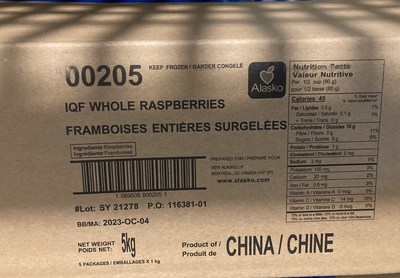
IQF Whole Raspberries (CNW Group/Ministry of Agriculture, Fisheries and Food)

Crate of raspberries (CNW Group/Ministry of Agriculture, Fisheries and Food)

The Ministry of Agriculture, Fisheries and Food (MAPAQ), in collaboration with the Food Inspection Division of the City of Montreal and the company Distribution Alimentaire Aubut inc., warns the public not to consume the product indicated in the table below, because this food may have been contaminated with a norovirus.

This warning stems from a Canadian Food Inspection Agency food recall involving Alasko brand IQF Whole Raspberries from China. They are distributed in several establishments across Canada . The recalled lot is as follows*:

*Lot # SY21278  PO
: 116381-01
BB/MA: 2023-OC-04

* The information on the batch concerned is only found on the transport boxes.

The product was offered in a frozen state. Its label includes, in addition to its name, the mention “Prepared for New Alasko LP”.

Establishment

Product name

Format

Affected lot

Aubut Food Distribution Inc.

3975 St. Ambroise Street

Montreal

“IQF Whole Raspberries”

Box of 5 kg (5 bags of 1 kg)

Units sold until June 15, 2022

1 kg bag

The company named in the table is voluntarily recalling the product in question. It has agreed with MAPAQ and the Food Inspection Division of the City of Montreal to issue this warning as a precautionary measure. In addition, people who have this product in their possession are advised not to consume it. They must return it to the establishment where they bought it or throw it away.

Even if the product does not show signs of tampering or a suspicious smell, it may be contaminated with norovirus and cause illness when consumed. Generally, the possible symptoms are nausea, vomiting, diarrhea and abdominal cramps. Muscle pain, fatigue, fever, chills and headache may also occur. People exposed to norovirus usually show these symptoms within 24 to 48 hours of eating contaminated food. Cases of illness have been reported to MAPAQ and could be associated with the consumption of this food.

USA – Will There Be a Cyclospora Outbreak in the U.S. This Summer?

Food Poisoning Bulletin

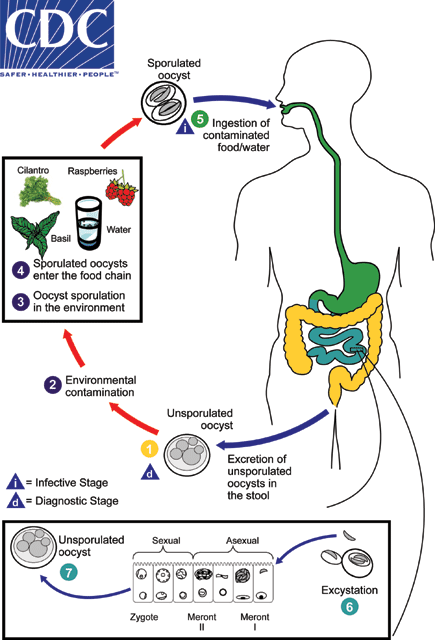
Will there be a cyclospora outbreak in the United States this summer? There have been multiple cyclospora outbreaks in the past nine years, including in 2013, 2014, 2015, 2016, 2017, 2018, 2019, 2020, and 2021. This year may be no exception.

In the past, Cyclospora outbreaks have been linked to fresh produce, including cilantro, raspberries, basil, mesclun, vegetable trays, bagged salad mixes, and snow peas. The cyclospora parasite is transmitted through human feces. The oocyst must mature, or sporulate, outside of the body before it becomes infectious. This infection is not passed person-to-person.

It is very difficult to protect yourself against this parasite, since it can cling to produce, especially produce such as leafy greens and herbs, and is not easily washed or rinsed off. And since most of the foods it contaminates are eaten without being heated, there is no kill step to destroy the parasite.

Mexico – At least 30 people suffered from severe food poisoning in Seyé, Yucatan

The Yucatan Times

On Sunday, June 12th, around two in the afternoon many people began to go to a private clinic located near the outskirts of the municipality of Seyé, presenting the same symptoms.

Nausea, high or low blood pressure, vomiting, and diarrhea were just some of the symptoms suffered by men, women, and children, due to the food poisoning cases that forced the municipal authorities to report the events to the Ministry of Health.

The Secretary of Public Security (SSP) transferred some people to other places for their attention, and staff from the Ministry of Health arrived in Seyé to carry out the corresponding investigations.

UK – Three dead in UK fish Listeria outbreak

Food Safety News

Three people have died in an ongoing Listeria outbreak linked to fish in the United Kingdom.

The UK Health Security Agency, Food Standards Agency (FSA), Public Health Scotland and Food Standards Scotland (FSS) are investigating the Listeria monocytogenes outbreak that was first made public in April.

Twelve patients across the UK have been identified, including three in Scotland, with onset dates of illness between October 2020 to March 2022.

Ten sick people are over the age of 65, and one is a pregnant woman. Three of those affected who are older than 65 have died.

Six people have fallen ill since January 2022. The majority of patients reported eating smoked fish.

The FSA and FSS are doing food chain and microbiological investigations including whole genome sequencing (WGS) but the cause is yet to be confirmed.

Indonesia – Indonesian Masters: Organisers probe suspected food poisoning involving Malaysian, Thai players

Malay Mail

The 2022 Indonesian Masters organising committee is investigating cases of Malaysian and Thai badminton players who came down with suspected food poisoning after having breakfast at a hotel here yesterday.

A spokesman of the All Indonesia Badminton Association centre manager, Broto Happy, said they sympathised with the victims and took a serious view of the incident, which they found out through social media.

The affected players or team managers have not lodged any official reports with the organising committee so far, he said in a statement today.

After liaising with the organising committee, the Badminton World Federation (BWF) urged team managers to remind their players to be cautious when ordering food from outside the hotel or consuming certain types of food.

Meanwhile, Broto said laboratory tests showed that the players who received treatment had probably eaten unhygienic food but there was no food poisoning.

“In cases of food poisoning, the effects are immediate,” said Dr Grace Corlesa Joselini, the tournament doctor.

She said players staying at the two official tournament hotels are free to order food online or eat at nearby restaurants.

Online media reports last night said five Malaysian and Thai players had sought treatment at hospitals for food poisoning.

Research – Investigators raid Ferrero as part of Salmonella outbreak probe

Food Safety News

Authorities have searched a number of Ferrero sites as investigations continue into a large Salmonella outbreak.

Six facilities in Belgium and Luxembourg were targeted this week including the factory in Arlon which is believed to be where contaminated occurred. The Belgian food safety agency stopped production at the plant in early April but it could reopen this month.

The monophasic Salmonella Typhimurium outbreak linked to Kinder chocolate has sickened almost 450 people including 122 in the United Kingdom, 118 in France as well as four in Canada and one in the United States.

Ferrero said it was cooperating with authorities as part of the investigation.

Documents and computer hardware were seized during the operation but no arrests were made, according to the Luxembourg Public Prosecutor’s Office.

The two outbreak strains of monophasic Salmonella Typhimurium were identified in 10 of 81 samples taken in Ferrero’s Arlon plant in Belgium between December 2021 and January 2022.

USA – Multistate Outbreak of Hepatitis A Virus Infections Linked to Fresh Organic Strawberries

CDC

At a Glance
  • Reported cases: 18
  • States: 3
  • Hospitalizations: 13
  • Deaths: 0

CDC recommends that people who purchased fresh organic strawberries branded as FreshKampo or HEB during March 5, 2022, through April 15, 2022, and then froze those strawberries for later consumption take the following actions:

  • Check your freezer for these fresh organic strawberries. If you froze them to eat later, do not eat them.
  • Throw away any remaining fresh organic strawberries that you froze for later consumption. If you are unsure of what brand you purchased, when you purchased your fresh organic strawberries, or where you purchased them prior to freezing them, you should throw the strawberries away.
  • If you have eaten these organic strawberries, purchased fresh and later frozen, within the last 14 days and are not vaccinated against hepatitis A, contact your local health department or health care provider to discuss getting postexposure prophylaxis (hepatitis A vaccine or immune globulin). Getting postexposure prophylaxis within 14 days of exposure can help prevent illness.
Outbreak Information
Clipboard icon
  • As of June 7, 2022, there are:
    • 18 outbreak-associated cases of hepatitis A reported from 3 states (California, Minnesota, and North Dakota).
    • Illnesses started on dates ranging from March 28, 2022, to May 6, 2022.
    • 13 people have been hospitalized. No deaths have been reported.
  • Epidemiologic and traceback evidence indicate that fresh organic strawberries are the likely source of this outbreak.
    • In interviews, 11/14 (79%) reported eating fresh organic strawberries.
What is Hepatitis A?

Hepatitis A is a contagious liver infection caused by the hepatitis A virus. The hepatitis A virus is found in the stool and blood of people who are infected. The hepatitis A virus is spread when someone ingests the virus, usually through close personal contact with an infected person or from eating contaminated food or drink. Hepatitis A can be prevented with a vaccine, which is recommended for all children at age one and adults at risk.

Symptoms of Hepatitis A

Human figure with ache
  • Symptoms of hepatitis A usually appear 2 to 7 weeks after exposure and can include
    • Yellow skin or eyes
    • Not wanting to eat
    • Upset stomach
    • Stomach pain
    • Throwing up
    • Fever
    • Dark urine or light-colored stools
    • Joint pain
    • Diarrhea
    • Feeling tired
  • Not everyone with hepatitis A has symptoms. Adults are more likely to have symptoms than children.
  • People who get hepatitis A may feel sick for a few weeks to several months but usually recover completely and do not have lasting liver damage. In some people, though, the illness may be so severe that the patient needs to be hospitalized.
  • In rare cases, hepatitis A can cause liver failure and even death. This is more common in older people and in people with other serious health issues, such as chronic liver disease.

USA- CDC Media Alert: Backyard poultry contact linked to more than 200 Salmonella illnesses in 2022

CDC

Salmonella Campylobacter

A CDC investigation notice regarding multistate outbreaks of Salmonella infections has been posted: https://www.cdc.gov/salmonella/backyardpoultry-06-22/index.html

Key points:

  • CDC and public health officials in several states are investigating multistate outbreaks of Salmonella infections linked to contact with backyard poultry.
  • In total, 219 illnesses have been reported from 38 states, and 27 people have been hospitalized.
  • One in four sick people are children younger than 5 years.
  • One death has been reported from Tennessee.
  • The true number of sick people is likely much higher than the reported number, as many people recover without medical care and are not tested for Salmonella.
  • Backyard poultry can carry Salmonella germs even if they look healthy and clean. These germs can easily spread in areas where the poultry live and roam.
  • These outbreaks occur annually and coincide with the increase in baby poultry purchases, beginning in the spring. Last year in 2021, a total of 1,135 people got sick from contact with backyard poultry.
  • These Salmonella outbreaks are not related to recent cases of H5N1 bird flu viruses detected in U.S. wild birds and poultry. However, backyard poultry owners should be aware that the steps needed to stay healthy around their flocks are similar for both diseases.

Take steps to enjoy your birds while staying healthy:

  • Always wash your hands for 20 seconds after touching birds, their supplies or collecting eggs.
  • Use a pair of dedicated shoes or boots for your coop and don’t wear them inside your house.
  • Keep birds and supplies outside the house to prevent spreading germs into your house.
  • Don’t let children younger than 5 years touch the birds (including chicks and ducklings) or anything in the area where the birds live and roam. This helps protect young children from getting sick, as their immune systems are still developing,  are more likely to put items in their mouths or not wash hands fully.

About Salmonella:

  • Most people infected with Salmonella develop diarrhea, fever, and stomach cramps 6 hours to 6 days after being exposed to the bacteria.
  • The illness usually lasts 4 to 7 days, and most people recover without treatment.
  • In some people, the illness may be so severe that the patient is hospitalized.
  • Children younger than 5, adults 65 and older, and people with weakened immune systems are more likely to have severe illness.

If you have questions about cases in a particular state, please call that state’s health department.

Research – Listeria monocytogenes outbreaks related to commercially produced caramel apples: Developments in sanitation, product formulation, and packaging

Journal of Food Protection

Prior to a deadly 2014 listeriosis outbreak, caramel apples were not thought to be vehicles for the foodborne pathogen Listeria monocytogenes. The purpose of this review article is to summarize what has been learned from research prompted by this outbreak. An overview of the two L. monocytogenes outbreaks related to prepackaged caramel apples, along with a brief discussion of apple sanitation and the production processes used to make caramel apples, is provided. Research suggesting ways to prevent future outbreaks arising from caramel apples is summarized. This review is based on a qualitative analysis of literature as well as interviews with current caramel apple manufacturers. Sanitation, packaging, and storage procedures used by manufacturers in the past may be insufficient to effectively inactivate L. monocytogenes in the case of product contamination. Novel apple sanitation methods and product formulations to control L. monocytogenes on caramel apples have been developed and, in some cases, implemented in commercial production.