Category Archives: Food Toxin

India – Ghaziabad: 20 people fall sick after having momos in Indirapuram

DNA India

Updated: Jul 1, 2018, 06:50 AM IST


Around 20 people fell sick after consuming momos at a local shop in Indirapuram area of Ghaziabad on Friday evening. Police have registered an FIR against the shop owner while 10 workers of the shop have also been detained for investigation.

According to the police, the incident took place on Friday evening when at least 20 people reported stomach pain after eating momos from a road-side stall in Indirapuram. Following which they were rushed to a nearby hospital where they are undergoing treatment.

Sources in the police said they are investigating the incident where people complained of stomach pain after having momos from one particular vendor. All of them are undergoing treatment for alleged food poisoning.
USA – One tests positive for E. coli, 30 others become ill after eating at Taylorsville restaurant

WRAL

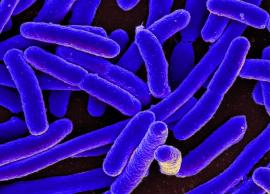
Health officials say dozens of people became very ill after eating at a restaurant in Taylorsville in Alexander County on Friday.Health officials said one person tested positive for E. coli, and more than 30 others are also sick after eating chicken at the restaurant.

Authorities did not positively identified the restaurant involved, but the Taylorsville location of Mexico Viejo posted a statement on their Facebook page Friday about sick customers


USA – CDC Investigation Update: Cyclosporiasis

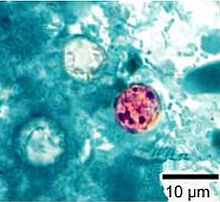
CDC 220px-Cyclospora_cayetanensis_stained

CDC investigation announcement of a multistate outbreak of cyclosporiasis linked to Del Monte Fresh Produce Vegetable Trays, U.S. 2018 can be found here: https://www.cdc.gov/parasites/cyclosporiasis/outbreaks/2018/a-062018/index.html

Key points:

  • CDC, the U.S. Food and Drug Administration, and state and local public health partners are investigating a multistate outbreak of Cyclospora infections associated with consumption of pre-packaged Del Monte Fresh Produce vegetable trays containing broccoli, cauliflower, carrots, and dill dip.
  • Cyclospora cayetanensis is a single-celled parasite that causes an intestinal infection called cyclosporiasis. People can become infected by consuming food or water contaminated with the parasite. Symptoms begin an average of 7 days after ingestion.
  • Symptoms may include watery diarrhea, loss of appetite, weight loss, cramping, bloating, increased gas, nausea and fatigue. Other less common symptoms include vomiting and low-grade fever.
  • As of June 15, 2018 (3pm EDT), CDC has been notified of 78 linked laboratory-confirmed cases of cyclosporiasis from four states—Iowa, Minnesota, Wisconsin, and Michigan.
  • Four of the 78 cases have been hospitalized. No deaths have been reported.
  • Cases reported in Michigan were from persons who bought the products in Wisconsin.
  • Consumers and retailers in Indiana and Illinois also are being alerted as the 28 oz. pre-packaged vegetable trays also were distributed in these states.
  • Most ill people reported buying and consuming pre-packaged Del Monte Fresh Produce vegetable trays containing broccoli, cauliflower, carrots, and dill dip in the Midwest.
  • Most people reported buying the trays at Kwik Trip/Kwik Star convenience stores.
  • On June 15, 2018, Del Monte Fresh Produce recalled 6 oz., 12 oz., and 28 oz. vegetable trays containing fresh broccoli, cauliflower, celery sticks, carrots, and dill dip.
    • Recalled products were sold in clear, plastic clamshell containers.
    • Recalled products were distributed to the following stores: Kwik Trip, Kwik Star, Demond’s, Sentry, Potash, Meehan’s, Country Market, FoodMax Supermarket, and Peapod.
    • Recalled products have a “Best If Enjoyed By” date of June 17, 2018.
      • The recalled 6 oz. Del Monte Fresh Produce vegetable tray has a UPC code of 7 1752472715 2 found on the package label.
      • The recalled 12 oz. Del Monte Fresh Produce vegetable tray has a UPC code of 7 1752472518 9 found on the package label.
      • The recalled 28 oz. Del Monte Fresh Produce small vegetable tray has a UPC code of 7 1752478604 3 found on the package label.
    • Do not eat or sell recalled vegetable trays. Throw them away.

The investigation is ongoing. CDC will provide updates when more information is available on CDC.gov – https://www.cdc.gov/parasites/cyclosporiasis/outbreaks/2018/a-062018/index.html

If you have further questions about this outbreak, please call the CDC media line at (404) 639-3286. If you have questions about cases in a particular state, please call that state’s health department.

CDC – Cyclospora Information

Canada – Food Recall Warning – Certain extra lean ground beef products recalled due to E. coli O157

CFIA

Recall details

Ottawa, June 29, 2018 – The Butcher’s Blend is recalling certain extra lean ground beef products from the marketplace due to possible E. coli O157 contamination. Consumers should not consume the recalled products described below.

Recalled products

Brand Name Common Name Size Code(s) on Product UPC
None Extra Lean Ground Beef Approx. 1 lb None – Sold by The Butcher’s Blend at the Western Fair District Farmer’s Market on June 16, 2018 None
Mitchell’s Butcher’s Blend / Old East Village Grocer Extra Lean Ground Beef Approx. 1 lb Best Before JUN 23/18 Starts with 0 200150
Mitchell’s Butcher’s Blend / Old East Village Grocer Extra Lean Ground Beef Approx. ½ lb Best Before JUN 23/18 Starts with 0 200150

USA – Canal water likely source of E. coli in romaine-related outbreak

Food Safety News 


Federal officials say contaminated canal water near romaine lettuce growing fields is the likely source of the unusually virulent strain of E. coli that has sickened people across 36 states, killing five.

The outbreak is over, according to an update this afternoon from the Centers for Disease Control and Prevention. The agency has confirmed 210 people with infections. Twenty-seven of the victims have developed kidney failure. The most recent victim became sick on June 6.

“Samples have been collected from environmental sources in the region, including water, soil, and cow manure. Evaluation of these samples is ongoing,” according to an update this afternoon from the Food and Drug Administration investigators.

“To date, CDC analysis of samples taken from canal water in the region has identified the presence of E. coli O157: H7 with the same genetic fingerprint as the outbreak strain. We have identified additional strains of Shiga-toxin producing E. coli in water and soil samples, but at this time, the samples from the canal water are the only matches to the outbreak strain.”

RASFF Alerts – Aflatoxin – Groundnuts – Ground Nutmeg – Dried Figs – Ginger Powder – Bitter Almond Kernels – Crushed Chillies – Pistachios

kswfoodworld food safety poisoning

RASFF-aflatoxins (B1 = 13; Tot. = 15 µg/kg – ppb) in groundnuts from Argentina in the Netherlands

RASFF -aflatoxins (Tot. = 14 µg/kg – ppb) and ochratoxin A (47 µg/kg – ppb) in grinded ground nutmeg from Indonesia in the Netherlands

RASFF-aflatoxins (B1 = 4.4 µg/kg – ppb) in groundnut kernels from Argentina in the Netherlands

RASFF-aflatoxins (B1 = 29.6; Tot. = 40 µg/kg – ppb) in dried figs from Greece in Poland

RASFF-aflatoxins (B1 = 11.30; Tot. = 16.31 µg/kg – ppb) in ginger powder from Nigeria, via Poland in Slovakia

RASFF-aflatoxins (B1 = 24 µg/kg – ppb) in bitter almond kernels from Turkey in Spain

RASFF-aflatoxins (B1 = 22; Tot. = 23 µg/kg – ppb) in crushed chillies from Sri Lanka in the UK

RASFF-aflatoxins (B1 = 161; Tot. = 180 µg/kg – ppb) in pistachio nuts with shell from Iran in Greece

RASFF-aflatoxins (B1 = 22; Tot. = 28 µg/kg – ppb) in groundnut kernels from India in the Netherlands

RASFF Alert – Diarrhoeic Shellfish Poisoning (DSP) toxins – Tellinas

kswfoodworld food safety poisoning

RASFF-Diarrhoeic Shellfish Poisoning (DSP) toxins (166.3 µg/kg – ppb) in tellinas from France in France

RASFF Alert – Moulds – Blanched Groundnut Kernels

kswfoodworld food safety poisoning

RASFF-blanched groundnut kernels from Argentina infested with moulds  in the Netherlands

USA – FDA Investigating Multistate Outbreak of E. coli O157:H7 Infections Linked to Romaine Lettuce from Yuma Growing Region

FDA Eurofins Food Testing UK

Update

The FDA, along with CDC and state partners, initiated an environmental assessment in the Yuma growing region to further investigate potential sources of contamination linked to this outbreak.

Samples have been collected from environmental sources in the region, including water, soil, and cow manure. Evaluation of these samples is ongoing.

To date, CDC analysis of samples taken from canal water in the region has identified the presence of E. coli 0157:H7 with the same genetic finger print as the outbreak strain. We have identified additional strains of Shiga-toxin producing E. coli in water and soil samples, but at this time, the samples from the canal water are the only matches to the outbreak strain.

Analysis of additional samples is still ongoing, and any new matches to the outbreak strain will be communicated publicly and with industry in the region.

Identification of the outbreak strain in the environment should prove valuable in our analysis of potential routes of contamination, and we are continuing our investigation in an effort to learn more about how the outbreak strain could have entered the water and ways that this water could have come into contact with and contaminated romaine lettuce in the region.

Canada – Canada calls E. coli Outbreak over after 8 Sickened by US Romaine Lettuce

Food Poison Journal 

According to Food Safety News, Canadian officials say an E. coli outbreak linked to romaine lettuce from Arizona has ended with eight confirmed cases in their country. The eight victims in Canada all reported eating chopped romaine lettuce in the days before becoming sick. They all said the romaine was in packaged salads from grocery stores or in salads from restaurants. Two of the Canadians reported traveling to the United States and eating romaine there before becoming ill. Canadians became sick between March 18 and April 22.

In Canada the investigation is officially over, according to the Public Health Agency of Canada.