Category Archives: Food Poisoning

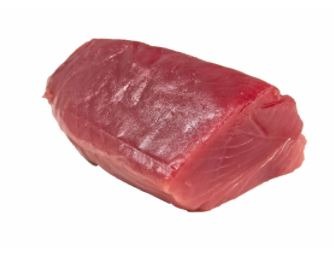
France – Sliced ​​Tuna Loin – Histamine

Gov france

Identifying information for the recalled product

  • Product category Food
  • Product sub-category Fishery and aquaculture products
  • Product brand name unbranded
  • Names of models or references Sliced ​​tuna loin sold at the traditional stand of the CARREFOUR IVRY SUR SEINE store between 02/10/2021 and 06/10/2021
  • Product identification
    GTIN Lot
    1111111111116 sold between 02/10/2021 and 06/10/2021
  • Packaging by weight, presented sliced
  • Start date / End of marketing From 02/10/2021 to 06/10/2021
  • Storage temperature Product to be stored in the refrigerator
  • Further information Sliced ​​tuna loin sold at the traditional stand of the CARREFOUR IVRY SUR SEINE store between 02/10/2021 and 06/10/2021
  • Geographical sales area CARREFOUR IVRY SUR SEINE ONLY
  • Distributors ONLY CARREFOUR IVRY SUR SEINE

Practical information regarding the recall

  • Reason for recall presence of histamine
  • Risks incurred by the consumer Endogenous toxins: histamine (fish, cheese, alcoholic drinks, cold meats)

Czech Republic – TATAR STEAK – STEC E.coli

Potravinynapranyri

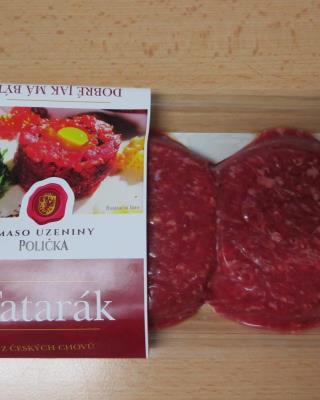
Illustration photo no. 1

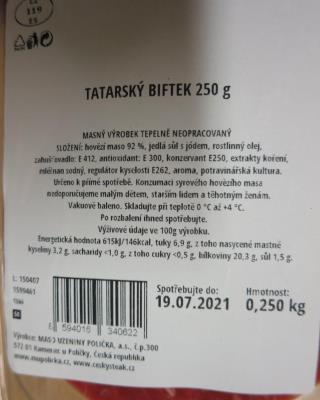
Illustration photo no. 3

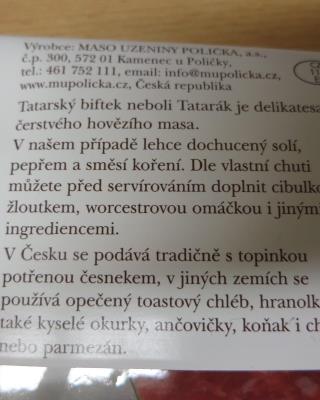
Illustration photo no. 4

Place of inspection:
Ústí nad Labem – Všebořice ( Všebořická 359/51, 400 10 Ústí nad Labem – Všebořice )
Company ID: 26178541
Unsatisfactory parameter:

Escherichia coli (presence of genes typical of pathogenic E. coli)

The product was found to contain the pathogenic bacterium Escherichia coli  producing shigatoxin.

Among other things, Shiga toxins cause diarrhea and can damage the kidneys.

Food cannot be considered safe.

Lots: L: 150407
Expiration date: 07/19/2021
Packaging: Vacuum packed
Quantity of product in package: 250 g
Producer: MASO UZENINY POLIČKA as, č.p. 300, 572 01 Kamenec u Poličky
Country of origin:  Czechia
Date of sampling: 13. 7. 2021
Reference number: 21-000386-CAFIA-CZ
The sample was found by an official inspection of the State Agricultural and Food Inspection Authority.

India – 50 Fall Sick Due To Food Poisoning In Madhya Pradesh, 5 Serious

NDTV

Gwalior: 

In a case of food poisoning, at least 50 people, including women and children, fell sick after eating food served at a feast in a village in Madhya Pradesh’s Gwalior district, an official said on Sunday.

The condition of five of them is serious and they are shifted to the Gajra Raja Medical College (GRMC) and Hospital here after receiving initial treatment at the Morar Hospital in the Gwalior district, he said.

The incident occurred in Damora village on Saturday evening.

India – Maha: Six of family hospitalised due to suspected food poisoning

Outlook India

In a suspected food poisoning case, six members of a family, including a six-year old girl, fell ill after eating a food item made of ”bhagar” (barnyard millet) at a village in Jalna district of Maharashtra on Thursday, a district official said.

They have been admitted to hospitals, he said.

The affected family members reside at Antarwali Sarati village in Ambad tehsil. Apart from the minor girl, the victims – aged between 27 and 55 – ate the food item made of bhagar (which is generally consumed during fasting by Hindus) on the occasion of Navratri that began from Thursday. However, after that, they started suffering from dizziness and vomiting. They were taken to a local hospital, the official said.

Majorca – Food poisoning at wedding reception costs restaurant thousands

Majorca Daily Bulletin

A Mallorcan restaurant has been ordered to give a couple a refund for their wedding reception and pay them compensation after a third of the guests got food poisoning.

The wedding took place in September 2016, but in the days after the reception, 52 guests went to the doctor with gastric symptoms.

The restaurateur claimed the food was analysed and found to be in good condition, but the court ruled that there was no other explanation for so many guests getting sick.

The couple will receive a total of 14,000 euros, which includes the full amount for the reception plus 2,500 euros

Germany – Rewe organic 6 herbs – STEC E.coli

LMW

Warning type: Food
Date of first publication: 08/10/2021
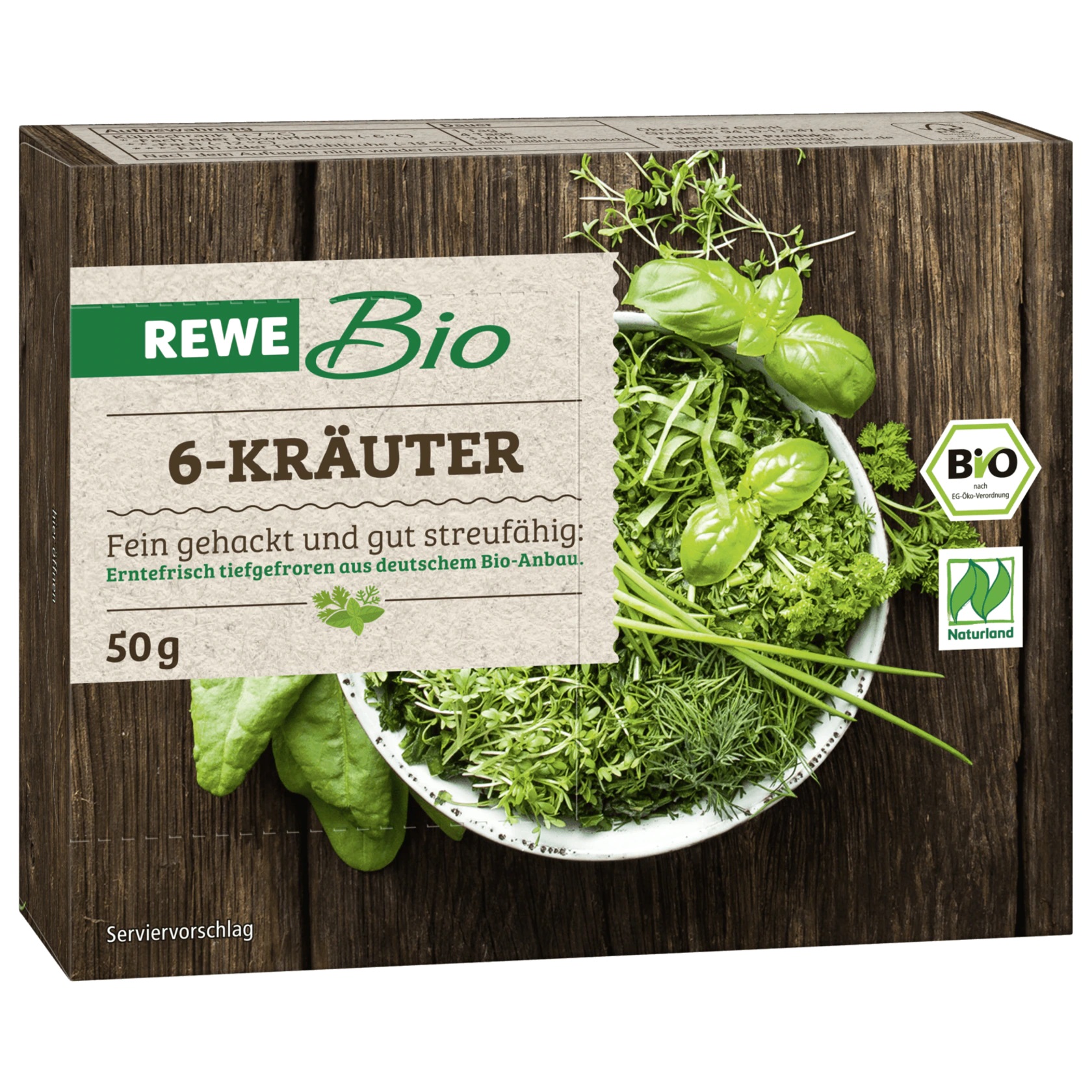
Product name: Rewe organic 6 herbs
Product pictures:

0184647-O1540 REWE organic 6-herb packshot.jpg

REWE GmbH

Manufacturer (distributor):

Öko Service GmbH, Auf dem Kleie 2, 49176 Hilter a. TW

Reason for warning:

Detection of Vero- / Shiga toxin-producing Escherichia coli (VTEC / STEC)

Packaging Unit: 50 g
Durability: Best before 07.2022
Lot identification: L1189F33; EAN 4388844006539
Additional Information:

According to BfR Opinion No. 009/2018 of April 19, 2018, all VTEC / STEC are to be regarded as potential enterohaemorrhagic Escherichia coli (EHEC).
Enterohaemorrhagic Escherichia coli (EHEC) are among the most important food-associated enteritis pathogens. In addition to gastrointestinal symptoms that occur after an incubation period of 1 – 8 days, EHEC can also cause post-infectious syndromes such as B. cause hemolytic uremic syndrome (HUS).

Homepage of the manufacturer:

Contact to the responsible authorities:

Baden-Württemberg:poststelle@mlr.bwl.de

Bavaria:poststelle@lgl.bayern.de
Brandenburg:Konsumenterschutz@Msgiv.Brandenburg.de
Hamburg:poststelle@justiz.hamburg.de
Hesse:Schnellwarnung@rpda.hessen.de
Lower Saxony:poststelle@ml.niedersachsen.de
North Rhine-Westphalia:poststelle@mulnv.nrw.de
Saarland:poststelle-luv@lav.saarland.de
Saxony:poststelle@sms.sachsen.de
Thuringia:LM-Ueberendung@tlv.thueringen.de

Research – An Analysis of Tuna Recalls in the United States, 2002 through 2020

Journal of Food Protection

This manuscript reviews 18 years of voluntary recalls for commercially sold tuna in the United States. This recall information is a valuable indicator of the failure to implement procedures for food safety. The voluntary recalls involve fresh, frozen, processed, hermetically sealed and retorted in a shelf stable pack (i.e., canned tuna), and formulated into other tuna products. The FDA regulations that regulate the capture, processing, transportation, and sale of raw and processed seafood are discussed. These regulations include the current Good Manufacturing Practices, the Food Modernization Act, the Emergency Permit Control, Low Acid Canned Foods, the Seafood Hazard Analysis and Critical Control Points, Food Labeling, and Sanitary Food Transportation. The importance of traceability and Food Safety Culture to successfully prevent or implement recalls is also discussed. The recalls themselves were separated into product treatment groups: uncooked, canned shelf-stable items, and using tuna as an ingredient. The recalls were further categorized and summarized by reason or cause, such as biological and chemical contamination, undeclared ingredients, under-processing, and foreign materials. The primary causes of recalls of the reviewed tuna products were, in order, Listeria monocytogenes , undeclared allergens, elevated histamine levels, and under-processing of retorted tuna items. The recalls for elevated levels of histamine primarily occurred in uncooked (raw) tuna. Recalls for Listeria sp. and undeclared allergens were considered to be primarily Class I recalls, while recalls for elevated levels of histamine and under-processing were almost always assigned to the less serious Class II designation.

RASFF Alert – Aflatoxin – Ground Nutmeg

RASFF

Aflatoxins in ground nutmeg in Belgium, Czech Republic, DRC, Denmark, Finland, France, Germany, Hungary, Romania and Slovakia.

RASFF

Aflatoxin B1 in blanched hazelnut kernels from Georgia in Poland and Germany

RASFF Alerts – Mycotoxin – Okadaic Acid -Mussels

RASFF

Okadaic acid in mussels (Mytilus galloprovincialis) from Spain

RASFF Alert – STEC E.coli – Raw Milk Cheese

RASFF

E. coli producers STEC in raw milk cheese from France in Italy