Category Archives: Food Pathogen

USA – Outbreak Investigation of E. coli – Leafy Greens (December 2020) – CDC declares outbreak over, FDA investigation ongoing

FDA

The FDA, along with CDC and state and local partners, investigated a multistate outbreak of E. coli O157:H7 infections in the fall of 2020. The epidemiology and traceback investigation have determined that the outbreak was linked to leafy greens. The epidemiological and traceback investigations were not able to determine a specific type of leafy green linked to illnesses. On 12/22/2020, the CDC announced that this outbreak appears to be over. This outbreak, announced by FDA and CDC on October 28, 2020, was caused by a strain of E. coli that is genetically related to a strain linked to the fall 2019 romaine outbreak.

The FDA completed a traceback investigation of multiple types of leafy greens identified in patient interviews. Although no single ranch was identified as a common source of the leafy greens, FDA and state partners also conducted on-site investigations on farms of interest. 

Teams were deployed to dozens of ranches in the region to conduct large scale environmental sampling. Additionally, no Shiga toxin-producing E. coli were found on leafy greens. 

At this time, FDA’s investigational activities, including sample analysis are ongoing. A detailed report of FDA’s findings in the investigation will be released in early 2021, following the conclusion of investigational activities.

Recommendation

CDC has declared this outbreak to be over. There is no recommendation for consumers, retailers, or suppliers.


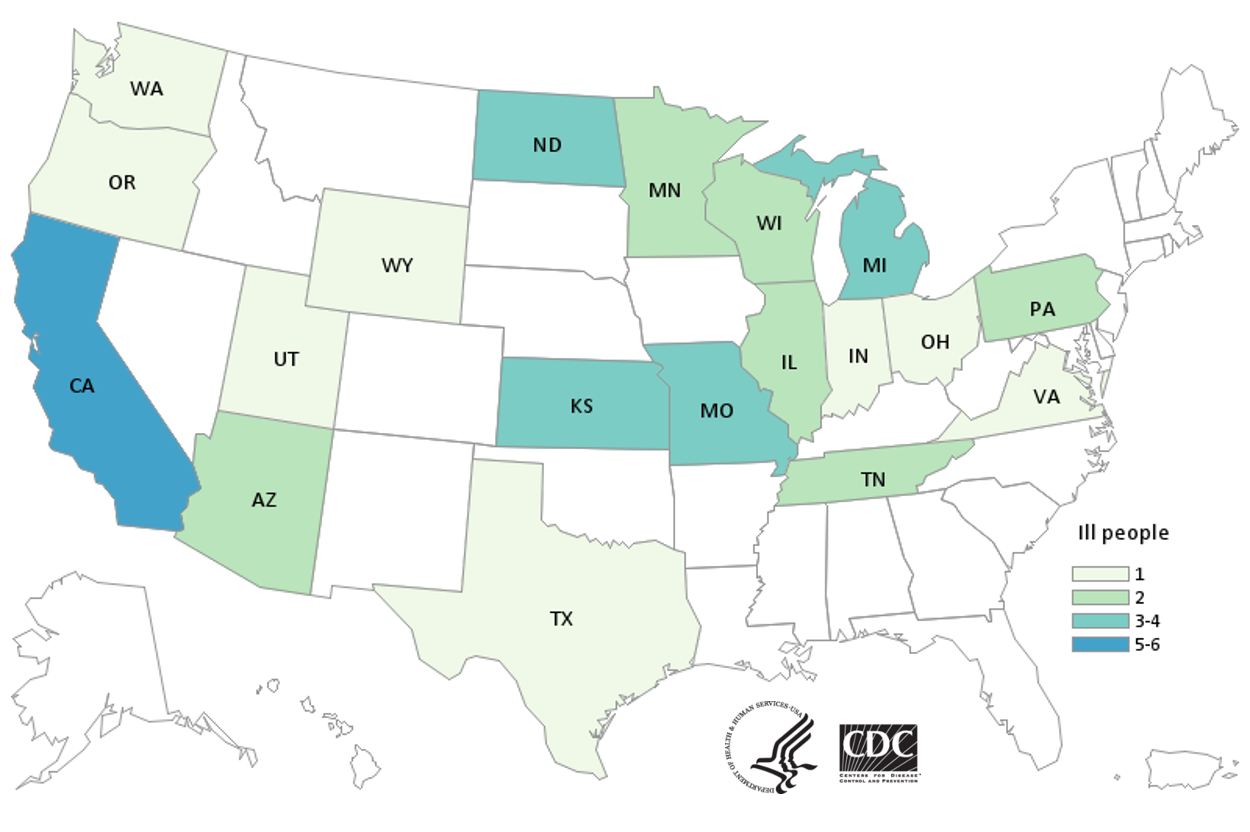
Case Count Map Provided by CDC

Outbreak Investigation of of E. coli in Leafy Greens (December 2020) - Case Count Map from CDC 12/22/2020

Case Counts

Total Illnesses: 40
Hospitalizations: 20 (4 Cases HUS)
Deaths: 0
Last Illness Onset Date: October 31, 2020
States with Cases: AZ (2), CA (6), IL (2), IN (1), KS (4), MI (3), MN (2), MO (3), ND (4), OH (1), OR (1), PA (2), TN (2), TX (1), UT (1), VA (1), WA (1), WI (2), WY (1)
*States with confirmed distribution; product could have been distributed further

Useful Links

India – Kerala health minister on Shigella outbreak: ‘Everything is under control’

Outbreak News Today

Shigella - kswfoodworld

After a suspected Shigella outbreak that claimed the life of an 11-year old child in the city of Kozhikode, Kerala health prime minister KK Shailaja has stated that the aforementioned outbreak has been ‘under control’ by health authorities.

“An 11-year-old child died last week in Kozhikode. After that tests have been done for about fifty suspected cases and six have been infected. Now, only two are in the hospital while others have been discharged,” she said.

She further added that the Shigella bacteria is prevalent in densely populated areas, through contaminated water.

The health department has conducted an awareness campaign and set up medical camps. Wells in the area were chlorinated,” Shailaja commented, while stressing health authority directives that people should first boil their water before consuming.

Denmark – Disease outbreaks with rare microsporidia – Enterocytozoon bieneusi.

SSI

The Statens Serum Institut and the Danish Veterinary and Food Administration are currently investigating a disease outbreak in a company with a microorganism that has so far not been registered as a cause of disease outbreaks in Denmark. It is a species of microsporidia, Enterocytozoon bieneusi. It is believed that the infection occurred through food.

In October, a company in the metropolitan area reported more than 70 cases of diarrhea among their employees.

The Statens Serum Institut (SSI) has so far found samples from 11 people positive for Enterocytozoon bieneusi, which is a species of microsporidia. It is not a microorganism that we often detect in Denmark, and we have not previously seen disease outbreaks with it.

The infection can cause severe and prolonged diarrhea, abdominal pain and nausea. In addition, there may be symptoms such as fever, headache, muscle aches and fatigue (flu-like). The infection occurs from feces from infected people with poor hygiene to other people either directly or through food and drink.

“There are no registered persons outside the company who should have been infected with E. bieneus. But we urge the country’s physicians to pay attention to patients with prolonged diarrhea for no apparent reason. Especially if it is about immunocompromised people and with particularly long-lasting symptoms, ”says ward doctor Lasse Skafte Vestergaard, SSI. Read more about the disease outbreak with microsporidia  (EPI-NEWS – week 52a – 2020)

Diagrams of Enterocytozoon bieneusi Spore, Life Cycle, and Possible... |  Download Scientific Diagram

Microsporidia are protozoan parasites belonging to the phylum Microsporidia within which exist over 1000 species classified into approximately 100 genera. These eukaryotic obligate intracellular protozoans have been described infecting every major animal group, especially insects, fish, and mammals (Wittner 1999). Microsporidia have been increasingly recognized as opportunistic pathogens of immunodeficient patients (Weber et al. 1994), especially in Aids patients but it is also becoming increasingly common in immunocompetent individuals (Gainzarain et al. 1998, Lores et al. 2001).

Although during the last decade numerous data related to the epidemiology of this infection in humans and animals have been accumulated, implying a zoonotic nature of these parasites, direct evidence of transmission from animals to humans are still lacking (Deplazes et al. 2000).

Encephalitozoon cuniculi is probably the most extensively studied mammalian microsporidian and has been reported to infect a wide range of hosts, including common laboratory rodents as well as human and non-human primates. This is the first microsporidian species infecting humans that has been considered a zoonosis (Deplazes et al. 1996, Didier et al. 1996) .

The first identification of E. intestinalis in mammals other than humans was reported by Bornay et al. (1998) in the faeces of donkeys, dogs, pigs, cow, and goat suggesting that E. intestinalis might also be of zoonotic origin.

Enterocytozoon bieneusi is the most frequent microsporidian found in humans, especially in Aids patients. It has been associated mainly with chronic diarrhoea, although it has been diagnosed in patients with other forms of immunosuppression and in immunocompetent travellers with self-limited diarrhoea (Weber & Bryan 1994, Sobottka et al. 1995). In addition, this pathogen has recently been detected in other natural hosts such as pigs (Deplazes et al. 1996, Breitenmoser et al. 1999, Rinder et al. 2000), cows, goats, pigs, chickens, cats, turkeys (Bornay et al. 1998), rabbits, dogs (del Aguila et al. 1999), and in simian immunodeficiency virus-inoculated monkeys (Tzipori et al. 1997, Mansfield et al. 1997). Consequently, this microsporidian infection may be more common than previously suspected.

Canada – Updated Food Recall Warning – Certain Assala, Compliments, The Deli-Shop, and Levitts brands deli meat products recalled due to Listeria monocytogenes

CFIA

Recall details

Ottawa, December 22, 2020 – The food recall warning issued on December 15, 2020 has been updated to include additional product information. This additional information was identified during the Canadian Food Inspection Agency’s (CFIA) food safety investigation.

Levitts Foods (Canada) Inc. is recalling certain Assala, Compliments, The Deli-Shop, and Levitts brands deli meat products from the marketplace due to possible Listeria monocytogenes contamination. Consumers should not consume the recalled products described below.

Recalled products

Brand Product Size UPC Codes
Assala Montreal Style Smoked Meat 150 g 8 82756 71684 4 All best before dates up to and including 2021/JA/22 EST 48
Compliments Smoked Beef Eye of the Round Pastrami 175 g 0 68820 13355 1 All best before dates up to and including 2021/JA/22 EST 48
Compliments Corned Beef 175 g 0 68820 13356 8 All best before dates up to and including 2021/JA/22 EST 48
Compliments Montreal-Style Smoked Meat 175 g 0 68820 13357 5 All best before dates up to and including 2021/JA/22 EST 48
Compliments Roast Beef 175 g 0 68820 13358 2 All best before dates up to and including 2021/JA/22 EST 48
Compliments Roast Beef 300 g 0 68820 13359 9 All best before dates up to and including 2021/JA/22 EST 48
Compliments Smoked Beef Pastrami 175 g 0 68820 13360 5 All best before dates up to and including 2021/JA/22 EST 48
Levitts Montreal Style Smoked Meat 150 g 8 82756 71084 2 All best before dates up to and including 2021/JA/22 EST 48
Levitts Corned Beef 150 g 8 82756 72084 1 All best before dates up to and including 2021/JA/22 EST 48
Levitts New York Style Pastrami 150 g 8 82756 73084 0 All best before dates up to and including 2021/JA/22 EST 48
Levitts Seasoned Roast Beef 150 g 8 82756 74084 9 All best before dates up to and including 2021/JA/22 EST 48
Levitts Old Fashioned Montreal Smoked Meat Variable Starting with 2 61043 All best before dates up to and including 2021/JA/22 EST 48
The Deli-Shop Sliced Pastrami 175 g 0 59749 95373 3 All best before dates up to and including 2021/JA/22 EST 48
The Deli-Shop Sliced Pastrami 2 x 175 g 0 59749 95227 9 All best before dates up to and including 2021/JA/22 EST 48

What you should do

If you think you became sick from consuming a recalled product, call your doctor.

Check to see if you have the recalled products in your home. Recalled products should be thrown out or returned to the store where they were purchased.

Background

This recall was triggered by CFIA test results. If other high-risk products are recalled, the CFIA will notify the public through updated Food Recall Warnings.

The CFIA is verifying that industry is removing the recalled products from the marketplace.

Illnesses

There have been no reported illnesses associated with the consumption of these products. However, there has been one reported illness that may be associated with the consumption of the products included in the Food Recall Warning of December 7, 2020.

Product photos

Printer ready version of photos

  • The Deli-Shop, sliced pastrami, 2 x 175 g - back
  • The Deli-Shop, sliced pastrami, 2 x 175 g - front
  • The Deli-Shop, sliced pastrami, 175 g
  • Compliments Smoked Beef Eye of the Round Pastrami, 175 g - front
  • Compliments Smoked Beef Eye of the Round Pastrami, 175 g - back
  • Compliments brand Corned beef, 175 g - front
  • Compliments corned beef, 175 g - back
  • Compliments Montreal-Style Smoked Meat, 175 g - front
  • Compliments Montreal-Style Smoked Meat, 175 g - back
  • Compliments Roast Beef, 175 g - front
  • Compliments Roast Beef, 175 g - back
  • Compliments Roast Beef, 300 g - front
  • Compliments Roast Beef, 300 g - back
  • Compliments Smoked Beef Pastrami, 175 g - front
  • Compliments Smoked Beef Pastrami, 175 g - back
  • Levitts Old Fashioned Montreal Smoked Meat, variable - front
  • Levitts Old Fashioned Montreal Smoked Meat, variable - back
  • Levitts Montreal Style Smoked Meat, 150 g - front
  • Levitts Montreal Style Smoked Meat, 150 g - back
  • Assala brand Montreal Style Smoked meat, 150 g - front
  • Assala brand Montreal Style Smoked meat, 150 g - back
  • Levitts Corned Beef, 150 g - front
  • Levitts Corned Beef, 150 g - back
  • Levitts New York Style Pastrami, 150 g - front
  • Levitts Seasoned Roast beef, 150 g - back
  • Levitts New York Style Pastrami, 150 g - back
  • Levitts Seasoned Roast beef, 150 g - front

Public enquiries and media

Company information
Levitts Foods (Canada) Inc.: Simon Larochelle, 514-367-1654
Public enquiries
Toll-free: 1-800-442-2342 (Canada and U.S.)
Telephone: 1-613-773-2342 (local or international)
Email: cfia.enquiries-demandederenseignements.acia@canada.ca
Media relations
Telephone: 613-773-6600
Email: cfia.media.acia@canada.ca

Germany – Potato Salad Buckwar with Herbs -Salmonella

LMW

Warning type:Food
Date of first publication:12/22/2020
Product name:

Potato Salad Buckwar with Herbs

Manufacturer (distributor):Feinkostmanufaktur – frisch & spracher GmbH, Pulsnitz / Saxony
Reason for warning:Suspected contamination with salmonella
Packaging Unit:200g and 750g
Durability:Best before: December 28th, 2020 and January 2nd, 2020
Lot identification:Batches: 12.10 and 12.15
Homepage of the manufacturer:

Contact to the responsible authorities:

Brandenburg:

Konsumenterschutz@Msgiv.Brandenburg.de

Saxony:

poststelle@sms.sachsen.de

Germany – Lusatian potato salad (gourmet) – Salmonella

LMW

Warning type: Food
Date of first publication:12/22/2020
Product name:Lusatian potato salad (gourmet)
Manufacturer (distributor):

Feinkostmanufaktur frisch & spracher GmbH, Pulsnitz / Saxony

Reason for warning:Suspected contamination with salmonella
Packaging Unit:250g and 750g
Durability:Best before: December 28th, 2020 and January 2nd, 2020
Lot identification:Batches: 12.10 and 12.15
Homepage of the manufacturer:

Contact to the responsible authorities:

Brandenburg: Konumenterschutz@Msgiv.Brandenburg.de

Lower Saxony: poststelle@ml.niedersachsen.de
Saxony:

poststelle@sms.sachsen.de

Germany – Meat salad with herbs – Salmonella

LMW

Warning type: Food
Date of first publication: 12/22/2020
Product name: Meat salad with herbs
Manufacturer (distributor): Feinkostmanufaktur frisch & spracher GmbH, Pulsnitz / Saxony
Reason for warning:

Suspected contamination with salmonella

Packaging Unit: 250g and 750g
Durability: Best before: December 31, 2020
Lot identification: Batch: 12.15
Homepage of the manufacturer:

Contact to the responsible authorities:

Mecklenburg-Western Pomerania:

poststelle@lm.mv-regierung.de

Saxony:

poststelle@sms.sachsen.de

Singapore – Recall of “Crab Brand” Black Pepper Seed Due to Presence of Bacillus cereus Exceeding Permitted Level

Click to access sfa-media-release—recall-of-crab-brand-black-pepper-seed-due-to-presence-of-bacillus-cereus-exceeding-permitted-levels.pdf

Iceland – Christmas without foodborne infections

MAST

There is a lot of pressure on Icelanders’ kitchens during Christmas preparations in December and during the holidays. Hygiene, cooling and proper heating of food are extremely important in order to prevent guests and household members from getting foodborne illnesses and associated discomfort.

Disease-causing bacteria can enter the kitchen with meat and soil that comes with vegetables and from there into other foods on the kitchen table or in the refrigerator. They can also be obtained in food from the person handling the food and from the equipment and utensils used in the kitchen.

Noroviruses can spread rapidly at Christmas and it is important that people with symptoms of foodborne illness stay away from cooking. Regular hand washing reduces the risk of infection between persons or from contaminated food.

Keep in mind that:

  • Raw meat and its juices should not come into contact with ready-to-eat foods
  • Wash fruits and vegetables to prevent bacteria from entering ready-to-eat foods
  • Wash hands before cooking and after contact with raw meat and unwashed vegetables
  • Clean cutting boards and utensils immediately after use
  • Let’s organize the fridge well and keep it clean to prevent cross-contamination
  • We regularly change tablecloths, tea towels and hand towels

Bacteria multiply very rapidly under ideal conditions. At 37 ° C, one bacterium can multiply to 1000 in 3 hours and to 1 million in 6 hours. It is therefore important to store and handle food at a temperature that prevents the rapid growth of bacteria by limiting the time that sensitive foods, such as smoked and buried fish and cold cuts, are on the table at room temperature. The risk of bacterial growth is greatest when the temperature of the food is between 5 and 60 ° C. Adequate heat treatment kills bacteria and storage at refrigerated temperatures (0-4 ° C) limits their proliferation. If foodstuffs are to be kept warm, they should be kept at 60 ° C and when cooling heated foodstuffs, care should be taken to ensure that they reach 4 ° C in 3 hours. 

Citizens are encouraged to practice hygiene, proper handling and cooling of food in the kitchen so that foodborne illnesses can be prevented from spoiling the Christmas spirit.

Belgium – Norovirus outbreak reported at Belgian school; raw vegetables blamed

Food Safety News

Food Borne Illness - Norovirus -CDC Photo

More than 150 students and staff at a school in Belgium fell ill during an outbreak of norovirus earlier this month, according to information recently released.

The Federal Agency for the Safety of the Food Chain (FASFC) reported the food poisoning at the Atheneum Pegasus school in the city of Ostend was caused by crudités, which are mixed raw vegetables.

The FASFC, known in French as AFSCA and Dutch as FAVV, was informed in early December about the incident and started investigating with Zorg en Gezondheid (The Agency for Care and Health), and Sciensano, the national reference laboratory, to determine the source of contamination.

A total of 71 students and some staff were absent on one day and complained of vomiting, abdominal pain and fever.