Category Archives: Food Microbiology

UK – Potts Partnership recalls Potts’ Truffle Mayonnaise because of the presence of Listeria monocytogenes

FSA

Potts Partnership Ltd is recalling Potts’ TruffleMayonnaise because Listeria monocytogenes has been found in the product.

Product details

name: Potts’ Truffle Mayonnaise
Pack size 230g
Batch code 18823
Best before July 2024

Risk statement

The presence of Listeria monocytogenes in the product listed above.

Symptoms caused by this organism can be similar to flu and include high temperature, muscle ache or pain, chills, feeling or being sick and diarrhoea. However, in rare cases, the infection can be more severe, causing serious complications, such as meningitis.

Some people are more vulnerable to listeria infections, including those over 65 years of age, pregnant women and their unborn babies, babies less than one month old and people with weakened immune systems.

Action taken by the company

Pott’s Partnership Ltd is recalling the above product. Point of sale notices will be displayed in retail stores where this product is sold. These notices explain to customers why the product is being recalled and tell them what to do if they have bought the product. Please see the attached notice.

Our advice to consumers

If you have bought the above product do not eat it. Instead return it to the store you bought it from for a full refund. For further information contact info@pottspartnership.co.uk

Research – Modified Atmosphere Packaging (MAP) for Seaweed Conservation: Impact on Physicochemical Characteristics and Microbiological Activity

MDPI

Abstract

Conventional conservation techniques such as drying, salting or freezing do not allow for preserving the original characteristics of seaweeds. The present work aims to study the impact of minimal processing, in particular “Modified Atmosphere Packaging” (MAP), on the physicochemical characteristics and food safety of two seaweed species, “laver” (Porphyra umbilicalis) and “sea-lettuce” (Ulva lactuca), stored at 6 °C for 15 days. Different parameters were evaluated using analytical methods, namely the composition of headspace gases, color, texture, microorganisms, and volatile organic compounds (VOCs). The main findings of this study were that the MAP treatment was able to inhibit the respiration rate of minimally processed seaweeds, also preserving their color and texture. There was a remarkable reduction in the microbial load for P. umbilicalis treated under modified and vacuum atmospheres, and U. lactuca exhibited relatively steady values with no notable differences between the treatments and the control. Therefore, during the 15-day study period, both seaweeds met the requirements for food safety. GC–TOF-MS allowed to conclude that both MAP and vacuum treatments were more efficient in maintaining the odor characteristics of U. lactuca compared to P. umbilicalis with no significant differences throughout the storage days. Metabolic responses to diverse sources of abiotic stress seemed to account for most of the changes observed.

Research – The brink of a phage paradigm shift in the EU?

Poultry World

We might be on the brink of a phage paradigm shift in the European Union. This was the view of various experts during an online webinar on 11 July organised by PhageEU, a coalition of stakeholders representing phages in industry, the scientific community and civil society.

A feed additive based on phage technology could be authorised by the European Commission in the near future, they agreed, adding that this would be a template for the development of ground-breaking phage products in poultry and other food-producing animals.

The webinar was an opportunity to discuss technical challenges to designing bacteriophage products, the regulatory hurdles in Europe for this new product category as well as to analyse the recent political debate in the EU institutions and the future outlook.

Research – Microbial Inhibition by UV Radiation Combined with Nisin and Shelf-Life Extension of Tangerine Juice during Refrigerated Storage

MDPI

Abstract

This study evaluated the efficiency of UV radiation doses (4.68–149.76 J/cm2) and nisin (50–200 ppm) and their combination in comparison with thermal pasteurization on the microbial inhibition kinetics and physicochemical properties of tangerine juice. It was noted that UV-149.76 J/cm2 and nisin (NS) at 200 ppm in conjunction exhibited the highest log reduction in spoilage and pathogenic microbes including Escherichia coliLactiplantibacillus plantarum, and Saccharomyces cerevisiae, yeast and molds, and total plate count in tangerine juice. Additionally, the first-order kinetic model provides a better fit for spoilage and pathogenic strains compared with the zero-order model (higher coefficient of determination, R2), particularly for E. coli. UV and NS showed insignificant effects (p > 0.05) on pH, TSS, and TA values compared with pasteurization. However, there were notable differences observed in color analysis, total phenolic compound, total flavonoid content, vitamin C, carotenoid content, and antioxidant activity using DPPH and FRAP assays. The optimized UV + NS samples were subjected to refrigerated storage for 21 days. The results revealed that during the entire storage period, the pH values and the TSS values slightly decreased, and the TA values increased in the treated samples. The UV + NS treatment insignificantly impacted the color properties. The total phenolic, total flavonoid, and carotenoid contents, and vitamin C decreased over time for all sample treatments, whereas the antioxidant properties exhibited varying outcomes, compared with an untreated control and pasteurization. Therefore, UV radiation and nisin (UV-149.76 J/cm2 + NS-200 ppm) in combination could serve as a viable alternative to traditional heat pasteurization of fruit juice during cold storage.

Research – Irish survey highlights barbecue food safety risks

Food Safety News

Almost half of respondents to a survey in Northern Ireland have been served raw or undercooked meat at a barbecue.

The poll revealed 45 percent of barbecue-goers in summer were given items such as burgers, chicken and sausages but left them untouched because of the risk of food poisoning.

Safefood conducted the survey of 300 adults across Northern Ireland to shed light on barbecue cooking habits. The group safefood promotes food safety and nutrition in Northern Ireland and the Republic of Ireland.

Quebec – Notice not to consume various seafood products packaged in glass jars prepared and sold by the company Fruits de mer Fougère – Clostridium botulinum

Quebec

QUEBEC CITY , July 19. 2023 /CNW/ – The Ministry of Agriculture, Fisheries and Food (MAPAQ), advises the population not to consume the products indicated in the table below, because they have not been prepared and packaged to ensure their safety. Indeed, these products could promote the proliferation of the  Clostridium botulinum bacterium .

Product name

Format

Affected batch

Mussels in oil

All sizes

Units sold
until July 19
, 2023

Smelt

lobster meat

Lobster paste

Clams

The products that are the subject of this warning were offered for sale until July 19, 2023, by Fruits de mer Fougère, located at 1189, route 199, in the Îles-de- Madeleine. The products were packaged in glass jars with a metal lid. They were sold at room temperature. The products do not have a label.

MAPAQ is issuing this warning as a precaution. In addition, people who have any of these products in their possession are advised not to consume it and to throw it away.

Even if the affected products show no signs of tampering or suspicious odors, they could be contaminated with Clostridium botulinum bacteria . Foods contaminated with the toxin of this bacterium can cause, when ingested, the following symptoms: facial paralysis, non-reactive or fixed pupils, difficulty swallowing, droopy eyelids, vision and speech disorders. In severe cases, the disease can cause death.

It should be noted that no case of illness associated with the consumption of these foods has been reported to MAPAQ to date.

USA – Outbreak Investigation of Hepatitis A Virus Infections: Frozen Strawberries (February 2023)

FDA

Product

Willamette Valley Fruit Recall:

  • Great Value Mixed Fruit 4-lb bags, Great Value Sliced Strawberries 4-lb bags, and Great Value Antioxidant Fruit Blend 2-lb bags sold at Walmart.
  • Rader Farms Organic Fresh Start Smoothie Blend 48-oz. bags sold at Costco.
  • Rader Farms Organic Berry Trio 3-lb bags sold at HEB stores.

Wawona Frozen Foods Recall: Wawona brand Organic DayBreak Blend 4-lb. bag with “Use By” dates of 9/23/2023, 9/29/2023, 9/30/2023 and 10/18/2023.

California Splendor Recall: Kirkland Signature 4-lb. bag Frozen Organic Whole Strawberries in certain states with specific lot codes.

Scenic Fruit Recall: Recalled brands include Simply Nature, Vital Choice, Kirkland Signature, Made With, PCC Community Markets frozen organic strawberries and Trader Joe’s Organic Tropical Fruit Blend with specific best by dates.

Additional recall information is available below.

Stores Affected

Great Value Mixed Fruit, Sliced Strawberries, and Antioxidant Fruit Blend were sold in Walmart stores in AR, AZ, CA, CO, HI, IA, ID, IL, IN, KS, KY, LA, MD, MI, MN, MO, MT, ND, NE, NV, NY, OH, OK, OR, PA, SD, TX, UT, VA, WI, WV, and WY.

Rader Farms Organic Fresh Start Smoothie Blend was sold in Costco stores in CO, TX, CA, and AZ.

Rader Farms Organic Berry Trio was sold in HEB stores in TX.

Wawona Frozen Foods distributed recalled packages of Organic DayBreak Blend to Costco Wholesale stores in Arizona, California, Colorado, Utah, and Washington.

California Splendor supplied recalled product to Costco stores in Los Angeles and Hawaii, and to two San Diego business centers. Scenic Fruit supplied recalled product to Costco, Aldi, KeHE, Vital Choice Seafood, and PCC Community Markets in specific states, and to Trader Joe’s nationwide.

On March 17, 2023, the retailer, Meijer, also issued press to voluntarily recall Made-WithExternal Link Disclaimer brand frozen organic strawberries from certain market store locations.

This is not an exhaustive list of products or stores. FDA is continuing to work with the firms to identify potential additional product information.

Symptoms of Hepatitis A

Illness usually occurs within 15 to 50 days after eating or drinking contaminated food or water. Symptoms of hepatitis A virus infection include fatigue, nausea, vomiting, abdominal pain, jaundice, dark urine, and pale stool. In some instances, particularly in children under the age of six, hepatitis A infection may be asymptomatic.

Status

Ongoing

Denmark – Record number of finds of diarrhea-causing parasite in humans – Cryptosporidium

SSI

water contamination

Around 800 Danes were diagnosed last year as being infected with a small single-celled intestinal parasite, Cryptosporidium, which can cause severe diarrhoea, abdominal pain, exhaustion and possibly nausea.

The many cases are a significant increase compared to previous years. The reason for the many new findings is probably primarily due to the introduction of more systematic analyzes of faecal samples at the clinical microbiology departments at the hospitals in Slagelse, Odense, Herlev and Aalborg.

“Cryptosporidium thus appears to be much more common in the population than we previously assumed. And this means that we have a diverse population of parasites whose sources and routes of infection are currently poorly understood. It is not a notifiable disease, but we follow the development through the samples that we receive,” says Rune Stensvold, senior researcher, Dept. Bacteria, parasites and fungi, Statens Serum Institut.

If you get sick from Crytosporidiosis it can last for a few weeks, but usually goes away on its own eventually, and is generally harmless.

In the past, sources of infection have been found among calves, but humans can also be infected via rodents. There are no vaccines against the parasite.

Belgium – “Kaffee Wiener Art” ground coffee from the original Gina brand – Ochratoxin A

AFSCA

07/20/2023
Recall from the FASFC
Product: “Kaffee Wiener Art” ground coffee from the original Gina brand
Problem: excessive ochratoxin A content

The FASFC is withdrawing the original Gina brand ‘Kaffee Wiener Art’ ground coffee from sale and is recalling it from consumers due to an excessively high content of ochratoxin A. The FASFC requests that
this product not be consumed and returned to the point of sale.

Product Description :

Name: Kaffee Wiener Art
Brand: Original Gina
Lot: A19Y 1/2025
Barcode: 9002859064401
Weight: 250g

The product was sold via several points of sale in Belgium.

For any additional information, you can contact the FASFC contact point for consumers: 0800/13.550 or pointdecontact@afsca.be .

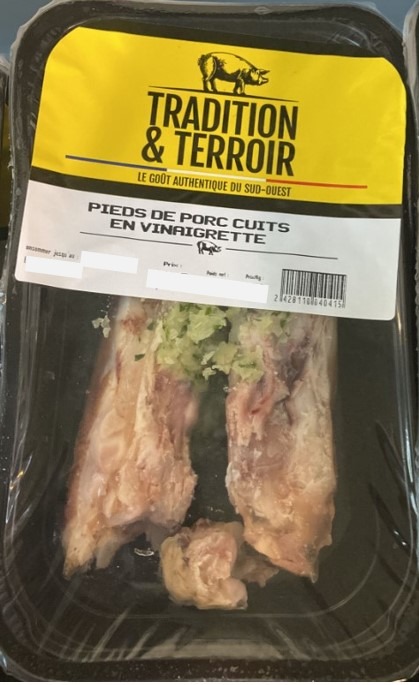
France – COOKED PORK’S FEET IN VINAIGRETTE – Listeria monocytogenes

Gov france

Identification information of the recalled product

  • Product category Feed
  • Product subcategory Others
  • Product brand name TRADITION & TERROIR
  • Model names or references COOKED PORK’S FEET IN VINAIGRETTE
  • Identification of products
    GTIN Batch Date
    2428110000000 231879002 Use-by date 07/26/2023
    2428110000000 231849005 Use-by date 07/23/2023
    231840001 Use-by date 07/23/2023
  • Packaging Pig’s trotters cooked in vinaigrette were also sold in the traditional department, the display of the recall is visible on the shelves of the stores concerned
  • Marketing start/end date From 03/07/2023 to 17/07/2023
  • Storage temperature Product to be stored in the refrigerator
  • Health mark EN 33.550.010 CE
  • Further information Pig’s trotters cooked in vinaigrette were also sold in the traditional department, the display of the recall is visible on the shelves of the stores concerned
  • Geographic area of ​​saleWhole France
  • Distributors CARREFOUR, SYSTEM U, AUCHAN, INTERMARCHE, MONOPRIX, E.LECLERC, CASINO