Category Archives: Food Microbiology Research

UK – Three of four UK Listeria outbreaks unsolved in 2018

Food Safety News

The source of infection was not found for three of four Listeria outbreaks in England in 2018.

The one which was solved was an international outbreak that involved 12 cases in England from 2015 to 2018 and was traced to frozen sweetcorn and vegetables produced by Greenyard in Hungary.

The company found the cause of contamination, a persistent presence of Listeria monocytogenes in one of the freezing tunnels, and closed down this tunnel at the plant. In June 2019, the factory was sold to Roger & Roger, a producer of potato and corn snacks.

This multi-country incident included 54 clinical cases of listeriosis in Australia, Finland, Sweden, Denmark, Austria, and the UK with 10 deaths. The outbreak was detected in Finland using whole-genome sequencing (WGS).

Traceability information indicated that frozen corn was produced in Hungary and packed in Poland. It was found that people had eaten the frozen sweetcorn uncooked, although instructions on the packaging told consumers to cook it. Implicated frozen products were distributed to 116 countries.

The second incident involved four people with illness onset in 2017 and 2018. The third outbreak sickened three people and the final one had five reported cases all in 2018.

Research – Effects of smoke produced from smoldering plants on the Aspergillus flavus growth and production of aflatoxin in pistachio

Wiley Online

Aflatoxin (AF) contamination of the Iranian exporting pistachio has become a major problem in the last decades. In this study, the antifungal effects of smoke produced from the smoldering of several herbal plants were investigated. Four different ratios of plant weight/exposure time (5/5, 10/15, 15/30, and 20 g/45 min) were used from each plant material to smoke two isolates of Aspergillus flavus (A47 and A3), grown in potato dextrose agar (PDA). The results showed that the 20 g/45 min treatment using smoldering cinnamon bark, neem leaves, and clove flowers had efficient inhibitions of 100, 85, and 75%, respectively. Furthermore, the smoking of pistachio inoculated with a spore concentration of 1 × 106 / ml using 30 g of cinnamon bark, neem leaves, and clove flowers for 75 min was capable of preventing the production of different types of AF, that is, B1, B2, G1, and G2 in the treated products. There is a good potential to smoke pistachio with these three herbal plants and prevent the production of AF in pistachio during the handling, storage, and transportation.

UK – Post Implementation review – The Food Safety and Hygiene (England) Regulations 2013 (As Amended)

FSA

About this consultation

The Food Standards Agency is carrying out a post implementation review of the Food Safety and Hygiene (England) Regulations 2013 (As Amended). Details of the review are available in a draft report.

Purpose of the consultation

The Food Safety and Hygiene (England) Regulations 2013 (SI 2013 No. 2996) came into force on 31 December 2013. This routine Post Implementation Review (PIR) is required as part of the Statutory Review requirements of the legislation. In order to do this, the FSA has collated evidence from key stakeholders based on their views and experiences, including on any costs and benefits arising from its implementation.

Who will this consultation be of most interest to?

  • Food Business Operators
  • Competent Authorities – Local Authority Food Safety and Standards Teams

Details of consultation

These Regulations revoked and re-enacted, in whole or in part, a number of pieces of legislation into a single consolidated Statutory Instrument (SI). The Regulations have been amended since coming into force on 31 December 2013 by:

  • The Official Feed and Food Controls (England) (Miscellaneous Amendments) Regulations 2019 (SI 2019 No. 1476)
  • The Food Safety and Hygiene (England) (Amendment) Regulations 2016 (SI 2016 No. 868)
  • The Food Safety and Hygiene (England) (Amendment) Regulations 2014 (SI 2014 No. 2885)
  • The Official Feed and Food Controls (England) and the Food Safety and Hygiene (England) (Amendment) Regulations 2014 (SI 2014 No. 2748)

The requirements introduced by the amending SIs are reviewed as part of this exercise.

This PIR reviews the objectives of the consolidation exercise; the extent to which those objectives have been achieved; and whether they could be achieved by means that impose less regulatory burden. The PIR also considers evidence provided by interested parties on the effectiveness of the regulations and the extent to which they are still relevant.

A light touch review was considered proportionate for this combined PIR due to the low impact identified in the regulatory impact assessments.  The FSA view is that the Regulations remain effective and fit for purpose – based on routine engagement and monitoring of UK official controls and enforcement.

Within the report are a series of questions that we would welcome responses to. These are copied below.

  1. Do you agree with the view that the consolidated SI created a simplified system? Please explain your response with evidence where possible.
  2. How significantly do you feel the subsequent amendments to the consolidated SI reduced the benefits of the original consolidation?
  3. Do you agree with the view that there were no significant impacts resulting from the consolidated SI? Please explain your response with evidence where possible.
  4. Do you agree with the FSA conclusion that the consolidated SI remains effective and relevant in meeting the intended objectives? Please explain your response with evidence where possible.
  5. Do you agree with the FSA conclusion that there is no evidence of unnecessary or disproportionate burdens in the enforcement of the EU regulations in England?
  6. We would welcome any additional comments or views in relation to the consolidated SI or the proportionality of this PIR.  Please explain your response with evidence where possible.
  7. Do you have any views on the use of sanctions generally, or the inclusion of criminal sanctions, in The Food Hygiene and Safety (England) Regulations 2013? Please explain your response with evidence where possible.

Impacts

No significant impacts were identified by the FSA when undertaking the consolidation and no significant impacts were highlighted by respondents during the formal consultation in 2013, or during the consultations of the amending Regulations. No significant impacts have since been identified during this review of the regulations, including comments received through our engagement with key stakeholders.

Consultation pack

How to respond

Responses are required by close 4 September 2020. Please state in your response whether you are responding as a private individual or on behalf of an organisation/company (including details of any stakeholders your organisation represents).

Responses to this consultation should be sent by email to: foodhygiene.policy@food.gov.uk

Or by post to:

Michelle Beer

General Food Hygiene Policy

Food Policy Directorate, Food Standards Agency, Clive House,

70 Petty France, London, SW1H 9EX

Publication of response summary

Within three months of a consultation ending we aim to publish a summary of responses received and provide a link to it from this page.

You can find information on how we handle data provided in response to consultations in our Consultations privacy notice.

Further information

This consultation has been prepared in accordance with HM Government Consultation Principles (Opens in a new window). If an Impact Assessment has been produced, this is included in the consultation documents. If no Impact Assessment has been provided, the reason will be given in the consultation document.

Research – Synergistic antibacterial effect of nisin, ethylenediaminetetraacetic acid, and sulfite on native microflora of fresh white shrimp during ice storage

Wiley Online

This study aims to investigate the effectiveness of using nisin, ethylenediaminetetraacetic acid (EDTA), and sulfite alone or in combination in reducing Vibrio parahaemolyticus Salmonella enterica , and Pseudomonas fluorescens in broth and native microflora on raw Pacific white shrimp during ice storage. Nisin (50 ppm), EDTA (20 mM), alone or in combination were used to test on the growth of parahaemolyticus enterica , and fluorescens in broth. Nisin (50 ppm), EDTA (20 mM), sodium metabisulfite (1.25 and 0.625%), ice; alone or in combination were used on shrimps during 1°C storage for 10 days. Microbial and chemical changes were analyzed during shrimp storage. First, the combination of nisin and EDTA exhibited antibacterial effects against parahaemolyticus enterica , and fluorescens in broth. Second, in shrimp preservation, the combination of nisin, EDTA, and sulfite at a low dose of 0.625% exhibited higher antimicrobial activity than did a high dose of sulfite (1.25%). Based on aerobic bacteria counts, psychrotrophic bacteria, and TVB‐N, shrimp treatment with combination of nisin, EDTA, and low‐dose sulfite were still acceptable within 10 days of storage. Based on our findings, nisin and EDTA can be used to reduce uses of sulfite for shrimp preservation in the future.

Italy – Italy records nearly 80 HUS cases in 12 months

Food Safety News

Almost 80 hemolytic uremic syndrome (HUS) cases were registered between July 2019 and June 2020 in Italy.

The 77 patients came from 17 regions in the country while one person contracted HUS while abroad. Notification rates varied by region but were highest in Aosta Valley and higher than 1 case per 100,000 in Basilicata, Calabria, Liguria, Lombardy, Marche, Trento, and Bolzano.

Seventy of those affected were under 15 years of age. The median age of patients at the clinical onset of the disease was 2 years and 7 months for the past 12 months and the past decade.

Research – Survival of Staphylococcus aureus and Salmonella enteritidis on salted sardines (Sardina pilchardus) during ripening

PubMed

The ripening period for salted sardines ranges from 4 to 6 months, depending on the season. Sometimes producing industries need to distribute the product earlier owing to market needs, and when this happens the product’s safety needs to be assured. The purpose of this work was to study the survival of Staphylococcus aureus and Salmonella Enteritidis on salted sardines during a ripening period of 115 days. Salted sardines were inoculated with pure cultures of S. aureus and Salmonella Enteritidis (10(5) CFU/g of fish on day 0). After 5 days of ripening, the water activity value for the sardines decreased from 0.93 to 0.69. The survival of both pathogens and that of total viable cells were evaluated during the ripening process. Total viable counts decreased by 2 log units over the 115-day ripening period. Salmonella Enteritidis and S. aureus survived for 60 and 90 days, respectively. Therefore, the use of a 90-day ripening period could be effective in assuring the safety of the final product.

Research – Cold-sensitive staphylococci reveal a weakness

Science Daily

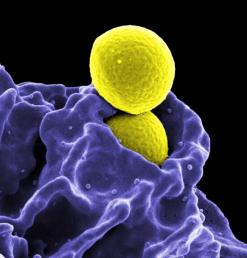
MRSA Staphylococcus KSW Food World

Image CDC

Staphylococcus aureus” — also known as “golden staph” — has the ability to develop in highly variable environmental conditions (on the skin, in the nose, on sterile surfaces, and so forth). Its great adaptability depends especially on a protein (an RNA helicase) involved in the degradation of RNA messengers that have become useless. In their attempts to have a better understanding of how this helicase works, scientists from the University of Geneva (UNIGE) discovered that it contributes to another physiological process, without any apparent link to the first: the synthesis of the fatty acids that are the essential constituents of the bacterial membrane. This advance, to be published in the journal PLoS Genetics, offers an interesting insight since fatty acid synthesis is precisely one of the targets favoured by numerous laboratories to fight this pathogen that is difficult to treat due to its resistance to antibiotics.

Golden staph (Staphylococcus aureus) is an opportunistic pathogenic bacterium that is capable of adapting to highly variable environments. It can be found in the nostrils of 25 to 30% of the population, although this is generally not a problem. However, the bacterium can take advantage of a drop in immunity or a surgical operation to trigger a real infection. And the problem with golden staph is its ability to develop resistance to antibiotic drugs, which often makes it difficult — sometimes impossible — to treat.

“My laboratory studies a protein, RNA helicase, which plays an important role in golden staph’s ability to adapt to very different environments,” begins Patrick Linder, a professor in the Department of Microbiology and Molecular Medicine in UNIGE’s Faculty of Medicine. “When the environment changes, the bacterium has to be able to synthesise new proteins that are more suitable and stop the production of others that are no longer useful. The helicase we’re interested in — called CshA — is involved in the degradation of the RNA, those molecules derived from the DNA and used in protein synthesis.”

Cold-sensitive bacteria

Oddly enough, when the helicase is absent (due, for example, to a genetic mutation), the researchers found that the cultured bacteria could no longer form colonies if the temperature dropped below a certain threshold (around 25°C).

The Geneva-based biologists undertook a series of experiments designed to improve our understanding of the link between golden staph’s sensitivity to cold, the degradation of the RNA and the adaptation capacity. They discovered that the same helicase is probably also required in another physiological process, namely the synthesis of fatty acids, which are the constituents of bacterial membranes.

“Using cultured golden staph stripped of helicases, we succeeded in isolating 82 gene mutations (appearing spontaneously in many different bacteria), which meant that their holders regained the ability to form colonies at 25°C,” continues Vanessa Khemici, a researcher in Patrick Linder’s laboratory and the article’s first author. “We identified almost all the affected genes, and no less than two thirds of them are involved in the fatty acid synthesis.”

The findings also helped the researchers understand that the lack of the helicase has the effect of deregulating the fatty acid synthesis and decreasing the flexibility of the membrane when the temperature drops. This prevents the membrane from fulfilling its functions properly and the bacterium from growing. In a second step, each of the 82 mutations succeeded in its own way in restoring the initial balance by acting on the different genetic levers involved in fatty acid synthesis.

Scientific controversy

“A section of the scientific community supports the idea that a future treatment against staphylococcus will involve a drug capable of inhibiting fatty acid synthesis,” notes Professor Linder, “but there is a controversy about it because some studies contradict this point of view.”

The results of the Geneva scientists do not provide a clear-cut answer or make it possible to directly develop a drug against these bacteria. Nevertheless, they fit into this context and provide a better understanding of golden staph’s fundamental mechanisms. The discovery of this unprecedented link between the fluidity of the membrane and adaptation to environmental change represents an important step in the fight against the bacterium. It is undoubtedly for these reasons that the journal decided to publish an overview in parallel with the article.


Story Source:

Materials provided by Université de GenèveNote: Content may be edited for style and length.


Journal Reference:

  1. Vanessa Khemici, Julien Prados, Bianca Petrignani, Benjamin Di Nolfi, Elodie Bergé, Caroline Manzano, Caroline Giraud, Patrick Linder. The DEAD-box RNA helicase CshA is required for fatty acid homeostasis in Staphylococcus aureusPLOS Genetics, 2020; 16 (7): e1008779 DOI: 10.1371/journal.pgen.1008779

Research – Antimicrobial efficacy of cinnamaldehyde, chitosan and high pressure processing against Cronobacter sakazakii in infant formula

Wiley Online

This study investigated the antimicrobial efficacy of trans‐cinnamaldehyde (TC) and chitosan (CH) along with high pressure processing (HPP) against Cronobacter sakazakii in infant formula. HPP, with or without TC, and CH, was applied to reconstituted powdered infant formula with C. sakazakii . Microbiological and sensory analyses, pH, protein oxidation, and emulsion stability of each sample were determined. C. sakazakii was totally inactivated by HPP (600 MPa for 5 min), TC (0.05%) and CH (1%) combination after 4, 6, and 2 weeks of storage at 7, 23, and 45°C, respectively. All HPP treatments exhibited a minimum of 5.5 log CFU/ml reduction while the highest reductions with non‐HPP treatments were 2.1, 1.1, and 3.7 log CFU/ml at 7, 23, and 45°C storage, respectively. Although TC exhibited a cinnamon‐like taste, overall sensory attributes were not significantly different from the control samples. Remarkable deformation and damage in C. sakazakii cells were observed by transmission electron microscopy after the application of HPP and bioactive compounds.

Research – New technology creates hard metal surfaces that kill bacteria

Food Safety News

A treatment to infuse hardened metal surfaces with naturally occurring antimicrobial peptides has been developed by researchers at Purdue University.

In other words, the Purdue research team’s technology can create hard metal surfaces that kill bacteria trying to attach to it.

David Bahr, team leader and professor of materials engineering at Purdue, said this technology applies primarily to food processing and cutting surfaces, which can be especially vulnerable to bacteria growth because of the materials and surface designs.

This technology can reduce the risk of cross-contamination. Cross-contamination is the transfer of harmful bacteria to food from other foods, cutting boards, utensils, etc. This is especially true when handling raw meat, poultry, and seafood, as placing them on the same hard surface as already cooked or ready-to-eat foods and fresh produce can spread harmful bacteria.

Legionella – What Landlords Need to Know About Legionella

Legionella Control 

This article provides a compilation of the most frequently asked questions we receive from landlords about the control of legionella in their properties and what they need to do to comply with the law. It covers a range of popular questions with comprehensive answers from our experts, along with a number of free downloads (full versions) for key guides produced by the Health and Safety Executive dealing with the control of legionella including their ACOP L8 and HSG274 Parts 1, 2 and 3.