Category Archives: Food Microbiology Research

USA -FDA Warning Letter – 5,000 Years Foods, Inc.

FDA

The U.S. Food and Drug Administration (FDA or we) inspected your kimchi operation located at 3465 N. Kimball Ave, Chicago, IL 60618 from June 14, 2021 through August 3, 2021. FDA conducted this inspection as a follow up to the Regulatory Meeting held with your firm on February 21, 2019.

During the inspection, FDA investigators found serious violations, described below, of the Current Good Manufacturing Practice, Hazard Analysis, and Risk-Based Preventive Controls for Human Food regulation (CGMP & PC rule), Title 21, Code of Federal Regulations, Part 117 (21 CFR Part 117). At the conclusion of the inspection, FDA issued an FDA Form 483, Inspectional Observations, listing deviations found at your facility.

Based on FDA’s inspectional findings, we have determined that the ready-to-eat kimchi products manufactured in your facility are adulterated within the meaning of Section 402(a)(4) of the Federal Food, Drug, and Cosmetic Act (the Act) [21 United States Codes (U.S.C.) § 342(a)(4)] in that they were prepared, packed, or held under insanitary conditions whereby they may have become contaminated with filth or whereby they may have been rendered injurious to health. In addition, failure to comply with the requirements under Section 418 of the Act [21 U.S.C. § 350h] is a prohibited act under section 301(uu) of the Act [21 U.S.C. § 331(vv)]. You can find the Act and FDA’s regulations through internet links in FDA’s home page at http://www.fda.gov.External Link Disclaimer

We received your written responses dated July 3, 2021, and August 17, 2021, which included a summary of corrective actions by your facility. After reviewing the inspectional findings and your response to the observations listed in the FDA Form 483, we are issuing this letter to advise you of FDA’s concerns and provide detailed information describing the findings at your facility.

Hazard Analysis and Risk-Based Preventive Controls (21 CFR Part 117, Subpart C):

1. Your hazard analysis did not evaluate known or reasonably foreseeable hazards to determine whether there are any hazards requiring a preventive control for your ready-to-eat kimchi products (e.g., sliced cabbage kimchi, cube cut radish kimchi, and white whole kimchi), as required by 21 CFR 117.130(a). Your “Hazard List” consisted of a number of potential hazards but did not evaluate which ones actually require a preventive control. Specifically:

a. You did not evaluate environmental pathogens, such as Listeria monocytogenes, to determine whether they are a hazard requiring a preventive control, to comply with 21 CFR 117.130(c)(1)(ii). For example, you manufacture ready-to-eat sliced cabbage kimchi which is exposed to the environment at the steps of cabbage halving, brining, rinsing, draining, chopping, mixing with sauce, and packaging. The kimchi does not receive a lethal treatment or otherwise include a control measure (such as a formulation lethal to the pathogen) that would significantly minimize the pathogen. Thus, environmental pathogens are a hazard likely to occur in the absence of preventive controls (i.e., sanitation controls). Your “Hazard List” identified but did not otherwise evaluate contamination from the “food handling environment.”

We note that at the start of the inspection, your written procedures for sanitation of food-contact surfaces consisted of a generic “Cleaning and Disinfection” document downloaded from the internet, which indicated general tips for completing and checking sanitation tasks. The document was not specific to your facility or food. In addition, your monitoring record was a general-facility (b)(4) “Cleaning Record” which did not specify what was being cleaned or monitored and which was not subject to record review. Further, deficiencies in your sanitation monitoring are evidenced by FDA investigators’ observations on June 14-15, 2021, that the (b)(4) that was cleaned, sanitized, and deemed ready for production of ready-to-eat kimchi had apparent food residue on the blades and behind the feed mechanism used to push the (b)(4) through the (b)(4) blades.

During the closeout meeting at the end of the inspection, you provided an updated blank sanitation monitoring record (“Environm[en]tal Cleaning & Sanitizing Log”) with a statement at the top on how to clean and sanitize specific pieces of food-contact equipment such as the (b)(4), cutting boards, preparing tables, utensils, and kimchi mixer. The form did not cover your tanks for cabbage brining and mixing. The form instructed to clean with soap and water but did not describe the type and concentration of soap or the tools and technique for cleaning. The form instructed to sanitize the equipment “using a mixture of (b)(4) of (b)(4) to (b)(4)” but did not actually describe how to sanitize the equipment with the solution.

FDA’s current inspection included the collection of environmental swabs on June 15, 2021, during the production of ready-to-eat kimchi, and confirmed five (5) of sixty-six (66) swabs positive for Listeria monocytogenes. Of the positive findings, three (3) swabs were collected from areas adjacent to food-contact surfaces where RTE ingredients were being prepared, including:

• Topside of a large white cutting board used to hold baskets of cabbage for draining after brining and rinsing. During our inspection, cabbage was observed hanging off the side of the baskets and in direct contact with cutting boards.
• Underside of a white cutting board was used to hold draining baskets of cabbage.
• Side of wet and difficult to clean wooden crate used to hold cutting boards that were holding the draining baskets of cabbage.

Whole genome sequencing (WGS) was conducted on the above referenced L. monocytogenes isolates obtained from the FDA environmental samples. Based on the results of the WGS analysis, the environmental samples collected at your facility represent one (1) unique strain. We advised you of the importance of these WGS results via a conference call on September 10, 2021.

L. monocytogenes is a pathogenic bacterium that is widespread in the environment and may be introduced into a food processing facility from raw materials, humans or equipment. Without proper controls, it can proliferate in food processing facilities where it may contaminate food. Once L. monocytogenes is established in a production area, personnel or equipment can facilitate the pathogen’s movement and contamination of food-contact surfaces and finished product. It is essential to identify the areas of the food processing plant where this organism is able to survive, and to take such corrective actions as necessary to eradicate the organism by rendering these areas unable to support the survival and growth of the organism and prevent the organism from being re-established in such sites.

Note that environmental monitoring is required when contamination of a ready-to-eat food with an environmental pathogen is a hazard requiring a preventive control (see 21 CFR 117.165(a)(3)). Environmental monitoring is used to verify that sanitation preventive controls are designed and functioning to reduce the hazard of environmental pathogens such as Listeria monocytogenes contaminating your finished product.
USA – FDA Core Investigation Table Update

FDA

Date
Posted
Reference
#
Pathogen
Product(s)
Linked to
Illnesses

(if any)
Investigation
Status
2/2/

2022

1054 Enteroinvasive E. coli
O143:H26
Not Yet Identified Active
1/10/

2022

1050 E. coli
O121:H19
Romaine Active
12/29/

2021

1052 E. coli
O157:H7
Packaged Salad Active
12/20/

2021

1039 Listeria
monocytogenes
Packaged Salad Active
12/15/

2021

1048 Listeria
monocytogenes
Packaged Salad Active

Research – Hepatitis E virus defies alcohol-based hand disinfectants

Science Daily

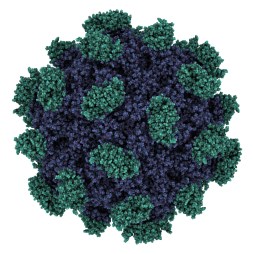
Hepatitis E virus capsid structure. HEV infection causes viral h

The hepatitis E virus (HEV) can cause serious liver inflammation and is the most common cause of acute virus-mediated hepatitis worldwide. Infection can be prevented through appropriate hygiene measures. Scientists from TWINCORE, Centre for Experimental and Clinical Infection Research, the Hannover Medical School (MHH) and the Ruhr Universität Bochum (RUB), together with partners from industry, have investigated the effectiveness of various common hand disinfectants against HEV. They were able to show that most formulations do not completely inactivate the virus.

In Germany and Europe, HEV has its natural reservoir in pigs. The infection can spread from animals to humans, which is called a zoonosis. This often happens through incompletely heated or raw meat products such as minced meat. In tropical regions of the world, infections occur via contaminated water, sometimes causing large outbreaks. “Some of these infections could possibly be prevented with the right hygiene measures,” says Dr. Patrick Behrendt, physician in the Department of Gastroenterology, Hepatology and Endocrinology at the MHH and head of the junior research group “Translational Virology” at TWINCORE. This includes, above all, correct hygienic hand disinfection in everyday clinical practice when dealing with hepatitis E patients and infected animals.

Together with the team of Professor Eike Steinmann, head of the Department of Molecular and Medical Virology at RUB, Behrendt has investigated whether common hand disinfectants can render the virus harmless. “We tested the effect of the alcohols ethanol and propanol, both individually and in the mixing ratios recommended by the WHO, and also commercial hand disinfectants,” says Steinmann. “However, only one product that contained another component was effective.”

Canada – Warning not to consume Nova smoked salmon sold by Kiryas Tosh supermarket

MAPAQ

WARNING TO THE POPULATION

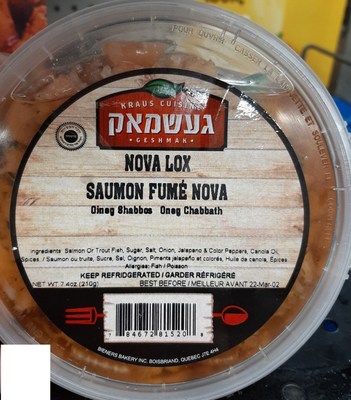
QUEBEC CITY, Feb. 2, 2022 /CNW Telbec/ – The Ministry of Agriculture, Fisheries and Food (MAPAQ), in collaboration with the Kiryas Tosh supermarket , located at 601, chemin de Tash, in Boisbriand , advises the population not to consume the product indicated in the table below, because it has not been packaged in such a way as to ensure its harmlessness.

Product name

Format

Affected lot

“NOVA smoked salmon”

210g

Units sold until February 2, 2022

The product that is the subject of this warning was offered for sale until February 2, 2022, and only at the establishment mentioned above. The product was packaged in a clear plastic container and was offered refrigerated. The product label bears the words “Kraus Cuisine”.

The operator is voluntarily recalling the product in question. It has agreed with MAPAQ to issue this warning as a precautionary measure. In addition, people who have this product in their possession are advised not to consume it. They must return it to the establishment where they bought it or throw it away. Even if the affected product shows no signs of tampering or suspicious odors, its consumption may represent a health risk. It should be noted that no case of illness associated with the consumption of this food has been reported to MAPAQ to date.

Additional information

The Ministry publishes various information documents concerning food safety. Interested persons can consult them in the “Food Consumption” section of the MAPAQ website: www.mapaq.gouv.qc.ca/consommation . They also have the possibility of registering online, by visiting www.mapaq.gouv.qc.ca/rappelsfoods , to receive, by e-mail, the food recall press releases published by the Ministry. Finally, it is possible to follow “MAPAQfoods” on Twitter at the following address: www.twitter.com/MAPAQfoods .

Nova smoked salmon (CNW Group/Ministry of Agriculture, Fisheries and Food) 

Hazard Classification:  Class 1
Reference Number:  4488

Source:
Media relations
Direction des communications
Ministry of Agriculture, Fisheries
and Food
Tel. : 418 380-2100, extension 3512
www.mapaq.gouv.qc.ca

USA – Outbreak Investigation of Listeria monocytogenes: Dole Packaged Salad (December 2021)

FDA

FDA, along with CDC and state and local partners, is investigating a multistate outbreak of Listeria monocytogenes infections linked to Dole packaged leafy greens by epidemiologic, laboratory, and traceback data. According to the CDC, as of February 1, 2022, 17 people infected with the outbreak strain of Listeria monocytogenes have been reported from 13 states. Illnesses started on dates ranging from August 16, 2014 to December 30, 2021 (one case occurred in 2014 and the remaining cases occurred between 2018 and 2021). CDC investigated this outbreak in 2019 and 2020 but was unable to gather enough data to identify the source in the past. CDC reopened the investigation in November 2021 after reports of new illnesses.

FDA sent investigators to multiple Dole processing facilities to conduct on-site inspections while at the same time Dole initiated their own investigation. On December 22, 2021, Dole voluntarily recalled all products and brands from their Bessemer City, NC, and Yuma, AZ, facilities. On January 7, 2022, as a result of continued investigations, Dole issued a voluntary recall of additional products after Dole detected the presence of Listeria monocytogenes on equipment used in the harvesting of the raw iceberg lettuce also used in finished products processed in the Dole Springfield, OH, and Soledad, CA, facilities. These products were shipped throughout the United States and several provinces in Canada. FDA analyzed the positive sample collected by Dole from the harvesting equipment. Results from FDA’s WGS analysis showed that the strain of Listeria monocytogenes found on the harvesting equipment matches the strain causing illnesses in this outbreak.

In addition to this outbreak of listeriosis linked to packaged salads produced by Dole, FDA and CDC are currently investigating a separate Listeria outbreak linked to packaged salads produced by Fresh Express. These investigations are ongoing and additional information will be provided as it becomes available.

Recommendation

FDA recommends that anyone who received recalled products use extra vigilance in cleaning and sanitizing any surfaces and containers that may have come in contact with these products to reduce the risk of cross-contamination. Listeria can survive at refrigeration temperatures and can easily spread to other foods and surfaces.

All recalled products are now past their “Best if Used By” dates of November 30, 2021 to January 9, 2022. If consumers have expired recalled Dole salads in their homes, they should throw them away. The initial list of recalled products and the second list of recalled products are available on FDA’s website.


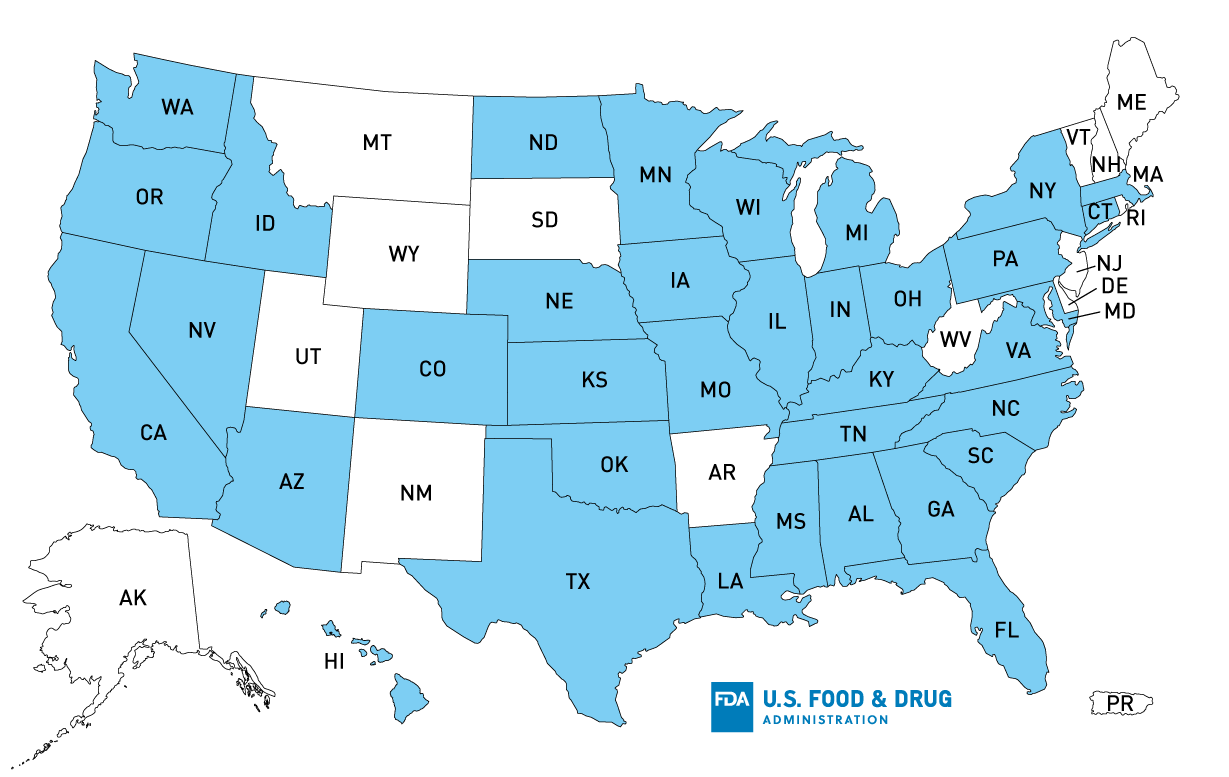
Map of U.S. Distribution of Recalled Packaged Salad

Outbreak Investigation of Listeria monocytogenes from Dole Packaged Salad - Map of U.S. Distribution of Recalled Packaged Salad (February 1, 2022)

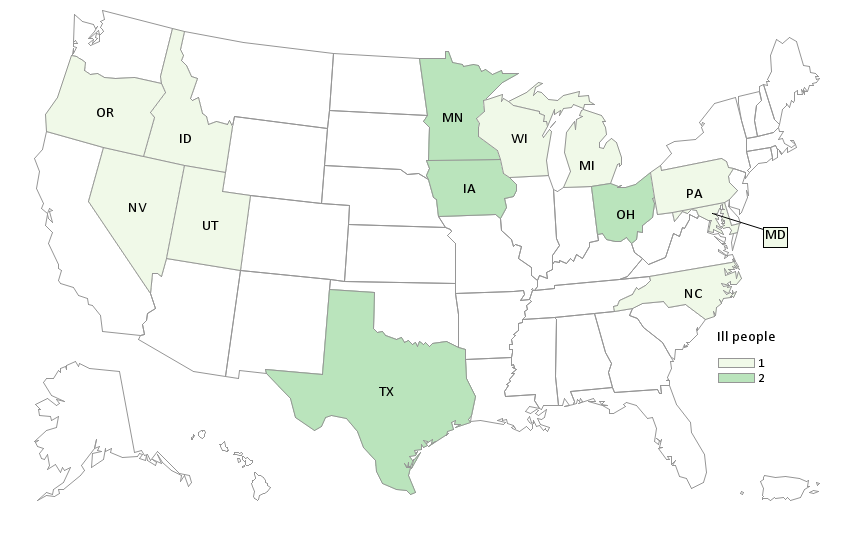
Case Count Map Provided by CDC

Outbreak Investigation of Listeria monocytogenes from Dole Packaged Salad - CDC Case Count Map (January 31, 2022)

Case Counts

Total Illnesses: 17
Hospitalizations: 13
Deaths: 2
Last illness onset: December 30, 2021
States with Cases: IA, ID, MD, MI, MN, NC, NV, OH, OR, PA, TX, UT, WI
Product Distribution*: AL, AZ, CA, CO, CT, FL, GA, HI,  IA, ID, IL, IN, KS, KY, LA, MA, MD, MI, MN, MO, MS, NC, ND, NE, NV, NY, OH, OK, OR, PA, SC, TN, TX, VA, WA, WI

*Distribution has been confirmed for states listed, but product could have been distributed further, reaching additional states

Australia – Salmonellosis in Australia 2020

Health Au

kswfoodworld salmonella

Abstract

Background

More than seventy per cent of salmonellosis in Australia is thought to be due to contaminated food. Rates of salmonellosis vary across the Australian states and territories, with the highest rates in the Northern Territory. In 2020, to control coronavirus disease 2019 (COVID-19), Australia implemented public health measures including border closures, physical distancing and hygiene advice. This study analyses salmonellosis notification rates in 2020 and considers possible impacts of COVID-19 measures.

Methods

Monthly and annual salmonellosis notifications per 100,000 population, for each of Australia’s eight states and territories for the years 2015 to 2020, were extracted from Australia’s publicly accessible National Notifiable Diseases Surveillance System. For each jurisdiction, the salmonellosis rate each month in 2020 was compared with the previous 5-year median rate for that calendar month. The possible impacts of COVID-19 public health measures on salmonellosis notifications in the respective states and territories were examined.

Results

The annual Australian salmonellosis notification rate was 27% lower in 2020 than the previous 5-year median. The reduction in salmonellosis rate varied throughout Australia. States and territories with more stringent, more frequent or longer COVID-19 public health measures had generally greater salmonellosis rate reductions. However, Tasmania had a 50% deeper reduction in salmonellosis rate than did the Northern Territory, despite similar restriction levels.

Conclusions

Salmonellosis notifications decreased in Australia during the global COVID-19 pandemic. The reduction in notifications corresponded with the implementation of public health measures. Persistence of high rates in the Northern Territory could indicate the overarching importance of demographic and environmental factors.

Research – Zoonoses and foodborne outbreaks guidance for reporting 2021 data

EFSA

This technical report of the European Food Safety Authority(EFSA)presents the guidance to reporting European Union(EU)Member States and nonMember States in data transmission using extensible markup language (XML)data transfer covering the reporting of prevalence data on zoonoses and microbiological agents and contaminants in food, foodborne outbreak data, animal population data and disease status data. For data collection purposes, EFSA has created the Data Collection Framework(DCF)application. The present report provides data dictionaries to guide the reporting of information deriving from 2021under the framework of Directive 2003/99/EC, Regulation (EU) 2017/625andCommission Implementing Regulation (EU) 2019/627.The objective is to explain in detail the individual data elements that are included in the EFSA data models to be used for XML data transmission through the DCF. In particular, the data elements to be reported are explained, including information about the data type, a reference to the list of allowed terms and any additional business rule or requirement that may apply.

USA – FSIS Issues Public Health Alert for Ready-To-Eat Chicken Salad Products Due to Possible Listeria Contamination

FSIS USDA

WASHINGTON, Jan. 28, 2022 – The U.S. Department of Agriculture’s Food Safety and Inspection Service (FSIS) is issuing a public health alert due to concerns that ready-to-eat (RTE) chicken salad products produced by Simply Fresh Market, a Marietta, Ga. establishment, may be contaminated with Listeria monocytogenes. A recall was not requested because the known affected product is no longer available in commerce for consumers to purchase.

The RTE chicken salad with apples and walnuts items were produced on Jan. 17, 2022. The following product is subject to the public health alert [view label]:

  • 8-oz and 16-oz. deli hinged containers of “simply fresh MARKET CHICKEN SALAD Apples & Walnuts” with a sell by date of “1/25” printed on the label.

The products bear establishment number “EST. P47170” inside the USDA mark of inspection. These items were shipped to three local markets in Atlanta, Ga.

The problem was discovered when the company notified FSIS that product sampling reported positive Listeria monocytogenes results.

There have been no confirmed reports of adverse reactions due to consumption of these products. Anyone concerned about an illness should contact a health care provider.

Consumption of food contaminated with L. monocytogenes can cause listeriosis, a serious infection that primarily affects older adults, persons with weakened immune systems, and pregnant women and their newborns. Less commonly, persons outside these risk groups are affected.

Listeriosis can cause fever, muscle aches, headache, stiff neck, confusion, loss of balance and convulsions sometimes preceded by diarrhea or other gastrointestinal symptoms. An invasive infection spreads beyond the gastrointestinal tract. In pregnant women, the infection can cause miscarriages, stillbirths, premature delivery or life-threatening infection of the newborn. In addition, serious and sometimes fatal infections can occur in older adults and persons with weakened immune systems. Listeriosis is treated with antibiotics. Persons in the higher-risk categories who experience flu-like symptoms within two months after eating contaminated food should seek medical care and tell the health care provider about eating the contaminated food.

FSIS is concerned that some product may be in consumers’ refrigerators. Consumers who have purchased these products are urged not to consume them. These products should be thrown away or returned to the place of purchase.

Click to access PHA-Simply-Fresh-Label-1-28-22.pdf

Research – Legionellosis: Diagnosis and Control in the Genomic Era

CDC

CDC legionella

Hundreds of books and textbook chapters, and thousands of journal review articles, have been published on Legionnaires’ disease and Legionella spp. bacteria over the past 45 years, making it important to decide whether this new and quite expensive compilation of reviews is worth acquiring (Figure). The field has become so specialized that even those who know one aspect of it may need a good review of other aspects to easily catch up on recent trends. The book contains chapters on the freshwater ecology of the bacterium; molecular and pathogenic aspects of virulence-associated bacterial secretion systems; very selected aspects of epidemiology; clinical aspects and treatment; laboratory diagnosis; and strain typing methods from serologic to whole-genome sequencing. Some chapters are more current than others. The most recent references for several chapters were published in 2016, and only 1 chapter cites references published in 2020. The book is lightly edited; some of the chapters contain overlapping material, but overall it has few typographical or spelling errors. Not all of the figures are properly labeled; for example, the figure legends in chapter 6 are reversed, and not all of the figure legends in chapter 3 fully explain the meanings of different colors and abbreviations.

I found that several of the chapters contained quite useful information that would be hard to find elsewhere, including a thorough review of L. pneumophila virulence secretory systems, as well as a review of the freshwater ecology of the bacterium, the clinical microbiology and clinical significance of Legionella spp. other than L. pneumophila, and regulatory and risk management strategies for control of the disease. Other readers, depending on their fields of interest and expertise, will find other chapters of particular interest. The chapter on non–whole-genome sequencing methods for strain typing for epidemiologic investigation is well done and could be of interest for those trying to dissect the older literature. Missing from the book, presumably by design, are a chapter reviewing in detail the ecology of the bacterium in the built environment, practical guidance on outbreak investigation, advanced techniques in epidemiologic source investigation, molecular and cellular pathogenesis other than secretion systems, and the molecular evolution of the bacterium, all of which can be found in other sources.

Is this book good value for money? Perhaps not for those who have a narrow interest in a specific field, because there are more up-to-date reviews on many of the topics in journal articles and some textbooks. For those who want to gain an overview of the topics covered in the book, some of which are more comprehensive than those found in textbooks or recent reviews, this may be a useful addition to their libraries.

Research – An Observational Study of the Impact of a Food Safety Intervention on Consumer Poultry Washing

Journal of Food Protection

Campylobacter kswfoodworld

This study tested the effectiveness of an educational intervention on consumer poultry washing using video observation of meal preparation with participants who self-reported washing poultry. Treatment group participants received three emails containing messages the U.S. Department of Agriculture has used on social media (video and infographics) related to poultry preparation, including advising against washing it. Participants were observed cooking chicken thighs (inoculated with traceable nonpathogenic Escherichia coli strain DH-5 alpha) and preparing a salad to determine whether they washed the chicken and the extent of cross-contamination to the salad and areas of the kitchen. After meal preparation, participants responded to an interview about food handling behaviors, including questions about the intervention for treatment group participants. Three hundred people participated in the study (158 control, 142 treatment). The intervention effectively encouraged participants not to wash chicken before cooking; 93% of treatment group participants did not wash the chicken compared to 39% of control group participants (P<0.0001). High levels of the tracer detected in the sink and on the salad lettuce suggest that microbes transferred to the sink from the chicken, packaging, or contaminated hands are a larger cause for concern than splashing contaminated chicken fluids onto the counter. Among chicken washers, lettuce from the prepared salad was contaminated at 26% for the control group and 30% for the treatment group. For nonwashers, lettuce was contaminated at 31% for the control group and 15% for the treatment group. Hand-facilitated cross-contamination is suspected to be a factor in explaining this cross-contamination. This study demonstrates the need to change the frame of “don’t wash your poultry” messaging to instead focus on preventing contamination of sinks and continuing to emphasize the importance of handwashing and cleaning and sanitizing surfaces.