Category Archives: cross contamination

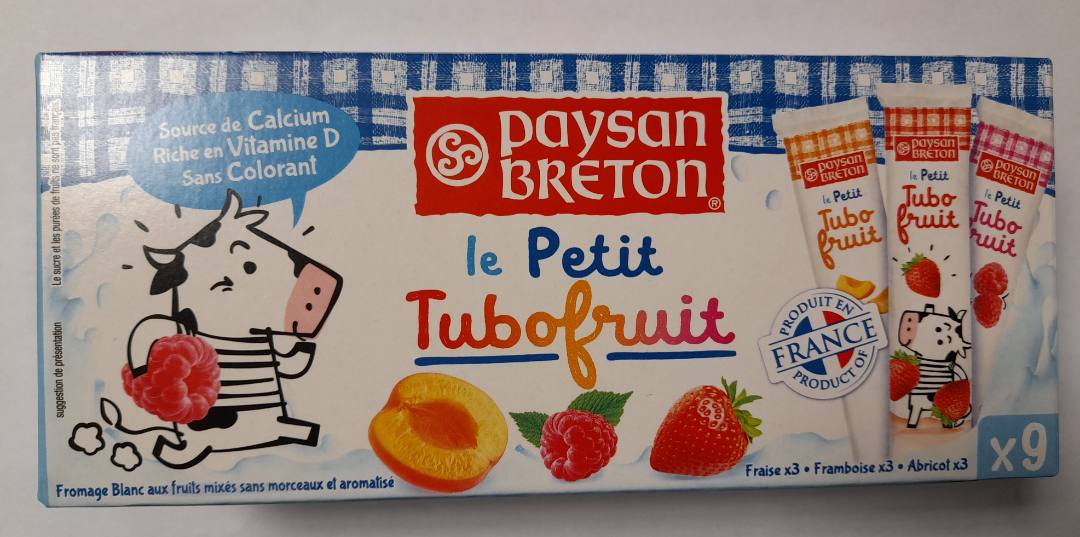
France – Tubofruit x9 – Bacterial Contamination

Gov france

Identification information of the recalled product

  • Product category Feed
  • Product subcategory Milk and dairy products
  • Product brand name Breton peasant
  • Model names or references Tubofruits x9 Paysan Breton
  • Identification of products
    GTIN Batch Date
    3412290007886 see attached product list Use-by date 02/14/2023
    3412290007886 see attached product list Use-by date 08/03/2023
    3412290007886 see attached product list Use-by date 03/21/2023
    3412290007886 see attached product list Use-by date 04/04/2023
    3412290007886 see attached product list Use-by date 04/18/2023
  • Products List traça_signal_conso_022023.pdfAttachment
  • Packaging Cardboard cases
  • Storage temperature Product to be stored in the refrigerator
  • Health mark EN 29.179.090 EC
  • Further information Tubes of white cheeses with fruits x9
  • Geographic area of ​​sale Regions: Guadeloupe, , , , French Guiana, , , , Martinique, , , , Mayotte, , , , Pays-de-la-Loire, , , , Réunion, , , , Overseas territories (tom)
  • Distributors All brands

Practical information regarding the recall

  • Reason for recall Precautionary measure due to a risk of product alteration that could make it unfit for consumption
  • Risks incurred by the consumer Other biological contaminants
    Organoleptic changes

USA – Conagra Brands Recalls Canned Meat and Poultry Products Due to Possible Packaging Defect

FSIS USDA

WASHINGTON, Jan. 31, 2023 – Conagra Brands, Inc., a Fort Madison, Iowa establishment, is recalling approximately 2,581,816 pounds of canned meat and poultry products due to a packaging defect that may cause the products to become contaminated without showing any outward signs of contamination, the U.S. Department of Agriculture’s Food Safety and Inspection Service (FSIS) announced today.

The meat and poultry products were produced between December 12, 2022, and January 13, 2023. The following products are subject to recall: [view spreadsheet] [view labels].

The products subject to recall bear establishment number “P4247” on the product cans. These items were shipped to retail locations nationwide.

The problem was discovered when the establishment notified FSIS after observing spoiled and/or leaking cans from multiple production dates at the establishment’s warehouse.

Subsequent investigation by the establishment determined that the cans subject to recall may have been damaged in a manner that is not readily apparent to consumers, which may allow foodborne pathogens to enter the cans.

There have been no confirmed reports of adverse reactions due to consumption of these products. Anyone concerned about an injury or illness should contact a healthcare provider.

Czech Republic – Tudlee Budapest spread – Microbial Contamination

Potravinynapranyri

Illustrative photo #5

Illustrative photo #9

Place of inspection:
Hodonín ( Dvořákova 4054/10, 695 01 Hodonín )
ID: 26178541
Food group: Cold food Other cold food

Tudlee Budapest spread
Category: Dangerous foods
Invalid parameter:

changes caused by microbial activity
content appearance

The packaging of the product was swollen, it was obvious that fermentation was taking place – bubbles were visible in the product. Food is not considered safe if it shows signs of spoilage. 

Unsuitable storage temperatures of this product were not detected during the inspection, the food did not have an expired use-by date.

Expiration date: 20/12/2022
Packaging: plastic tub with sealed printed foil and label
Quantity of the product in the package: 120 g
Producer: GASTRO-MENU EXPRESS as, Konská 199, 739 61 Třinec
Date of sample collection: 13/12/2022
Reference number: 23-000054-SZPI-CZ
The sample was detected by the official control of the State Agricultural and Food Inspection.

Research – Small Contaminations on Broiler Carcasses Are More a Quality Matter than a Food Safety Issue

MDPI

Abstract

Depending on the interpretation of the European Union (EU) regulations, even marginally visibly contaminated poultry carcasses could be rejected for human consumption due to food safety concerns. However, it is not clear if small contaminations actually increase the already present bacterial load of carcasses to such an extent that the risk for the consumers is seriously elevated. Therefore, the additional contribution to the total microbial load on carcasses by a small but still visible contamination with feces, grains from the crop, and drops of bile and grease from the slaughter line was determined using a Monte Carlo simulation. The bacterial counts (total aerobic plate count, EnterobacteriaceaeEscherichia coli, and Campylobacter spp.) were obtained from the literature and used as input for the Monte Carlo model with 50,000 iterations for each simulation. The Monte Carlo simulation revealed that the presence of minute spots of feces, bile, crop content, and slaughter line grease do not lead to a substantial increase of the already existing biological hazards present on the carcasses and should thus be considered a matter of quality rather than food safety.

Italy – Iceberg Lettuce Hearts – Microbiological Contamination

Salute

Brand : DESPAR

Name : HEARTS OF ICEBERG

Reason for reporting : Recall due to microbiological risk

Publication date : January 26, 2023

Documentation

Documentation

USA – DOJ Starts Criminal Investigation into Abbott Over Formula – Cronobacter

Food Poisoning Bulletin

According to news reports, the Department of Justice has started a criminal investigation into Abbott Laboratories in relation to the cronobacter contamination at the Abbott plant that caused a shutdown last year and the resulting baby food supply crisis that triggered a severe shortage of powdered baby formula. Cronobacter can cause serious illness in infants and can be deadly.

Austria – TANN Bacon 250g – Bacterial Contamination

AGES

AGES informs about a recall of the company SPAR. On January 20th, 2023, the company recalled the product TANN Jausenspeck 250g:
recall reason
Possible bacterial contamination
Marketed by
SAVE
Manufacturer
TANN
Expiry Date
02/23/2023
Batch number
6125040509, 6125110509, 6130121732, 6130141732, 6130342298

As a precaution, SPAR is recalling “TANN Jausenspeck 250g” in Vienna, Lower Austria and northern Burgenland

A possible bacterial contamination was found in the product “TANN Jausenspeck 250g” during a routine quality control.
The batches affected are:

  • 6125040509 – MHD: 01/19/2023
  • 6125110509 – MHD: 01/23/2023
  • 6130121732 – MHD: 07.02.2023
  • 6130141732 – MHD: 09.02.2023
  • 6130342298 – MHD: 02/23/2023

For this reason, SPAR is recalling the product with the stated best before dates. The bacon was only delivered in Lower Austria, Vienna and northern Burgenland. Other regions and batches are not affected.

SPAR asks customers not to consume the “TANN Jausenspeck 250g” with the batch numbers mentioned. All other TANN products are not affected by this recall.

All customers who have bought one of the products that may be affected can of course return it to the nearest SPAR, EUROSPAR or INTERSPAR store or Maximarkt. Customers are reimbursed the purchase price even without proof of purchase.

Customers who have questions about this are welcome to contact customer service at  office@spar.at  or call the free phone number 0800 / 22 11 20 .

original recall

Luxembourg – BLOCK OF DUCK FOIE GRAS WITH PIECES OF THE FEYEL BRAND – Microbial Contamination

SAP

Last name Block of duck foie gras with pieces
Brand Feyel
Unity 200g
bar code 3018258980002
Use-by date (DLC) 02/28/2024
Batch A035773FF

Danger  : unusual odor (organoleptic defect)

Different micro-organisms, which can harm human health, can be the cause of this organoleptic alteration of the product.

Sold in Luxembourg by: Pall Center Oberpallen

A sale by other operators cannot be excluded.

Source of information: RASFF (Rapid Alert System for Food and Feed)

Research – A Comprehensive Review of Variability in The Thermal Resistance (D-Values) of Food-Borne Pathogens—A Challenge for Thermal Validation Trials

MDPI

Abstract

The thermal processing of food relies heavily on determining the right time and temperature regime required to inactivate bacterial contaminants to an acceptable limit. To design a thermal processing regime with an accurate time and temperature combination, the D-values of targeted microorganisms are either referred to or estimated. The D-value is the time required at a given temperature to reduce the bacterial population by 90%. The D-value can vary depending on various factors such as the food matrix, the bacterial strain, and the conditions it has previously been exposed to; the intrinsic properties of the food (moisture, water activity, fat content, and pH); the method used to expose the microorganism to the thermal treatment either at the laboratory or commercial scale; the approach used to estimate the number of survivors; and the statistical model used for the analysis of the data. This review focused on Bacillus cereus, Cronobacter sakazakii, Escherichia coli, Listeria monocytogenes, and Clostridium perfringens owing to their pathogenicity and the availability of publications on their thermal resistance. The literature indicates a significant variation in D-values reported for the same strain, and it is concluded that when designing thermal processing regimes, the impact of multiple factors on the D-values of a specific microorganism needs to be considered. Further, owing to the complexity of the interactions involved, the effectiveness of regimes derived laboratory data must be confirmed within industrial food processing settings.


USA – FDA Core Investigation Table -Investigations of Foodborne Illness Outbreaks

fda

What’s New

  • While FDA’s overall response regarding powdered infant formula is continuing, this investigation of Cronobacter illnesses linked to powdered infant formula (reference #1056) has been marked as closed. Resources for Parents and Caregivers are available on the FDA website and additional updates will be provided as needed.
  • The outbreak of Salmonella Litchfield linked to seafood (reference #1105) is over and the FDA investigation has closed. 
  • The outbreak of Listeria monocytogenes linked to Brie and Camembert Cheese (reference #1106) is over and the FDA investigation has closed. 
  • The case count for the outbreak of Salmonella Typhimurium has increased from 270 to 274 cases.