Category Archives: Bacillus

Research – The growth characteristics of Bacillus cereus in sake and during its manufacture.

Journal of Food Protection

Sake (Japanese rice wine) has been recognized as being low-risk in terms of its microbiological safety. However, a confirmation of the food safety aspects of sake based on scientific evidence is important for establishing consumer confidence, in part because consumer concerns regarding food safety have increased. The presence of Bacillus cereus spores in refined rice wine has been reported, and in light of consumers’ growing concern over food safety, the establishment of food and beverage safety is important for consumers’ reassurance. Herein, to confirm the microbiological safety of sake, we investigated the content and growth of B. cereus. We conducted a spore addition test to determine whether B. cereus spores grow during sake production, and we observed no growth or germination of B. cereus spores during the manufacturing process. We also observed that processes such as solid-liquid separation and filtration help remove the risk posed by B. cereus. We then conducted a survey to assess the density of B. cereus in various commercial sake products. We analyzed 162 samples of commercial sake and observed that 11 of the products had ≥1 CFU of living cells in 1 mL of sake (detection rate: 6.8%). There was no product in which ≥100 CFU/mL-sake of living cells was detected. Our findings confirmed that the density of these bacteria in sake is lower than that in other foods, and the probability of infection is very low. The emetic toxin produced by B. cereus was not detected in any of the sake samples. This is the first study based on experimental data demonstrating that B. cereus is not able to grow in sake or during the sake manufacturing process. We thus conclude that the safety risk of B. cereus in sake is negligible. Our findings indicate that Bacillus cereus is not a significant hazard in the sake brewing process, and they will contribute to the food hygiene management based on scientific evidence in sake breweries.


Research – Surveillance of foodborne disease outbreaks in China, 2003–2017

Science Direct

Foodborne disease remains a major public health problem worldwide. To understand the epidemiology and changes of foodborne disease in China, data reported to the National Foodborne Disease Outbreak Surveillance System during 2003–2017 were collected. A total of 19,517 outbreaks, which resulted in 235,754 illnesses, 107,470 hospitalizations, and 1,457 deaths, were reported in this period. Of the 13,307 outbreaks with known etiology, 31.8% of outbreaks were caused by poisonous mushrooms, followed by Vibrio parahaemolyticus (11.3%), saponin (8.0%), Salmonella (6.8%), nitrite (6.4%), pesticide (4.8%), Staphylococcus aureus (4.2%) and Bacillus cereus (3.0%). Among 18,955 outbreaks with reported setting, 46.6% were associated with food prepared in a household, followed by 22.5% with food prepared in a restaurant, and 18.4% prepared in a canteen. Of the 13,305 outbreaks associated with a single food category, fungi (mainly poisonous mushroom) were the most commonly implicated food category, followed by meats, vegetables, aquatic animals, condiments, poisonous plants (such as saponin, tung oil or seed, aconite) and grains (such as rice, noodle, rice noodle). Analysis of foodborne disease outbreaks can provide insight into the most important causative agents and sources of foodborne disease, and assist public health agencies determine the high-risk etiology and food pairs, specific points of contamination and settings to reduce foodborne disease illnesses.

RASFF Alert – Bacillus cereus – Cooked Scorpions!

RASFF

Bacillus cereus (5.58x10E10 CFU/g) in cooked whole scorpions (Mesobuthus martensii) from Thailand in Germany

Research – Outbreaks, Germination, and Inactivation of Bacillus cereus in Food Products: A Review

JFP

ABSTRACT

Bacillus cereus has been reported as a foodborne pathogen worldwide. Although food processing technologies to inactivate the pathogen have been developed for decades, foodborne outbreaks related to B. cereus have occurred. In the present review, foodborne outbreaks, germination, inactivation, and detection of B. cereus are discussed, along with inactivation mechanisms. B. cereus outbreaks from 2003 to 2016 are reported based on food commodity, number of cases, and consequent illnesses. Germination before sporicidal treatments is highlighted as an effective way to inactivate B. cereus, because the resistance of the pathogen increases significantly following sporulation. Several germinants used for B. cereus are listed, and their efficacies are compared. Finally, recently used interventions with sporicidal mechanisms are identified, and rapid detection methods that have been developed are discussed. Combining two or more interventions, known as the hurdle technology concept, is suggested to maximize the sporicidal effect. Further study is needed to ensure food safety and to understand germination mechanisms and sporicidal resistance of B. cereus.

HIGHLIGHTS
  • Bacillus cereus has been associated with several foodborne outbreaks.
  • Several germinants have been used to induce Bacillus cereus germination.
  • Resistance of Bacillus cereus may depend on the germination method.
  • Sporicidal effect of interventions can be maximized by hurdle technology.

RASFF Alerts – Bacillus cereus – Food Supplements

European Food Alerts

RASFF

Bacillus cereus (up to 370 000 CFU/g) in and unauthorised irradiation of food supplement from Sweden in Finland

RASFF

Bacillus cereus (up to 160 000 CFU/g) and unauthorised substance magnesium orotate in food supplement from Sweden in Finland

RASFF

Bacillus cereus (between 49000 and 800000 CFU/g) in food supplement from Sweden in Finland

RASFF Alert – Bacillus cereus – Spicy Smoked Paprika Powder

RASFF-Logo

RASFF – Bacillus cereus (up to 23000 CFU/g) in spicy smoked paprika powder from Spain in Austria

Research – Biofilm-forming ability of pathogenic strains isolated from retail food in Poland

Journal of Food Protection

Biofilms have a significant impact on food safety in the food industry. Many foodborne outbreaks have been associated with pathogenic strains that can form a biofilm. The present study aimed to examine the ability to form biofilms by pathogenic strains collected from retail food samples under the Official Control and Monitoring Program in Poland. Biofilm formation was assessed by the qualitative detection of EPS production on Congo Red Agar, tube method, crystal violet biofilm assay, and MTT assay. A total of 40 isolates from food samples (10 strains for each of the species Listeria monocytogenes, Staphylococcus aureus, Escherichia coli, and Bacillus cereus ) were examined. . . The study classifies strains as adherent strain, slightly adherent, nonadherent (A, SA and N); as weak, moderate, and strong biofilm formation (WBF, MBF and SBF); and weak, moderate, and high metabolic activity (WMA, MMA and HMA). Incubation conditions and time influenced the biofilm levels formed. Moreover, growth medium had a significant impact on biofilm formation. Results showed that 22.5% strains demonstrated A type in LBB and 77.5% SA type in LBB in the test tube while the stronger adhesion was obtained in BHI with 2% sucrose. Among the isolates incubated in the BHI medium with 2% sucrose, A type was observed in 60% of isolates (60%).. CV assay result show that the after 24 h incubation in LBB, SBP was 7,5% while after 48 h – 37.5% tested strains. For BHI medium supplemented with 2% sucrose after 24 h incubation strains 42.5% was classified as SBP and 37.6% after 48h.MTT assay result indicate that 15% strains incubate in LBB (24h) was HMA, and after 48h incubation time HMA show 25%. For BHI medium supplemented with 2% sucrose after 24 h or 48 h incubation strains 70% and 85 % was classified as HMA.

Research – Optimization on antimicrobial effects of surfactin against Bacillus cereus spore

JFP

Abstract :The purpose of this study was to establish a three-variable bactericidal model of temperature, time, and concentration to determine the optimal conditions for Bacillus cereus  spore inactivation by surfactin. In order to obtain the binary regression equation of the inactivated spore model, a total of 17 simulations were performed using response surface methodology. The experimental results showed that the three factors each had a discernible but non-equal impact on the inactivation response value. Multiple regression analysis of experimental results using Design-Expert software yielded as the following equation: Optimal inactivation of spores was achieved by treatment with surfactin at a concentration of 4 mg/ml for 40 h at 53 °C, with the response value reaching 1.8. The spores were treated with surfactin under these conditions; the microstructural changes of spores were observed by scanning electron microscopy. We found that the structures of the outer wall of the spores were damaged, while the spores in the control sample showed no visible damage.

New Zealand – Soyummy brand Dr. Fermented Bean Paste – Bacillus Cereus

MPI

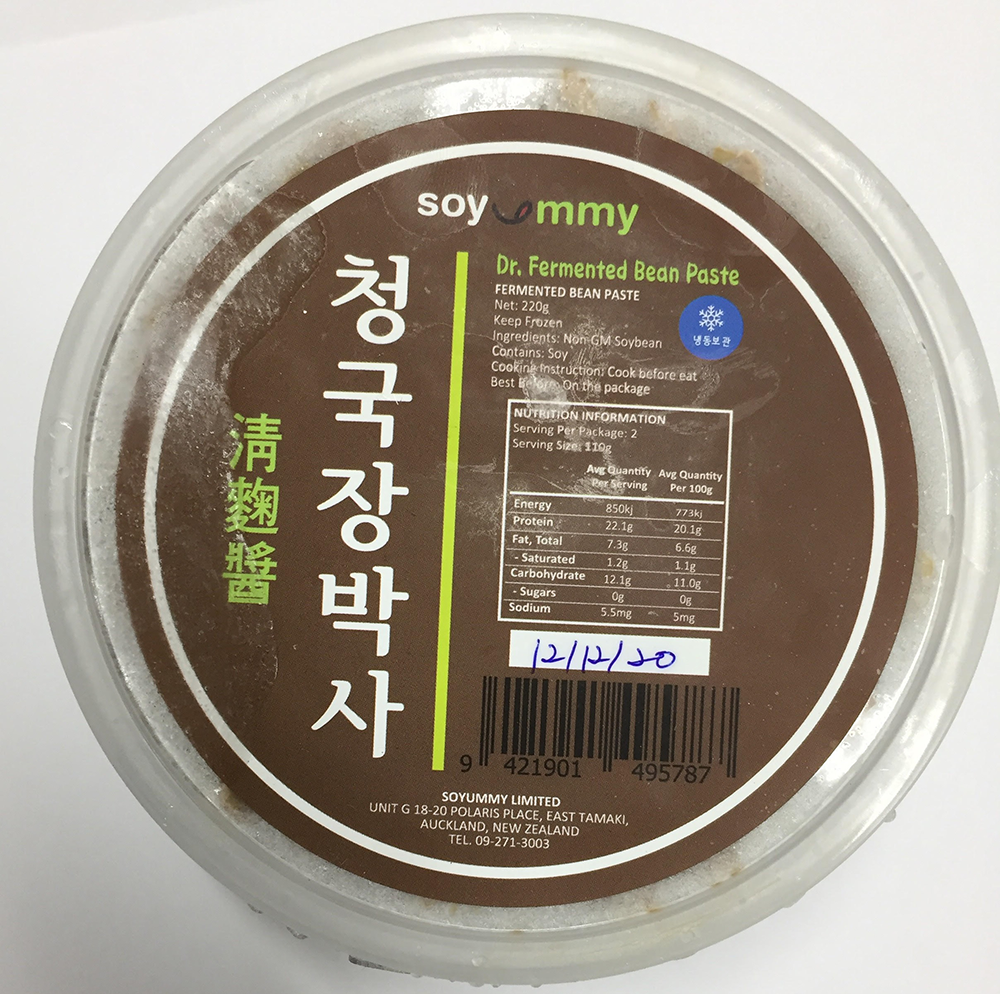
Soyummy Ltd is recalling specific batches of its Soyummy brand Dr. Fermented Bean Paste as the product contains elevated levels of Bacillus cereus bacteria.

Frozen plastic tub of Soyummy brand Dr. Fermented Bean Paste.
Soyummy brand Dr. Fermented Bean Paste (220g tub).


Product identification
Product type Soybean paste
Name of product (size) Soyummy brand Dr. Fermented Bean Paste (220g tub)
Date marking Best before: 30/09/20 and 13/12/20
Package size and description The product is sold frozen in a 220g plastic tub.
Distribution The affected product is sold in ethnic grocery stores throughout Auckland.
Notes This recall does not affect any other Soyummy brand products.

Consumer advice

Customers are asked to check the best before date on the lid of the product.

Affected product should not be consumed. There have been no reports of associated illness, however if you have consumed any of this product and have any concerns about your health, seek medical advice.

Customers should return the product to their retailer for a full refund.

Who to contact

If you have questions, contact Soyummy Limited:

  • Phone: 021 0261 4140
  • Address: Unit G, 18 Polaris Place, East Tamaki, Auckland.

Research – Examination of the Culturable Microbiota from Low-Moisture Foods Imported into Canada for Antibacterial Activity against Listeria monocytogenes

Journal of Food Protection

ABSTRACT

Listeria monocytogenes, a resilient and ubiquitous foodborne pathogen, is associated with a high case-fatality rate in humans. This study investigated the culturable microbiota of low-moisture foods (LMFs) imported into Canada to see how well bacteria isolated from these foods could inhibit or inactivate the growth of L. monocytogenes. Imported LMFs were acquired from various supermarkets in the Greater Toronto Area (Ontario, Canada). The foods included dried apples, bee pollen, cumin seeds, date fruits, fennel seeds, pistachios, raisins, and seaweed. Bacterial strains were isolated from the foods using blood agar and then screened using an in-house-designed growth inhibition plate assay against L. monocytogenes. The inhibitory strains detected were then identified using 16S rRNA sequencing. Diverse bacteria were recovered from the foods; 236 isolates belonging to 122 observed phenotypes were obtained. From the inhibition plate assays, 10 of the 11 imported LMFs harbored inhibitory strains against L. monocytogenes, whereby 48 of the collected isolates (20%) were found to produce a zone of inhibition against this pathogen. The inhibitory strains belonged to six genera (Acinetobacter, Aerococcus, Bacillus, Lysinibacillus, Paenibacillus, and Sporosarcina) and 15 unique species. Among all foods tested, the date fruit microbiota displayed the greatest number and diversity of anti–L. monocytogenes inhibitory strains. Overall, it was found that the culturable microbiota of LMFs, imported into Canada, possess bacterial members that can inhibit the growth of L. monocytogenes. These results could lead to the discovery of either novel antimicrobial metabolites or beneficial anti–L. monocytogenes bacteria that could be added to foods to inactivate and/or control L. monocytogenes.

HIGHLIGHTS
  • Modification to an inhibition plate assay detects anti-Listeria bacteria more rapidly.
  • Unconventional anti-Listeria genera, such as Lysinibacillus, were discovered.
  • Date fruit microbiota warrants further investigation for anti-Listeria applications.
  • Isolated bacteria from low-moisture foods are diverse and can inhibit L. monocytogenes growth.