Monthly Archives: October 2019

Information – 10 Dangerous Food Safety Mistakes

CDC

We all want to keep our families safe and healthy. But sometimes a simple mistake in the way we handle and prepare food can lead to serious sickness. With some germs like Salmonella, just a small amount in undercooked food is enough to cause food poisoning. And just a tiny taste of food with botulism toxin can cause paralysis and even death.

You can protect your family by avoiding these common food safety mistakes.

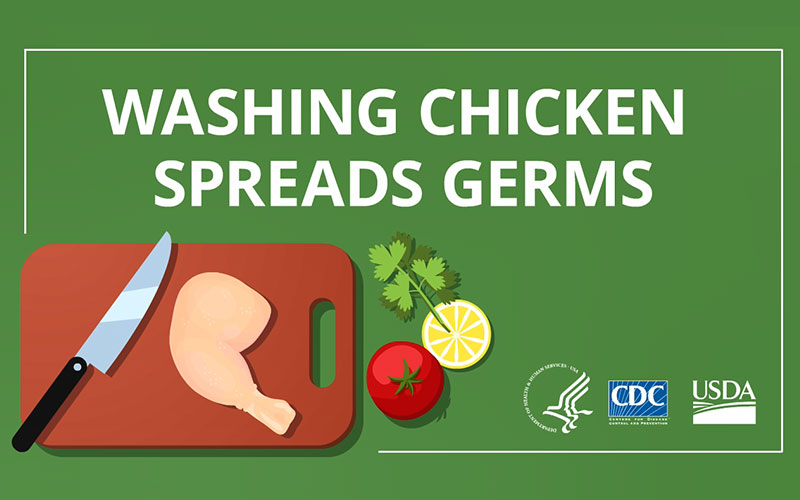
Washing Chicken Spreads Germs

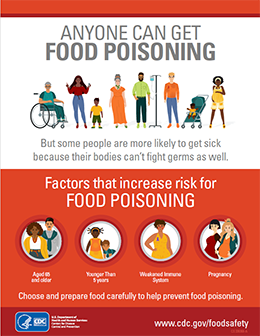
Thumbnail image of downloadable PDF about Food Poisoning.

cdcookie

Research -Occurrence, Seasonal Distribution, and Molecular Characterization of Vibrio vulnificus, Vibrio cholerae, and Vibrio parahaemolyticus in Shellfish (Mytilus galloprovincialis and Ruditapes decussatus) Collected in Sardinia (Italy)

Journal of Food Protection

ABSTRACT

In this study, we investigated the occurrence, seasonal distribution, and molecular characterization of pathogenic vibrios in Mediterranean mussels (Mytilus galloprovincialis) and grooved carpet shells (Ruditapes decussatus) from two harvesting areas of Sardinia (Italy). Samples collected before and after depuration were submitted for qualitative and quantitative determination of Vibrio spp. Vibrio spp. isolates were presumptively identified by means of biochemical methods. Identification and virulence profile of Vibrio cholerae, Vibrio parahaemolyticus, and Vibrio vulnificus were performed by molecular methods. The prevalence of Vibrio spp. in M. galloprovincialis and R. decussatus was, respectively, 96 and 77%. The averaged enumeration (mean ± standard deviation) of Vibrio spp. in samples of M. galloprovincialis and R. decussatus collected at the harvesting time was 2.04 ± 0.45 and 2.51 ± 0.65 log CFU/g, respectively. The average contamination levels in samples collected after purification were 2.28 ± 0.58 log CFU/g (M. galloprovincialis) and 2.12 ± 0.67 log CFU/g (R. decussatus). Four potentially pathogenic V. parahaemolyticus isolates (tdh+ or trh+) were recovered from grooved carpet shells samples. No isolate was tdh+/trh+. The presence of potentially pathogenic vibrios in Sardinian waters strengthens the need for rational purification practices under controlled conditions to guarantee the protection of consumers.

HIGHLIGHTS
  • Occurrence and pathogenicity characteristics of Vibrio pathogens were investigated.

  • Prevalence of Vibrio spp. in M. galloprovincialis was 96% and in R. decussatus was 77%.

  • Environmental conditions influence the occurrence of Vibrio spp.

  • Four V. parahaemolyticus isolates carried tdh or trh genes.

  • Rational purification practices are needed to guarantee the protection of consumers.

USA – Egg Rolls Recalled Because They Were Produced Under Insanitary Conditions

Food Poisoning Bulletin

T&R Enterprise USA Inc. of St. Louis, Missouri, is recalling about 118,000 pounds of meat and poultry egg rolls because they were produced and packed under insanitary conditions. No illnesses have been reported to date in connection with this recall. The recall notice did not go into more discussion about the potential problems with these products.

These meat and poultry egg rolls were produced on dates ranging from August 1, 2019 to September 25, 2019. They include:

  • 2 ounce cases containing 80 pieces of “SILVER LABEL PORK & VEGETABLE PROTEIN EGG ROLL.”
  • 2 ounce cases containing 120 pieces of “Dai Kin PORK & TEXTURED VEGETABLE PROTEIN EGG ROLL.”
  • 2 ounce cases containing 120 pieces of “TITA’S PORK & TEXTURED VEGETABLE PROTEIN EGG ROLL.”
  • 2 ounce cases containing 120 pieces of “TITA’S CHICKEN & TEXTURE VEGETABLE PROTEIN EGG ROLL.”

These products all have the establishment number “EST. 33792” or “P33792” inside the USDA mark of inspection. They were shipped to institutions in Georgia and Missouri.

Research – Potential Ad Hoc Markers of Persistence and Virulence in Canadian Listeria monocytogenes Food and Clinical Isolates

Food Protection Journal

ABSTRACT

The Listeria monocytogenes gene inlA, encoding a surface virulence protein, was examined for the presence of premature stop codon (PMSC) mutations in 82 isolates obtained by the Canadian Food Inspection Agency (CFIA) from foods and food contact surfaces. These mutations were coanalyzed for the presence of stress survival islet 1 (SSI-1) and for the abilities of the isolates to invade Caco-2 intestinal epithelial cells and form biofilms on polystyrene. PMSC mutations were present in one-third of the isolates (predominantly those of serogroup 1/2a), and their presence was correlated with a noninvasive phenotype. The presence of SSI-1 and the ability to form biofilms were also linked to the 1/2a serogroup. Serogroup 4b isolates lacked inlA PMSC mutations and were invasive, but neither formed biofilms nor carried SSI-1. To expand upon these experimental findings, an in silico analysis was performed on L. monocytogenes genomes from Canadian databases of 278 food isolates and 607 clinical isolates. The prevalence of inlA PMSC mutations in genomes of food isolates was significantly higher (P < 0.0001) than that in clinical isolates. Also, a three-codon deletion in inlA associated with a hyperinvasive phenotype was more prevalent in genomes from clinical isolates (primarily of clonal complex 6, serogroup 4b) than in those from food isolates (P < 0.001). In contrast, SSI-1 was significantly overrepresented (P < 0.001) in genomes from food isolates. We propose the hypothesis that SSI-1 and inlA play a role in the evolution of Canadian L. monocytogenes strains into either a virulent (represented by serogroup 4b clinical isolates) or an environmentally persistent (represented by serogroup 1/2a food isolates) phenotype. The combined presence of SSI-1 and inlA PMSC mutations have potential for use as genetic markers for risk assessment when L. monocytogenes is recovered from foods, indicating low potential for pathogenesis.

HIGHLIGHTS
  • Numerous Canadian food isolates of L. monocytogenes have attenuated virulence.

  • Food but not clinical Canadian L. monocytogenes strains often have inlA mutations.

  • Listeria strains carry potential markers of virulent or persistent phenotypes.

  • SSI-1 and inlA may be phenotypic markers for Canadian L. monocytogenes strains.

  • SSI-1 and inlA may indicate the health risk associated with L. monocytogenes food isolates.

USA -Another Case of Hepatitis A via a food service worker

Food Poison Journal

A case of Hepatitis A has been confirmed in a food worker at Popeyes Louisiana Kitchen on earl Core Road, according to the Monongalia County Health Department.

“While the risk of contracting Hepatitis A from a food worker is low, people who have not been vaccinated against Hepatitis A who have consumed food from the restaurant within the past two weeks should consider getting a Hepatitis A vaccine to prevent infection,” said Dr. Lee B. Smith, MCHD executive director and county health officer

RASFF Alerts – Aflatoxin – Dried Figs – Rice -Groundnut Kernels – Hazlenuts

RASFF-Logo

RASFF – aflatoxins (B1 = 255.4 / B1 = 30.8 µg/kg – ppb) in dried figs from Turkey in Italy

RASFF – aflatoxins (B1 = 19 µg/kg – ppb) in rice from Myanmar in Portugal

RASFF – aflatoxins (B1 = 20; Tot. = 23 µg/kg – ppb) in groundnut kernels from the United States in the Netherlands

RASFF – aflatoxins (B1 = 13.4; Tot. = 33 µg/kg – ppb) in dried figs garland from Turkey in Malta

RASFF – aflatoxins (B1 = 12.44 µg/kg – ppb) in shelled hazelnuts from Turkey in Italy

RASFF – aflatoxins (B1 = 20.4; Tot. = 22.1 µg/kg – ppb) in groundnuts with shell from the United States in Germany

RASFF – aflatoxins (B1 = 30.12; Tot. = 31 µg/kg – ppb) in dried figs from Turkey in Italy


RASFF Alerts – Salmonella – Frozen Pork Cheek – Chilled Whole Chicken – Frozen Poultry Meat Preparation -Frozen Turkey Breast – Frozen Kebab – MRM Chicken – Chicken Breast – Chicken Broiler – Black Pepper

RASFF-Logo

RASFF – Salmonella enterica ser. Typhimurium (presence) in frozen pork cheek from Poland in Estonia

RASFF – Salmonella enterica ser. Enteritidis (present /25g) in chilled whole chicken from Poland, via Estonia in Latvia

RASFF – Salmonella (presence /25g) in frozen poultry meat preparation from the Netherlands in the Netherlands

RASFF – Salmonella enterica ser. Saintpaul (present /25g) in frozen turkey breast from Poland, packaged in the Czech Republic in the Czech Republic

RASFF – Salmonella enterica ser. Agona (present /25g) in frozen kebab from Poland in the Czech Republic

RASFF – Salmonella (presence /10g) in chilled mechanically separated chicken meat from Belgium in Belgium

RASFF – Salmonella (present /25g) in frozen chicken breasts from Brazil in the Netherlands

RASFF – Salmonella enterica ser. Enteritidis (presence /25g) in chilled broiler from Poland in Latvia

RASFF – Salmonella (present /25g) in ground black pepper from Vietnam, packaged in Poland in Poland

RASFF Alert – Listeria monocytogenes – Frozen Red Kidney Beans

RASFF-Logo

RASFF – Listeria monocytogenes (presence /25g) in frozen red kidney beans used for ready-to-eat salad from China in the Netherlands

RASFF Alert – Mould – Cream Yoghurt

RASFF-Logo

RASFF – bulging packaging of cream yogurt from Germany infested with moulds in Germany

RASFF Alert – Bacillus cereus- Cinnamon and Curry

RASFF-Logo

RASFF – enterotoxin producing Bacillus cereus (6000 and 120000 CFU/g) in cinnamon and curry from the West Bank and Gaza Strip in Slovenia