Globally, the Vibrio parahaemolyticus and Vibrio vulnificus represent important human pathogens associated with the consumption of seafood. In response to the requests for scientific advice from Codex Committee on Food Hygiene (CCFH), risk assessments for the pathogens V. vulnificus, V. cholerae, V. parahaemolyticus and guidance on methods for the detection of Vibrio spp. with seafood have been conducted and published previously by JEMRA. In order to provide an update on the state-of-the-art advice regarding risk assessment for V. parahaemolyticus and V. vulnificus in seafood, an expert meeting was convened.
Several critical developments in the last decade were subsequently noted by the expert working group: 1) The emergence of highly pathogenic strains; 2) In response to climate change, there has been a significant geographical spread regarding when and where these seafood-associated Vibrio infections; 3) Demographic considerations are very important; 4) A range of new approaches for best practice; and 5) A range of new methods, such as those utilising genomics and satellite imagery. This report describes the output of that expert meeting.
A systematic analysis of the literature showed that 58% of infectious diseases in humans have been aggravated at some point by climatic hazards, such as changes in temperatures and water and food availability.
The leading pathogens responsible (eg, S aureus, E coli, K pneumoniae, S pneumoniae, and non-typhoidal Salmonella) have all been found to have climate-dependent reactions, causing an increase in their diffusion and even resistance to treatment.
For example, sharp temperature decreases have been associated with an increased incidence of pneumonia, and increased morbidity in cold and humid weather.
Although Shiga toxin-producing Escherichia coli (STEC) have been isolated from a variety of food production animals, they are most commonly associated with ruminants from which we derive meat and milk. Because of the widespread and diverse nature of ruminant-derived food production, coupled with the near ubiquity of STEC worldwide, there is no single definitive solution for controlling STEC that will work alone or in all situations. Instead, the introduction of multiple interventions applied in sequence, as a “multiple-hurdle scheme” at several points throughout the food chain (including processing, transport and handling) will be most effective.
This report summarizes the review and evaluation of interventions applied for the control of STEC in cattle, raw beef and raw milk and raw milk cheese manufactured from cows’ milk, and also evaluates available evidence for other small ruminants, swine and other animals. The information is presented from primary production, to the end of processing, providing the reader with information on the currently available interventions based on the latest scientific evidence.
This work was undertaken to support the development of guidelines for the control of STEC in beef, raw milk and cheese produced from raw milk by the Codex Committee on Food Hygiene (CCFH).
Listeriosis is a serious food-borne illness, especially in susceptible populations, including children, pregnant women, and elderlies. The disease can occur in two forms: non-invasive febrile gastroenteritis and severe invasive listeriosis with septicemia, meningoencephalitis, perinatal infections, and abortion. Expression of each symptom depends on various bacterial virulence factors, immunological status of the infected person, and the number of ingested bacteria. Internalins, mainly InlA and InlB, invasins (invasin A, LAP), and other surface adhesion proteins (InlP1, InlP4) are responsible for epithelial cell binding, whereas internalin C (InlC) and actin assembly-inducing protein (ActA) are involved in cell-to-cell bacterial spread. L. monocytogenes is able to disseminate through the blood and invade diverse host organs. In persons with impaired immunity, the elderly, and pregnant women, the pathogen can also cross the blood–brain and placental barriers, which results in the invasion of the central nervous system and fetus infection, respectively. The aim of this comprehensive review is to summarize the current knowledge on the epidemiology of listeriosis and L. monocytogenes virulence mechanisms that are involved in host infection, with a special focus on their molecular and cellular aspects. We believe that all this information is crucial for a better understanding of the pathogenesis of L. monocytogenes infection.
More than 100 students of a campus having several medical colleges in Maharashtra’s Nashik suffered food poisoning and some 55 of them continue to be in the hospital while others were discharged post-treatment, an official said on Thursday.
The students from SMBT Institute of Medical Sciences and Research Centre in Dharmagaon in the district’s Igatpuri taluka complained of nausea and stomach upset on Wednesday, he said.
The aim of this study was to investigate the level of strain variability amongst food and clinical Listeria monocytogenes isolates growing at low temperatures (4 and 7 °C) in both laboratory media and real food matrices. Isolates (n = 150) grown in laboratory media demonstrated a large variation in growth profiles measured using optical density.
Overall, it was noted that clinical isolates exhibited a significantly higher growth rate (p ≤ 0.05) at 7 °C than the other isolates. Analysis of variance (ANOVA) tests of isolates grouped using Multi Locus Sequence Typing (MLST) revealed that clonal complex 18 (CC18) isolates were significantly (p ≤ 0.05) faster growing at 4 °C than other CC-type isolates while CC101, CC18, CC8, CC37 and CC14 were faster growing than other CC types at 7 °C. Euclidean distance and Ward method-based hierarchical clustering of mean growth rates classified 33.33% of isolates as faster growing.
Fast and slow growing representative isolates were selected from the cluster analysis and growth rates were determined using plate count data in laboratory media and model food matrices. In agreement with the optical density experiments, CC18 isolates were faster and CC121 isolates were slower than other CC types in laboratory media, UHT milk and fish pie. The same trend was observed in chocolate milk but the differences were not statistically significant. Moreover, pan-genome analysis (Scoary) of isolate genome sequences only identified six genes of unknown function associated with increased cold tolerance while failing to identify any known cold tolerance genes. Overall, an association that was consistent in laboratory media and real food matrices was demonstrated between isolate CC type and increased cold tolerance.
A study found two mycotoxins in some packages of grated Grana Padano. Specifically, the paper found ochratoxin and sterigmatocystin, both produced by microscopic molds. The former was found in 48.6% of the cases analysed, while the latter was present in 94.4% of the packs of grated “grana” type cheeses sold in supermarkets. These would be small but significant quantities.
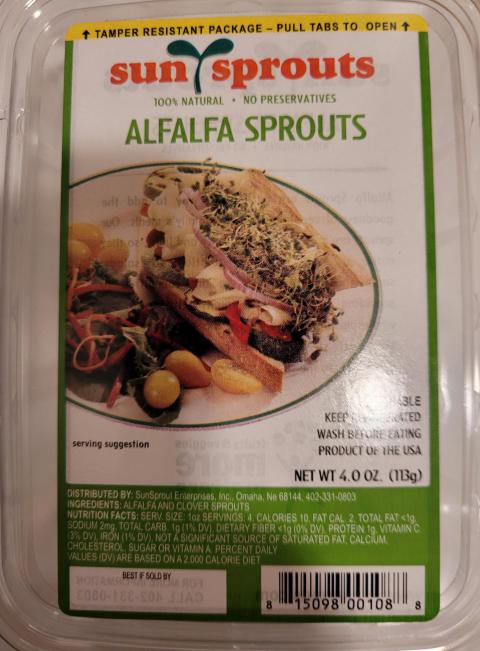
Fremont, Nebraska, December 29, 2022 – SunSprout Enterprises is voluntarily recalling four lots (#4211, 5211, 3212, and 4212) of raw alfalfa sprouts in 4-ounce clamshells and 2.5lb packages, with best by dates between 12/10/22 and 1/7/23, due to potential contamination with Salmonella.
Salmonella is an organism which can cause serious and sometimes fatal infections in young children, frail or elderly people, and others with weakened immune systems. Healthy persons infected with Salmonella often experience fever, diarrhea (which may be bloody), nausea, vomiting and abdominal pain. In rare circumstances, infection with Salmonella can result in the organism getting into the bloodstream and producing more severe illnesses such as arterial infections (i.e., infected aneurysms), endocarditis and arthritis.
The company directly distributed 1406 pounds of product to five foodservice and grocery customers in Nebraska, Kansas, and Iowa between late November and mid December 2022. No other SunSprout lot codes or products are impacted by this voluntary recall.
The raw alfalfa sprouts are packaged in 4-ounce clamshells and 2.5lb packages with best sold buy dates between 12/10/2022 and 1/7/2023 and lot codes #4211, 5211, 3212, and 4212. The best sold buy date can be found on the front of the package. The alfalfa sprouts are available in the produce section of grocery stores. To date, SunSprout has received no complaints or reports of illness due to this recalled product. This voluntary recall is a result of a preliminary investigation by the State of Nebraska in connection with CDC of an outbreak of illness likely associated with alfalfa sprouts. SunSprout, out of an abundance of caution, is initiating this voluntary recall while it further investigates how this alfalfa product was handled and stored after it left its Nebraska facility.
Customers with product from this lot number in their possession should stop using it and dispose of it immediately. Consumers are also encouraged to follow all safe handling instructions and wash their hands and all preparation surfaces after handling any raw product. If consumers have any questions, they can contact SunSprout by email at Admin@sunsprouts.com anytime, responses will be provided Monday–Friday, 8:00 a.m. through 5:00 p.m. CST.
This recall is being conducted in cooperation with the U.S. Food and Drug Administration. Photographs of the product label are below for ease of confirmation.
Caesar’s Pasta, LLC of Blackwood, NJ is recalling 5,610 lbs. of frozen manicotti, because it has the potential to be contaminated with Listeria monocytogenes, an organism which can cause serious and sometimes fatal infections in young children, frail or elderly people, and others with weakened immune systems. Although healthy individuals may suffer only short-term symptoms such as high fever, severe headache, stiffness, nausea, abdominal pain and diarrhea, Listeria infection can cause miscarriages and stillbirths among pregnant women.
Frozen manicotti was sold to various foodservice distributors, distributing to restaurants in the Philadelphia, PA; Harrisburg, PA; Southeastern NY State; Northeastern PA; and San Juan, PR markets. Product did NOT enter retail commerce.
Frozen manicotti was packaged in 10 lb. bulk boxes under the brand names Orefresco and Caesar’s Pasta with a “Best By” date of September 28, 2024.
No illnesses have been reported to date.
The product is categorized as “Not-Ready-To-Eat” and cooking instructions on the product label clearly state that product must be cooked to 160 degrees, which would effectively kill the bacteria.
The recall was the result of a routine sampling program, which revealed that the finished products may contain the bacteria. The FDA and the company continue their investigation as to what may have caused the problem.
Each of the company’s customers who received the affected product have been notified and have been provided with instructions to discard the product.