Do not use, sell, serve or distribute the affected product.
| Yoso | Unsweetened Coconut Plant-Based Yogurt | 440 g | Best Before: 24 JA 03 | 8 34914 00251 1 |
Yoso brand Unsweetened Coconut Plant-Based Yogurt recalled due to mould
Do not use, sell, serve or distribute the affected product.
| Yoso | Unsweetened Coconut Plant-Based Yogurt | 440 g | Best Before: 24 JA 03 | 8 34914 00251 1 |
Yoso brand Unsweetened Coconut Plant-Based Yogurt recalled due to mould
Posted in CFIA, food contamination, food handler, Food Hazard, Food Hygiene, Food Inspections, Food Micro Blog, Food Microbiology, Food Microbiology Blog, Food Microbiology Research, Food Microbiology Testing, Food Quality, food recall, Food Spoilage, Food Testing, mold, Mold/ MouldAscospores, Mould/Mold, Visible Mould/Mold
Because food poisoning and the stomach flu can present with similar symptoms, it can be difficult to tell them apart.
“While the symptoms of food poisoning and stomach bugs overlap, there is a difference in how quickly the symptoms arise,” Dr. Jackson says. “With food poisoning, rapid diarrhea and vomiting will begin within three to six hours of eating a contaminated food source. With a stomach flu, it’s a slower course, and the symptoms of vomiting and diarrhea may not show up for 12 to 24 hours. A person will start feeling unwell and queasy first.”
Posted in Food Poisoning, Norovirus, Poisoning
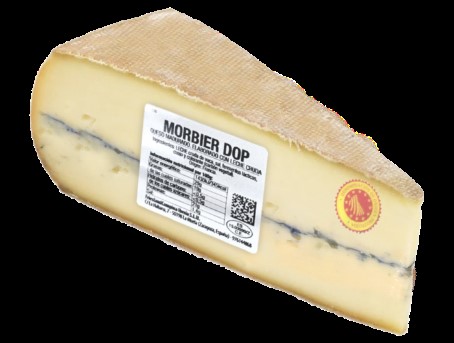
| The Spanish Agency for Food Safety and Nutrition (AESAN) has been informed by France, through the European Food Alert Network (RASFF), of the presence of Shiga toxin-producing Escherichia coli (STEC) in the product: matured processed cheese with raw milk.
People who have the products included in this alert at home are recommended to refrain from consuming them. |
The Spanish Agency for Food Safety and Nutrition has learned, through the European Food Alert Network (RASFF), of an alert notification sent by the French health authorities regarding the presence of Shiga toxin-producing Escherichia coli (STEC). ), in the product ripened cheese made with raw milk, MORBIER DOP.
The information included here is the result of the self-control of the company itself, which has reported the incident to the competent authorities, in compliance with the legislation and in order not to make unsafe food available to the population.
The data of the product involved are:
Available images are attached.

This information has been transferred to the competent authorities of the autonomous communities through the Coordinated System for Rapid Information Exchange (SCIRI), in order to verify the withdrawal of the affected products from marketing channels.
People who have products affected by this alert in their homes are recommended to refrain from consuming them.
If you have consumed any of the products from the affected batches and present any symptoms compatible with toxiinfection by E. coli that produces shiga toxins (severe abdominal cramps, which can progress to watery and bloody diarrhea), it is recommended to go to a doctor. clinic.
You can expand the information from the AESAN on toxiinfection by Shiga toxin-producing E. coli (STEC) at the following link
Posted in AESAN, food contamination, food handler, Food Hazard, Food Hygiene, Food Inspections, Food Micro Blog, Food Microbiology, Food Microbiology Blog, Food Microbiology Testing, Food Pathogen, Food Quality, food recall, Food Safety, Food Safety Alert, Food Safety Management, Food Safety Regulations, STEC, STEC E.coli
Baumann Käse AG has informed the cantonal laboratory of Bern and the Federal Office of
Food Safety and Veterinary Affairs (FSVO) than E. coli producing
Shiga toxins (STEC) had been highlighted in “Morbier Jeune AOP” in
raw milk from the Fromagerie de Montbéliard. A health risk that cannot be
excluded, the OSAV recommends not consuming the product concerned. Baumann Käse
AG immediately removed the affected product from sale and ordered a recall.
The following products are recalled in Luxembourg:

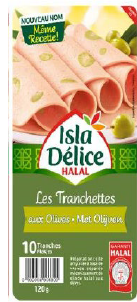
| Name | Olive slices (10 slices) |
| Brand | Isla Délice |
| Unit | 120g |
| Barcode | 3512690000149 |
| DLC/DDM | 01/07/2024 |
| Batch | 33340094 |

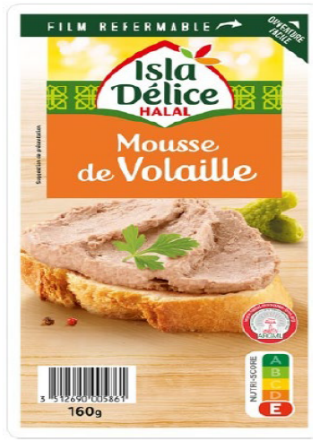
| Name | Poultry mousse |
| Brand | Isla Délice |
| Unit | 160g |
| Barcode | 3512690005861 |
| Date-bound batch (DLC/DDM) | 12/20/2023 / 33260012
12/27/2023 / 33330016 |

| Name | Beef flavor delight with olives |
| Brand | Isla Délice |
| Unit | 500g |
| Barcode | 3512690000842 |
| DLC/DDM | 05/14/2024 |
| Batch | 33200106 |
Danger : Possible presence of Clostridium botulinum
Graying on the surface of part of our production, linked to a non-compliant supplier ingredient. This situation does not exclude a Clostridium botulinum risk.
Botulism is a rare disease that most commonly results from eating contaminated food containing botulinum toxin produced by Clostridium botulinum . This toxin develops in particular in canned or sausage products made at home or at home for which the sterilization process has not been mastered. Symptoms usually appear 12 to 72 hours after ingesting contaminated food, but they can develop earlier or later (2 hours up to 10 days). Botulinum poisoning is characterized by neurological signs: sensation of blurred vision, drooping eyelids, speech problems, difficulty swallowing, dry mouth, muscle weakness. Digestive signs (constipation, vomiting, diarrhea) often accompany neurological signs.
The products can be distributed by different points of sale in Luxembourg.
Information Source: Recall Notification
Posted in Clostridium, Clostridium botulinum, food contamination, food handler, Food Hazard, Food Hygiene, Food Inspections, Food Micro Blog, Food Microbiology, Food Microbiology Blog, Food Microbiology Testing, Food Pathogen, Food Poisoning, Food Quality, food recall, Food Safety, Food Safety Alert, Food Safety Management, Food Safety Regulations, Food Testing, Food Toxin
| Date |
Ref | Pathogen or Cause of Illness |
Product(s) Linked to Illnesses (if any) |
Total Case Count |
Status |
| 12/6/
2023 |
1205 | Listeria monocytogenes |
Not Yet Identified |
3 | Active |
| 11/22/
2023 |
1201 | Salmonella Newport |
Not Yet Identified |
44 | Active |
| 11/22/
2023 |
1203 | Salmonella Sundsvall and Oranienburg |
Cantaloupe | See | Active |
| 11/15/
2023 |
989 | Listeria monocytogenes |
Peaches, Plums, and Nectarines |
See | Active |
| 11/8/
2023 |
1198 | Elevated Lead Levels |
Apple Cinnamon Puree |
See | Active |

FIVE roving exhibitions will be held in the following venues in January 2024. Details are as follows:
| Date | Time | Venue | Theme |
|---|---|---|---|
| 10/1 | 10am – 4pm | Quarry Bay Market | 5 Keys for Food Safety; Veterinary Drug Residues; Trans Fats |
| 15/1 | 10am – 4pm | Yeung Uk Road Market | Nutrition Labelling; Genetically Modified Food; Trans Fats |
| 19/1 | 10am – 4pm | North Point Government Offices | Acrylamide; Food Safety Advice for Pregnant Women; Enhance Food Traceability, Strengthen Food Safety |
| 24/1 | 10am – 4pm | Yee On Street Market | Nutrition Labelling; Enhance Food Traceability, Strengthen Food Safety; Ciguatoxins |
| 31/1 | 10am – 4pm | Shek Wu Hui Market | Enhance Food Traceability, Strengthen Food Safety; Pesticide Residues; Trans Fats |
New arrangements of the exhibitions will be announced regularly and members of the public are welcome to visit the CFS website. For any enquiries, please contact our Communication Resource Unit at 2381 6096.
Improving the identification of toxin-producing bacteria is a real challenge for understanding food poisoning episodes. As part of the Joint European “One Health” Program coordinated by ANSES, the agency coordinated a European collaborative project on the toxin-producing bacteria which cause the most collective foodborne illnesses (TIAC).
Staphylococcus aureus, Bacillus cereus and Clostridium perfringens were at the heart of the European TOX-Detect project. This trio was not chosen at random: they are the toxin-producing bacteria most frequently involved in collective foodborne illness (TIAC) . According to the European Union Zoonoses Report One Health 2021 published by the European Food Safety Authority (EFSA), bacterial toxins are the second leading cause of TIAC after bacteria themselves (17%). The project, coordinated by ANSES, began in 2018 for a duration of 3 years. It was funded by the One Health EJP program and involved the Institut Pasteur, INRAE as well as various partners from several European countries.
“ Depending on the bacterial strains, the expression of virulence factors is not the same. These virulence factors are, for example, the presence of adhesion proteins or the production of toxins, in food or in the body. They serve the bacteria to counter the defenses that the host could put up against them, explains Yacine Nia, co-coordinator of the project and deputy head of unit of the Staphylococcus, Bacillus, Clostridium (SBCL) unit, of the food safety laboratory. of Anses. The ability of the bacteria to harm the body will be higher or lower depending on these virulence factors. »
Most poisonings caused by the toxins of the three bacteria studied cause gastrointestinal symptoms (nausea, vomiting, abdominal pain, diarrhea). Deaths may occur, especially in the most sensitive subjects.

Product category
Food
Product subcategory
Meats
Product brand name
Unbranded
Model names or references
PISTACHIO PHEASANT BALLOTINE, cut catering section
Product identification
GTIN Batch
0203303000000 sold between 12/12/2023 and 12/15/2023
Packaging
In the cutting department
Start/end date of marketing
From 12/12/2023 to 12/15/2023
Storage temperature
Product to keep in the refrigerator
Geographical sales area
Reze
Distributors
LECLERC ATOUT SUD
Posted in food contamination, food handler, Food Hazard, Food Hygiene, Food Inspections, Food Micro Blog, Food Microbiology, Food Microbiology Blog, Food Microbiology Testing, Food Pathogen, Food Quality, food recall, Food Safety, Food Safety Alert, Food Safety Management, Food Safety Regulations, Food Testing, Listeria, Listeria France, Listeria monocytogenes

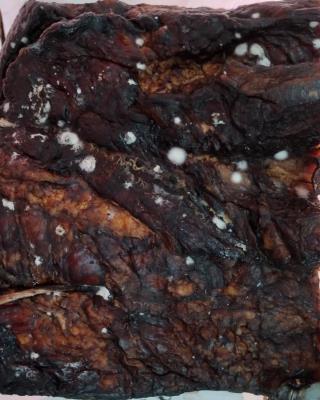
There were white mold colonies on the surface of the food. The product smelled of spoilage and had a slimy surface. Food is not considered safe if it shows signs of spoilage.
During the inspection, no unsatisfactory storage temperatures of this food were found.
| Date of sample collection: | 16/10/2023 |
| Reference number: | 23-000914-SZPI-CZ |