The product has been found to contain the pathogenic bacterium Campylobacter spp ., Which causes diarrheal disease. The food was evaluated as harmful to health
Food packaging with efficient antibacterial ability is highly desirable and challenging in facing the crisis of microbial contamination. However, most present packaging is based on metal-based antibacterial agents and requires a time-consuming antibacterial process. Here, the unique packaging (CC/BB films) featuring aggregation-induced emission behavior and photodynamic inactivation activity is prepared by dispersing self-assembled berberine–baicalin nanoparticles (BB NPs) into a mixed matrix of sodium carboxymethylcellulose-carrageenan (CC). The superiority of this design is that this packaging film can utilize sunlight to generate reactive oxygen species, thus eradicating more than 99% of E. coli and S. aureus within 60 min. Also, this film can release BB NPs to inactivate bacteria under all weather conditions. Surprisingly, the CC/BB nanocomposite film presented excellent mechanical performances (29.80 MPa and 38.65%), hydrophobicity (117.8°), and thermostability. The nanocomposite film is validated to be biocompatible and effective in protecting chicken samples, so this work will provide novel insights to explore safe and efficient antibacterial food packaging.
Some 250 women working at Foxconn’s iPhone factory in the southern Indian state of Tamil Nadu were treated for food poisoning this month. One-hundred-fifty-nine were hospitalized.
That prompted demonstrations against living conditions at company hostels that have kept the factory at Sriperumbudur, near Chennai, closed since December 18.
Apple said it has placed the plant “on probation” and is working with the supplier to rapidly implement “a comprehensive set of corrective actions.”
Researchers at the University of California-Davis have developed a new type of cooling cube with the potential, they say, to transform how cold storage is done.
The benefits of plastic-free, “jelly ice cubes” are that they do not melt, are compostable and antimicrobial, and can help prevent cross-contamination.
It can be easy for foodservice operators and their employees not to think about the food safety implications of how ice is used and handled. If they don’t take proper precautionary measures to handle food properly or keep up with necessary preventive maintenance measures to ensure that their ice machines are clean, sanitary and operating safely, there can be serious food safety risks. The researchers at the UC-Davis took note of this concern.
The researchers began working on their coolant cubes after Luxin Wang, an associate professor in the Department of Food Science and Technology, saw the amount of ice used at fish-processing plants and the cross-contamination that meltwater could spread among products or drains.
“The amount of ice used by these fish-processing sites is massive,” Wang said. “We need to control the pathogens.”
On December 27, 2021, Relish Foods, Inc of El Segundo, California voluntarily initiated the recall of Frozen Pacific Fusion Brand 10 oz Tuna Steaks. The recall was the result of a consumer complaint whereafter sampling by FDA revealed that the product has potential to contain elevated levels of histamines which can produce an allergic reaction called scombroid fish poisoning. Symptoms, including a tingling or burning sensation in the mouth, facial swelling, rash, hives and itchy skin, nausea, vomiting or diarrhea, can appear within minutes to several hours after eating the affected fish. If symptoms are severe, an individual should seek immediate medical attention for treatment. Relish Foods Inc is continuing the investigation with FDA as to what caused the problem.
Product was distributed in Northern California and made for sale at Save Mart Supermarkets and Lucky Stores from October 6th, 2021 potentially up to December 27th, 2021. Product was sold to consumers as frozen 10 oz tuna steaks. 10 oz tuna steaks sold individually would have been labeled with the following dates and production code: Production Date : July 2021 Best Before : July 2023 R11G2821D22A D2091A. This information can readily be found on the packaging of the individual tuna steaks in the top right corner:
Products not bearing these codes are not affected by or involved in this recall.
Consumers concerned about whether the tuna steaks they purchased may be part of the recalled product should check with the store from which they purchased the tuna. Currently Relish Foods does not believe that any affected product is still available for purchase by consumers. Apart from initial complaint, Relish Foods has not received any other complaints to date.
Consumers with questions may contact the company at 1-888-301-0881, Mondays through Fridays, 8 A.M. to 5 P.M. (PDT).
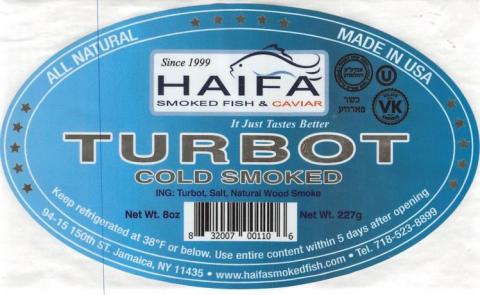
HAIFA SMOKED FISH of Jamaica, NY is expanding their recall of Turbot Cold Smoked 8 oz Packages to include 920 LB of Turbot from Lots 97, 223, 299, 321. The products have the potential to be contaminated with Listeria monocytogenes, an organism which can cause serious and sometimes fatal infections in young children, frail or elderly people, and others with weakened immune systems. Although healthy individuals may suffer only short-term symptoms such as high fever, severe headache, stiffness, nausea, abdominal pain and diarrhea, Listeria infection can cause miscarriages and stillbirths among pregnant women.
The following lots of Turbot Cold Smoked 8z Lots are being recalled:
Lot #97
Lot #223
Lot #246 (original recall)
Lot #299
Lot #321
The above lots of TURBOT COLD SMOKED 8 OZ were distributed to retail stores in New York and New Jersey Areas.
The product is packaged in clear plastic with a gold board that contains sliced Cold Smoked Turbot fish with a blue label that reads “Haifa Smoked Fish & Caviar Turbot Cold Smoked” Net wt. 8 oz/227g. Ingredients: Turbot, Salt and Natural wood smoke. On the back of the board, it will display a sticker that reads “LOT # 97; LOT #223; LOT #246; LOT # 299; LOT # 321.”
No illnesses have been reported up to date.
Consumers who have purchased Turbot Cold Smoked 8 oz Package LOTS # 97, 223, 246, 299, 321 are urged to return it to the place of purchase for a full refund.
Consumers with question may contact the company at 718 523-8899. Our hours of operation are Monday thru Friday 9am to 5pm Eastern Standard Time. Contact name: Dmitriy Yakubbayev.
Reference is made to the food warning published on December 23, 2021 at 3:10 p.m. As a precaution, all batches made from the same raw material are now being recalled.
Active foodpackaging materials that are sustainable, biodegradable, and capable of precise delivery of antimicrobial active ingredients (AIs) are in high demand. Here, we report the development of novel enzyme- and relative humidity (RH)-responsive antimicrobial fibers with an average diameter of 225 ± 50 nm, which can be deposited as a functional layer for packaging materials. Cellulose nanocrystals (CNCs), zein (protein), and starch were electrospun to form multistimuli-responsive fibers that incorporated a cocktail of both free nature-derived antimicrobials such as thyme oil, citric acid, and nisin and cyclodextrin-inclusion complexes (CD-ICs) of thyme oil, sorbic acid, and nisin. The multistimuli-responsive fibers were designed to release the free AIs and CD-ICs of AIs in response to enzyme and RH triggers, respectively. Enzyme-responsive release of free AIs is achieved due to the degradation of selected polymers, forming the backbone of the fibers. For instance, protease enzyme can degrade zein polymer, further accelerating the release of AIs from the fibers. Similarly, RH-responsive release is obtained due to the unique chemical nature of CD-ICs, enabling the release of AIs from the cavity at high RH. The successful synthesis of CD-ICs of AIs and incorporation of antimicrobials in the structure of the multistimuli-responsive fibers were confirmed by X-ray diffraction and Fourier transform infrared spectrometry. Fibers were capable of releasing free AIs when triggered by microorganism-exudated enzymes in a dose-dependent manner and releasing CD-IC form of AIs in response to high relative humidity (95% RH). With 24 h of exposure, stimuli-responsive fibers significantly reduced the populations of foodborne pathogenic bacterial surrogates Escherichia coli (by ∼5 log unit) and Listeria innocua (by ∼5 log unit), as well as fungi Aspergillus fumigatus (by >1 log unit). More importantly, the fibers released more AIs at 95% RH than at 50% RH, which resulted in a higher population reduction of E. coli at 95% RH. Such biodegradable, nontoxic, and multistimuli-responsive antimicrobial fibers have great potential for broad applications as active and smart packaging systems.