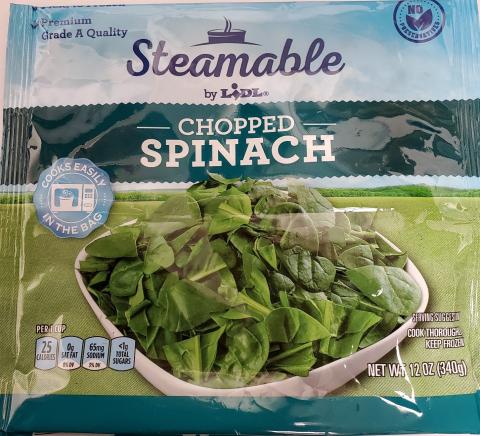
USA – Frozen Food Development Recalls Lidl Branded Chopped Spinach Because of Possible Health Risk – Listeria monocytogenes

FDA

Steamable by Lidl, Chopped Spinach, 12 oz. bag

Company Announcement

Frozen Food Development is voluntarily recalling specific lots of Lidl branded 12-ounce packages of Frozen Chopped Spinach because the product has the potential to be contaminated with Listeria monocytogenes, an organism which can cause serious and sometimes fatal infections in young children, frail or elderly people, and others with weakened immune systems. Although healthy individuals may suffer only short-term symptoms such as high fever, severe headache, stiffness, nausea, abdominal pain and diarrhea, Listeria infection can cause miscarriages and stillbirths among pregnant women.

The recalled Frozen Chopped Spinach was distributed in Lidl retail stores in GA, SC, NC, VA, MD, DE, NY, NJ, and PA.

The product comes in 12-ounce poly bags, and items included in the recall are marked with lot # R17742 or R17963 on the back of the poly bag with a best by date of 09/10/23.

No illnesses have been reported to date in connection with this problem.

The potential for contamination was noted after routine testing revealed the presence of Listeria monocytogenes in 12-ounce packages of Lidl Frozen Chopped Spinach.

The production of the product has been suspended while FDA and Frozen Food Development continue to investigate the source of the problem.

Consumers who have purchased 12-ounce packages of Lidl Frozen Chopped Spinach are urged to return them to the place of purchase for a full refund. Consumers with questions may contact LIDL Customer Care at 1-844-747-5435 Monday thru Saturday 8:00 AM – 8:00 PM Eastern Standard time .


Company Contact Information

Consumers:
LIDL Customer Care
 1-844-747-5435

Belgium – Tupelo farm brand chicken sausages 1 kg (frozen) – Salmonella

AFSCA

Aldi recall
Product: Tupelo farm brand chicken sausages 1 kg (frozen).
Problem: Presence of Salmonella.

ALDI has therefore decided, in consultation with the FASFC, to withdraw this product from the market and to recall it from consumers.

Other ALDI products are not affected by this product recall.

PRODUCT DESCRIPTION

Name: Chicken sausages 1 kg – frozen
EAN code: 270 0883 6
Brand: Tupelo farm
Type of packaging: plastic bag
Batch code: 212234168
Expiry date: 05/11/2023
Points of sale: ALDI stores

DESCRIPTION OF THE RISK

Possible symptoms of salmonella poisoning are: fever, abdominal cramps and diarrhea within 12 to 48 hours of eating the contaminated food. The risk of infection is higher in the elderly, children, pregnant women and immunocompromised people.

People who have consumed these products and who have this type of symptom are invited to consult their doctor without delay, notifying him of this consumption.

CONSUMER ADVICE

Please do not consume these products and return them to the store.
Returned products will be refunded (also without receipt).
For further information, you can contact ALDI viaserviceclients@aldi.be .

Ireland – Recall of an Additional Batch of The Little Milk Co. Organic Irish Cheddar and a Batch of Organic Sheebeg Raw Milk Cheese due to Elevated Levels of Histamine

FSAI

Little milk co. recall.

Sheebeg cheese recall

Summary
Category 2: For Information
Alert Notification: 2021.110 (Update 1)
Product: The Little Milk Co. Organic Irish Cheddar; Organic Sheebeg Raw Milk Cheese; pack size: 135 g; approval number: IE 1987 EC
Batch Code: K93; best before date: 06.04.22
Country Of Origin: Ireland

Message:

Further to the FSAI Food Alert 2021.110, the above additional batch of The Little Milk Co. Organic Irish Cheddar and the above batch of Organic Sheebeg Raw Milk Cheese are being recalled due to elevated levels of histamine. In some people, elevated levels of histamine can cause symptoms which are similar to those of an allergic reaction. Point-of-sale recall notices will be displayed in stores supplied with the implicated products.

Belgium – Terrine with 2 salmon from the “Les Entrees de la Mer” brand- Listeria monocytogenes

AFSCA

Recall from Carrefour Market – Mestdagh group
Product: Terrine with 2 salmon from the “Les Entrees de la Mer” brand.
Problem: Possible presence of Listeria monocytogenes .

Carrefour Market – Mestdagh group asks its customers not to consume and to bring the product below back to the store.

Following an alert from our supplier, it was noted the possible presence of Listeria monocytogenes in the product: Terrines with 2 salmons Brand: Les entrée de la mer Code EAN: 3302100005556 Expiry dates (BBD): All BBD between the 01/21/2022 and 02/02/2022 These products were sold via Carrefour Market stores – Mestdagh group (in the self-service fish counter). In the meantime, Carrefour Market – Mestdagh group has already removed all the products concerned from the shelves.

Customers who have purchased these products are asked not to consume them. Customers have the option of returning the products in question to the point of sale where they were purchased. Reimbursement for each affected item is guaranteed.

People who have consumed the product mentioned above and who have a fever, isolated or accompanied by headaches, are invited to consult their doctor and report this consumption.

Pregnant women should be especially alert to these symptoms, as well as immunocompromised people and the elderly.

These symptoms may suggest listeriosis, a disease that can be serious and whose incubation period can be up to eight weeks.

For further information,you can contact the Carrefour Market – Groupe Mestdagh consumer service by dialing 071/ 25 73 46, from 8:30 a.m. to 4:00 p.m. on working days.

Carrefour market – Mestdagh group apologizes to customers for the inconvenience caused.

Germany – Organic nettle seeds 250g – Salmonella

LMW

Alert type: Food
Date of first publication: 01/21/2022
Product name:

Organic nettle seeds 250g

Product images:

Nettle seed photo.JPG

Company Vita-Natura

Manufacturer (distributor): Vita Natura GmbH & Co.KG Pützchens Chaussee 60 / Hall 1 D-53227 Bonn
Reason for warning:

A salmonella contamination cannot be ruled out.

Packaging Unit: 250 g
Durability: 08/31/2024
Lot identification: Al21K1
Further information:

Germany – Camembert de Terroir au lait cru – Bertrand Père & Fils – VTEC/STEC E.coli

LMW

product photo.jpg

Alert type:

Food

Date of first publication:

01/21/2022

Product name: Camembert de Terroir au lait cru – Bertrand Père & Fils
Gillot SAS
Manufacturer (distributor):

Gillot SAS, Saint-Hilaire-de-Briouze, Orne – France

Reason for warning: Detection of verotoxin-producing E. coli bacteria
Packaging Unit: 250g pack
Durability: 01/27/2022
Lot identification: 334513
Further information:

Enterohemorrhagic Escherichia coli (EHEC)

An EHEC (synonyms: STEC, VTEC) disease usually manifests itself within a week after infection with diarrhea and abdominal cramps. Babies, small children, the elderly and people with a weakened immune system in particular can develop more severe illnesses with bloody diarrhea. Rarely, especially in small children, acute kidney failure can occur in a second flare-up a few days after the onset of diarrhea. Anyone who has eaten this food and develops severe or persistent symptoms should seek medical attention and report possible EHEC infection. It makes no sense to seek preventive medical treatment without symptoms.

USA – Sewage release prompts shellfish harvesting ban for Upper Machodoc Creek

WTVR

RICHMOND, Va. —Health officials announced Saturday night that a release of partially treated sewage has closed all shellfish harvesting in Upper Machodoc Creek in King George County.

As a result, shellfish, which include bivalve mollusks like oysters and clams, from impacted areas are not safe to eat because of “potential microbiological pollution hazards,” officials with the Virginia Department of Health said.

Research -Surveillance of berries sold on the Norwegian market for parasite contamination using molecular methods

Science Direct

water contamination

The risk of foodborne parasite infection linked to the consumption of contaminated fresh produce has long been known. However, despite epidemiological links between the outbreaks and contaminated berries, few studies have assessed the magnitude of parasite contamination on fresh produce sold in Europe. The present study was aimed to address the knowledge gap on parasite contamination of berries sold in Norway. Samples of blueberries, strawberries, and raspberries were analysed by multiplex qPCR for detection of Echinococcus multilocularis, Toxoplasma gondii, and Cyclospora cayetanensis. In addition, a simplex qPCR method was employed for detecting contamination of the berries with Cryptosporidium spp. A total of 820 samples of berries, each of around 30 g (274 samples of blueberries, 276 samples of raspberries, and 270 samples of strawberries), were analysed. We found an overall occurrence of 2.9%, 6.6%, and 8.3% for T. gondii, C. cayetanensis, and Cryptosporidium spp., respectively, whereas E. multilocularis was not detected from any of the samples investigated. Strawberries and raspberries were most often contaminated with Cryptosporidium spp., whereas blueberries were contaminated mostly with C. cayetanensis. Detection of parasite contaminants on fresh berries indicates the need for a system to ensure the parasitological safety of fresh berries.

Research – Modelling the Potential Risk of Infection Associated with Listeria monocytogenes in Irrigation Water and Agricultural Soil in Two District Municipalities in South Africa

MDPI

Listeria monocytogenes (L. monocytogenes) is the etiologic agent of listeriosis which significantly affects immunocompromised individuals. The potential risk of infection attributed to L. monocytogenes in irrigation water and agricultural soil, which are key transmission pathways of microbial hazards to the human population, was evaluated using the quantitative microbial risk assessment modelling. A Monte Carlo simulation with 10,000 iterations was used to characterize the risks. High counts of L. monocytogenes in irrigation water (mean: 11.96 × 10² CFU/100 mL; range: 0.00 to 56.67 × 10² CFU/100 mL) and agricultural soil samples (mean: 19.64 × 10² CFU/g; range: 1.33 × 10² to 62.33 × 10² CFU/g) were documented. Consequently, a high annual infection risk of 5.50 × 10⁻² (0.00 to 48.30 × 10⁻²), 54.50 × 10⁻² (9.10 × 10⁻³ to 1.00) and 70.50 × 10⁻² (3.60 × 10⁻² to 1.00) was observed for adults exposed to contaminated irrigation water, adults exposed to contaminated agricultural soil and children exposed to agricultural soil, respectively. This study, therefore, documents a huge public health threat attributed to the high probability of infection in humans exposed to L. monocytogenes in irrigation water and agricultural soil in Amathole and Chris Hani District Municipalities in the Eastern Cape province of South Africa. View Full-Text

Research – Wildlife Waterfowl as a Source of Pathogenic Campylobacter Strains

MDPI

Background: The aim of the study was to determine whether free-living birds belonging to game species whose meat is used for human consumption can constitute a reservoir of pathogenic Campylobacter strains, spreading these bacteria to other hosts or directly contributing to human infection. Methods: A total of 91 cloacal swabs were taken from different species of wildlife waterfowl to estimate the Campylobacter prevalence, the genetic diversity of the isolates, and the presence of virulence genes and to evaluate the antimicrobial resistance. Results: The presence of Campylobacter spp. was confirmed in 32.9% of samples. Based on flaA-SVR sequencing, a total of 19 different alleles among the tested Campylobacter isolates were revealed. The virulence genes involved in adhesion were detected at high frequencies among Campylobacter isolates regardless of the host species. The highest resistance was observed for ciprofloxacin. The resistance rates to erythromycin and tetracycline were observed at the same level. Conclusions: These results suggest that wildlife waterfowl belonging to game species may constitute a reservoir of Campylobacter, spreading these bacteria to other hosts or directly contributing to human disease. The high distribution of virulence-associated genes among wildlife waterfowl Campylobacter isolates make them potentially able to induce infection in humans.