Category Archives: Vibrio

Research – Effect of essential oils on pathogenic and biofilm-forming Vibrio parahaemolyticus strains

Tandfonline

In this study, the effect of three essential oils (EOs) – clove oil (CO), thyme oil (TO), and garlic oil (GO), which are generally recognized as safe – on the planktonic growth, minimum inhibitory concentration (MIC), minimum bactericidal concentration (MBC), motility, biofilm formation, and quorum sensing (QS) of Vibrio parahaemolyticus was investigated. All three EOs showed bacteriostatic activity, with MICs in the range 0.02%–0.09% (v/v). CO and TO completely controlled planktonic growth at 0.28% and 0.08% (v/v), which is four times their MIC (4 × MIC), after 10 min, whereas GO completely controlled growth at 0.36% (v/v) (4 × MIC) after treatment for 20 min. V. parahaemolyticus motility was significantly reduced by all three EOs at 4 × MIC (0.28% for CO, 0.08% for TO, and 0.36% for GO), whereas QS was controlled and biofilm formation reduced by all three EOs at 8 × MIC (0.56% for CO, 0.16% for TO, and 0.72% for GO) after 30 min of treatment. These results suggest that CO, TO, and GO have a significant inhibitory effect on V. parahaemolyticus cells in biofilm sand thus represent a promising strategy for improving food safety. These results provide the evidence required to encourage further research into the practical use of the proposed EOs in food preparation processes.
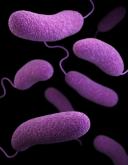

Research – The fate of cold‐stressed or tetracycline‐resistant Vibrio spp. in precooked shrimp during frozen storage

Wiley Online

CDC Vibrio

Image CDC

We compared the fate of cold‐stressed (CS) or tetracycline‐resistant (TR) Vibrio parahaemolyticus, Vibrio vulnificus , and Vibrio cholerae in precooked shrimp during frozen storage. The recovery ability of viable but nonculturable (VBNC) Vibrio cells was compared at 25°C. Each suspension of nonstressed (NS), CS, or TR Vibrio cells inoculated into cooked shrimps were subjected to frozen storage at −20°C or three freeze–thaw cycles. CS and TR cells were more rapidly converted to VBNC state than NS cells. Most of VBNC Vibrio cells were observed as viable cells after frozen storage. Although there were differences in the recovery extent of cells depending on the types of stress and strain, VBNC cells were resuscitated at 25°C. The most resistant to tetracycline and the lowest injury rate were observed in V. cholerae cells during frozen storage.

Research – Study reveals foodborne illness burden in Taiwan

Food Safety News

One in six Taiwanese people suffered from foodborne illness annually during a four year period studied by researchers.

From 2012 to 2015, almost 3.9 million foodborne illnesses and 50 deaths occurred annually in the country.

Scientists said the study, published in the Journal of the Formosan Medical Association, provided the first national estimates on the disease burden from foodborne illnesses in Taiwan.

Among just more than half of foodborne illnesses cases with identifiable causal microorganisms, non-typhoid Salmonella, norovirus, and Vibrio parahaemolyticus were leading pathogens.

Foodborne illnesses caused a substantial financial disease burden, with a medical cost up to NT $1.3 billion (U.S. $43,400) annually.

Research – Use of algal oil in shrimp diets shows sharp reduction in vibrio deaths, study finds

Under Current News

A study conducted by a team of shrimp disease experts from the US and Vietnam has found that the usage of algal oil in vannamei shrimp diets has a notable impact on survival rates among shrimp exposed to the bacterium vibrio, responsible for early mortality syndrome, or EMS, reports the Global Aquaculture Alliance.

Groups of specific pathogen-free 3-gram shrimp were fed different diets by the research team, before being exposed to shrimp broth inoculated with a consistently virulent strain of vibrio collected from a farm in Vietnam.

Research – Cholera studies reveal mechanisms of biofilm formation and hyperinfectivity

UCSC

Free-swimming cholera bacteria are much less infectious than bacteria in biofilms, aggregates of bacterial cells embedded in a sticky matrix that form on surfaces. This accounts for the surprising effectiveness of filtering water through cloth, such as a folded sari, which can reduce infections dramatically in places where the disease is endemic, despite the fact that individual cholera bacteria easily pass through such a filter.

A new study led by researchers at UC Santa Cruz goes a long way toward explaining the hyperinfectivity of cholera biofilms. The study, published the week of April 20 in the Proceedings of the National Academy of Sciences (PNAS), is one of several new papers on cholera biofilms from the laboratory of UCSC microbiologist Fitnat Yildiz.

Research – The fate of cold‐stressed or tetracycline‐resistant Vibrio spp. in precooked shrimp during frozen storage

Wiley Online

We compared the fate of cold‐stressed (CS) or tetracycline‐resistant (TR) Vibrio parahaemolyticus, Vibrio vulnificus, and Vibrio cholerae in precooked shrimp during frozen storage. The recovery ability of viable but nonculturable (VBNC) Vibrio cells was compared at 25°C. Each suspension of nonstressed (NS), CS, or TR Vibrio cells inoculated into cooked shrimps were subjected to frozen storage at −20°C or three freeze–thaw cycles. CS and TR cells were more rapidly converted to VBNC state than NS cells. Most of VBNC Vibrio cells were observed as viable cells after frozen storage. Although there were differences in the recovery extent of cells depending on the types of stress and strain, VBNC cells were resuscitated at 25°C. The most resistant to tetracycline and the lowest injury rate were observed in V. cholerae cells during frozen storage.

Information – Common Symptoms of All of the Food Poisoning Pathogens

Food Poisoning Bulletin

Food poisoning outbreaks occur every year in the United States. These outbreaks can be caused by bacteria such as E. coli, Salmonella, Listeria Monocytogenes, Clostridium botulinum, Campylobacter, Shigella, Staphylococcus aureus, Brucella, Vibrio, and Bacillus cereus; and viruses such as norovirus and hepatitis A. At least 48,000,000 Americans are sickened with food poisoning every year. Do you know the common symptoms of all of the food poisoning pathogens? Follow the link above to find out.


Research- FAO and WHO report rise in foodborne diseases related to Vibrio species

New Food Magazine

The FAO/WHO assessment revealed that there have been a series of pandemic outbreaks of V. parahaemolyticus foodborne illnesses due to the consumption of seafood and outbreaks have occurred in regions of the world where it was previously unreported.

Full Report


USA – New Oyster Rules Aim to Reduce Vibrio Cases

Coastal Review

Division of Marine Fisheries Director Steve Murphey implemented the new oyster harvest control measures through Proclamation SS-1-2020  and Proclamation SS-2-2020, both issued Monday.

The Division of Marine Fisheries announced that while the state’s public health record concerning shellfish-related illnesses is one of the best in the country, the number of Vibrio cases nationwide had increased in recent years. Vibrio are naturally occurring bacteria in coastal waters that can cause illness in humans if precautions are not taken during the warmer months of the year.

The new regulations also will bring the state into conformity with guidance from the National Shellfish Sanitation Program, which is the federal, state and industry cooperative program recognized by the U. S. Food and Drug Administration and the Interstate Shellfish Sanitation Conference for the sanitary control of shellfish produced and sold for human consumption.

The changes include the following new requirements to:

  • Shade oysters harvested between May 1 and Oct. 14. This involves providing shade over harvested oysters or covering the oysters with a light-colored tarp or other nontoxic material while they are stored on the vessel, floating container when the oysters are not submerged, or a vehicle (this is already required for the harvest of clams in the summer).
  • Resubmerge oysters exposed to the air for greater than five hours between May 1 and Oct. 14 (this might occur during air-drying or de-fouling with gear such as OysterGro). The oysters must remain submerged for at least 14-days to abate Vibrio levels that may have been elevated.
  • Clarify that when working in intertidal waters the term “start of harvest” begins when the oyster is first exposed by the receding tide.
  • Clarify the tagging procedures when oysters leave the lease for tumbling or culling.
  • Resubmerge oysters moved from one growing area to another for at least 21 days prior to harvest (Certified shellfish dealers with a wet storage permit are exempt). This may prevent the closure of multiple growing areas in the event of an illness outbreak.

Previously implemented regulations pertaining to recording the start of harvest on the harvest tag and delivering the oysters to a licensed dealer within a specified time remain in effect.

For more information, contact Shannon Jenkins, chief of the division’s Shellfish Sanitatio

RASFF Alert- Vibrio cholerae – Raw Soft Shelled Crab

RASFF-Logo

RASFF – Vibrio cholerae (presence /25g) in raw soft shell crabs from Thailand in the Netherlands