Category Archives: Microbiology

Research -Carbon dioxide as a novel indicator for bacterial growth in milk

Wiley Online

Human milk spoils due to bacterial, yeast, or mold contamination. Current domestic methods of assessing milk spoilage are subjective or rely on time and temperature‐based guidelines. A key unmet food safety need remains the objective assessment of human milk spoilage. Experiments were conducted using a simplified human milk spoilage model based on goat’s milk as a human milk surrogate, spiked with a single bacterial strain (Staphylococcus epidermidis ), in which pH and carbon dioxide (CO2) concentration were measured along with bacteria count over 160 hr. Bacteria count correlated highly with CO2 but not with pH. A 0.21% CO2 concentration threshold could be defined for milk spoilage (correlating to a bacteria count threshold of 105 CFU/ml), with sensitivity and specificity above 84%. These findings suggest that CO2 measurement is a promising method to detect S. epidermidis growth in milk which merits further investigation for the objective and quantitative assessment of milk spoilage.

 

China – More than 100 primary school children hospitalised with suspected food poisoning in China

7 News

Chaotic scenes erupted at a hospital in China after more than 100 children suffered suspected poisoning at a primary school.

Officials in Henan are investigating a so-called ‘central kitchen project’ in Yucheng County, where four government-contracted catering companies were supplying school meals to 4,500 kids.

According to Chinese state media, four catering companies in Yucheng are being investigated as possible sources of the suspected food poisoning scandal.


Research -Fate of Listeria on various food contact and noncontact surfaces when treated with bacteriophage

Wiley Online

Listeria kswfoodworld food safety food poisoning

Image CDC


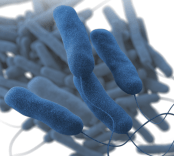
Study objective was to determine efficacy of a bacteriophage suspension against Listeria spp. when applied to three common types of materials used in food manufacturing facilities. Materials included two food contact materials (stainless steel and polyurethane thermoplastic belting) and one noncontact material (epoxy flooring). Coupons of each material were inoculated with a cocktail containing L. monocytogenes and L. innocua (4 to 5‐log10 CFU/cm2). Two phage concentrations and a control, 0, 2 × 107 and 1 × 108 PFU/cm2 were evaluated. Treated samples were held at 4 or 20°C for 1 and 3 hr to determine the effect of temperature and treatment time. Reductions in Listeria populations ranged from 1.27 to 3.33 log10 CFU/cm2 on stainless steel, from 1.17 to 2.76 log10 CFU/cm2 on polyurethane thermoplastic belting, and from 1.19 to 1.76 log10 CFU/cm2 on epoxy resin flooring. Higher phage concentration (1 × 108 PFU/cm2), longer treatment time (3 hr), and processing area temperature of 20°C showed a greater ( ≤ .05) reduction of Listeria on the stainless‐steel and polyurethane thermoplastic belting coupons. Overall, Listeria reduction by phage treatment occurred on all three materials tested, under all conditions.


Research – The European Union control strategy for Campylobacter spp. in the broiler meat chain

Wiley Online

Campylobacter

Image CDC


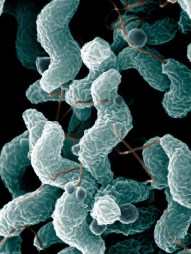
Campylobacter is the most common cause of bacterial gastroenteritis worldwide and the most frequently reported foodborne pathogen in the European Union (EU). While campylobacteriosis is generally self‐limiting, some patients could develop severe sequelae. The predominant source of infection is poultry. This review addresses the most relevant factors influencing the prevalence and contamination level of Campylobacter spp. in the poultry chain continuum. The emphasis was put on the novel control strategy for Campylobacter that is based on evidence‐based risk assessment and the introduction of process hygiene criterion intended for monitoring the prevalence and counts of Campylobacter spp. on broiler carcasses at slaughter level. The reduction of Campylobacter spp. in the poultry meat chain in the EU can only be achieved with an integrated meat safety assurance approach. This includes primary interventions at the level of the poultry farm, implementation of effective control measures at slaughterhouses, and fostering awareness campaigns aimed at consumers.

Research – Transmission of Legionnaires’ Disease through Toilet Flushing

CDC CDC legionella

We describe 2 cases of healthcare-associated Legionnaires’ disease in patients in France hospitalized 5 months apart in the same room. Whole-genome sequencing analyses showed that clinical isolates from the patients and isolates from the room’s toilet clustered together. Toilet contamination by Legionella pneumophila could lead to a risk for exposure through flushing.

Canada – Carnivora frozen pet food patties recalled over E. coli concerns

CTV News

CDC E.coli

Image CDC


TORONTO — Health Canada has recalled Carnivora Fresh Frozen Patties for Dogs and Cats due to a possible E. coli contamination that could be spread after handling the pet food.

The recall affects six varieties of the Carnivora brand raw pet food sold between January 13, 2020 to June, 2020. Approximately 1,803 units of the affected product were in Canada.

Health Canada says the recalled pet food may be contaminated with E. coli and consumer are at risk of cross contamination and illness after handling the pet food.

Research – Reusing chicken litter shows benefits against Salmonella

Feed Stuffs


Broiler chickens raised for meat need millions of tons of litter, or bedding material, each year. Reusing chicken litter can save costs, but the practice has some health and safety concerns, according to an announcement from the American Society of Agronomy.

A new study shows that the environment in reused poultry litter can deter growth of pathogens like salmonella.

Korea – ‘Special bank will manage, distribute food poisoning bacteria’

Korea Biomed

The Ministry of Food and Drug Safety said that its food poisoning bacteria resource center has been designated as a bank specializing in managing the pathogen.

It is the first food poisoning bacteria bank. The nation has six specialized banks dealing with pathogen resources in the areas of viruses and zoonotic diseases.

With the latest designation, the new bank will preserve, manage, and distribute the food poisoning bacteria that are separated from food as a national resource.


RASFF Alert – Animal Feed – Enterobacteriaceae – Fish Meal

RASFF-Logo

RASFF – high count of Enterobacteriaceae (up to 340 CFU/g) in fish meal from Mauritania in Spain

RASFF Alert – Animal Feed -Salmonella – Dog Chews

RASFF-Logo

RASFF – Salmonella (in 3 out of 5 samples /25g) in dog chews from Brazil in Germany