Category Archives: Foodborne Illness Death

India – Food poisoning: Salmonella, Shigella found in shawarma samples

New Indian Express

THIRUVANANTHAPURAM: The food samples collected from the shawarma outlet at Cheruvathur had the presence of salmonella and shigella bacteria, Health Minister Veena George has said. The chicken shawarma samples had salmonella and shigella while the pepper powder had salmonella. These samples have been confirmed ‘unsafe’ as per the Food Safety Act. A 16-year-old schoolgirl died and 52 persons fell sick after having shawarma from a snacks bar at Cheruvathur recently.

The special drive of the Food Safety Department saw inspections on 349 premises across the state on Saturday. Action was taken against 32 outlets which did not have licence or registration. Notices were served on 119 institutions. Twenty-two kilograms of stale meat was seized. Thirty-two samples were sent for lab test.

Since May 2, 1,132 raids were conducted across the state. Action was taken against 142 outlets which lacked licence or registration. Notice was served on 466 establishments. One hundred and sixty-two kilograms of stale meat was seized and 125 samples were sent for lab test. A total of 6,035 kg of fish, either adulterated or stale, was destroyed. Four hundred and fifty eight outlets were raided as part of ‘Operation Jaggery’ drive, the minister said.

India – Food poisoning: E.Coli, Coliforms found in samples from snacks shop

New Indian Express

KASARGOD: The presence of e-Coli and coliform bacteria was found in the food samples taken from Ideal snacks bar at Cheruvathur, said an official source. The Department of Food Safety had sent the samples for testing at the Regional Analytical Laboratory in Kozhikode after a schoolgirl, who had shawarma from the eatery, died, and another 52 persons who ate from there fell sick.

The presence of the highly contagious shigella bacteria, which causes intestinal infection, was found in the blood and stool samples of the patients tested at Kozhikode Medical College Hospital.
The laboratory is now conducting tests on the food samples to ascertain the presence of shigella and salmonella, another bacteria that affect the intestinal tracts, said the source. Only after these two tests, the report would be officially released.

India – Shigella caused food poisoning in girl who died after eating shawarma: Kerala health department

India Express

Shigella - kswfoodworld

Kerala health department on Tuesday identified shigella bacteria as the cause of food poisoning which claimed the life of a student and led to the hospitalisation of around 30 others in the state’s Kasaragod district.

District medical officer Dr S K Ramdas said the presence of shigella was confirmed after testing the blood and faeces of those undergoing treatment for food poisoning. The samples collected from the hospitalised persons were tested at the government medical college hospital in Kozhikode, he said.

Israel – Food poisoning suspected as three die at Holon shelter for people with disabilities

Times of Israel

A shelter for people with disabilities in Holon has come under scrutiny after three of its residents died one after the other within the last couple of days, apparently as a result of food poisoning.

A special team sent to the Beit Dafna shelter by the Health Ministry found severe deficiencies in its kitchen, according to reports Monday, and has instructed the staff to shut down the kitchen completely until the investigation is completed.

A few residents began feeling ill during the night between Saturday and Sunday, with some suffering from diarrhea.

According to Ynet, some 30 residents were affected by the incident and suffered from diarrhea and vomiting. However, most of them presented mild symptoms.

Initial findings pointed to possible food poisoning, the Health Ministry stated, without providing further details.

According to a report by the Walla news site, a professional team from the Welfare and Social Affairs Ministry was also sent to the shelter in order to provide the staff with further assistance.

The team will remain at the facility until the Health Ministry completes its investigation, the report said.

India – 16-year-old student dies of food poisoning in Kerala, 40 others hospitalised

The News Minute

A 16-year-old girl died and at least 40 other students were hospitalised on Sunday, May 1, due to suspected food poisoning from an eatery in Kerala’s Kasaragod. The girl, identified as Devananda of Karivellur in Kannur district, had eaten chicken shawarma on Friday from a food outlet called Ideal Food Point at Neeleswaram in Kasargod.

State Food and Civil Supplies Department, in a statement, said that the outlet, which was functioning without proper license from the department, has been sealed and the District Collector directed to conduct an investigation. State Health Minister Veena George has ordered a comprehensive inquiry into the incident.

USA – FDA Investigation of Cronobacter Infections: Powdered Infant Formula (February 2022)

FDA

If you want to check if your powdered formula is part of the recall, you can enter the product lot code on the bottom of your package on the company’s websiteExternal Link Disclaimer.

If you have questions or need information about the recall, you can Submit Questions/Get Assistance.

If your infant is experiencing symptoms related to Cronobacter infection, such as poor feeding, irritability, temperature changes, jaundice, grunting breaths, or abnormal body movements; contact your health care provider to report their symptoms and receive immediate care.

To report an illness or adverse event, you can

The U.S. Food and Drug Administration (FDA), along with the Centers for Disease Control and Prevention (CDC) and state and local partners are investigating consumer complaints and/or reports of infant illness, received from 9/20/2021 to 1/11/2022, related to products from Abbott Nutrition’s Sturgis, MI, facility. The four ill patients are reported to have consumed powdered infant formula produced from Abbott Nutrition’s Sturgis, MI, facility.

Following the voluntary recall and hold of certain powdered infant formula products produced at the Abbott Nutrition facility in Sturgis, MI, Abbott has committed to completing enhanced testing of stored product batches prior to making release determinations. While the FDA recognizes that Abbott has conducted standard product testing, there were a limited number of samples tested. Additionally, although finished product testing does not eliminate the risk of contamination, the enhanced testing will provide for a greater chance to detect Cronobacter sakazakii, if present; however, this enhanced level of testing will take additional time.

In the meantime, the FDA has informed Abbott Nutrition that the agency has no objection to the company immediately releasing product to individuals needing urgent, life-sustaining supplies of the specialty and metabolic formulas listed below on a case-by-case basis. The FDA is concerned that the risk of not having certain specialty and metabolic products available could significantly worsen underlying medical conditions and in some cases pose life-threatening risks for infants and individuals who rely on these products. In these circumstances, the benefit of allowing parents, in consultation with their healthcare providers, to access these products may outweigh the potential risk of bacterial infection.

Abbott has confirmed with the FDA that the company will consider release of these products on a case-by-case basis, depending on product availability and the severity of the individual’s need. Patients and caregivers seeking access to these products should contact Abbott directly to request that a product be made available to them by calling 1-800-881-0876.

It is important for parents and caregivers to understand that any products released on a case-by-case basis at this time were made at Abbott Nutrition’s Sturgis, MI, facility, and that the processes, procedures, and conditions that the FDA observed during its inspection of the Sturgis MI production facility from January 31 – March 3, 2022, raise concerns that powdered infant formula produced at this facility prior to the FDA’s inspection carry a risk of contamination. Therefore, those seeking access should consult with their healthcare provider in considering whether the benefit of consuming such product outweighs the potential risk of bacterial infection in the user’s particular circumstances. Parents and caregivers should continue to work with their medical provider to consider whether comparable alternative products may be appropriate.

Parents and caregivers who obtain these products should carefully follow Abbott’s preparation instructions as indicated on the product container. Should product released on a case-by-case basis be used, parents and caregiver should pay close attention to the user’s health status and alert a healthcare provider immediately of any change in health status. In the meantime, the FDA is continuing to work diligently to ensure the safe resumption of production of infant formula at Abbott Nutrition’s Sturgis, Michigan facility.

Specialty and Metabolic Formulas that may be Released on a Case-By-Case Basis:

  • Glutarex-1
  • Glutarex-2
  • Cyclinex-1
  • Cyclinex-2
  • Hominex-1
  • Hominex-2
  • I-Valex-1
  • I-Valex-2
  • Ketonex-1
  • Ketonex-2
  • Phenex-1
  • Phenex-2
  • Phenex-2 Vanilla
  • Pro-Phree
  • Propimex-1
  • Propimex-2
  • ProViMin
  • Calcilo XD
  • Tyrex-1
  • Tyrex-2
  • Similac PM 60/40

Recommendation

The FDA is advising consumers not to use recalled Similac, Alimentum, or EleCare powdered infant formulas. Recalled products can be identified by the 7 to 9 digit code and expiration date on the bottom of the package (see image below). Products are included in the recall if they have all three items below:

  • the first two digits of the code are 22 through 37 and
  • the code on the container contains K8, SH, or Z2, and
  • the expiration date is 4-1-2022 (APR 2022) or later.

In addition to products described above, Abbott Nutrition has recalled Similac PM 60/40 with a lot code 27032K80 (can) / 27032K800 (case). At this time, Similac PM 60/40 with lot code 27032K80 (can) / 27032K800 (case) is the only type and lot of this specialty formula being recalled. Additional recall information for the initial recall is available on the FDA website. Parents can also enter their product lot code on the company’s websiteExternal Link Disclaimer to check if it is part of the recall.

Additional information for parents and caregivers of infants receiving medical specialty infant formulas and individuals using certain medical foods is available below.

Additional Information for Parents and Caregivers:

The recalls do not include liquid formula products.

Parents and caregivers should never dilute infant formula and should not make or feed homemade infant formula to infants. Consumers should also avoid purchasing imported formula through online sales, as it has the potential to be counterfeit.

If your regular formula is not available, contact your child’s healthcare provider for recommendations on changing feeding practices.

If you get infant formula through WIC, do not throw the formula out. Instead, you should take it to the store for a refund and exchange or call the company at 1-800-986-8540 to help you. WIC recipients should be able to obtain a different brand of similar formula. Call your local WIC clinic for more guidance. Also see:

More information on Cronobacter and infant formula is available on CDC’s website.

Recalled powdered infant formulas have the potential to be contaminated with Cronobacter, a bacterium that can cause severe foodborne illness primarily in infants. Cronobacter infections are rare but are especially high risk for newborn infants (see symptoms below).

Cronobacter bacteria can cause severe, life-threatening infections (sepsis) or meningitis (an inflammation of the membranes that protect the brain and spine). Symptoms of sepsis and meningitis may include poor feeding, irritability, temperature changes, jaundice (yellow skin and whites of the eyes), grunting breaths, and abnormal body movements. Cronobacter infection may also cause bowel damage and may spread through the blood to other parts of the body.

If your child is experiencing any of these symptoms, you should notify your child’s healthcare provider and seek medical care for your child immediately. Healthcare providers and health departments are encouraged to report any confirmed cases of Cronobacter sakazakii to CDC.

Former employee blows whistle on baby formula production plant tied to outbreak – Cronobacter

EFOOD ALERT

A whistle blower document regarding product safety at a plant that manufactured infant formula linked to a deadly, ongoing outbreak provides damning information against Abbott Nutrition, the maker of Similac and other popular formulas that have been recalled in relation to the outbreak.

The document, sent to top officials at the Food and Drug Administration in October 2021, sparked outrage from U.S. Rep. Rosa DeLauro who has already demanded information from the FDA regarding the Cronobacter outbreak among babies. DeLauro, D-CT, on April 28 shared a redacted version of the whistle blower complaint and renewed her criticism of FDA and Abbott Nutrition for their slow response to the outbreak in which at least four babies have been hospitalized, with two having died.

“I am deeply concerned about the practices at this Abbott facility and their apparent failure to implement and enforce internal controls at this facility. We need to know exactly who in the company was aware of this failure and the alleged attempts to hide this information from the FDA,” DeLauro said during a meeting on the Fiscal Year 2023 Budget Request for the United States Department of Agriculture.

“I am equally concerned that the FDA reacted far too slowly to this report. The report was submitted to the FDA on October 20, 2021. The FDA did not interview the whistleblower until late December 2021. According to news reports, FDA did not inspect the plant in person until January 31, 2022, and the recall was not issued until February 17, 2022.”

Read the full story at the link above.

Kinder International Recall -Salmonella

EFOOD ALERT

International recall of Ferrero’s Kinder chocolate products

Ferrero has expanded its international recall of Kinder Surprise chocolate novelty products, linked to a multi-country outbreak of Salmonella Typhimurium illnesses. Click on the country link to navigate to the most recent recall notice for that jurisdiction.

EU – 8 April update: ECDC/EFSA investigation into multi-country Salmonella outbreak continues

ECDC

The outbreak has been linked to a factory in Arlon. Belgian authorities suspended all activities, all products that were manufactured there will be recalled, and retailers are also asked to remove the products from their shelves.

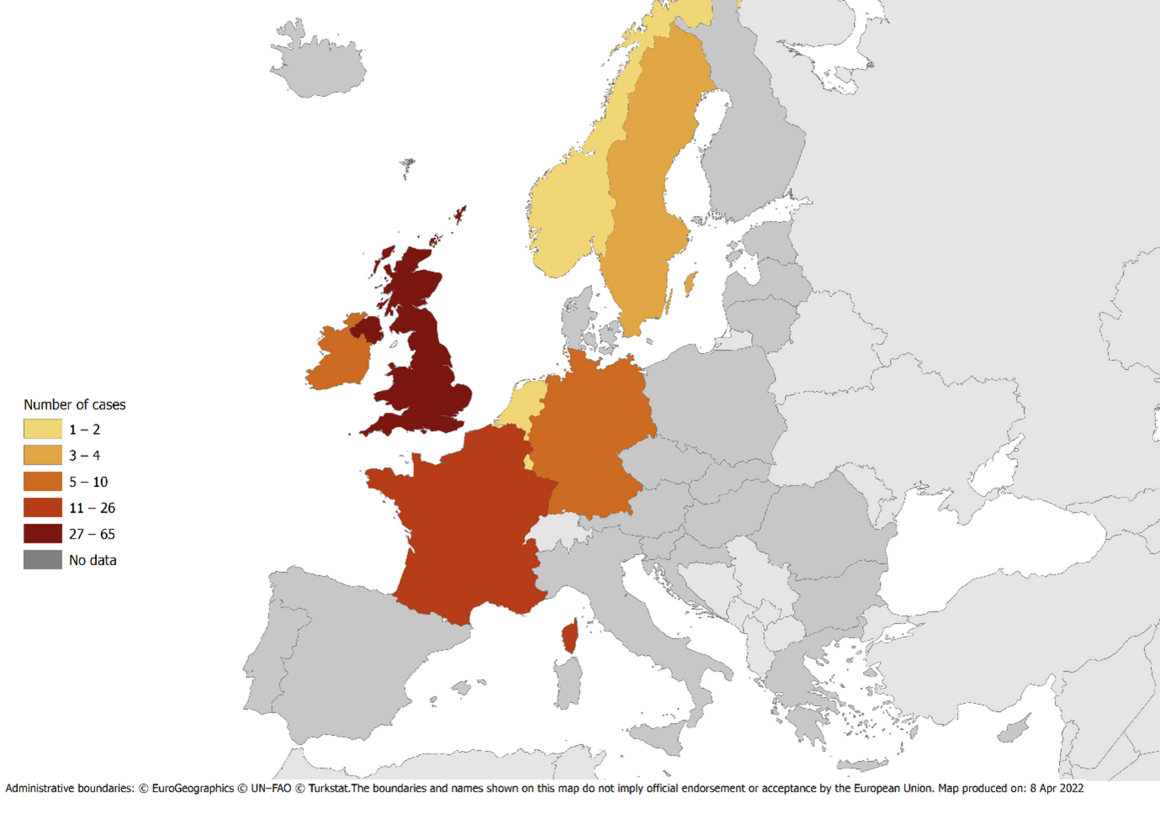
An outbreak caused by monophasic Salmonella Typhimurium is rapidly evolving in eight EU/EEA countries and the United Kingdom (UK). As of 8 April 2022, 142 cases have been reported, mainly among children under 10 years old. The first case was identified in the UK on 7 January 2022. Since 17 February 2022, cases have also been identified elsewhere in Europe.

Geographical distribution of confirmed and probable cases of monophasic S. Typhimurium in the EU/EEA and the UK, as of 8 April 2022
 

The outbreak is characterised by an unusually high proportion of children being hospitalised, some with severe clinical symptoms such as bloody diarrhoea. Based on interviews with patients and initial analytical epidemiological studies, specific chocolate products have been identified as the likely route of infection. Affected cases have been identified through advanced molecular typing techniques. As this method of testing is not routinely performed in all countries, some cases may be undetected.

Product recalls have been launched in several countries to date, including BelgiumFranceGermanyIrelandLuxembourgNetherlandsNorway, and the UK, to prevent the consumption of products potentially contaminated with Salmonella. Further investigations are being conducted by public health and food safety authorities in countries where cases are reported, to identify the cause and the extent of the contamination, and to ensure contaminated products are not put on the market.

ECDC and EFSA are assessing the available data from these countries and preparing a rapid outbreak assessment to be published next week. Questions regarding ongoing product recalls should be addressed to national food safety authorities.

Number of confirmed and probable cases* with monophasic S. Typhimurium infection by country, EU/EEA and the UK, as of 8 April 2022

Country Confirmed cases Probable cases Total cases
Belgium 0 26 26
France 25 0 25
Germany 6 2 8
Ireland 10 0 10
Luxembourg 1 0 1
Netherlands 2 0 2
Norway 1 0 1
Sweden 4 0 4
Total EU/EEA 42 29 77
United Kingdom 65 0 65
Total 114 28 142

*According to the European outbreak case definition

Germany – * Baby food * Similac, Alimentum and EleCare from the ABBOTT brand

LMW

Alert type: Food
Date of first publication: 03/25/2022
Product name:

* Baby food * Similac, Alimentum and EleCare from the ABBOTT brand

Product images:

image.jpg

BVL

Manufacturer (distributor): Abbott Nutrition in Sturgis, Michigan Country of origin: United States of America
Reason for warning:

Possible contamination with Salmonella Newport and Cronobacter sakazakii

Packaging Unit: 400 grams
Durability: from April 01, 2022
Lot identification: The first two digits of the lot number start with 22 to 37 AND the lot numbers contain the details K8, SH or Z2.
Further information:

Reference to a public warning from the US Food and Drug Administration:

Possible contamination of US infant formula with Cronobacter sakazakii and Salmonella Newport

Status 03/24/2022

The US Food and Drug Administration (FDA) warns against the use of certain powdered infant formulas manufactured by Abbott Nutrition in Sturgis, Michigan.

On February 17, 2022, Abbott announced that it had initiated a voluntary recall of certain lots of potentially affected products. The products in question are Similac, Alimentum and EleCare powdered food, which are manufactured at the plant in Sturgis, Michigan.

The recall is related to consumer complaints about Cronobacter sakazakii and Salmonella Newport infections in the United States. In all of these cases, infant formula from the manufacturer Abbott Nutrition is said to have been consumed. All five cases related to these ailments required hospitalization. In two cases, the infection may have contributed to the deaths of the patients.

The FDA is warning against the purchase and consumption of certain infant formulas manufactured at Abbott Nutrition’s Sturgis, Michigan facility.

The products were shipped within the USA and in member states of the EU (Italy, Ireland, Croatia, Netherlands, Slovenia, Spain) and other third countries (e.g. Great Britain, India, Islamic Republic of Iran, Northern Ireland, Russian Federation, Turkey, Ukraine, United States of America ) expelled. According to current knowledge, the products mentioned were not sold in Germany.

There is a possibility that consumers could have purchased the products online via marketplaces or through short-term stays in the Member States or third countries.

The FDA advises consumers not to use Similac, Alimentum, or EleCare powdered infant formula if:

  • the first two digits of the batch number begin with 22 to 37 and
  • the details K8, SH or Z2 are included and
  • a best-before date of April 1, 2022 is specified

The manufacturer offers the possibility to check the batch number of purchased products on the following page:  https://www.similacrecall.com/us/en/product-lookup.html

For more information on the FDA’s warning, please visit the following link: https://www.fda.gov/news-events/press-announcements/fda-warns-consumers-not-use-certain-powdered-infant-formula-produced- Abbott Nutrition Facility

The manufacturer’s recall can be found at the following link: https://www.fda.gov/safety/recalls-market-withdrawals-safety-alerts/abbott-voluntarily-recalls-powder-formulas-manufactured-one-plant

For the warning in Turkish language, please refer to the following link: https://www.titck.gov.tr/duyuru/ilac-geri-cekme-24022022101035

Information on Salmonella and Cronobacter sakazakii

Salmonella  and  Cronobacter sakazakii  can cause illness in infants when present in powdered infant formula. Although Cronobacter sakazakii and Salmonella cannot grow in powdered infant formula, they can survive for a long period of time and therefore pose a potential risk after liquid addition if the product is not heated sufficiently during preparation. Contamination of infant formula powder with Cronobacter sakazakiiand salmonella can cause serious illnesses in infants, such as diarrhea (sometimes bloody), fever, sepsis or meningitis, which can cause serious neurological and developmental problems and, in rare cases, can be fatal. Sepsis and meningitis can present with poor feeding, irritability, temperature changes, jaundice (yellow skin and whites of the eyes), and abnormal breathing and movements. Among infants, newborns (<28 days), especially preterm, low birth weight, or immunocompromised infants are most at risk of becoming infected.

(Unofficial translation of the information at: https://www.fsai.ie/news_centre/food_alerts/Similac.html )

Further information on salmonella, also in other languages, can be found here: http://www.infectionsschutz.de/erregersteckbriefe/salmonellen