Category Archives: Foodborne Illness Death

USA – Big Olaf Who? Amid Outbreak Shops Ditch Ice Cream, Branding

Food Poisoning Bulletin

Listeria kswfoodworld food safety food poisoning

Image CDC

For Big Olaf, the break-ups came quickly but not all at once. And not all of them quietly.

In the two and half weeks since Big Olaf ice cream was linked to a deadly Listeria outbreak, licensed shops throughout Florida started switching to new suppliers. One owner has permanently changed the names of the two stores she operates.

Although Listeria isn’t as common as other foodborne pathogens. It is the most deadly. And it targets pregnant women, who can suffer a miscarriage or stillbirth if they develop an infection.

“Five of the patients in this outbreak are women who contracted listeriosis while they were pregnant,” said Eric Hageman, a Listeria lawyer, and Food Poisoning Bulletin Publisher. Hageman has extensive experience with Listeria lawsuits including one filed on behalf of a 31-year-old man who suffered permanent brain damage after eating ice cream contaminated with Listeria in 2013.

Read the full story at the link above.

USA – Florida officials order Big Olaf Creamery to stop all activities as part of outbreak investigation – Listeria monocytogenes

Food Safety News

State officials have ordered Big Olaf Creamery to stop use of processing equipment in a plant associated with a deadly outbreak of Listeria monocytogenes infections.

The Florida Department of Agriculture & Consumer Services (FDACS) is still waiting for results of product sampling, but the evidence of Listeria in the production plant is enough for the state to take action.

Twenty-three people have been infected with Listeria and one has died. One pregnant women suffered a miscarriage.

A spokesman with the Florida Department of Health told Food Safety News today that the agency has been investigating the outbreak for a year.

The agriculture and consumers services department took more than 100 samples at the manufacturing plant of Big Olaf Creamery and nine came back positive, including one from a transfer pipe from pre mix to an ice cream machine.

“FDACS has issued a stop use order of the processing equipment where the Listeria monocytogenes was found. This will effectively shut down all operations at this processing facility, which had already been done voluntarily by the company,” according to a statement today from the department.

USA – Outbreak Investigation of Listeria monocytogenes: Ice Cream (July 2022)

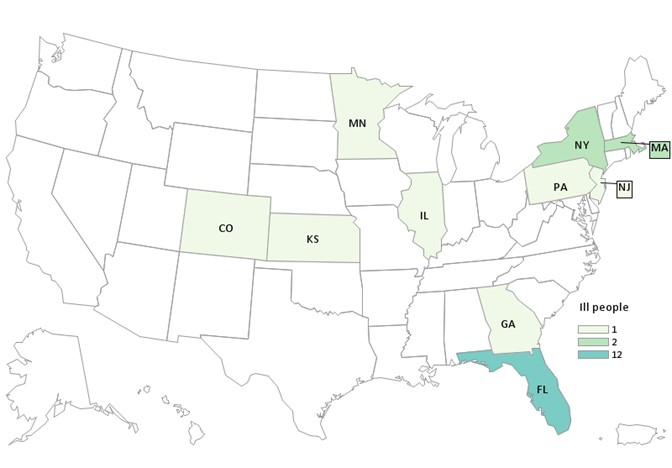
Outbreak Investigation of Listeria Monocytogenes in Florida-Based Big Olaf Ice Cream (July 2022) - CDC Case Count Map as of July 11, 2022

FDA

The FDA, along with CDC, is assisting the Florida Department of Health (FL DOH) and Florida Department of Agriculture & Consumer Services (FDACS) in investigating an outbreak of Listeria monocytogenes infections linked to ice cream supplied by Big Olaf Creamery of Sarasota, Florida.

Based on epidemiological information collected by CDC and the FL DOH, Big Olaf ice cream products are a likely source of illness in this outbreak. A total of 23 people infected with the outbreak strain of Listeria monocytogenes have been reported from 10 states. Of the 18 people interviewed, all (100%) reported eating ice cream. Among 18 people who remembered details about the type of ice cream they ate, 10 reported eating Big Olaf Creamery brand ice cream or eating ice cream at locations that might have been supplied by Big Olaf Creamery. Twelve sick people are residents of Florida and nine reported traveling to Florida before getting sick.

FDA is concerned that retailers may still be selling Big Olaf ice cream products. Retailers should not sell or serve Big Olaf ice cream products and should throw them away. Consumers who may still have these products in their freezers should not eat or serve any Big Olaf ice cream products and should also throw the product away.

This is an ongoing investigation, and the firm has initiated a voluntary recall of its ice cream products. The FDA is continuing to work with the FL DOH and FDACS to investigate and will update this advisory should additional consumer safety information become available.

Recommendation

Consumers, restaurants, and retailers should not eat, sell, or serve any Big Olaf ice cream products and should throw the product away, regardless of the “Best By” or expiration date.

Call your healthcare provider right away if you have these symptoms after eating Big Olaf ice cream products:

  • Pregnant people typically experience only fever, fatigue, and muscle aches. However, Listeria infection during pregnancy can lead to miscarriage, stillbirth, premature delivery, or life-threatening infection of the newborn.
  • People who are not pregnant may experience headache, stiff neck, confusion, loss of balance, and convulsions, in addition to fever and muscle aches.

Consumers, restaurants, and retailers who purchased or received any Big Olaf ice cream products should throw the products away, follow FDA’s safe handling and cleaning advice and use extra vigilance in cleaning and sanitizing any surfaces and containers that may have come in contact with these products to reduce the risk of cross-contamination. Listeria can survive in refrigerated temperatures and can easily spread to other foods and surfaces.

Case Counts

Total Illnesses: 23
Hospitalizations: 22
Deaths: 1
Fetal Loss: 1
Last illness onset: 6/12/2022
States with Cases: CO (1), FL (12), GA (1), IL (1), KS (1), MA (2), MN (1), NJ (1), NY (2), PA (1)
Product Distribution*: FL
*Distribution has been confirmed for states listed, but product could have been distributed further, reaching additional states


USA – Listeria Outbreak Connected to Big Olaf Creamery Allegedly Causes Death of One Woman

Food Poisoning News

A recent outbreak of Listeria infections is believed to be linked to an ice cream producer in Sarasota, Florida, called Big Olaf Creamery. The U.S. Center for Disease Control and Prevention (CDC) reports that there have been 23 people affected by the outbreak with 22 of these people seeking hospitalization due to the severity of their symptoms. One woman, Mary Billman, has passed away, allegedly due to the consumption of Big Olaf ice cream. Ms. Billman’s estate is pursuing legal action in response to her death.

Sweden – Foodborne illness figures rise in Sweden in 2021

Food Safety News

The number of foodborne infections climbed in Sweden in 2021 compared to the year before but most are still below pre-Coronavirus pandemic levels.

The report by the National Veterinary Institute (SVA), Folkhälsomyndigheten (the Public Health Agency of Sweden), Livsmedelsverket (the Swedish Food Agency) and Jordbruksverket (Swedish Board of Agriculture) showed a rise for Campylobacter, Salmonella, Listeria, E. coli and Yersinia infections.

Disease surveillance relies on patients seeking care and fewer people have done this during the pandemic. This is believed to be related to patients with symptoms choosing to not seek care and a true reduction in disease incidence because of changes in general hygiene such as increased handwashing, physical distancing and reduced travel because of COVID-19-related recommendations, according to the agencies.

Spain – Seven face charges in deadly Listeria outbreak in Spain

Food Safety News

Seven people are set to stand trial as part of Spain’s largest ever Listeria outbreak, which occurred in 2019.

A judge in a court in Seville this week decided to continue proceedings against seven defendants for offences including alleged crimes against public health and injury to a fetus resulting in abortion. At the conclusion of an investigation into the outbreak, Pilar Ordóñez also considered that Seville Council could be held civilly liable, this means it would have to pay compensation if convicted.

The outbreak from “La Mecha” brand chilled roasted pork produced by Magrudis affected almost 250 people. During the health alert between mid-August and mid-October 2019, four people died and there were six abortions.

Those investigated are José Antonio Marín Ponce, administrator of Magrudis; his wife, Encarnación Rodríguez Jiménez, responsible for production and the company’s self-control system; their children Sandro José and Mario Marín Rodríguez as well as a local veterinary inspector and two other people. Action against another four people has been stopped.

UK – Retired retail manager, 63, died of Salmonella after eating four fried duck eggs he had bought at country show, inquest hears

Daily Mail

A retired retail manager sadly died from one of the worst salmonella infections a consultant had seen in his career after eating four duck eggs bought at a country show.

Niptoon Tavakoli, 65, died in hospital two months after he was taken ill in June 2019, an inquest jury heard today.

Mr Tavakoli’s wife Cheryl told Doncaster Coroner’s Court that they had bought six eggs from the Melton Mowbray Deli stall at Messingham Show, in North Lincolnshire, during a family day out on Sunday, June 2, 2019.

Denmark – Denmark hit by a trio of Listeria outbreaks with unknown sources; eight deaths reported

Food Safety News

AdobeStock_195439963

Officials in Denmark are investigating three separate Listeria monocytogenes outbreaks that have affected almost 30 people with eight deaths reported.

The Statens Serum Institut, Danish Veterinary and Food Administration (Fødevarestyrelsen) and DTU Food Institute are trying to find the sources of these outbreaks.

One had already been reported but the Statens Serum Institut has updated the number of people sick. This incident has affected nine people, all of them have been hospitalized and four have died. Five cases are men and four are women.

Patients range from 33 to 93 years old and all had an underlying disease or other immune system issue prior to infection that made them particularly vulnerable, such as meningitis or sepsis. Eight are from the Hovedstaden region of the country. Sample dates range from May 13 to June 6, 2022.

Whole genome sequencing found the strains were closely related and of the sequence type (ST) 37.

Speaking earlier in June, Nikolas Hove from Fødevarestyrelsen said it was rare to see so many Listeria infections in such a short period of time and officials were working to find out which foods were the cause of illness, so the outbreak could be stopped.

Fødevarestyrelsen has written to a number of large industry organizations calling for their members to sharpen in-house monitoring of Listeria. If they find the bacterium in the environment or products, they can have it typed for free at Fødevarestyrelsen’s laboratory.

USA – FDA Investigating Another Infant Death Potentially Related to Abbott Baby Formula

Food Safety Tech

On Wednesday, June 22, the FDA announced that it was investigating the death of an infant that occurred in January 2022 and is potentially related to Abbott baby formula. In a statement, the FDA said that it was notified of the death through a consumer complaint received on June 10, 2022. “The agency has initiated an investigation, given that the complaint referenced that the infant had consumed an Abbott product. However, the investigation of this most recent consumer complaint is in its preliminary stages and the agency will provide an update as it learns more,” the statement read.

The FDA has previously reported its review of complaints related to nine infant deaths. Two were found to be associated with the Abbott Nutrition Sturgis plant investigation. However, the FDA notes that, despite extensive investigation, the evidence does not rule in or rule out a definitive link between these infant deaths and the product produced at Abbott Nutrition’s Sturgis, Michigan-based plant.

Research – Vital Surveillances: Epidemiological Analysis of Foodborne Botulism Outbreaks — China, 2004–2020

China CDC

kswfoodworld

  • Abstract

    IntroductionFoodborne botulism is a rare, potentially fatal illness resulting from the ingestion of foods contaminated with preformed botulinum neurotoxin types A, B, E, or F, produced by Clostridium botulinum. The descriptive epidemiology of foodborne botulism outbreaks in China during 2004−2020 was performed to inform public health response strategies.

    MethodsData from 22 of 31 provincial-level administrative divisions (PLADs) of the National Foodborne Disease Outbreaks Surveillance System during 2004−2020 and Embase, China National Knowledge Infrastructure (CNKI), Wanfang Data, and Chinese Science and Technique Journals (CQVIP) from January 2004 to December 2020 to identify indexed publications in the Chinese literature using the following search terms “botulism,” or “botulinum toxin,” or “Clostridium botulinum.” The number and proportion of outbreaks, illnesses, and deaths by PLAD, food types, and contributing factors were calculated.

    ResultsDuring 2004−2020, a total of 80 foodborne botulism outbreaks occurred in China, involving 386 illnesses and 55 deaths; most outbreaks were reported between June and August, with a sharp peak in January; 22 out of 31 PLADs reported foodborne botulism outbreaks, Xinjiang reported the largest number of outbreaks (20), followed by Qinghai (13); the most commonly implicated food was home-prepared traditional processed stinky tofu and dried beef, accounting for 51.25% events. Improper processing and improper storage in contributing factors accounted for 77.50% outbreaks. Initial misdiagnosis occurred in 27.50% of cases.

    ConclusionsOutbreaks of foodborne botulism had a high case-fatality rate. Targeted food safety and popularization education to farmers and herdsmen in Xinjiang and Qinghai related to botulism prevention should be carried out, and timely outbreak investigation and hospital surge capacity should be improved.

  • Belgian scholars in consumers of sausages first described botulism in 1896 (1). It was confirmed that the growth and germination of toxins occurred only under particular conditions in an anaerobic low salt, low-acid environment. People who ingest food contaminated with botulinum neurotoxin (BoNT) produced by botulinum toxin can have a potentially fatal outcome (2). Outbreaks have been reported worldwide. In Canada, the first Clostridium botulinum type E outbreak in 1944 in Nanaimo, British Columbia was reported in 1947 (3); In China, Wu et al. first reported botulism in Xinjiang in 1958 due to edible semi-finished noodle sauce (4). A better understanding of the epidemiology of botulism outbreaks can help tailor local prevention and public health response strategies. Here, we reviewed surveillance data on outbreaks, illnesses, and deaths of botulism in China from 2004 to 2020.