
Category Archives: Food Testing

Research – Whole genome sequencing data used for surveillance of Campylobacter infections: detection of a large continuous outbreak, Denmark, 2019

Eurosurveillance

CDC Campy

Human campylobacteriosis is the most commonly reported zoonotic disease in Europe, with 246,571 reported cases in the European Union (EU) in 2018 [1].  infections are predominantly food-borne, with poultry as the primary source. However, other transmission routes are known, such as bathing, drinking contaminated water or direct contact with animals. In food samples, the highest occurrence of  was detected in fresh chicken meat (37.5% of samples tested) [1]. In Denmark, we had 5,389 registered human cases in 2019 (incidence: 93/100,000 inhabitants) and 33% of conventional chicken meat samples were positive for  at slaughter [2]. Of note, one third of the human infections diagnosed in Denmark are estimated to be travel-related [3].

Efforts to identify the specific source of  infection in humans are rarely made in Denmark or other countries. Therefore, relevant information for targeted public health actions to prevent  infections often does not exist. For decades, surveillance of other food-borne pathogens, especially  and  with high-discriminatory typing methods has proved to be a powerful tool for outbreak detection and investigations as well as for following trends and emergence of epidemic strains. Similar typing-based surveillance for  has not been widely used and generally has not been very useful for the decision-making process on mitigating efforts by the public health and food safety authorities. The high diversity of  isolates and the general assumption that most  infections are sporadic are plausible explanations.

We have previously shown that, based on whole genome sequencing (WGS) data of  isolates in 2015–17, we could identify numerous small outbreak-like clusters and, in many instances, genetically link them to concurrent animal and food isolates [4]. A large fraction of all 774 clinical isolates (27%) could be genetically linked to broilers or chicken meat, whereas only a few clinical isolates (2%) could be genetically linked to cattle isolates. A Danish case–control study conducted in the same period pointed at several food sources of campylobacteriosis among children and young adults, including consumption of chicken meat, minced beef, and fresh strawberries [5]. Therefore, in addition to sampling of chicken meat, the Danish Veterinary and Food Administration (DVFA) initiated sampling and analysis for  in several other food sources that were identified by the case–control study to obtain knowledge on the impact of these sources.

In our 2015–17 study, a comparison of human isolates to food and animal isolates was done retrospectively and therefore no specific public health actions were taken. To evaluate the value of a prospective and continuous WGS-based surveillance system for  in Denmark, we initiated WGS of isolates from human cases and retail food samples as well as the concurrent analysis of these cross-sector data. Here, we report the first year of surveillance (2019) and show that integrated WGS-based surveillance of  in humans and food sources can identify correlations between the occurrence of specific strains in chicken meat and in human infections. The surveillance was also able to detect prolonged or reappearing outbreaks, which allows for specific interventions to control  in the food production chain and thereby prevent human infections.
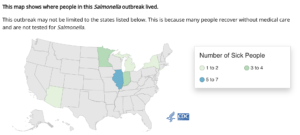
USA – Kirkwood’s Chicken Cordon Bleu appears linked to Salmonella Outbreak

Food Poison Journal

Arizona, Minnesota, Indiana, Indiana, Michigan and New York report Salmonella illnesses.

CDC, public health and regulatory officials in several states, and the U.S. Department of Agriculture’s Food Safety and Inspection Service (USDA-FSIS) are collecting different types of data to investigate a multistate outbreak of Salmonella Enteritidis infections linked to raw frozen breaded stuffed chicken products.

As of June 2, 2021, a total of 17 people infected with the outbreak strain of Salmonella Enteritidis have been reported from 6 states. Illnesses started on dates ranging from February 21, 2021 to May 7, 2021.

Sick people range in age from 3 to 83 years, with a median age of 52 years, and 60% are female. Of 13 people with information available, 8 (62%) have been hospitalized; no deaths have been reported.

People reported buying many different brands of raw frozen breaded stuffed chicken products from multiple stores. When asked about how the products were prepared at home, seven people reported undercooking, microwaving, or air frying the product.

France – Product recall: Fromagerie Du Pré Verdot brand raw cream – Microbiological Contamination

Oulah

ENCOUNTERED PROBLEM

Microbiological contamination.
Symptoms are vomiting, mild or severe diarrhea, abdominal pain. These symptoms may be aggravated in pregnant women, young children, immunocompromised individuals and the elderly.

PROPOSED SOLUTION

Do not consume and bring back to the point of sale

FURTHER INFORMATION

▸ Model names or references
Raw cream 25 cL
Raw cream 50 cL


▸ Barcode
376009100026


▸ Lot
16/06/2021


▸ DLC – DDM
06/16/2021


▸ Packaging
Plastic jars


▸ Start date / End of marketing
From 05/26/2021 to 06/03/2021


▸ Health mark
FR-25-467-001-CE


▸ Geographical sales area
…


▸ Distributors
Click here


▸ Contact
customer service 0381590846


▸ Source
Fromagerie Du Pré Verdot

France – Product recall: Fromagerie Du Pré Verdot brand raw milk white cheese – Microbiological Contamination

Oulah

ENCOUNTERED PROBLEM

Microbiological contamination.
Symptoms are vomiting, mild or severe diarrhea, abdominal pain. These symptoms may be aggravated in pregnant women, young children, immunocompromised individuals and the elderly.

PROPOSED SOLUTION

Do not consume and bring back to the point of sale

FURTHER INFORMATION

▸ Model Names or reference
white cheese beaten Nature 500g
white cheese beaten with fruit 500g
white cheese 500g cottage cheese
Cottage cheese curds 6x110g
curd cheese 1kg


▸ Barcode
3760091000156


▸ Lot
06/13/2021


▸ DLC – DDM
06/13/2021


▸ Packaging
Plastic jars


▸ Start date / End of marketing
From 05/26/2021 to 06/03/2021


▸ Health mark
FR-25-467-001-CE


▸ Geographical sales area
…


▸ Distributors
Click here


▸ Contact
customer service 0381590846


▸ Source
Fromagerie Du Pré Verdot

RASFF Alerts – Moulds – Whole Black Olives

RASFF

Spoilage by mould Penicillium spp. of whole black olives with stone from Turkey in France, Germany, Netherlands and Switzerland

RASFF

Spoilage due to mould infestation (Penicillium spp.) of whole black olives with stone from Turkey in Germany, Austria, France and the Netherlands

RASFF Alerts – DSP – Diarrhoeic Shellfish Poisoning – Live Cockles

RASFF

Diarrhoeic Shellfish Poisoning (DSP) toxins (okadaic acid: >320 µg/kg; dinophystoxins: <40 and 71 µg/kg – ppb) in live cockles (Cerastoderma edule) from Portugal

RASFF Alert- E.coli – Mussels – Aspic

RASFF

Aspic – too high content of Escherichia coli from Austria in Austria and Germany

RASFF

Elevati valori di E. coli in MITILI/ too high count of E Coli in mussel (Mytilus galloprovincialis) from Italy in France

RASFF

Presence of E.coli in mussels from Denmark in France, Luxembourg 

RASFF Alert – Ochratoxin A – Organic Rye Flakes

RASFF

OCHRATOXIN A IN ORGANIC RYE FLAKES FROM SPAIN in Spain and Portugal

RASFF Alerts – Aflatoxin – Piatchios – Organic Groundnuts – Organic Sesame Seeds – Watermelon Seeds with Saffron

RASFF

Pistachios total aflatoxins and B1 above legal limit from Iran in Spain

RASFF

Aflatoxins (B1 = 4.0; Tot. = 4.3 µg/kg – ppb) in organic groundnuts from China in the Netherlands

RASFF

Too much Aflatoxin B1 (11,7 µg/kg) in Organic Sesame seeds from Pakistan in Finland

RASFF

Aflatoxins in watermelon seeds with saffron from Iran in Germany

RASFF Alerts – Salmonella – Frozen MRM Chicken – Polish Chicken – Frozen Green Pepper Strips – Pork – Minced Meat- Kebab

RASFF

Salmonella infantis in chicken meat from Spain in France

RASFF

Salmonella infantis in chicken breast from Poland in the Czech republic

RASFF

Salmonella in frozen, mechanically separated chicken from Belgium in Latvia and Lithuania.

RASFF

Salmonella enterica subsp. Enteritidis in minced meat from Poland in Slovakia and Hungary

RASFF

Salmonella spp. in fresh chicken meat from Poland in Germany and the UK

RASFF

Meat with Salmonella from the Netherlands in Sweden

RASFF

Salmonella spp. in frozen green pepper strips from China in Germany

RASFF

Salmonella enterica ser. enteritidis in chicken breast from Poland in the Czech Republic

RASFF

Salmonella in pork from the Netherlands in Germany

RASFF

Salmonella spp in kebab from the Netherlands in France