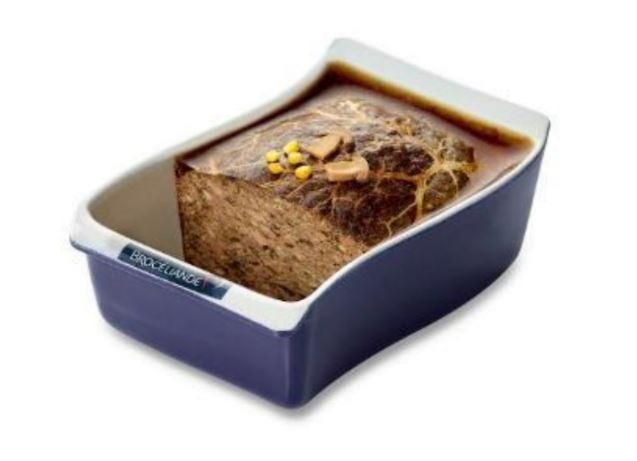
Brand : MARCEL
Name : DANUBIANA GROUP SRL
Reason for reporting : Recall due to microbiological risk
Publication date : 7 December 2021
Click to access C_17_PubblicazioneRichiami_1604_azione_itemAzione0_files_itemFiles0_fileAzione.pdf

Brand : MARCEL
Name : DANUBIANA GROUP SRL
Reason for reporting : Recall due to microbiological risk
Publication date : 7 December 2021
Click to access C_17_PubblicazioneRichiami_1604_azione_itemAzione0_files_itemFiles0_fileAzione.pdf

Lansing, Mich. – The Michigan Department of Agriculture and Rural Development (MDARD) is advising consumers not to eat the following brand of fresh enoki mushrooms after a sample tested positive for Listeria monocytogenes. The food safety issue was identified as part of proactive, routine sampling and testing by the department.
The impacted brand is listed below:
A sample of these mushrooms was collected in November by MDARD from Dong Yu China Market d/b/a Way 1 Supermarket located at 2789 Plymouth Road, Ann Arbor, MI. Enoki mushrooms have a long shelf life, so some consumers or restaurants may still have the mushrooms in their kitchens. MDARD is working with its partners at the U.S. Food and Drug Administration to assist industry in removing affected products from commerce and identifying where else the products may have been sold.
If consumers, restaurants or retail stores believe they purchased the product at a location other than Way 1 Supermarket in Ann Arbor, please provide information about your purchase location via MDARD’s online complaint system.
Consumers with Xinkang Sheng brand enoki mushrooms should discard them. Retailers and restaurants should remove this product from commerce and contact their MDARD inspector or local health department food sanitarian immediately.
Listeria can cause serious and sometimes fatal infections in young children, frail or elderly people, and others with weakened immune systems. Although healthy individuals may suffer only short-term symptoms such as high fever, severe headache, stiffness, nausea, abdominal pain and diarrhea, Listeria infection can cause miscarriages and stillbirths in pregnant women.
No illnesses have been reported to date in connection with these products. If you think you or a family member may have become ill from consuming any of these products, seek immediate medical attention.
Enoki mushrooms should not be eaten raw or undercooked. The mushrooms should be cooked thoroughly and heated to an internal temperature of at least 165° F to eliminate the risk of illness due to the presence of harmful microorganisms like Listeria monocytogenes.
Leader Price recall
Product: Pure pork dry sausage (225 g) from the Leader Price brand.
Problem: possible presence of Listeria monocytogenes.

In agreement with the AFSCA, LEADER PRICE is withdrawing the Label Rouge premium quality pure pork dry sausage (225 g) from the Leader Price brand and is recalling it to consumers because of the possible presence of Listeria monocytogenes.
LEADER PRICE asks its customers not to consume this product and to return it to the point of sale where it was purchased for reimbursement.
Product description
– Product name: Label Rouge superior quality pure pork dry sausage
– Brand: LEADER PRICE
– Use-by date (DLC) and batch number:
o 26/12/2021 – 20713000035
o 02/01/2022 – 20713070032
– Type of packaging: plastic film
– Weight: 225g
The product was sold via the Leader Price stores in Belgium
219 CHAUSSEE DE PHILIPPEVILLE 6010 COUILLET CHARLEROI
1 ANGLE RUE DU SEWAGE / CONCORDE 4100 SERAING
90 BD ERNEST SOLVAY 4040 HERSTAL
70 RUE PHILIPPE MONNOYER 6180 COURCELLES
RUE LAGUESSE 13 44NEITE
160 GRACE HOLLOGUESSE 13 4460 GRACE HOLLOGUESSE RUE 7134 BINCHE
RUE DU MONS 280 7301 HORNU BELGIUM
31 AVENUE DE L’INDUSTRIE 4500 TIHANGE
787 CHAUSSEE DE CHARLEROI 6220 FLEURUS
For any further information , you can contact the consumer service by dialing the telephone number: 0033 800 35 00 00 from Monday to Friday from 8:30 a.m. to 6 p.m.

| GTIN | Lot | Dated |
|---|---|---|
| 3263858674428 | 20713000035 | Date of minimum durability 12/26/2021 |
| 3263858674428 | 20713070032 | Date of minimum durability 01/02/2022 |
In Sumy Oblast in northeastern Ukraine, four people were hospitalized with botulism after eating homemade canned mushrooms at a dinner in the city of Lebedin.
According to the medical director of the Clinical Center for Infectious Diseases and Dermatology, Krasovitsky Irina Trotskaya, two victims were hospitalized at the center for infectious diseases in Sumy, two remained to be treated in the city hospital.
So far in 2021, Ukraine has reported 80 foodborne botulism outbreaks involving 89 patients, including three children.
In most cases, botulism in Ukraine is due to the consumption of dried and salted freshwater and sea fish (40%), meat, fish, vegetables, mushroom canned food and other meat products made at home or bought in unauthorized places.
Posted in botulism, Clostridium, Clostridium botulinum, Death, food bourne outbreak, food contamination, food death, food handler, Food Hazard, Food Hygiene, Food Illness, Food Inspections, Food Micro Blog, Food Microbiology, Food Microbiology Blog, Food Microbiology Testing, Food Pathogen, Food Poisoning, Food Poisoning Death, Food Safety, Food Safety Alert, Food Testing, Food Toxin, foodborne outbreak, foodbourne outbreak, outbreak
The FDA, along with CDC and state and local partners, investigated a multistate outbreak of Salmonella Thompson infections linked to seafood manufactured or processed by Northeast Seafood Products, Inc. of Denver, CO. As of 12/6/2021, the CDC has declared this outbreak over. According to CDC, the majority of sick people were either Colorado residents or reported traveling to Colorado in the week before they got sick.
FDA’s traceback investigation identified Northeast Seafood Products, Inc. as a common distributor among illness sub-clusters. As part of this outbreak investigation, environmental samples were collected from Northeast Seafood Products, Inc. On 10/7/2021, environmental samples collected from Northeast Seafood Products, Inc. were reported positive for Salmonella Thompson and were determined to be a match to the outbreak strain through whole genome sequencing.
On 10/8/2021, Northeast Seafood Products, Inc. recalled Haddock, Monkfish, Bone-in Trout, Grouper, Red Snapper, Red Rock Cod, Ocean Perch, Pacific Cod, Halibut, Coho Salmon, Atlantic Salmon Portions, Lane Snapper, Tilapia, All Natural Salmon Fillet, Pacific Sole, and Farm Raised Striped Bass. These products were sold to restaurant and Albertsons, Safeway, and Sprouts supermarkets in Colorado. The Pacific Cod sold through Sprouts is not being recalled. A full list of recalled products is available on FDA’s website.
Consumers, restaurants, and retailers should not eat, sell, or serve any recalled seafood. Recalled seafood was sold fresh and would be past shelf-life unless it was frozen after purchase. FDA recommends that anyone who might have purchased or received recalled product, check their freezers and throw away recalled product.
A full list of recalled products is available on FDA’s website.
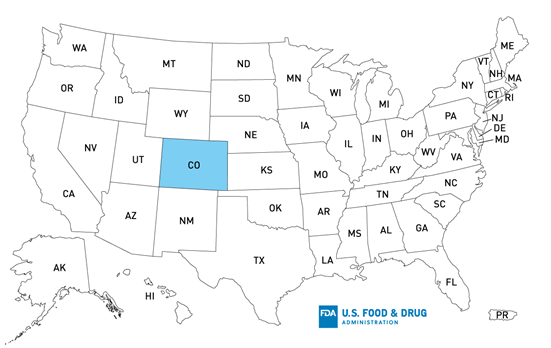

Total Illnesses: 115
Hospitalizations: 20
Deaths: 0
Last Illness Onset: September 7, 2021
States with Cases: AZ (1), CA (1), CO (93), CT (1), IA (1), MN (2), MO (1), NE (2), NJ (2), PA (1), TX (2), VA (3), WA (1), WI (2), WY (2)
Product Distribution*: CO
*States with confirmed distribution; product could have been distributed further
Posted in food bourne outbreak, food contamination, food death, Food Hazard, Food Hygiene, Food Illness, Food Inspections, Food Micro Blog, Food Microbiology, Food Microbiology Blog, Food Microbiology Testing, Food Pathogen, food recall, Food Safety, Food Safety Alert, Food Testing, Foodborne Illness, foodborne outbreak, foodbourne outbreak, Illness, outbreak, Salmonella
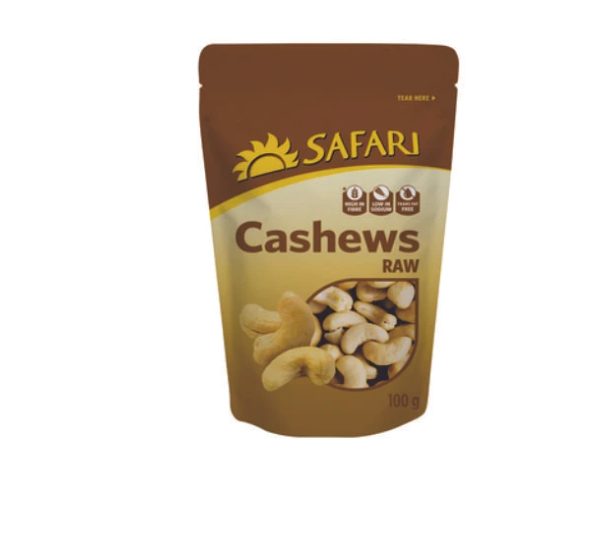
Pretoria-based Pioneer Foods has announced that it is recalling specific batches of the Peanuts & Raisins and Cashew nuts products, sold under its Safari brand in South Africa, Botswana and Namibia.
This after routine testing at the Safari production site in KwaZulu-Natal identified a batch of products which tested positive for low levels of salmonella.
Pioneer Foods says production was halted following the discovery, with the product placed on hold and ring-fenced.
It’s understood a limited number of cases of Safari 60g Peanuts & Raisins and Safari 100g Raw Cashews products were released from the site last month, despite having been isolated for destruction.
“This limited number of affected products should never have been released into trade, and whilst we have not received any health-related complaints from consumers to date, we have decided to proceed to proactively recall these specific products,” says CEO, Tertius Carstens.
At least 92% of the products have been retrieved.
“All other Safari products remain safe for consumption,” the company adds.
“We have already engaged with the South African National Consumer Commission as well as the South African Department of Health.
“Consumers who have the products listed above, with the specific batch or date coding, are urged to return these products to the retailer from which they were purchased in order to receive a full refund.”
The source of infection for the national outbreak of hepatitis A was probably imported, frozen raspberries. This is shown by the investigation that the Norwegian Food Safety Authority and the Norwegian Institute of Public Health have carried out in connection with the outbreak, which is now considered over.
The outbreak of hepatitis A lasted from April to October this year and involved 20 infected people.
Tracing of the source shows that the raspberries are probably no longer on the market. The outbreak is therefore considered over, says senior adviser Heidi Lange at the National Institute of Public Health (NIPH).
Posted in food bourne outbreak, food contamination, food handler, Food Hazard, Food Hygiene, Food Illness, Food Inspections, Food Micro Blog, Food Microbiology, Food Microbiology Blog, Food Microbiology Research, Food Microbiology Testing, Food Pathogen, food recall, Food Safety, Food Safety Alert, Food Virus, Foodborne Illness, foodborne outbreak, foodbourne outbreak, Hepatitis A, Illness, outbreak, Virus
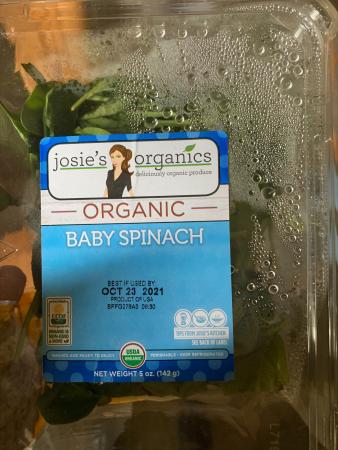
The FDA and CDC, in collaboration with state and local partners, are investigating illnesses in a multistate outbreak of E. coli O157:H7. According to the CDC, as of November 15, 2021, 14 people infected with the outbreak strain of E. coli O157:H7 have been reported from nine states. Illnesses started on dates ranging from October 13 to October 27, 2021. 10 people in this outbreak report eating spinach in the week before becoming sick and six people reported Josie’s Organics brand.
On November 15, 2021, the Minnesota Department of Agriculture reported that, as part of this outbreak investigation, a sample of Josie’s Organics Baby Spinach collected from the home of an ill person tested positive for E. coli O157:H7. This sample had a “Best If Used By” date of October 23, 2021. Whole Genome Sequencing (WGS) analysis determined that the strain of E. coli O157:H7 present in the product sample matches the outbreak strain.
FDA traced the supply chain for this positive product sample back to a small number of farms in two different geographic regions and deployed Investigators along the supply chains of interest. FDA continues tracing back reported spinach exposures to identify if spinach from additional farms could have been implicated.
FDA and state partners are working with the firm to determine if additional products could be affected. This is an ongoing investigation and additional information will be provided as it becomes available.
Consumers, restaurants, and retailers, should not eat, sell, or serve Josie’s Organics Baby Spinach with a “Best If Used By” date of October 23, 2021. Josie’s Organics Baby Spinach is sold in a clear plastic clamshell with the Best If Used By Date on the top label.
Although this product is past expiration and should no longer be available for purchase, consumers should check their homes for product and discard it. If consumers froze fresh Josie’s Organics Baby Spinach, they should discard it.
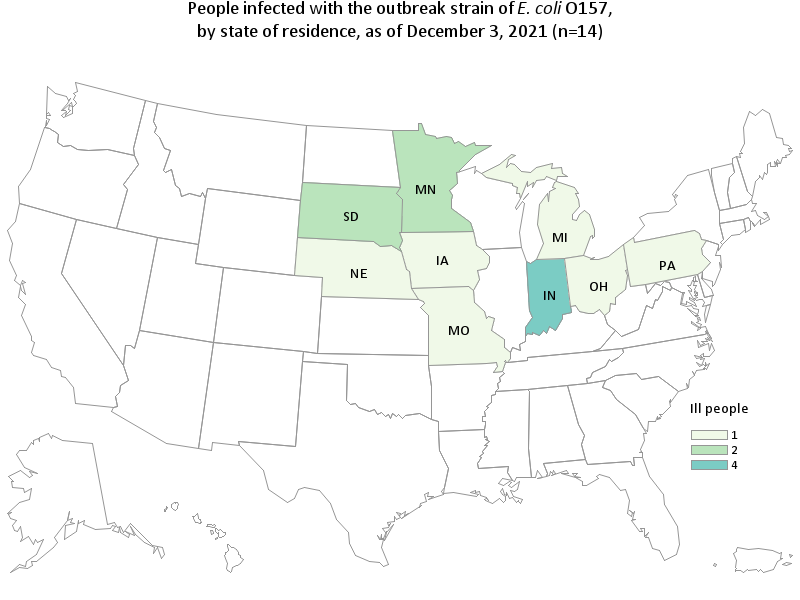
Total Illnesses: 14
Hospitalizations: 4
Deaths: 0
Last Illness Onset: October 27, 2021
States with Cases: IA (1), IN (4), MI (1), MN (2), MO (1), NE (1), OH (1), PA (1), SD (1)
Posted in E.coli O157, E.coli O157:H7, food bourne outbreak, food contamination, food handler, Food Hazard, Food Hygiene, Food Illness, Food Inspections, Food Micro Blog, Food Microbiology, Food Microbiology Blog, Food Microbiology Testing, Food Pathogen, food recall, Food Safety, Food Safety Alert, Food Testing, Food Toxin, Foodborne Illness, foodborne outbreak, foodbourne outbreak, Illness, outbreak, STEC, STEC E.coli
| Lot | Dated | |
|---|---|---|
| 1031496 | Use-by date 01/02/2022 | |


