Category Archives: Food Microbiology Research

Research – Mycotoxins and Essential Oils—From a Meat Industry Hazard to a Possible Solution: A Brief Review

MDPI

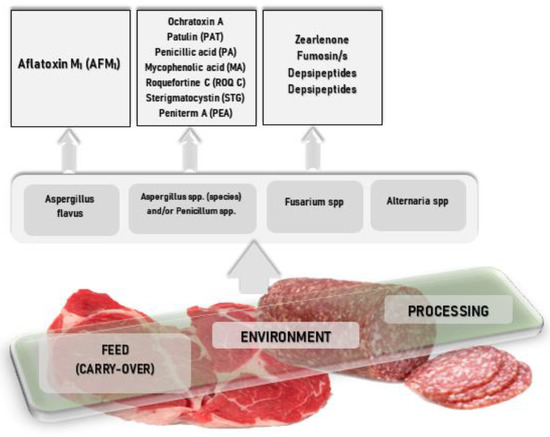
The preservation of food supplies has been humankind’s priority since ancient times, and it is arguably more relevant today than ever before. Food sustainability and safety have been heavily prioritized by consumers, producers, and government entities alike. In this regard, filamentous fungi have always been a health hazard due to their contamination of the food substrate with mycotoxins. Additionally, mycotoxins are proven resilient to technological processing. This study aims to identify the main mycotoxins that may occur in the meat and meat products “Farm to Fork” chain, along with their effect on the consumers’ health, and also to identify effective methods of prevention through the use of essential oils (EO). At the same time, the antifungal and antimycotoxigenic potential of essential oils was considered in order to provide an overview of the subject. Targeting the main ways of meat products’ contamination, the use of essential oils with proven in vitro or in situ efficacy against certain fungal species can be an effective alternative if all the associated challenges are addressed (e.g., application methods, suitability for certain products, toxicity). View Full-Text

Research – Molecular Epidemiological Evidence Implicates Cattle as a Primary Reservoir of Campylobacter jejuni Infecting People via Contaminated Chickens

MDPI

CDC Campy

The study aimed to determine the relative contribution of cattle to the burden of illness in a model agroecosystem with high rates of human campylobacteriosis (≥ 115 cases/100 K), and high densities of cattle, including large numbers of cattle housed in confined feeding operations (i.e., in southwestern Alberta, Canada).
To accomplish this, a large-scale molecular epidemiological analysis of Campylobacter jejuni circulating within the study location was completed. In excess of 8000 isolates of C. jejuni from people (n = 2548 isolates), chickens (n = 1849 isolates), cattle (n = 2921 isolates), and water (n = 771 isolates) were subtyped.
In contrast to previous studies, the source attribution estimates of clinical cases attributable to cattle vastly exceeded those attributed to chicken (i.e., three- to six-fold). Moreover, cattle were often colonized by C. jejuni (51%) and shed the bacterium in their feces.
A large proportion of study isolates were found in subtypes primarily associated with cattle (46%), including subtypes infecting people and those associated with chickens (19%). The implication of cattle as a primary amplifying reservoir of C. jejuni subtypes in circulation in the study location is supported by the strong cattle association with subtypes that were found in chickens and in people, a lack of evidence indicating the foodborne transmission of C. jejuni from beef and dairy, and the large number of cattle and the substantial quantities of untreated manure containing C. jejuni cells.
Importantly, the evidence implicated cattle as a source of C. jejuni infecting people through a transmission pathway from cattle to people via the consumption of chicken. This has implications for reducing the burden of campylobacteriosis in the study location and elsewhere. View Full-Text

 USA – Salmonella Typhimurium outbreak (reference # 1113) 

Food Poisoning News

kswfoodworld salmonella

As of November 16, 2022, a Salmonella Typhimurium outbreak (reference # 1113) has been identified in the United States with no known source as the cause of the outbreak. A total of 264 cases have been identified in connection with the outbreak, though the number of actual cases is thought to be much higher and the investigation remains ongoing. The Food and Drug Administration (FDA) is leading the investigation in collaboration with both federal, state, and local partners. The FDA is currently working vigilantly to find the source of the Salmonella Typhimurium outbreak and will update the public accordingly.

Research – Crustaceans (shrimp, crab, and lobster): A comprehensive review of their potential health hazards and detection methods to assure their biosafety

Wiley Online

Abstract

Crustaceans are popular seafood items worldwide owing to their rich nutritional value, unique tastes, and their incorporation in a variety of cuisines. There has been a great concern about the safety of crustaceans for human consumption being more prone to hazardous contaminants due to their exposure to diverse habitats and unhealthy farming and handling practices. These hazards can arise from chemical contaminants such as heavy metals, environmental pollutants, and biotoxins or biological sources, that is, pathogenic microbes and parasites. The different types of chemical contamination of crustaceans as well as biological hazards are reviewed as major part of this review. Although there are many reviews on contaminants in fisheries, nothing is traces to crustaceans. The current review compiles the food safety hazards of crustaceans arising from both chemical and biological origins and their impact on human health in farmed versus wild origins. The different methods of contaminants detection, viz. microbiological, molecular, and analytical methods, as well as control measures viz. cooking and processing methods that can be implemented to safeguard consumer safety are also reviewed. Future perspectives have been raised toward HACCP protocol implementation during handling, processing, and storage of crustaceans and posing real-time freshness monitoring tools such as intelligent packaging.

Research – Combined Pulsed Electric Field with Antimicrobial Caps for Extending Shelf Life of Orange Juice

MDPI

The purpose of this study was to investigate the effectiveness of combined pulsed electric fields (PEF) and antimicrobial packaging treatment in maintaining the quality and stability of orange juice stored at 10 °C. Orange juice was treated by PEF and stored in glass jars with antimicrobial caps coated with 10 µL of carvacrol essential oil (AP). Microbial reductions and physiochemical properties of juice samples were determined after treatments and during storage at 10 °C. Orange juice samples subjected to the combined treatment (PEF+AP) had the lowest yeast and mold populations after 14 day-storage at 10 °C. There were no significant differences in pH, acidity, color, total soluble solid contents, total phenol compounds, and Vitamin C among all samples after treatments. Storage studies showed that PEF, AP, and PEF+AP treatments maintained the quality and stability of orange juice stored at 10 °C for 5 weeks but lost Vitamin C. This study provides valuable information to juice processors for consideration and design of nonthermal pasteurization with antimicrobial packaging of juice products. View Full-Text

Research – Mathematical modeling of Bacillus cereus in Saengsik, a powdered ready-to-eat food and its application in quantitative microbial risk assessment

Wiley Online

Abstract

In this study, we developed a mathematical model to describe the fate of Bacillus cereus in Saengsik, a powdered ready-to-eat food with reduced moisture content, and to estimate the probability of B. cereus infection from Saengsik consumption, using quantitative microbial risk assessment (QMRA). The isothermal kinetic behavior of B. cereus was analyzed as a function of temperature (5–40°C). Bacterial cell counts were fitted to the Weibull model using GinaFit, and the obtained delta values (required time for the first decimal reduction) for each temperature were 128.3–17,124.1 hr and concave (ρ < 1) were observed under all experimental conditions. The obtained delta values were analyzed using the Davey model as a function of temperature, and the performance of the developed model of survival of B. cereus was appropriate based on the validation parameters (BfAf, and RMSE) within the acceptable range. QMRA model was developed using data on the prevalence and concentration of B. cereus along with time and temperature along the retail-to-consumer steps. Using a baseline model with the currently available data, the probability of B. cereus infection was zero. These results provide useful information for the risk assessment and management of microbial risk in foods, especially those with very low-moisture content.

Research – Guidance for Controlling Listeria monocytogenes (Lm) in Retail Delicatessens – Best Practice Tips for Deli Operators

FSIS USDA

This guidance document provides specific recommendations for actions that retailers can take in the delicatessen (deli) area to control Listeria monocytogenes (Lm) contamination of ready-to-eat (RTE) meat and poultry products. This document is also available in PDF format. These materials highlight recommendations that are based on an evaluation of retail conditions and practices in the Interagency Risk Assessment–Listeria monocytogenes in Retail Delicatessens (Interagency Retail Lm Risk Assessment). In addition, FSIS has included information from the Food and Drug Administration (FDA) Food Code, scientific literature, other guidance documents, and lessons learned from Food Safety and Inspection Service (FSIS) verification sampling and review of sanitation programs for Lm in meat and poultry processing establishments.

This version of the guidance document replaces the previous version of the document which was issued and announced in the Federal Register (79 FR 22082; April 21, 2014). FSIS updated this guidance based on comments received during the public comment period, which closed on June 20, 2014. FSIS made the following changes in response to comments:

  • Clarified that food processing equipment should be disassembled during cleaning and sanitizing.
  • Added a recommendation that retailers scrub surfaces during cleaning to prevent biofilm formation.
  • Clarified that retailers should rotate (change) sanitizers to help prevent Lm from establishing niches in the environment and forming biofilms.

LISTERIA – Action Plan for Retailers

FMI

LISTERIA Action Plan for Retailers
Listeria control is an ongoing challenge for retailers in the deli and any department where fresh foods are stored and foods are prepared. FMI and our members are committed to finding ways to control the growth and if possible, eliminate the presence of Listeria at retail to reduce the risk in the retail environment. Retail delis provide an ideal environment for Listeria growth due to the type of food (ready to eat [RTE] meats, cheeses, and salads), the moist environment, and temperatures that support the growth of Listeria. As retailers increase the RTE and prepared foods they offer to customers, Listeria control plans need to be in place to offer the appropriate food safety controls. For the purposes of this document, the organism we are concerned about is Listeria monocytogenes which we will abbreviate as Listeria. It is commonly found in the environment and when ingested, it can cause serious disease in humans and has been associated with a significantly higher hospitalization and fatality rate than other foodborne pathogens. FMI Food Protection Committee have expanded upon the advice and recommendations of the Listeria Action Plan for Retail Delis to include additional recommendations in order to assist retailers in developing food safety plans to help control the growth of Listeria beyond the deli.

Hong Kong – Draft ‘Oysters Intended for Raw Consumption – the Food Safety Guidelines for Food Businesses’

CFS

The Centre for Food Safety has drafted a set of trade guidelines on oysters intended for raw consumption. This set of guidelines aims to assist the food businesses in understanding the risks associated with raw oysters and implementing appropriate and practical food safety measures in their operations to reduce the occurrence of foodborne illnesses while also allowing susceptible groups of consumers to make informed choices. We are inviting members of the trade to provide comments on the draft guidelines. Your valuable comments will help us improve this set of guides. Please return your comments by 30 November 2022. Thank you.

Draft Oysters Intended for Raw Consumption – Food Safety Guidelines for Food Businesses

Questionnaire (Comments are welcome until 30 November 2022)

USA – FDA – Core Outbreak Table Update


FDA

What’s New

  • A new outbreak of Salmonella Typhimurium (reference #1113) in a not yet identified food has been added to the table and traceback has been initiated. There are currently 264 cases. The FDA is working closely with federal, state, and local partners to investigate multiple food items of interest to determine the source of this outbreak and will update the public when more information becomes available.
  • For the E. coli O157:H7 outbreak in a not yet identified food (reference #1121), the outbreak status has changed to “Ended”.