Category Archives: Food Microbiology Research

Research – Low levels of E. coli found in Norwegian produce testing

Food Safety News

Testing of fresh produce in Norway has found a low level of E. coli contamination.

The Norwegian Food Safety Authority (Mattilsynet) commissioned the Veterinary Institute to examine ready-to-eat lettuce and sugar snap peas in 2021.

A total of 118 samples, of which 37 were sugar snap peas and 81 ready-to-eat leafy greens, were analyzed. Salmonella was not detected, while E. coli was found in 11 samples, one of sugar snap peas and 10 of lettuce. E. coli, as a hygiene indicator, at levels above the guideline values was only detected in one sample of lettuce.

Results were considered unsatisfactory if three or more samples contained more than 100 colony forming units per gram or one sample contained above 1,000 CFU/g.

Officials said finding high levels of E. coli in lettuce may indicate the production process is not working optimally. Good raw material control and management of the washing and rinsing process are important, so microorganisms do not build-up and cross-contamination via water is minimized.

Research – Bacterial Pathogens in the Food Industry: Antibiotic Resistance and Virulence Factors of Salmonella enterica Strains Isolated from Food Chain Links

MDPI

kswfoodworld salmonella

Salmonella is one of the most important foodborne pathogens. Fifty-three strains of Salmonella deposited in the Culture Collection of Industrial Microorganisms—Microbiological Resources Center (IAFB) were identified using molecular and proteomic analyses. Moreover, the genetic similarity of the tested strains was determined using the PFGE method. Main virulence genes were identified, and phenotypical antibiotic susceptibility profiles and prevalence of resistance genes were analyzed. Subsequently, the occurrence of the main mechanisms of β-lactam resistance was determined. Virulence genes, invA, fimA, and stn were identified in all tested strains. Phenotypic tests, including 28 antibiotics, showed that 50.9% of the strains were MDR. The tet genes associated with tetracyclines resistance were the most frequently identified genes. Concerning the genes associated with ESBL-producing Salmonella, no resistance to the TEM and CTX-M type was identified, and only two strains (KKP 1597 and KKP 1610) showed resistance to SHV. No strains exhibited AmpC-type resistance but for six Salmonella strains, the efflux-related resistance of PSE-1 was presented. The high number of resistant strains in combination with multiple ARGs in Salmonella indicates the possible overuse of antibiotics. Our results showed that it is necessary to monitor antimicrobial resistance profiles in all food chain links constantly and to implement a policy of proper antibiotic stewardship to contain or at least significantly limit the further acquisition of antibiotic resistance among Salmonella strains.

USA – Turkey Day Myths

USDA

Quit food safety confusion cold turkey this Thanksgiving! While this holiday is a great time to spend with family and friends, it’s also time to bust some myths.

Myth 1:  Refrigerating a whole cooked turkey is safe

False! Always carve your turkey after cooking. A whole cooked turkey will not cool quickly enough, thus putting it at risk for bacterial growth. Carve the turkey into smaller pieces so it cools faster in the refrigerator.

Myth 2: Thawing a turkey on the counter is safe.

Never thaw a turkey on the kitchen counter. Once a turkey has sat at room temperature beyond two hours, it enters the Danger Zone, where bacteria grow rapidly. Thawing a turkey in a refrigerator is safe. Allow approximately 24 hours of thawing time for every four to five pounds of turkey. Turkeys are also safely thawed in a microwave and cold water. When using the cold-water method, allow 30 minutes per pound of turkey and keep it in the original wrapping. Change the water every 30 minutes and cook immediately after thawing.

Myth 3: My pop-up timer is enough to know if my turkey is fully cooked.

Pop-up timers are disposable thermometers used to measure a turkey’s temperature. These timers are a great tool. However, don’t forget to check in the three recommended places as well. The turkey’s internal temperature must reach 165 F in the following locations: the thickest part of the breast, the innermost part of the thigh, and the innermost part of the wing. Use a food thermometer in addition to a pop-up timer to check the turkey’s internal temperature.

Remember the four steps to food safety:

  • Clean: Wash hands before touching food.
  • Separate: Keep raw meats and poultry away from fruits and vegetables.
  • Cook: Turkey is safe to eat once it reaches an internal temperature of 165 F.
  • Chill: Refrigerate any leftovers within two hours.

For more information, call the USDA Meat and Poultry Hotline at 1-888-MPHotline (1-888-674-6854) or email MPHotline@usda.gov to reach a food safety expert or chat live at ask.usda.gov from 10 a.m. to 6 p.m. Eastern Time, Monday through Friday. The Meat and Poultry Hotline is also open on Thanksgiving Day from 8 a.m. to 2 p.m. Eastern Time.

Research – Fatal Listeria outbreak linked to Scottish fish processor

Food Safety News

A deadly Listeria outbreak in the United Kingdom has been linked to one company but product testing has only found low levels of contamination.

Food Standards Scotland (FSS) and the Food Standards Agency (FSA) suspect the source of contamination to be a salmon-smoking processing factory in Scotland.

Food Standards Scotland wouldn’t name the company or answer questions about the incident from Food Safety News.

Instead, a spokesperson said: “This is an ongoing outbreak of Listeria monocytogenes and, as yet, no definitive source of contamination has been found. Investigations to determine the root cause continue. Investigations of any outbreaks of foodborne illness will comprise both patient questionnaires and sampling of products.

“Local authorities are responsible for working on mitigations with any implicated businesses, and FSS, alongside partners the UK Health Security Agency, Public Health Scotland, and the Food Standards Agency, have been involved in raising awareness of the outbreak with consumers, most recently with targeted messaging to vulnerable groups.”

There have been 14 confirmed Listeria monocytogenes cases in just under two years. At least 10 sick people are above 65 years old, and one was a pregnant woman.

Three people older than 65 have died and for two Listeria monocytogenes was a contributory cause of death. All cases had underlying health conditions.

Of the linked cases of listeriosis since October 2020, eight have been identified since January 2022. The majority of them reported eating ready-to-eat smoked fish.

Research – EU and UK record travel-related Shigella infections

Food Safety News

A multi-country Shigella outbreak in Europe has been linked to stays at some hotels in Cape Verde.

Confirmed Shigella sonnei cases have been reported in the Netherlands, Denmark, France, Germany, Portugal, and the United Kingdom.

The European Centre for Disease Prevention and Control (ECDC) said there is no information about the source of infection but given the increase in travel during the coming holiday season, new cases are likely.

However, Holiday Claims Bureau and Hudgell Solicitors in the UK have noted complaints of illness and poor hygiene standards from holidaymakers, suggesting the source could be contaminated food or water. Holiday Claims Bureau said it had been informed of sick people testing positive for Shigella.

Travelers have described symptoms such as diarrhea, vomiting, stomach cramps, and pains, which in some cases lasted until they returned home.

Anne ThomsonHudgell Solicitors’ travel litigation executive, said people can suffer as a result of a change in diet and climate.

“However, when we are alerted to situations where a number of holiday guests are affected by similar symptoms, particularly when they are not part of the same traveling group, we feel an investigation is needed to contain any wider outbreak and prevent future problems,” she said.

“Holidaymakers becoming ill having only ever eaten at the specific hotel they are staying at, and concerns raised by guests over standards of hygiene and cleanliness throughout premises, and not just in dining areas, are often red flags to potential underlying problems.”

Do You Know How to Use a Food Thermometer?

Food Poisoning Bulletin

With the holidays approaching, it’s important to keep food safety in mind. One of the best ways to ensure that the food you make and serve is safe to eat it to use a food thermometer. But do you know how to use a food thermometer correctly?

First, you should know that there are several types of food thermometers. The most inexpensive and common is a dial thermometer. This has a dial on a stem that is attached to a probe. You can find these thermometers are most grocery stores. This thermometer is not always the most accurate, but it will give you a general reading.

The second type is an oven-proof thermometer that you use while the food is cooking.  A probe goes into the meat roast or whole chicken or turkey, then a cord extends outside the oven to the dial that shows the reading. These can be digital or dial thermometers. You remove the food from the oven when it reaches the safe final internal temperature (or 5°F below that temperature with a 5-minute covered stand time).

Candy thermometers have larger temperature ranges, since the sugar solutions are often cooked to 300°F. These utensils look like a ruler, with a bulb at the bottom. They clip onto the side of a saucepan. To use when making candy or syrups, make sure that the bulb is in the sugar syrup but not touching the bottom of the saucepan.

Finally, instant-read digital thermometers consist of a probe that is attached to a plastic body and folds out. The digital reading is the most accurate, but these utensils can be expensive. You should know that the thermometer will usually time out after a few minutes. To restart it, just clip the probe back into the body and open it up again.

Read more at the link above.

Research – Attribution Analysis of Foodborne Disease Outbreaks Related to Meat and Meat Products in China, 2002–2017

Mary Anne Liebert

Abstract

kswfoodworld

This study aimed to understand the epidemiological characteristics of foodborne disease outbreaks related to meat and meat products in China from 2002 to 2017. Data collected from the National Foodborne Diseases Surveillance System and searched databases were analyzed. From 2002 to 2017, China reported 2815 outbreaks caused by foodborne diseases related to meat and meat products, resulting in 52,122 illnesses and 25,361 hospitalizations, and 96 deaths. Outbreaks were markedly seasonal and concentrated from May to September, accounting for 66.93%. Outbreaks were concentrated mainly in China’s eastern coastal and southern regions. Unidimensional attribution analysis revealed that livestock meat was the most commonly implicated food category causing the outbreaks, accounting for 28.67%. Bacteria were the most common pathogenic cause of outbreaks, accounting for 51.94%. Clostridium botulinum was the most common pathogenic cause of death, accounting for 34.38%. Improper processing was the most common contributing factor, accounting for 27.89%. Households were the most common food preparation location causing the outbreak, accounting for 34.39%. Two-dimensional and multidimensional attribution analysis found that Salmonella contamination occurred in different locations and regions, mainly caused by various contributing factors and improper processing. Nitrite poisoning is caused by improper processing in households in East China. Bacterial causes were the commonest agents associated with foodborne diseases related to meat and meat products, and improving the safety and quality of meat and meat product should be a priority.

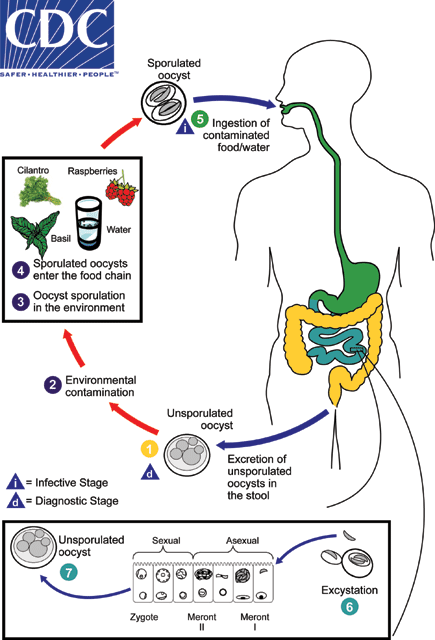
USA – Cooper’s Hawk Duval County Cyclospora Outbreak Attributed to Contaminated Basil

Food Poisoning News

The final investigation of the 2019 Cyclospora outbreak in Duval County, Florida found the most likely cause of the Cooper’s Hawk outbreak was serving food containing contaminated fresh basil – ironically, to-date Cooper’s Hawk continues to deny it served contaminated food. The Florida Department of Health of Duval County (DOH-Duval) first announced the potential outbreak on June 22, 2019 after one of Cooper’s Hawks own restaurant managers notified them of an estimated 20 employees who had became sick with gastrointestinal illness beginning on June 18, 2019. After the first report of employee infections, reports of illnesses in customers came pouring in, with a total of 153 gastrointestinal illnesses.

Research – UK food microbiology lab notes less contact with the EU

Food Safety News

The United Kingdom leaving the European Union has resulted in reduced communication between UK and EU food networks, according to a new report.

The annual report covers work of the UK’s national reference laboratory (NRL) for food microbiology between April 2021 and March 2022.

The UK Health Security Agency (UKHSA) provides this service for the Food Standards Agency (FSA) for Listeria monocytogenes, coagulase-positive staphylococci, E. coli, Campylobacter, Salmonella and antimicrobial resistance.

Research – Looking at edible insects from a food safety perspective. Challenges and opportunities for the sector

FAO

The release of the pioneering FAO publication,
 
Edible insects. Future prospects for food and feed security in 2013 spurred considerable interest in insect farming . While insects have been part of the normal diets of many cultures in various regions through the centuries, the practice is not widespread in the Western world .
 
However, with growing concerns about the environmental effects of food production, sustainable agriculture is garnering increasing support within our food systems . This has led to an increased interest in using insects as an additional source of nutrition in human food and animal feed, propelling research activities as well as business opportunities worldwide .Until recently edible insects have been collected mainly from the wild but farming insects for human as well as animal consumption is now on the rise .
 
Their high fecundity, high feed conversion efficiency, and rapid growth rates make insects viable and attractive candidates for farming . In addition, they can be reared in small, modular spaces, making it feasible to raise them in rural as well as urban farm settings .The low carbon, water and ecological footprints associated with insect production, as compared to those of other livestock species, make them attractive from an environmental sustainability standpoint . In general, edible insects are a good source of protein, fatty acids, vitamins, and minerals, though the nutritional profile is insect species dependent .
 
This makes them a potential food source for healthy human diets .Insects can also be a nutritionally beneficial and sustainable source of feed for animals . These factors make insects a good prospect to help address food insecurity issues related to a rising global population, without simultaneously harming the environment .


However, the benefits of this emerging food source must be weighed against all possible challenges: for instance, any food safety issues that could pose health threats to consumers . As with other foods, edible insects can also be associated with a number of food safety hazards .
 
This publication covers some of the major food safety hazards that should be considered, including biological agents (bacterial, viral, fungal, parasitic) as well as chemical contaminants (pesticides, toxic metals, flame retardants) . Safe and successful insect production must include efforts to prevent, detect, identify and mitigate such food safety concerns . Food safety risks can be higher when insects are harvested from the wild and consumed raw .
 
Farming insects under controlled hygienic conditions and implementing sanitary processing techniques should reduce some hazards, such as microbiological contamination .An important area of food safety consideration is the quality and safety of the feed or substrates used for rearing insects . The use of raw materials that are alternative to conventional feed are being explored as potential substrates for mass production of insects .Some of these raw materials include food side streams such as food waste, agricultural by-products or manure from livestock farms .
 
The high nutritional content and low cost of such side streams provide a means to enforce circular economy in the process, in addition to further reducing the environmental footprint and economic costs associated with insect farming . However, as the nutrient content and food safety aspects of reared insects depend on the substrate, further studies and monitoring will be needed to determine the quality and safety of such side streams as well as the insects that are produced .Insects and crustaceans (shrimp, prawns, etc .) belong to the arthropod family . While allergic reactions to shellfish are well-known, the potential allergenic risks associated with consuming edible insects needs further investigation .
 
Individuals already allergic to crustaceans are particularly vulnerable to developing allergic reactions to edible insects, due to allergen cross-reactivity . The immune systems of shellfish-allergic individuals are sensitized to certain proteins from crustaceans .Recognition of similar proteins in insects upon consumption can trigger the immune system to initiate an allergic reaction .
 
In addition to cross-reactivity, there is also a risk associated with developing de-novosensitization to yet unidentified allergens from insects . Research in this area must be broadened to gain a better understanding of this risk .Other challenges facing this emerging sector are also discussed in the publication . These include the general absence of insect-specific regulations governing the production and trade of insects as food and feed, issues related to upscaling the production of insects, and overcoming the negative attitude associated with insect consumption among some consumers .