Category Archives: Food Microbiology Blog

Norway – UNIL is recalling Folkets Hamkestek and Roast beef – Listeria monocytogenes

Matportalen

UNIL is recalling certain shelf lives of Folkets Hamkestek and Roast beef on the basis of suspicion of Listeria

The product is sold via NorgesGruppen’s grocery stores throughout the country. Consumers are asked to discard the product or return it to the store where it was purchased for a refund.

Listeria can cause serious illness in pregnant women and people with compromised immune systems. The bacterium grows well at refrigerator temperature.

The products have been removed from the store.

Contact:
UNIL consumer service via www.unil.no or by phone 24 11 35 55

The withdrawal applies to the following goods:

People’s Ham Steak 90 g

  • Last day of consumption 28.08.2023, LOT 33110027
  • Last day of use 01/09/2023, LOT 33150016

People’s Roast Beef 90 g

  • Last day of consumption 28.08.2023, LOT 33110105

Singapore – Recall of eggs from LCC “Yasensvit” (Ukraine) due to presence of Salmonella Enteritidis

SFA

hazegg.jpg

Consumers who have purchased the affected eggs are advised to cook them
thoroughly before consumption. Those who have consumed the eggs and are unwell should
seek medical attention.

Consumers who have purchased the affected eggs are advised to cook them
thoroughly before consumption. Those who have consumed the eggs and are unwell should
seek medical attention.

The Singapore Food Agency (SFA) has detected the presence of Salmonella Enteritidis
(SE) in eggs imported from LCC “Yasensvit” farm in Ukraine. The affected eggs can be
identified by the stamp “CEUA001” on the eggs.

Consumers who have purchased the affected eggs are advised to cook them
thoroughly before consumption. Those who have consumed the eggs and are unwell should
seek medical attention.

Denmark – Listeria monocytogenes in meal salads

Foedevarestyrelsen

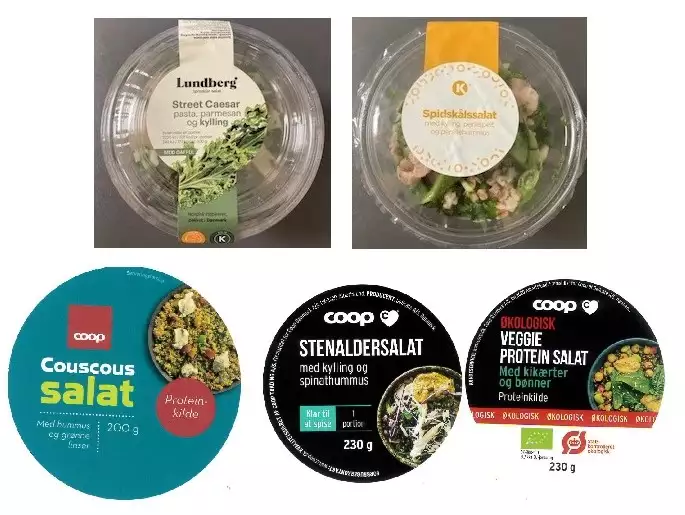
Delicate A/S is recalling coop Couscous salad, coop Stone Age salad, coop Organic Veggie Protein salad, Lundberg Street Cæsar Salad and Cicle K Spinach salad with chicken, pearl spelled and parsley hummus, as Listeria has been found in the products. The products should be returned to the store where they were purchased or discarded.

Updated on 08-08-2023 with the addition of more products and images.

See picture of the products here

Which foods are recalled

coop Couscous salad with hummus and green lentils
Net content: 200g
Best before: 29.07.2023
EAN code: 5704177011931

coop STENALDER SALAD with chicken and spinach hummus
Net content: 230g
Best before: 29.07.2023
EAN code: 5704177009167

coop ORGANIC VEGGIE PROTEIN SALAD with chickpeas and beans
Net content: 230g
Best before date: 29.07.2023
EAN code: 5700382854554

Sold in: Coop stores.

Lundberg Street Cæsar Salad
Net content: 300g
Last use-by date: 07.08.2023
EAN code: 5713300031166

Sold in: Netto and Føtex stores all over the country.

Cicle K Spinach salad with chicken, pearl barley and parsley hummus
Net content: 275g
Best-by date: 07.08.2023
EAN code: 5713300020399

Sold in: Circle K stores nationwide.

Why are the products being recalled?

The bacterium Listeria monocytogenes has been found in the products. You can therefore become infected with Listeria bacteria if you eat the products. The symptoms can include flu-like symptoms, fever and headache and, in rare cases, gastrointestinal problems. 

What should you do as a consumer?

The Danish Veterinary and Food Administration advises consumers to return the products to the store where they were purchased, or to discard them.

Who recalls the product

Delicate A/S, Greve Main 12, 2670 Greve

USA- David Oppenheimer and Company I, LLC Voluntarily Recalls Organic Green Kiwifruit Due to Possible Health Risk – Listeria monocytogenes

FDA

Zespri organic green kiwifruit, one-pound clear plastic clamshells

David Oppenheimer and Company I LLC is voluntarily recalling from the market all one-pound clamshells of organic green kiwifruit described below because they have the potential to be contaminated with Listeria monocytogenesListeria monocytogenes is an organism which can cause serious and sometimes fatal infections in young children, frail or elderly people, and others with weakened immune systems.  Although healthy individuals may suffer only short-term symptoms such as high fever, severe headache, stiffness, nausea, abdominal pain and diarrhea, listeria infection can cause miscarriages and stillbirths among pregnant women.

The recalled organic green kiwifruit is grown in New Zealand, exported to North America and repacked locally for sale in one-pound clear plastic clamshells bearing the Zespri brand and UPC code 8 18849 02009 3, containing fruit stickered with the GTIN bar code 9400 9552.

The organic green kiwifruit subject to the voluntary recall was shipped between June 14, 2023 and July 7, 2023, and sold in clamshells at retail locations in FL, GA, IL, IN, KY, MI, NC, NY, OH, PA, TN, TX, VA, and WI.  Zespri organic green kiwifruit sold in other states is NOT subject to this recall.

Zespri organic green kiwifruit shipped after August 7, 2023 in one-pound plastic clamshells with a WHITE STICKER that includes Work Order (WO) number and Packed on date is NOT affected by this recall. See example of white sticker below:

The recall was the result of a routine sampling by the Kentucky Department for Public Health on July 7, 2023. Since being notified on August 3, David Oppenheimer and Company I LLC has worked with Zespri to trace the product through the supply chain to two grower lots, and immediately ceased the distribution of organic green kiwifruit from the related grower lots as it continues its investigation in cooperation with the U.S. Food and Drug Administration. 

No illnesses have been reported to date. No other David Oppenheimer and Company I, LLC products are part of this voluntary recall.

Consumers who still have any of these products are urged not to consume the product and to discard it immediately. Consumers with questions may contact David Oppenheimer and Company I, LLC (Oppy) at 1-866-698-2580, Monday-Friday, 9am-4:30pm PDT, or send an email to contact@oppy.com.

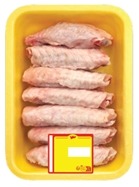
France – TURKEY FINS – Listeria monocytogenes

Gov france

Identification information of the recalled product

  • Product category Feed
  • Product subcategory Meats
  • Product brand name Neutral
  • Model names or references Turkey wings
  • Identification of products
    GTIN Batch Date
    3230890037795 531981992100 Use-by date 07/30/2023
  • Packaging tray
  • Marketing start/end date From 07/21/2023 to 07/30/2023
  • Storage temperature Product to be stored in the refrigerator
  • Health mark EN 85.215.001 EC
  • Geographic area of ​​sale Departments: RHONE (69), YONNE (89), HAUTS-DE-SEINE (92), SEINE-SAINT-DENIS (93), VAL-DE-MARNE (94)
  • Distributors Leclerc, Crossroads

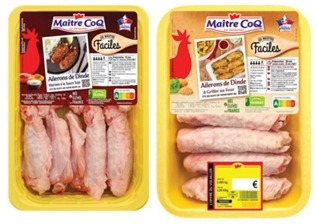
France – TURKEY FINS – Listeria monocytogenes

Gov france

Identification information of the recalled product

  • Product category Feed
  • Product subcategory Meats
  • Product brand name MASTER COCK
  • Model names or references Turkey wings
  • Identification of products
    GTIN Batch Date
    3230890001499 531981992100 Use-by date 07/30/2023
    3230890029011 531981992100 Use-by date between 07/30/2023 and 07/31/2023
  • Packaging tray
  • Marketing start/end date From 20/07/2023 to 31/07/2023
  • Storage temperature Product to be stored in the refrigerator
  • Health mark EN 85.215.001 EC
  • Geographic area of ​​sale Departments: ARDECHE (07), CHARENTE (16), GIRONDE (33), LOT-ET-GARONNE (47), MEUSE (55), PARIS (75), SEINE-ET-MARNE (77), YVELINES (78), HAUTE-VIENNE (87), ESSONNE (91), HAUTS-DE-SEINE (92), SEINE-SAINT-DENIS (93), VAL-DE-MARNE (94), VAL-D’OISE (95)
  • Distributors Leclerc

Research – Prevalence and Association of Campylobacter spp., Salmonella spp., and Blastocystis sp. in Poultry

MDPI

Foodborne Pathogen

Abstract

Poultry and poultry meat are considered the most important sources of human campylobacteriosis and salmonellosis. However, data about the occurrence of Campylobacter and Salmonella concomitantly with intestinal protozoa such as Blastocystis sp. in poultry remain very scarce. Therefore, this study aimed to investigate the presence and possible interactions between these three microorganisms in fecal samples from 214 chickens collected either on farms or from live bird markets in Egypt. The results obtained showed that Campylobacter spp., Salmonella spp., and Blastocystis sp. were present in 91.6% (196/214), 44.4% (95/214), and 18.2% (39/214) of tested samples, respectively, highlighting an active circulation of these microorganisms. Moreover, a significant positive correlation was reported between the occurrence of Campylobacter spp. and Blastocystis sp. together with a significant negative correlation between Blastocystis sp. and Salmonella spp. This study confirms the association reported previously between Blastocystis sp. and Campylobacter spp. while disclosing an association between Blastocystis sp. and Salmonella spp.; it also highlights the need to improve studies on the interactions between bacteria and eukaryotes in the gut microbiota of poultry.

Wales – Wrexham: 25 salmonella cases linked to single venue

Leader Live

kswfoodworld Salmonella

Public Health Wales (PHW) launched an investigation last week alongside Wrexham Council and Betsi Cadwaladr Health Board to find the source of the outbreak.

A multi-agency Outbreak Control Team (OCT) made up of the three organisations was set up.

And PHW has issued an update in relation to the investigation.

“We are currently investigating 25 confirmed and 4 probable cases of salmonella associated with a single venue in the city.” The venue has not yet been named

Norway – Outbreak of E. coli (EHEC infection)

Matportalen

This outbreak is caused by a different EHEC bacterium than the outbreak reported in June. FHI has started an outbreak investigation together with relevant municipal chief medical officers, the Norwegian Food Safety Authority and the Veterinary Institute. All the infected fell ill in July and none of them have traveled abroad.

The infected are aged < 5 to 45 years, and live in Trøndelag (4), Viken and Vestfold and Telemark. Two of them have developed the serious complication haemolytic uraemic syndrome (HUS). In addition, a further HUS case has been notified where EHEC has been detected, but we are awaiting more analyzes before we can say whether the person is infected with the same strain of bacteria as the other cases. It is not yet known what the source of infection is, but it is common for gastrointestinal bacteria to become infected through food.

– At the present time, we cannot say whether this is a limited outbreak or whether there may be new cases, says Silje Bruland Lavoll, senior physician in the section for infection from food, water and animals at the Norwegian Institute of Public Health. Investigative work can be complicated and take time, and in many cases we are unable to find the source of infection or to clarify whether it is a common source.

– We follow the situation closely and work closely with the municipal health service, the Norwegian Food Safety Authority and the Veterinary Institute, she adds.

– The Norwegian Food Safety Authority assists the Norwegian Institute of Public Health and municipal chief physicians in obtaining information from the sick persons and their relatives. Interviews are conducted about what the people have eaten and what they have been in contact with, says senior advisor Turid Berglund in the biological food safety section of the Norwegian Food Safety Authority.

Preliminary analyzes show that it is the bacterium EHEC O26:H11, which has been detected in all those infected. FHI is now working on further analyzes (whole genome sequencing) to confirm this.

Sweden – Axfood is recalling Falkenberg Seafood cold-smoked salmon in pieces because it may contain Listeria monocytogenes

Livsmedelsverket

Axfood recalled August 5 Falkenberg Seafood cold smoked salmon in pieces because it may contain listeria. The content is well below the statutory limit, but as a precautionary measure, Axfood still chooses to recall the product.

Recall Notice