Category Archives: Food Micro Blog

Research – Efficacy of Repeated Applications of Bacteriophages on Salmonella enterica-Infected Alfalfa Sprouts during Germination

MDPI

Nontyphoidal Salmonella enterica is one of the leading pathogens for foodborne outbreaks in a multitude of food commodities, including alfalfa sprouts, which are commonly consumed raw. The food industry has commonly used chlorinated washes, but such methods may not be perceived as natural; this can be a detriment as a large portion of sprouts are designated for the organic market. A natural and affordable antimicrobial method that has been acquiring popularity is the use of bacteriophages. This study compared the efficacy of repeated daily applications and a single application of two separate bacteriophage cocktails (SE14, SE20, SF6 and SE14, SF5, SF6) against four Salmonella enterica (S. enterica) strains on germinating alfalfa sprout seeds from days 0 to 7. The results show S. Enteritidis to be the most susceptible to both cocktails with ~2.5 log CFU/mL decrease on day 0 with cocktail SE14, SF5, and SF6. S. enterica populations on all strains continued to grow even with repeated daily bacteriophage applications but in a significantly decreased rate (p < 0.05) compared with a single bacteriophage application. The extent of the reduction was dependent on the S. enterica strain, but the results do show benefits to using repeated bacteriophage applications during sprout germination to reduce S. enterica populations compared with a single bacteriophage application.

USA – FSMA Final Rule on Laboratory Accreditation for Analyses of Foods (LAAF)

FDA

The FDA Food Safety Modernization Act (FSMA) final rule on Laboratory Accreditation for Analyses of Foods (LAAF) establishes a laboratory accreditation program for the testing of food in certain circumstances. Under the LAAF program, FDA will recognize accreditation bodies (ABs) that will accredit laboratories to the standards established in the final rule (referred to as LAAF-accredited laboratories).

The final rule specifies eligibility requirements that ABs and laboratories wishing to participate in the program will need to satisfy, as well as procedures for how the FDA will manage and oversee the program. In certain circumstances, owners and consignees will be required to use a LAAF-accredited laboratory for food testing. FDA will maintain an online public registry listing recognized accredited bodies and LAAF-accredited laboratories.

The establishment of the LAAF program is intended to improve the accuracy and reliability of certain food testing through the uniformity of standards and enhanced FDA oversight of participating laboratories.

Structures of the Laboratory Accreditation for Analyses of Foods (LAAF) Program

Enlarge in PDF (241KB)

Denmark – Listeria monocytogenes in Meatballs

DVFA

Danish Crown Foods A/S is recalling a batch of pre-fried mini meatballs, Den Gode Frikadelle, due to the discovery of Listeria in the product.

Recalled Foods , Published: October 7, 2022

​Which food:
Den Gode Frikadelle, Mini frikadelle (see picture here )
Net content: 800g
Best before date: 12.10.2022
Lot number: 12.10.22
EAN barcode number: 5711044171087

Sold in:
Netto, Bilka and Føtex throughout the country

Company that recalls :
Danish Crown Foods A/S

Reason:
The company has found the bacterium Listeria monocytogenes in the product.

Risk:
Infection with Listeria bacteria, where the symptoms can include flu-like symptoms, fever and headache and, in rare cases, gastrointestinal problems. Read more about Listeria in food here .

Advice for consumers:
The Danish Veterinary and Food Administration advises consumers to return the product to the store where it was purchased, or to discard it.
If you have questions about symptoms or illness, you should contact your own doctor or the doctor on call.

Serbia – Lidl withdraws certain brand of waflles from its shelves as a precautionary measure- Salmonella

Serbian Monitor

Lidl in Serbia has informed consumers that, as a precautionary measure, it has withdrawn from sale the products of Pak Rampart (from Visoko, Bosnia and Herzegovina).

The Lidl Company is urging shoppers not to consume them, but rather to return them (there is no need to show the receipt) and they will be reimbursed for the money spent.

The following wafers were withdrawn:

Cocoa-flavoured wafers – a product with 72% cocoa filling, 800g pack,

Hazelnut-flavoured wafers – a product with 72% hazelnut-flavoured filling, 800g pack,

Waffle with cocoa filling – produced with 80% cocoa filling, 200-gram pack,

Waffle with hazelnut-flavoured filling – produced with 80% hazelnut-flavoured filling, 200-gram pack

Waffle with cocoa topping – the product with 57% cocoa filling, coated with 20% cocoa topping, 200-gram pack.

“The products were withdrawn due to the possibility of the presence of Salmonella Typhimurium bacteria, as regular checks in Croatia determined its presence in two production batches,” announced Lidl.

Samples of products from the shelves in Serbia were, as mentioned, sent to local laboratories for thorough testing, and the relevant institutions were also informed.

The retailer and the manufacturer have apologised to all consumers who bought the mentioned products for the inconvenience.

(Seebiz.eu, 05.10.2022)

https://www.seebiz.eu/tvrtke/lidl-u-srbiji-povlaci-pet-proizvoda-zbog-moguceg-prisustva-salmonele/282444

Research – Salmonella rising in British raw meat pet food

Pet Food Industry

The occurrence of Salmonella in raw pet food seems to be rising in Great Britain. Raw meat pet food had the highest number of Salmonella contaminated samples of all the feeds tested by the UK’s Animal and Plant Health Agency scientists. The agency report “Salmonella in Animals and Feed in Great Britain 2021” documented an upward trend.

In 2021, the agency’s laboratories isolated 295 instances of Salmonella from raw pet food available on the British market. That’s up 8.1% from 2020’s 273 isolations, and 20.4% higher than 2019 with 245 isolations.

Some of these Salmonella bacteria were from strains with resistance to drugs used to fight infection. These potentially dangerous pathogens were found in 71 of the samples taken in 2021. These made up 57.3% of the total regulated varieties of Salmonella found by the Animal and Plant Health Agency in 2021 among all feeds and locations tested. The proportion of drug-resistant Salmonella in British raw meat pet food didn’t increase much over 2020, but did show an upward tendency compared to 2019.

“Contaminated raw meat pet food, which does not undergo any heat treatment to deactivate pathogens, may therefore represent a potential source of infection to both the dogs consuming it and people who handle it, especially if insufficient hygiene measures are adopted,” the report authors wrote.

Research – History of Food Poisoning Outbreaks Linked to Cantaloupe

Food Poisoning Bulletin

In the latest update to the FDA‘s CORE Outbreak Investigation Table, that agency stated that a Salmonella Typhimurium outbreak that has ended is linked to cantaloupe. This is not the first time that this fruit has caused illnesses. What is the history of food poisoning outbreaks linked to cantaloupe?

While the outbreak is over, the FDA says that more information is forthcoming. We do not know the case count by state, but there are at least 87 people who are sick. We also do not know the patient age ranges, or illness onset dates.

History of Food Poisoning Outbreaks Linked to Cantaloupe

There have been six other multistate food poisoning outbreaks since 2011 that were linked to cantaloupe. Many of these outbreaks were deadly.

Read more in the link above.

Quebec -Notice not to consume any type of spices, nuts or dried fruits sold in bulk by Marché Mon Village

Quebec

QUEBEC CITY , Oct. 6, 2022 /CNW Telbec/ – The Ministry of Agriculture, Fisheries and Food (MAPAQ), in collaboration with the Food Inspection Division of the City of Montreal and the company Marché Mon Village, located at 1689, rue Poirier, in Montreal, advises the public not to consume the products indicated in the table below, because they have not been preserved in such a way as to ensure their safety.

Product name

Format

Affected lot

Various spices

in bulk

Sold until October 6, 2022

various nuts

Various dried fruits

The products that are the subject of this warning were offered for sale until October 6, 2022, and this, only at the establishment designated above. Products were sold in bulk and stored at room temperature.

The operator is voluntarily recalling the products in question. It has agreed with MAPAQ and the Food Inspection Division of the City of Montreal to distribute this warning as a precautionary measure. Also, people who have any of these products in their possession are advised not to consume it. They must return it to the establishment where they bought it or throw it away. Even if the affected products show no signs of tampering or suspicious odors, their consumption may represent a health risk.

It should be noted that no case of illness associated with the consumption of these foods has been reported to MAPAQ to date.

India – 3 Tamil Nadu Children Die, 11 Hospitalised Allegedly Due To Food Poisoning

NDTV

Chennai: 

Three children died allegedly due to food poisoning at a children’s home in Tiruppur in Tamil Nadu.

Eleven other children who had consumed the same food are being treated at a hospital.

The children, all residents of Vivekananda Sevalaya, investigators say had fallen sick after they consumed idli and Pongal on Wednesday morning. Officials of the Sevalaya had given them medicines. Their condition did not improve and the children could not eat rice and rasam served for both lunch and dinner.

Two of the 15 students in the Sevalaya were found dead this morning in the hostel and another died on the way to the hospital. Those who died are between 10-14 age cohort.

Officials say no arrests have been made yet and food samples have been sent for investigation.

USA – Outbreak Investigation of Listeria monocytogenes: Brie and Camembert Soft Cheese Products (September 2022)

FDA

The FDA, along with CDC and state and local partners, is investigating a multistate outbreak of Listeria monocytogenes infections linked to Brie and Camembert soft cheese products, including all baked Brie cheeses, manufactured by Old Europe Cheese, Inc. of Benton Harbor, MI, and sold at various retailers under multiple labels and brands.

On September 30, 2022, Old Europe Cheese, Inc. voluntarily recalled multiple brands of Brie and Camembert cheeses produced at their Michigan facility and on October 5, 2022 expanded their recall to include multiple brands of baked Brie products. The firm has also halted production and distribution of their Brie and Camembert products from the Michigan facility and is working with FDA on corrective actions. Consumers, restaurants, and retailers should not eat, sell, or serve recalled products and should throw them away; this includes Best By Dates ranging from September 28, 2022 to December 14, 2022, and all flavors and quantities.

An expanded list of recalled products and stores that potentially sold these products is available below and on the firm’s recall. Swiss American has also issued a voluntary recall of their St. Louis Brie products sourced from Old Europe Cheese Inc.’s Michigan facility. A full list of their products can be found on the firm’s recall notice.

FDA’s investigation is ongoing to determine if additional products are potentially contaminated. Updates to this advisory will be provided as they become available.

Recommendation

Consumers, restaurants, and retailers should not eat, sell, or serve recalled products and should throw them away; this includes Best By Dates ranging from September 28, 2022 to December 14, 2022, and all flavors and quantities. An expanded list of recalled products and stores that potentially sold these products is available below and on the firm’s recall.

Retailers may have repackaged bulk Old Europe Cheese items into smaller containers and sold this repackaged product to consumers. This repackaged product may not bear the original labeling and product information. If you are unsure where your Brie or Camembert cheese products are from, ask your retailer or throw them away.

Listeria is most likely to sicken pregnant people and their newborns, adults aged 65 or older, and people with weakened immune systems. Other people can be infected with Listeria, but they rarely become seriously ill.

Call your healthcare provider right away if you have these symptoms after eating Old Europe Cheese Inc. Brie and Camembert products:

  • Pregnant people typically experience only fever, fatigue, and muscle aches. However, Listeria infection during pregnancy can lead to miscarriage, stillbirth, premature delivery, or life-threatening infection of the newborn.
  • People who are not pregnant may experience headache, stiff neck, confusion, loss of balance, and convulsions, in addition to fever and muscle aches.

Follow FDA’s safe handling and cleaning advice and use extra vigilance in cleaning and sanitizing any surfaces and containers that may have come in contact with these products to reduce the risk of cross-contamination, including retailers who repackaged bulk recalled cheese. Listeria can survive in refrigerated temperatures and can easily spread to other foods and surfaces.

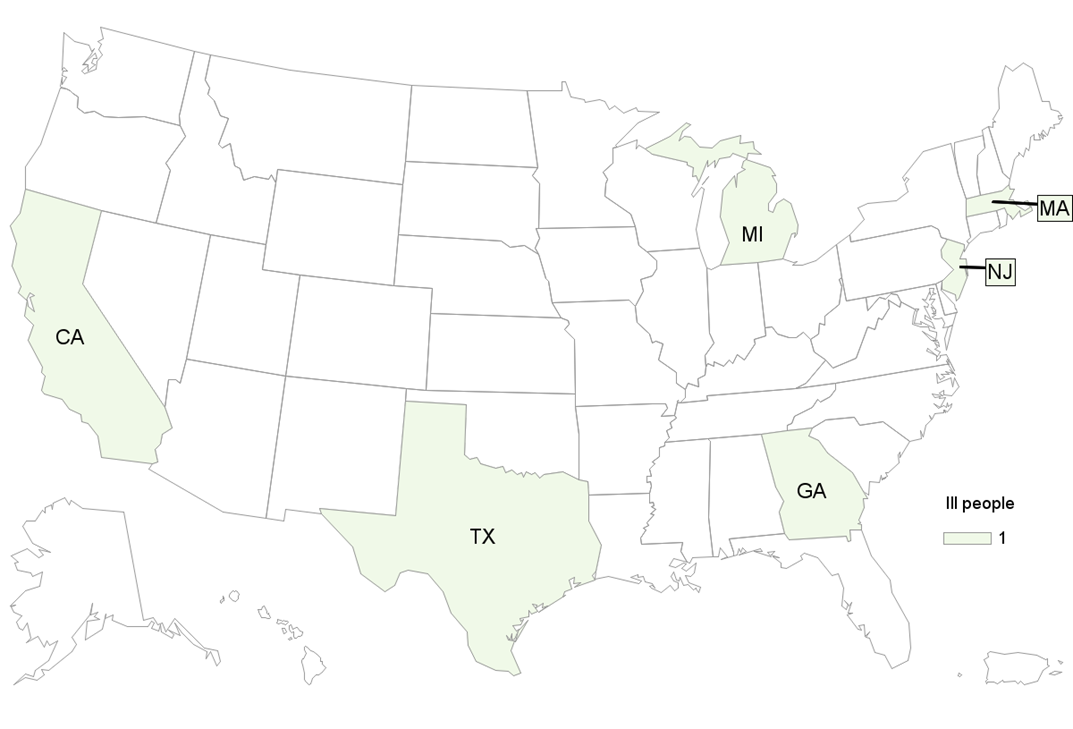
Case Count Map Provided by CDC

CDC Case Count for the Outbreak Investigation of Listeria monocytogenes from Brie and Camembert Soft Cheese Products (as of 10/6/2022)

Case Counts

Total Illnesses: 6
Hospitalizations: 5
Deaths: 0
Last illness onset: August 5, 2022
States with Cases: CA, GA, MA, MI, NJ, TX
Product Distribution: Nationwide

RASFF Alert- E.coli – EPEC – Sheep Fillet

RASFF

Detection of EPEC in sheep fillet from Australia in Germany