Category Archives: Food Micro Blog

Italy – Tuna suspected for a dozen illnesses in Italy – Food Poisoning

Food Safety News

At least 12 people are sick in Italy with tuna being investigated as the source of their illnesses.

The foodborne outbreak is suspected to have been caused by thawed yellowfin tuna steaks with added water from Italy and raw material from Spain.

In recent days, nine people with symptoms such as such as nausea, vomiting and loss of consciousness or fainting were reported to the Tuscany local health unit (ASL) and admitted to two hospitals before later being discharged.

They all reported consumption of tuna in various forms at two different restaurants in Florence.

France – Product recall: Cahills brand orig irish cheddar 32% 2k27 – Listeria monocytogenes

Oulah

ENCOUNTERED PROBLEM

Presence of Listeria monocytogenes

PROPOSED SOLUTION

People who may have this product are asked not to consume it and to return it to the point of sale where it was purchased.

People who have consumed this product and who present with fever, isolated or accompanied by headaches, are invited to consult their attending physician, notifying him of this consumption.
Pregnant women should pay special attention to these symptoms, as well as immunocompromised people and the elderly. These symptoms may suggest listeriosis, a disease that can be serious and can take up to eight weeks to incubate.

FURTHER INFORMATION

▸ Model names or references
CHEDDAR CAHILLS ORIG IRISH PORTER 32% 2K27


▸ Barcode
05390274111119


▸ Lot
21141


▸ DLC – DDM
10/21/2021


▸ Packaging
2.27 kg


▸ Start date / End of marketing
From 06/01/2021 to 06/08/2021


▸
IE 1811 EEC health mark


▸ Geographical sales area
…


▸ Distributors
Company of the France Frais group: Team Ouest Distralis, Aumand Dis Frais, Lodifrais, Team Ouest Normandie, Guilmot Gaudais, Ouest Frais Distribution.


▸ Consumer service contact
0230 210 150


▸ Source
TEAM OUEST DISTRALIS Team Ouest Distralis, France Frais group

Israel – Alrozana International Trade Ltd. recalls various tahini products due to Salmonella contamination.

Click to access RCL_10062021_03.pdf

France- Product recall: Bleu de Provence unbranded – Listeria monocytogenes

Oulah

ENCOUNTERED PROBLEM

Presence of Listeria monocytogenes

PROPOSED SOLUTION

People who may have this product are asked not to consume it and to return it to the point of sale where it was purchased.

People who have consumed this product and who present with fever, isolated or accompanied by headaches, are invited to consult their attending physician, notifying him of this consumption.
Pregnant women should pay special attention to these symptoms, as well as immunocompromised people and the elderly. These symptoms may suggest listeriosis, a disease that can be serious and can take up to eight weeks to incubate.

FURTHER INFORMATION

▸ Names of models or references
…


▸ Barcode
3760007489914


▸ Lot
154


▸ DLC – DDM
07/07/2021


▸ Packaging
BREAD 1KG TRAY 125 G


▸ Start date / End of marketing
From 06/03/2021 to 06/11/2021


▸ Health mark
FR.26.362.001 CE


▸ Geographical sales area
…


▸
GMS distributors WHOLESALE TRADE SEDENTARY / NON-SEDENTARY


▸ Contact
customer service 0760901938


▸ Source
STE OF DISTRAL FOOD DISTRIBUTION

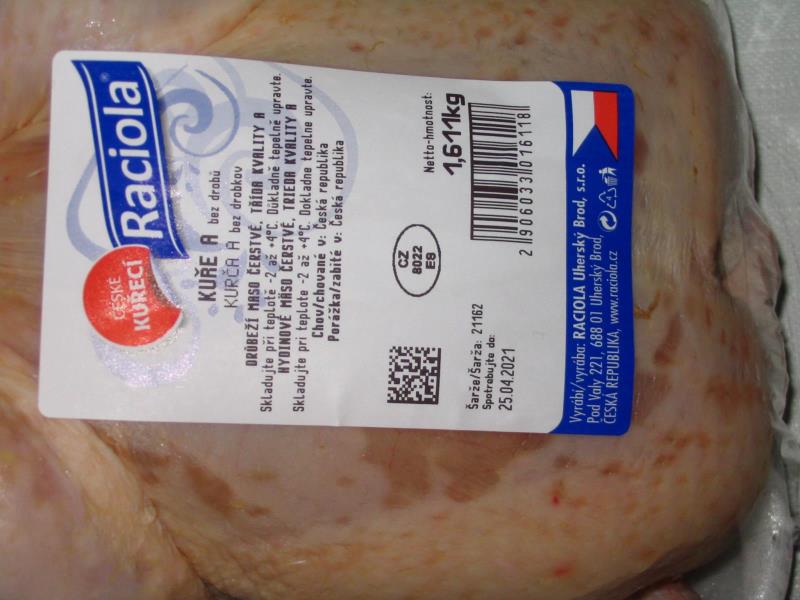
Czech Republic- Chilled chicken without offal B – Salmonella

Potravinynapranyri

Food group: Meat and meat products / Packaged meat

Chilled chicken without offal B
Category: Dangerous food
Unsatisfactory parameter:

Salmonella enterica serum. Enteritidis

The pathogenic bacterium Salmonella enterica serum was detected in chilled chickens without offal . Enteritidis , which can cause a condition called salmonellosis.

Expiration date: 4/25/2021
Packaging: Plastic foil
Producer: RACIOLA Uhersky Brod, sro
Country of origin:  Czechia
Date of sampling: 20. 4. 2021
Reference number: 21-000018-SVS-CZ
The sample was found by official inspection of the State Veterinary Administration.

Germany – Basak curry 100g – Salmonella

AGES

AGES informs about a recall of the company Macro Group Handels GmbH. The company initiated a recall of the product Basak Curry 100g on June 11th, 2021:

Food recall

Basak curry 100g
Recall reason Salmonella
Marketed by Macro Group Handels GmbH
Manufacturer Basak
Expiry Date 04.2023

Product recall: Basak Curry 100g

Vienna (OTS) – The article Basak Curry 100g contains salmonella and is therefore criticized as HARMFUL. We therefore ask you not to consume and return goods that have already been purchased.

The following best before dates are affected: Best before: 03.2023

The article Basak Curry 100g could contain foreign bodies and will therefore be rejected as HARMFUL. We therefore ask you not to consume and return goods that have already been purchased.

The following
best before dates are affected : Best before: 12.2022, 03.2023 and 04.2023 Inquiries

& contact:

Mücahit Bülük: TEL .: + 43 2162 65 708 21

Original broadcast

USA- Recalled: A Single Lot of Freshpet Select Small Dog – Salmonella

Petful

Maker: Freshpet, Inc.
Cause: Potential for salmonella
Announcement: FDA alert dated June 13, 2021 (archived here)
What was recalled: Freshpet Select Small Dog Bite Size Beef & Egg Recipe Dog Food, 1 lb., UPC # 627975012939, with sell by date of Oct. 30, 2021 and Lot Code 1421FBP0101

Only the dog food listed above — with the exact UPC, sell by date and lot code — is part of this recall, and no other Freshpet products are affected.

Research – Antimicrobial effect of tea polyphenols against foodborne pathogens

Journal of Food Protection

In recent years, science and technology have developed to a considerable level. However, food contamination by food-borne pathogens is still widespread in many countries around the world, and food safety is a major global public health issue. Therefore, novel preservatives that can guarantee safer food are high in demand. Contrary to artificial food preservatives, tea polyphenols (TP) are getting wide attention as food additives for being “green”, “safe” and “healthy”. The sources of TP are wide, and the purification technology is sophisticated. Compared with other natural antibacterial agents, its antibacterial effect is more stable. It is an excellent natural antibacterial agent. Here, this review systematically summarizes the important chemical components of TP and discusses their antibacterial mechanisms against various foodborne pathogens. In addition, the potential application areas of TP are also discussed. It can provide a theoretical basis for the in-depth study of TP.

Research- Monte Carlo Simulation Model for Predicting Salmonella Contamination of Chicken Liver as a Function of Serving Size for Use in Quantitative Microbial Risk Assessment

Journal of Food Protection

Salmonella kswfoodworld

The first step in quantitative microbial risk assessment (QMRA) is to determine distribution of pathogen contamination among servings of the food at some point in the farm-to-table chain. In the present study, distribution of Salmonella contamination among servings of chicken liver for use in QMRA was determined at meal preparation. A combination of five methods: 1) whole sample enrichment; 2) quantitative polymerase chain reaction; 3) cultural isolation; 4) serotyping; and 5) Monte Carlo simulation were used to determine Salmonella prevalence (P), number (N), and serotype for different serving sizes. In addition, epidemiological data were used to convert serotype data to virulence (V) values for use in QMRA. A Monte Carlo simulation model based in Excel and simulated with @Risk predicted Salmonella P, N, serotype, and V as a function of serving size from one (58 g) to eight (464 g) chicken livers. Salmonella P of chicken livers was 72.5% (58/80) per 58 g. Four serotypes were isolated from chicken livers: 1) Infantis (P = 28%, V = 4.5); 2) Enteritidis (P = 15%, V = 5); 3) Typhimirium (P = 15%, V = 4.8); and 4) Kentucky (P = 15%, V = 0.8). Median Salmonella N was 1.76 log per 58 g (range: 0 to 4.67 log/58 g) and was not affected ( P > 0.05) by serotype. The model predicted a non-linear increase ( P ≤ 0.05) of Salmonella P from 72.5% per 58 g to 100% per 464 g, minimum N from 0 log per 58 g to 1.28 log per 464 g, and median N from 1.76 log per 58 g to 3.22 log per 464 g. Regardless of serving size, predicted maximum N was 4.74 log, mean V was 3.9, and total N was 6.65 log per lot (10,000 chicken livers). The data acquired and model developed in this study fill an important data and modeling gap in QMRA for Salmonella and chicken liver.

Research – High Hydrostatic Pressure Treatment Ensures the Microbiological Safety of Human Milk Including Bacillus cereus and Preservation of Bioactive Proteins Including Lipase and Immuno-Proteins: A Narrative Review

MDPI

Breast milk is the nutritional reference for the child and especially for the preterm infant. Breast milk is better than donated breast milk (DHM), but if breast milk is not available, DHM is distributed by the Human Milk Bank (HMB). Raw Human Milk is better than HMB milk, but it may contain dangerous germs, so it is usually milk pasteurized by a Holder treatment (62.5 °C 30 min). However, Holder does not destroy all germs, and in particular, in 7% to 14%, the spores of Bacillus cereus are found, and it also destroys the microbiota, lipase BSSL and immune proteins. Another technique, High-Temperature Short Time (HTST 72 °C, 5–15 s), has been tried, which is imperfect, does not destroy Bacillus cereus, but degrades the lipase and partially the immune proteins. Therefore, techniques that do not treat by temperature have been proposed. For more than 25 years, high hydrostatic pressure has been tried with pressures from 100 to 800 MPa. Pressures above 400 MPa can alter the immune proteins without destroying the Bacillus cereus. We propose a High Hydrostatic Pressure (HHP) with four pressure cycles ranging from 50–150 MPa to promote Bacillus cereus germination and a 350 MPa Pressure that destroys 106 Bacillus cereus and retains 80–100% of lipase, lysozyme, lactoferrin and 64% of IgAs. Other HHP techniques are being tested. We propose a literature review of these techniques. View Full-Text