Category Archives: Food Inspections

USA – Outbreak Investigation of Listeria monocytogenes – Hispanic-style Fresh and Soft Cheeses (February 2021)

FDA

The FDA, along with CDC and state and local partners, are investigating a multistate outbreak of Listeria monocytogenes infections linked to queso fresco cheeses made by El Abuelito Cheese, Inc.

As part of this outbreak investigation, the Connecticut Department of Public Health collected product samples of El Abuelito-brand Hispanic-style fresh and soft cheeses from a store where a sick person bought cheeses. Sample analysis showed the presence of Listeria monocytogenes in samples of El Abuelito Queso Fresco sold in 10 oz packages, marked as Lot A027 with an expiration date of 02/26/2021. On 2/19/2021, Whole Genome Sequencing (WGS) analysis conducted by the Connecticut State Laboratory determined that the Listeria monocytogenes found in the samples is a match to the outbreak strain.

On 2/19/2021, El Abuelito Cheese, Inc. of Paterson, NJ recalled all Queso Fresco products with “sell by” dates through 03/28/21. Products include El Abuelito, Rio Grande, and Rio Lindo brand queso frescos, distributed to CT, MD, NC, NJ, NY, PA, and VA. A full list of recalled products is included below. At this time, El Abuelito Cheese, Inc. has ceased production and distribution of all products.

Recommendation

Consumers, restaurants, and retailers should not eat, sell, or serve any recalled queso fresco cheeses.

FDA recommends that anyone who purchased or received recalled products use extra vigilance in cleaning and sanitizing any surfaces and containers that may have come in contact with these products to reduce the risk of cross-contamination. Listeria can survive in refrigerated temperatures and can easily spread to other foods and surfaces.


Product Images

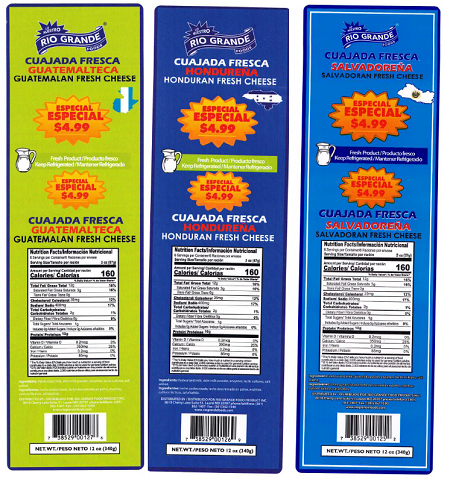
Sample Product Label from the Outbreak Investigation of Listeria monocytogenes in Hispanic-style Fresh and Soft Cheeses (February 2021) - Rio Grande


Sample Product Label from the Outbreak Investigation of Listeria monocytogenes in Hispanic-style Fresh and Soft Cheeses (February 2021) - Rio Grande


Sample Product Label from the Outbreak Investigation of Listeria monocytogenes in Hispanic-style Fresh and Soft Cheeses (February 2021) - Rio Lindo


Sample Product Label from the Outbreak Investigation of Listeria monocytogenes in Hispanic-style Fresh and Soft Cheeses (February 2021) - El Abuelito


Sample Product Label from the Outbreak Investigation of Listeria monocytogenes in Hispanic-style Fresh and Soft Cheeses (February 2021) - Chirilagua, Yorito


Recall Information

On 2/19/2021, El Abuelito Cheese of Paterson, NJ recalled all Queso Fresco products within expiration. Products include:

Brand

Product Name

Size

Container Type

UPC Code

El Abuelito Cheese

Queso Fresco Regular

12 oz.

Plastic Container

673130100003

El Abuelito Cheese

Queso Fresco Promoción

10 oz.

Plastic Container

673130100078

El Abuelito Cheese

Queso Fresco de Hoja

12 oz.

Plastic Container

673130100065

El Abuelito Cheese

Queso Fresco

5 Lb.

Vaccuum Packed

673130100058

El Abuelito Cheese

Queso Fresco Guatemala

12 oz.

Plastic Container

673130100027

Rio Grande Food Products, Inc.

Chirilagua Queso de Hacienda

12 oz.

Plastic Container

738529005571

Rio Grande Food Products, Inc.

Queso Fresco Campestre con Hoja

14 oz.

Plastic Container

812324031161

Rio Grande Food Products, Inc.

Queso Fresco Campestre Artesanal

14 oz.

Plastic Container

738529002518

Rio Grande Food Products, Inc.

Queso Fresco con Hoja

14 oz.

Plastic Container

738529004581

Rio Grande Food Products, Inc.

Queso Fresco Yorito

12 oz.

Plastic Container

738529005564

Rio Grande Food Products, Inc.

Queso Fresco Olancho

14 oz.

Plastic Container

812324031222

Rio Grande Food Products, Inc.

Cuajada Fresca Guatemalteca

12 oz.

Plastic Container

738529001276

Rio Grande Food Products, Inc.

Cuajada Fresca Hondureña

12 oz.

Plastic Container

738529001269

Rio Grande Food Products, Inc.

Cuajada Fresca Salvadoreña

12 oz.

Plastic Container

738529001252

Rio Lindo

Queso Fresco Mexicano

12 oz.

Plastic Container

718122088587

Rio Lindo

Queso Fresco Hondureño

12 oz.

Plastic Container

718122088591

Rio Lindo

Queso Fresco Salvadoreño

12 oz.

Plastic Container

718122088607

U.S. Distribution of Recalled El Abuelito Queso Fresco

Product Distribution*: CT, MD, NC, NJ, NY, PA, VA

*States with confirmed distribution; product could have been distributed further


Case Count Map Provided by CDC

CDC Case Count Map for the Outbreak Investigation of Listeria monocytogenes in Hispanic-style Fresh and Soft Cheeses - 2/12/2021

Case Counts

Total Illnesses: 7
Hospitalizations: 7
Deaths: 0
Last Illness Date: 1/22/2021
States with Cases: MD (4), CT (1), NY (1), and VA (1)

FDA – Aaron’s Gourmet Smoked Fish Recalls Smoked Fish Products Produced Without Licensure and Regulatory Oversight

FDA

Summary

Company Announcement Date:
FDA Publish Date:
Product Type:
Food & Beverages
Fish
Food Compliance Programs
Reason for Announcement:
Lack of licensure and regulatory oversight by the state agency
Company Name:
Aaron’s Gourmet Smoked Fish
Brand Name:
Aaron’s Gourmet Smoked Fish
Product Description:
Smoked fish products

Company Announcement

Aaron’s Gourmet Smoked Fish is issuing a voluntary recall of all smoked fish products due to the lack of licensure and regulatory oversight by the state agency. The products are packaged in both glass jars and vacuum-packed plastic bags.

The products were distributed to Growers Outlet and Berry Good PDX in Portland, Oregon. Consumers who have purchased these products are urged not to consume them. These products should be thrown away or returned to the place of purchase for a full refund.

The products have been voluntarily recalled by Aaron’s Gourmet Smoked Fish. We are not aware of any reported cases of illness related to these products.

This recall is being made with the knowledge of the Oregon Department of Agriculture.

Please contact Aaron at 503-372-9849 for questions or complaints.


Company Contact Information

Consumers:
Aaron
 503-372-9849

Canada – Notice not to consume salmon packaged in glass jars, manufactured and sold by the company Poissonnerie de l’Île

MAPAQ

The MAPAQ, in collaboration with the company Poissonnerie de l’Île, located at 224, boulevard Perron Est, in Saint-Siméon , is warning the population not to consume the product indicated in the table below. below, because it was not prepared and packaged in such a way as to ensure its safety . 

Product name Format Targeted lot
“Canned salmon in a jar”
250 ml
500 ml
Units sold until February 18, 2021

The product that is the subject of this warning was offered for sale until February 18, 2021 inclusively , and only at the establishment designated above. The product was packaged in mason-type glass jars and sold at room temperature.

The operator is voluntarily recalling the product in question. He agreed with MAPAQ to disseminate this warning as a precautionary measure. Persons who have this product in their possession are advised not to consume it. They must either return it to the establishment where they bought it or throw it away. Even if the affected product does not show any signs of spoilage or a suspicious odor, consuming it may represent a risk to health. It should be noted that no case of illness associated with the consumption of this food has been reported to MAPAQ so far.

Additional information

Media relations
Communications
Department Ministry of Agriculture, Fisheries
and Food
Tel. : 418 380-2100, extension 3512
www.mapaq.gouv.qc.ca

Product (s)

Ireland – Recall of Zena Moringa Powder Due to the Presence of Salmonella

FSAI

Summary
Category 1: For Action
Alert Notification: 2021.19
Product: Zena Moringa Powder; pack size: 100g
Batch Code: Best before date: 31/12/2023
Country Of Origin: Senegal

Message:

Unidex B.V. is recalling Zena Moringa Powder due to the presence of Salmonella. The presence of Salmonella may make this product unsafe to consume. A point-of-sale recall notice will be displayed in stores supplied with the product.

Nature Of Danger:

People infected with Salmonella typically develop symptoms between 12 and 36 hours after infection, but this can range between 6 and 72 hours. The most common symptom is diarrhoea, which can sometimes be bloody.  Other symptoms may include fever, headache and abdominal cramps. The illness usually lasts 4 to 7 days. Diarrhoea can occasionally be severe enough to require hospital admission. The elderly, infants, and those with impaired immune systems are more likely to have a severe illness.

Action Required:

Manufacturers, wholesalers, distributors, caterers & retailers:

Retailers are requested to remove the product from sale and to display a point-of-sale recall notice in stores where the product was sold. 

Consumers:

Consumers are advised not to consume the product

Recall of Zena Moringa Powder Due to the Presence of Salmonella

USA – NY Dunkin Donuts Hepatitis A Employee Worked While Infectious

Food Poisoning Bulletin

Close up 3d render of an influenza-like virus isolated on white

In Schuyler County, New York, a Dunkin Donuts hepatitis A employee worked while infectious, according to a press release by the Chemung County Health Department. An investigation has been launched because that person worked at two area Dunkin Donuts locations.

USA – Fresh Organic Basil Recalled Over Cyclospora Contamination Concerns

Consumer Reports

Cyclospora_LifeCycle201

Shenandoah Growers has recalled 3,240 units of fresh-cut, packaged organic basil because it may be contaminated with the parasite cyclospora.

The problem was found when a sample of the basil, which was imported from Columbia, was found to contain the parasite during a Food and Drug Administration routine test. No illnesses have been reported.

UK – The FSA is reiterating its advice on cooking frozen raw breaded chicken products following link to rising cases of Salmonella

FSA

The Food Standards Agency (FSA) along with Food Standards Scotland (FSS) and Public Health England (PHE), Public Health Scotland and Public Health Wales are reminding people once again to take care when handling and cooking frozen raw breaded chicken products at home, such as nuggets, goujons, dippers, poppers and kievs

This comes as we issued two further product recalls of products linked to two ongoing outbreaks of Salmonella Enteritidis (a food poisoning bug).

An investigation is ongoing into two particular strains of Salmonella linked to frozen raw breaded chicken products. We saw an increase in salmonellosis cases caused by these strains of Salmonella throughout 2020. Control measures were put in place, businesses undertook product recalls and the FSA published alert notifications. We also issued precautionary advice to consumers in October 2020. Given the long shelf life of these products and the fact that we continue to receive reports of disease caused by these Salmonella strains, we are reminding the public again about the importance of cooking and handling frozen breaded chicken products.

Colin Sullivan, Chief Operating Officer, FSA said:

‘Our advice is to always take care when storing, handling and cooking these types of frozen breaded chicken products to help reduce the risk of food poisoning to you and your family.’

‘You should always check the cooking instructions on food packaging, as different brands of the same product might have different instructions. Cooking food at the right temperature and for the correct length of time will ensure that any harmful bacteria are killed.’

Saheer Gharbia, Head of the Gastrointestinal Pathogens Unit of PHE’s National Infection Service, said:

‘Cases continue to be reported, albeit at lower levels than last year, following the control measures taken to date.

‘Salmonella generally causes a mild illness, although vulnerable groups like children under five years, the elderly, and those with weakened immune systems may experience more severe illness and may require hospitalisation. Symptoms of a Salmonella infection include diarrhoea, stomach cramps and sometimes vomiting and fever. Anyone who is concerned about symptoms should contact their GP or out of hours service in the first instance.’

Further information on Salmonella and food poisoning can be found on the NHS Choices website (Opens in a new window).

Top food hygiene tips:

  • Always carefully check the advice on food packaging and follow the cooking instructions provided
  • If the packaging advises the product should be thawed/defrosted before cooking, follow the instructions
  • Consume or freeze food by its use-by date
  • Wash your hands with soap and water after touching raw chicken products and before you handle ready-to-eat food
  • Avoid cross-contamination by cleaning any surface, plate or utensil that has been in contact with raw meat

Salmonella is a common bacteria that can cause food poisoning. Salmonella can be found in raw meat (processed and unprocessed), undercooked poultry and unpasteurised milk. Inadequate cooking and cross-contamination in the kitchen during food preparation can lead to Salmonellosis.

The following recalls are linked to this Salmonella outbreak:

Find out more about salmonella and how to avoid salmonella infection

From January 2020 there have been 480 cases of Salmonellosis caused by two strains of Salmonella Enteritidis and linked to consumption of frozen, raw, breaded chicken products.

Research – Food risk survey shows low awareness of Campylobacter

Food Safety News

There is low awareness of Campylobacter and its impact despite it being the main cause of food poisoning in the UK, according to a project on how people perceive food-related risks.

Results come from a survey by Kantar Public and analysis at the Food Standards Agency (FSA). The study was online and had 1,194 participants in March 2017 but results were only published this month.

The objective was to improve the FSA’s understanding of consumer perceptions on food risk. This could help develop the targeting, messaging and effectiveness of communication with the public, researchers said.

Consumer risk perception on 17 topics identified by FSA and Food Standards Scotland (FSS) including E. coli O157, food allergens, chemicals in food, Campylobacter, norovirus, pesticides, and radioactivity in food were measured.

Research – Evaluation of avocados as a possible source of Listeria monocytogenes infections, United States, 2016–2019

Journal of Food Protection


Outbreaks of Listeria monocytogenes (L. monocytogenes) infections have historically been associated with contaminated deli meats, but recent outbreaks have been linked to produce. To date, avocados have not been identified as the source of any outbreaks of L. monocytogenes infections in the United States, but avocado samples have yielded strains that were closely related genetically to clinical L. monocytogenes isolates. To determine whether avocados have been a source of listeriosis, we conducted a retrospective review of epidemiological data for clinical isolates that were genetically related to isolates from avocados. Using a national database, we identified clusters containing clinical and at least one avocado isolate. We then selected clusters based upon isolation dates, cluster and composition size, and available food history data. For each cluster, we assessed whether (1) avocado consumption was higher among case-patients in the cluster than among those with sporadic illnesses, and (2) whether the only food isolates within the cluster were from avocados. If both conditions were met, the link was considered “likely,” if one condition was met the link was considered “possible,” and if neither condition was met evidence was “limited.” Five of fifteen clusters met criteria for assessment. Of these, two were classified as having “limited” evidence for a link to avocados, two as “possible,” and one as “likely.” For the cluster considered “likely”, avocado consumption was significantly higher among case-patients in the cluster compared to sporadic illnesses (Odds ratio: 8.5, 95% CI 1.5-86.5). We identified three clusters that were likely or possibly linked to avocados, suggesting avocados could be a source of listeriosis in the United States. Messaging on safe handling might be warranted for groups at higher risk, but further research is first needed to better characterize the ecology of pathogens on avocados and likelihood of internalization of L. monocytogenes.

Germany and Morocco: Working together for safe food

bfr

The German Federal Institute for Risk Assessment (BfR) and the Moroccan Food Safety Authority (ONSSA) agree on close cooperation

Food and feed must also be safe along global and increasingly complex commodity chains. With a volume of 3.6 billion euros, Morocco is an important trading partner for Germany in North Africa. Against this background, the German Federal Institute for Risk Assessment (BfR) has signed a Memorandum of Understanding with the Moroccan Food Safety Authority (ONSSA). The aim is to strengthen cooperation between the two authorities through a continuous partnership dialogue in consumer health protection “The focal points of the future alliance are the risk assessment of plant protection products and risk communication, especially in connection with foodborne disease outbreaks”, says BfR President Professor Dr. Dr. Andreas Hensel. This project also implements the Africa concept of the Federal Ministry of Food and Agriculture (BMEL).

In view of the liberalisation of global trade, it is, in the view of the BfR, indispensable in the sense of consumer health protection that the risk assessment of foodstuffs is harmonised and standardised internationally. In this context, cooperation with the countries of the European Neighbourhood Policy, to which Morocco belongs, is also increasingly important. Therefore, the Memorandum of Understanding with Morocco is an important milestone.

For the first time, BfR and ONSSA worked together with the BMEL and the Federal Office of Consumer Protection and Food Safety (BVL) from 2015 to 2018 in the project “Control of plant protection products, fertilisers and growing media”. Since then, contact has grown continuously through mutual visits by experts and discussions at management level.

The Moroccan Food Safety Authority (ONSSA) is a scientific body under the Moroccan Ministry of Agriculture, Fisheries, Rural Development, Water and Forests. It works on behalf of the Moroccan government for consumer protection and in the field of animal and plant health. Within this framework, the ONSSA is also responsible for the risk management of food and feed.

About the BfR