Category Archives: food contamination

USA – House-Autry Mills Announces Voluntary Recall of House-Autry Tartar Sauce Due to Spoilage

FDA

House-Autry Mills, Inc. is voluntarily recalling 9 oz. House-Autry Tartar Sauce (60013) with the following Best By dates: BB 08182021, BB 08232021, BB 09162021, BB 09172021, BB 09182021 and BB 09212021 as a precaution, due to the company’s co-manufacturer’s verification of spoilage associated with the product. Several factors cause food spoilage, making items unsuitable for consumption. Light, oxygen, heat, humidity, temperature and spoilage bacteria can all affect both safety and quality of perishable foods. When subject to these factors, foods will gradually decline.

Samples have been issued to two separate laboratories for confirmation testing, but the company has decided to recall products produced from the specific lot received from the co-manufacturer to reduce any risk to our consumers.

The product was distributed between December 15, 2020 and January 18, 2021. The products are packaged in 9 oz. clear plastic bottles and sold to distribution centers in the following states: South Carolina, North Carolina, Virginia, Pennsylvania, Florida and Ohio.

No illnesses have been reported to date in connection with this issue.

The following products are affected by the recall:

Product Name: House-Autry Tartar Sauce – 9 oz. bottle

UPC: 0 73484-60013 4

BB 08182021 (located on the top portion of the bottle)
BB 08232021 (located on the top portion of the bottle)
BB 09162021 (located on the top portion of the bottle)
BB 09172021 (located on the top portion of the bottle)
BB 09182021 (located on the top portion of the bottle)
BB 09212021 (located on the top portion of the bottle)

Consumers who have purchased these products are urged to discontinue use and return them to the place of purchase for a full refund. Consumers with questions may contact the company by calling 1-800-849-0802, 8am-5pm EST daily, or by emailing Retail@House-Autry.com.

To learn more about House-Autry Mills, please visit house-autry.comExternal Link Disclaimer.

About House-Autry Mills

Founded in 1812 and based in Four Oaks, N.C., House-Autry Mills is a producer of stone- ground grits, chicken and seafood breaders, corn meal, and hushpuppy, biscuit and corn bread mixes available at more than 13,000 grocery stores in 37 states. The company has produced innovative products for more than 200 years and offers nearly three-dozen classic Southern products. For more information, please visit www.house-autry.comExternal Link Disclaimer.


Company Contact Information

Consumers:
House-Autry Mills
 1-800-849-0802
 Retail@House-Autry.com
Media:
Frank Pogue
 919-963-6200
 FPogue@House-Autry.com

Product Photos

Information – Food Safety During Pregnancy

MPI

FW20017: Food Safety During Pregnancy
Most foods and drinks are safe to consume during pregnancy. But there are some products pregnant women should be careful with or avoid. Public Health and Food Safety authorities in most OECD countries provide risk communication material related to food safety during pregnancy. Such a resource is available on the New Zealand Food Safety (NZFS) website.
However, this advice was published in 2007 and was based on information available then. Since that time a range of new foods has been introduced and become popular in the diet of New Zealanders, while there is improved understanding over which foods might be a risk.
NZFS wants to ensure the food safety advice for pregnancy remains current with the latest science and dietary practices for New Zealand.It is important that food safety advice for pregnant women captures all of the foods that could be a risk, however it needs to balance this with ensuring pregnant women can maintain a varied diet and have access to the widest source of nutrition without being overly restrictive.
To achieve this a research project was commissioned to the Institute of Environmental Science and Research Limited (ESR) to provide a scientifically robust background for updating food safety advice for pregnant women. Food safety considerations are focused on Listeria monocytogenes, Toxoplasma gondii, mercury and caffeine, as these four hazards have known specific impacts on the foetus.
Other microbiological and chemical hazards were not targeted as the risks are not pregnancy specific and food safety advice for the general public is also applicable for pregnant women. This report is restricted to food safety issues and does not cover advice on healthy nutrition during pregnancy.Maternal exposure to the microbiological hazards Listeria monocytogenes and Toxoplasma gondii is strongly linked to adverse effects on the foetus. For two other microbiological hazards, Salmonella spp. and Campylobacter spp., associated with adverse outcomes specific to the pregnancy period, the supporting epidemiological evidence is weaker.
The report has examined up-to-date information on these two other hazards and provided safety advice where relevant.The research examined data on complex changes in the maternal immune system that include both down regulation and up regulation of aspects of the immune system. Evidently pregnant women may be more susceptible to some infections than non-pregnant women, but no more susceptible to most types of infections. However, the complications of common infections in pregnant women can be more severe.
The main outcome of the research is an evaluation of evidence for food safety advice during pregnancy. The report included an evaluation of all food groups listed in the current New Zealand Food Safety’s guide to food safety in pregnancy. Consideration was also given to a small number of foods that were not previously evaluated in relation to pregnancy. Additional advice was proposed for these foods. NZFS agrees with the suggestion that advice should

New Zealand Food Safety Food Safety During Pregnancy be included in the guide for sprouts, recommending that these foods are not eaten unless cooked; for dried herbs recommending thorough cooking and a recommendation to not drink unpasteurised fruit juice and cider (non-alcoholic). The report confirmed that in most cases, New Zealand Food Safety’s advice on foods to eat or not eat during pregnancy are consistent with the available scientific evidence.
In a small number of instances, suggestions were made to better align the advice with the current available evidence. NZFS agrees with these suggestions and intends to expand the advice accordingly. Based on the evidence provided NZFS agrees that the current advice related to low acid soft pasteurised cheeses (e.g. Brie, Camembert, blue, ricotta, mozzarella, feta) should be strengthened to recommend that pregnant women do not eat these cheeses unless cooked.The report supports NZFS’s intention to make its advice on a range of commercial pasteurised dairy products with relatively short shelf-life less restrictive. Currently the advice is to dispose products like pasteurised milk or yoghurt after two days of opening.
The reviewed scientific evidence identified that, if that the products are refrigerated in original packaging and care is taken not to contaminate lids when using, it is safe to follow manufacturer’s advice on the package. Suggested modifications will allow pregnant women better planning of their daily diets and will also reduce unnecessary food wastage.
The report has suggested the current advice related to soft serve ice cream be reconsidered. However, NZFS’s opinion is that, given the likelihood of Listeria sloughing into the product through its processing, current advice to avoid this product during pregnancy is adequate. For some foods the scientific evidence is not currently strong enough to support specific food safety advice on these foods, although the available evidence suggests they may represent potentially emerging risk foods for pregnant women. A brief summary of such foods is provided at the end of the report. NZFS will follow up on any new scientific research related to these products.

France – Sheep fresh and Grated organic sheep cheese from the Fromagerie du Val d’Ormèze brand – Salmonella

Oulah

Product reminder: Sheep fresh and Grated organic sheep cheese from the Fromagerie du Val d'Ormèze brand

ENCOUNTERED PROBLEM

Presence of salmonella

PROPOSED SOLUTION

People who may have this product are asked not to consume it and to return it to the point of sale where it was purchased.

Foodborne illness caused by Salmonella results in gastrointestinal disturbances, diarrhea, vomiting and abdominal pain, often accompanied by fever; these symptoms may be more severe in young children, immunocompromised individuals and the elderly. The incubation period can range from 6 to 72 hours.
People who have consumed the products mentioned below and who have these symptoms are invited to consult their doctor, notifying him of this consumption.

FURTHER INFORMATION

▸ Sheep
fresh 120g • Barcode: 3368131220115
• Lot: 212006
• DLC: 11/02/2021 – 14/02/2021 – 16/02/2021

▸ Grated organic sheep 90g
• Barcode: 3368130719078
• Lot: 212006
• DLC: 02/14/2021 – 02/15/2021 – 02/17/2021 – 02/18/2021

▸ Sanitary
approval N ° FR 07.095.001 CE

▸ Consumer service contact
For more information, please contact the cheese factory on 0611110638 or 0475062131

▸ Source
https://www.naturalia.fr/

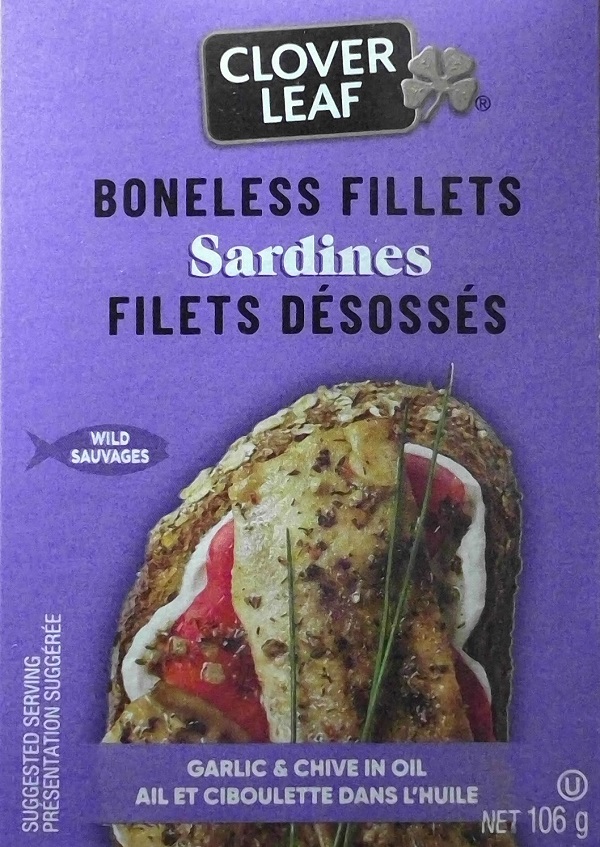
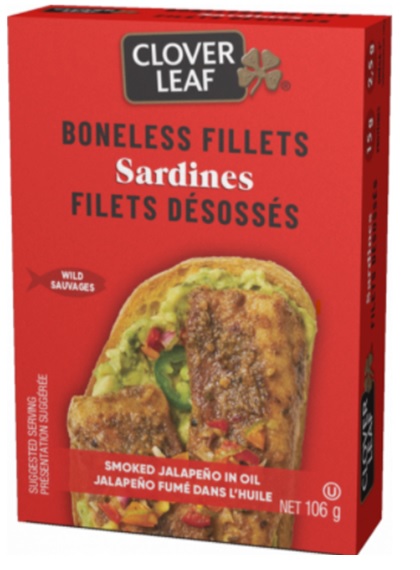
Canada – Food Recall Warning – Clover Leaf brand Sardines Boneless Fillets – Garlic & Chive in Oil and Sardines Boneless Fillets – Smoked Jalapeño in Oil recalled due to potential presence of dangerous bacteria – Clostridium botulinum

CFIA

Recall details

Ottawa, January 22, 2021 – Clover Leaf Seafoods Corp. is recalling Clover Leaf brand Sardines Boneless Fillets – Garlic & Chive in Oil and Sardines Boneless Fillets – Smoked Jalapeño in Oil from the marketplace because they may permit the growth of Clostridium botulinum. Consumers should not consume the recalled products described below.

Recalled product

Brand Product Size UPC Codes
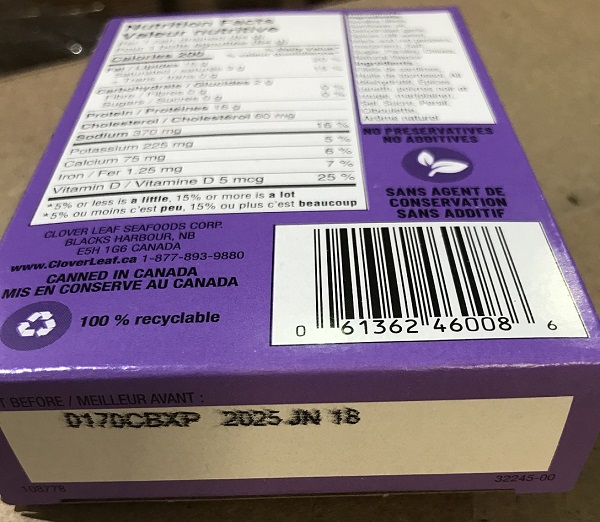
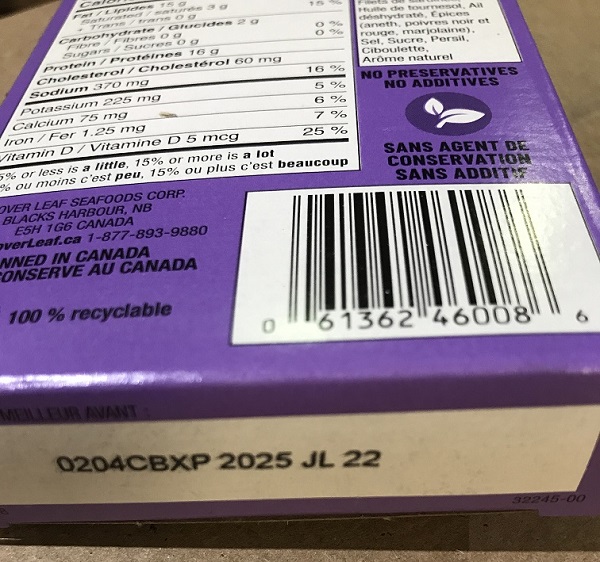
Clover Leaf Sardines Boneless Fillets – Garlic & Chive in Oil 106 g 0 61362 46008 6

0170CBXP 2025 JN 18

0204CBXP 2025 JL 22

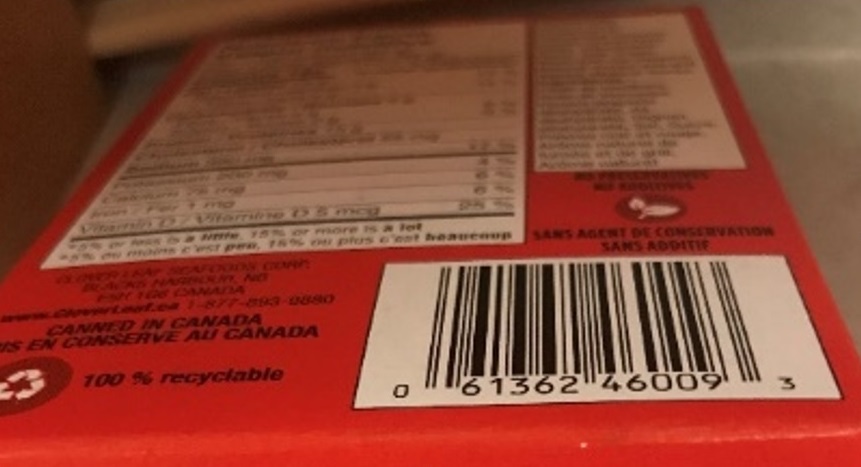
Clover Leaf Sardines Boneless Fillets – Smoked Jalapeño in Oil 106 g 0 61362 46009 3

0171CBXP 2025 JN 19

0218CBXP 2025 AU 05

0307CBXS 2025 NO 02

What you should do

If you think you became sick from consuming a recalled product, call your doctor.

Check to see if you have the recalled products in your home. Recalled products should be thrown out or returned to the store where they were purchased.

Food contaminated with Clostridium botulinum toxin may not look or smell spoiled but can still make you sick.

Symptoms in adults can include facial paralysis or loss of facial expression, unreactive or fixed pupils, difficulty swallowing, drooping eyelids, blurred or double vision, difficulty speaking, including slurred speech, and a change in sound of voice, including hoarseness.

Symptoms of foodborne botulism in children can include difficulty swallowing, slurred speech, generalized weakness and paralysis. In all cases, botulism does not cause a fever. In severe cases of illness, people may die.

Background

This recall was triggered by the company. The Canadian Food Inspection Agency (CFIA) is conducting a food safety investigation, which may lead to the recall of other products. If other high-risk products are recalled, the CFIA will notify the public through updated Food Recall Warnings.

The CFIA is verifying that industry is removing the recalled products from the marketplace.

Illnesses

There have been no reported illnesses associated with the consumption of these products.

Product photos

Printer ready version of photos

  • Clover Leaf – Sardines Boneless Fillets – Garlic & Chive in Oil – 106 grams (front)
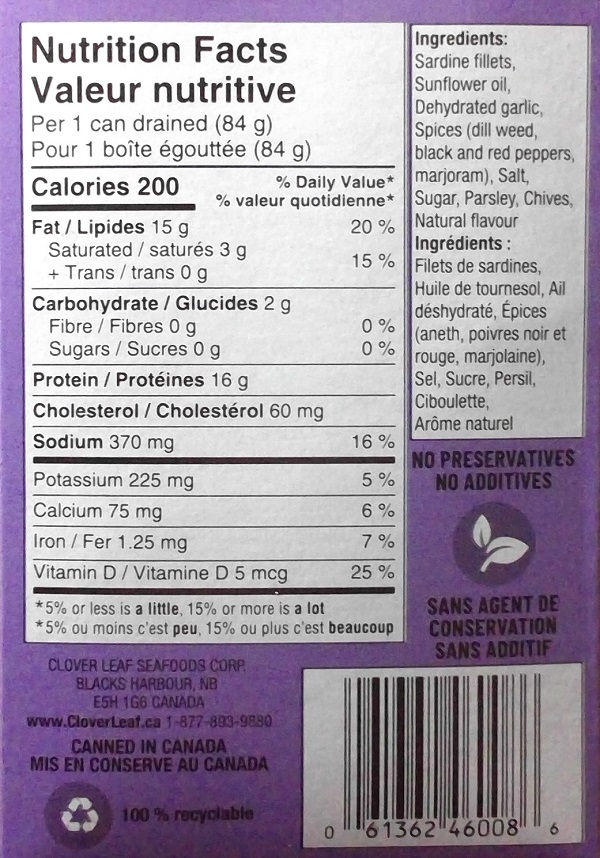
  • Clover Leaf – Sardines Boneless Fillets – Garlic & Chive in Oil – 106 grams (back)
  • Clover Leaf – Sardines Boneless Fillets – Garlic & Chive in Oil – 106 grams (lot code - JN)
  • Clover Leaf – Sardines Boneless Fillets – Garlic & Chive in Oil – 106 grams (lot code - JL)
  • Clover Leaf – Sardines Boneless Fillets – Smoked Jalapeño in Oil – 106 grams(front)
  • Clover Leaf – Sardines Boneless Fillets – Smoked Jalapeño in Oil – 106 grams(back)

Public enquiries and media

Company information
Clover Leaf Seafoods Corp.: Consumer Affairs Recall Line, 1-888-686-1535
Public enquiries
Toll-free: 1-800-442-2342 (Canada and U.S.)
Telephone: 1-613-773-2342 (local or international)
Email: cfia.enquiries-demandederenseignements.acia@canada.ca
Media relations
Telephone: 613-773-6600
Email: cfia.media.acia@canada.ca

UK – Several retailers recall chilled and frozen seafood products because of possible contamination with Salmonella

FSA

Several retailers listed below are recalling several chilled and frozen seafood products because they might be contaminated with salmonella.

Product details

by Sainsbury’s Mussels (Chilled)
Pack size 150g
Best before All Date codes
by Sainsbury’s Cockles (Chilled)
Pack size 90g
Best before All Date codes
Co-op Cooked Mussels (Chilled)
Pack size 140g
Best before All date codes
Asda Seafood Selection (Mussels, seafood bites and king prawns) (Chilled)
Pack size 240g
Best before 22, 24, 25, 26, 27 and 28 January 2021
Asda Cooked Mussels (Chilled)
Pack size 150g
Best before 22, 23, 24, 25, 26, 27 and 28 January 2021
by Sainsbury’s Seafood Selection (Chilled)
Pack size 200g
Best before All Date codes
by Sainsbury’s Cooked Cockles (Frozen)
Pack size 200g
Best before All Date codes
by Sainsbury’s Cooked Mussels (Frozen)
Pack size 300g
Best before All Date codes
by Sainsbury’s Seafood Selection (Frozen)
Pack size 300g
Best before All Date codes
Waitrose & Partners Essential Frozen Seafood Selection, (King prawns, mussels and squid rings) (Frozen)
Pack size 250g
Best before All dates up to and including end January 2022
Co-op Cooked Seafood Selection (Frozen)
Pack size 300g
Best before All date codes
Product
Pack size Pack Size
Best before Use by dates
Waitrose & Partners Essential Cooked Seafood Selection, (Mussels, king prawns and squid) (Chilled)
Pack size 200g
Best before All use by dates from 20 December 2020 to 20 January 2021

Risk statement

The products listed above might be contaminated with salmonella. Symptoms caused by salmonella usually include fever, diarrhoea and abdominal cramps.

Action taken by the company

The retailers listed are recalling the above products. Point of sale notices will be displayed in all retail stores that are selling these products. These notices explain to customers why the products are being recalled and tell them what to do if they have bought the product. Please see the attached notices.

Our advice to consumers

If you have bought any of the above products do not eat them. Instead, return them to the store from where they were bought for a full refund.

Research – Inactivation of Foodborne Viruses by High-Pressure Processing (HPP)

MDPI

Rotavirus

High-pressure processing (HPP) is an innovative non-thermal food preservation method. HPP can inactivate microorganisms, including viruses, with minimal influence on the physicochemical and sensory properties of foods. The most significant foodborne viruses are human norovirus (HuNoV), hepatitis A virus (HAV), human rotavirus (HRV), hepatitis E virus (HEV), human astrovirus (HAstV), human adenovirus (HuAdV), Aichi virus (AiV), sapovirus (SaV), and enterovirus (EV), which have also been implicated in foodborne outbreaks in various countries. The HPP inactivation of foodborne viruses in foods depends on high-pressure processing parameters (pressure, temperature, and duration time) or non-processing parameters such as virus type, food matrix, water activity (aw), and the pH of foods. HPP was found to be effective for the inactivation of foodborne viruses such as HuNoV, HAV, HAstV, and HuAdV in foods. HPP treatments have been found to be effective at eliminating foodborne viruses in high-risk foods such as shellfish and vegetables. The present work reviews the published data on the effect of HPP processing on foodborne viruses in laboratory media and foods. View Full-Text

RASFF Alerts – Salmonella – Various Chicken/Turkey/Egg Products from Poland – Raw Smoked Bacon Strips – Organic Chilli Pepper – Black Pepper – Sesame Seeds – Chipolata – Paprika Powder – Turkey Fillets – Turkey Escalopes

European Food Alerts

RASFF

Salmonella (in 1 out of 5 samples /25g) in raw smoked bacon strips from Germany in Germany

RASFF

Salmonella (presence /25g) in organic chilli pepper from Uganda in the Netherlands

RASFF

Salmonella (presence /25g) in organic sesame seeds from Turkey in the Netherlands

RASFF

Salmonella (presence /25g) in chipolata from the Netherlands in the Netherlands

RASFF

Salmonella (presence /25g) in paprika powder from China in Spain

RASFF

Salmonella enterica ser. Matadi (presence /25g), Salmonella enterica ser. München (presence /25g), Salmonella enterica ser. Newport (presence /25g) and Salmonella enterica ser. Saintpaul (presence /25g) in black pepper from Brazil in Germany

RASFF

Salmonella enterica ser. Abaetetuba (in 1 out of 10 samples /25g), Salmonella enterica ser. Coeln (in 1 out of 10 samples /25g), Salmonella enterica ser. Matadi (in 1 out of 10 samples /25g), Salmonella enterica ser. Newport (in 1 out of 10 samples /25g) and Salmonella enterica ser. Oranienburg (in 2 out of 10 samples /25g) in black pepper from Brazil in Germany

RASFF

Salmonella enterica ser. Saintpaul (presence /25g) in black pepper from Brazil in Germany

RASFF

Salmonella enterica ser. Typhimurium (presence /25g) in chilled turkey fillets and escalopes from France in Finland

RASFF

Salmonella enterica ser. salamae (in 3 out of 5 samples /25g) in frozen turkey breast fillets from Poland, via Estonia in Finland

RASFF

Salmonella enterica ser. Enteritidis (in out of 5 samples /25g) in chilled chicken thighs from Poland in Lativa

RASFF

Salmonella enterica ser. Liverpool (in 1 out of 5 samples /25g) in sesame seeds from Uganda in Germany

RASFF

suspicion of Salmonella enterica ser. Enteritidis (found in faecal samples) in eggs from Poland in Poland

RASFF

Salmonella enterica ser. Enteritidis (presence /25g) in frozen chicken broiler fillets from Poland in Lithuania

RASFF

Salmonella (presence /25g) in chilled chicken meat from Poland in Poland

RASFF

Salmonella enterica ser. Enteritidis (presence/ /25g) in chilled chicken broiler soup sets from Poland in Lithuania

RASFF

Salmonella enterica ser. Infantis (presence /25g) in chicken wings from Poland in Lithuania

RASFF Alert – Listeria monocytogenes – Frozen Pre-Cooked Chicken Curry Cassolettes

European Food Alerts

RASFF

Listeria monocytogenes (< 10 CFU/g) in frozen pre-cooked chicken curry cassolettes from Spain in France

RASFF Alerts – Aflatoxin – White Rice – Pistachios

European Food Alerts

RASFF

aflatoxins (B1 = 3 µg/kg – ppb) in white rice from Pakistan in Spain

RASFF

aflatoxins (B1 = 24; Tot. = 27 µg/kg – ppb) in pistachios from Turkey in Belgium

Switzerland – Early detection for food safety

FFSVO

For sustainable assurance of food safety and the prevention of fraud, the FSVO identifies newly emerging risks to the health of Switzerland’s population. Early detection of this kind allows appropriate action to be taken in real time.

The FSVO compiles the most important food safety information every month 

Monitoring developments in the field of food safety is an essential task of early detection. This is why the FSVO summarises and evaluates the main information in Seismo Info. The publication is sent out by newsletter.

The aim of early detection for food safety is to identify and assess potential risks of food to the health of consumers.

The FSVO distinguishes between different types of risk:

  • Microbiological risks in foodstuffs and food fraud and deception
  • Chemical risks in foodstuffs and commodities
  • Nutrition-related risks

Monitoring system

The detection of newly emerging risks requires vigilant monitoring of societal and ecological changes, technological developments, economic trends and political conditions.

To perform these tasks, the FSVO manages an early detection system for food safety. This system considers information from a variety of sources, as well as the opinion of experts from the federal government, the cantons, industry and universities. The FSVO is also part of an international network that regularly shares information on new risks, assesses these risks and discusses the action to be taken.

Information and communication

The information gathered is compiled in the ADURA database, which can be accessed by federal and cantonal experts and to some extent also by the public.

The FSVO summarises and evaluates the main information every month in Seismo Info. The publication is communicated via the «Food safety and nutrition» newsletter (Subscription in French, German or Italian).

«Briefing letters» are short summaries of issues. They are characterised by in-depth research on a specific topic. Their purpose is to draw attention to hazards or risks that could endanger food safety in the medium to long term.

Anyone can contribute to early detection by submitting information to seismo@blv.admin.ch. Specialists check the information and incorporate it into the ADURA database or Seismo Info as appropriate.