Category Archives: food bourne outbreak

USA -Statement on new findings and current status of the romaine lettuce E. coli O157:H7 outbreak investigation

FDA

Today, the U.S. Food and Drug Administration is providing an update on our investigation of an outbreak of E. coli O157:H7 illnesses linked to romaine lettuce. The FDA takes our responsibility of protecting the public from unsafe food very seriously and is committed to providing the public with more information as it becomes available.

Outbreaks Reported

Early on, based on test results provided by the Maryland Department of Health, our investigation pointed to farms in Salinas, California, as potential sources of contaminated romaine lettuce based on the initial, limited number of reported illnesses. The FDA, in partnership with the California Department of Public Health and the California Department of Food and Agriculture, rapidly mobilized in November to concurrently deploy inspection teams to the farms identified through the initial traceback investigation. The on-site investigations at these farms included collecting a wide-variety of samples for lab testing, including water, soil, soil amendments, scat and swab samples. While the majority of these samples tested negative for the outbreak strain, final results are pending and the Wisconsin Department of Health Services recently reported that it had isolated E. coli O157:H7 from a particular bag of pre-washed, chopped romaine lettuce.

The FDA has also been tracking two additional and separate outbreaks of E. coli O157:H7.

Earlier this week, the FDA, U.S. Centers for Disease Control and Prevention (CDC), and the Canadian Food Inspection Agency announced an outbreak linked to Fresh Express Sunflower Crisp Chopped Salad Kits. To date, the CDC reported eight confirmed cases in the U.S. across three states associated with this cluster of illnesses.The Public Health Agency of CanadaExternal Link Disclaimer also reports 24 cases in six Canadian provinces.

Concurrently, the FDA has been working with health officials in Washington State regarding an outbreak of E. coli O157:H7 associated with romaine consumption at a local restaurant chain. Washington State officials reported 10 confirmed and three probable cases in this outbreak with all reports of exposure in early to mid-November.

It should be noted; these are currently being considered as three separate outbreaks caused by three different strains of E. coli O157:H7.

USA -Investigation of E. coli O157:H7 Outbreak Linked to Romaine from Salinas, California, November 2019

FDA

December 12, 2019

Case Counts

Total Illnesses: 102
Hospitalizations: 58
Deaths: 0
Last illness onset: November 18, 2019
States with Cases:  AZ (3), CA (4), CO (6), FL (1), IA (1), ID (3), IL (1), MD (4), MI (1), MN (3), MT (1), NE (1), NJ (7), NC (1), NM (2), OH (12), OR (1), PA (8), SD (1), TX (4), VA (4), WA (2), WI (31)

Recommendation

FDA, CDC, and state health authorities are investigating an outbreak of illnesses caused by E. coli O157:H7 in the United States. Epidemiologic, laboratory, and traceback evidence indicates that romaine lettuce from the Salinas, California growing region is a likely source of this outbreak. According to CDC, there have been 102 cases reported in 23 states.  The latest date that one of these patients reports becoming ill was on November 18, 2019.

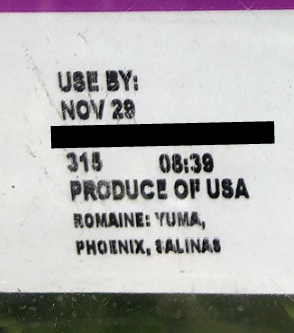
Romaine from Salinas, California Label Enjoy By December 2, 2019


Romaine from Salinas, California Label Use By November 29, 2019

Consumers: Consumers should not eat romaine lettuce harvested from Salinas, California. Additionally, consumers should not eat products identified in the recall announced by the USDA on November 21, 2019.

Romaine lettuce may be voluntarily labeled with a harvest region. If this voluntary label indicates that the romaine lettuce was grown in “Salinas” (whether alone or with the name of another location) do not eat it. Throw it away or return it to the place of purchase.  If romaine lettuce does not have information about harvest region or does not indicate that it has been grown indoors (i.e., hydroponically- and greenhouse-grown), throw it away or return it to the place of purchase. Consumers ordering salad containing romaine at a restaurant or at a salad bar should ask the staff whether the romaine came from Salinas.  If it did, or they do not know, do not eat it.

At this time, romaine lettuce that was harvested outside of the Salinas region has not been implicated in this outbreak investigation. Hydroponically- and greenhouse-grown romaine, which is voluntarily labeled as “indoor grown,” from any region does not appear to be related to the current outbreak. There is no recommendation for consumers to avoid using romaine harvested from these other sources.

Restaurants and Retailers: Restaurants and retailers should not serve or sell romaine harvested from Salinas, California.  If you do not know the source of your romaine lettuce, and if you cannot obtain that information from your supplier, you should not serve, nor sell it.

Suppliers and Distributors: Suppliers, distributors and others in the supply chain should not ship or sell romaine harvested in Salinas, California. If the source of the romaine lettuce is unknown, you should not ship, nor sell the product.

For Restaurants, Retailers, Suppliers and Distributors: Currently, the FDA does not have enough traceback information to identify the specific source of the contamination that would allow us to request a targeted recall from specific growers.

FDA requested that industry voluntarily withdraw romaine grown in Salinas from the market and is requesting that industry withhold distribution of Salinas romaine for the remainder of the growing season in Salinas. Without more specific traceback information, this was the most efficient way to ensure that contaminated romaine was off the market.

At this time, romaine lettuce that was harvested outside of the Salinas region has not been implicated in this outbreak investigation. Hydroponically- and greenhouse-grown romaine, which is voluntarily labeled as “indoor grown,” from any region does not appear to be related to the current outbreak. There is no recommendation for consumers or retailers to avoid using romaine harvested from these other sources.

Update

Based on the information indicating that ill people in Maryland were exposed to romaine lettuce harvested in Salinas, California, FDA, with the assistance of staff from the California Department of Public Health and the California Department of Food and Agriculture, immediately deployed investigators to three farms in the Salinas area that were identified based on the traceback investigation.

FDA continues to actively investigate the cause of this outbreak. Additionally, FDA is investigating two other E. coli outbreaks, each caused by strains that are different from each other and different from the larger outbreak. One of the additional outbreaks, in Washington state, is linked to romaine lettuce, and the other outbreak, with cases in the U.S. and Canada, is linked to Fresh Express Sunflower Crisp Chopped Salad Kits. As part of these investigations, FDA and state partners are conducting traceback investigations to trace romaine exposures to the source.

Currently, the tracebacks on all three outbreaks have identified a common grower in Salinas. FDA, CDC, and California partners are deploying a team to conduct new investigations at several ranches used by this grower as we try to identify the source of the contamination.

Europe – Salmonella the most common cause of foodborne outbreaks in the European Union

ECDC

Nearly one in three foodborne outbreaks in the EU in 2018 were caused by Salmonella. This is one of the main findings of the annual report on trends and sources of zoonoses published today by the European Food Safety Authority (EFSA) and the European Centre for Disease Prevention and Control (ECDC).

In 2018, EU Member States reported 5 146 foodborne outbreaks affecting 48 365 people. A foodborne disease outbreak is an incident during which at least two people contract the same illness from the same contaminated food or drink.

Slovakia, Spain and Poland accounted for 67% of the 1 581 Salmonella outbreaks. These outbreaks were mainly linked to eggs.

 “Findings from our latest Eurobarometer show that less than one third of European citizens rank food poisoning from bacteria among their top five concerns when it comes to food safety. The number of reported outbreaks suggests that there’s room for raising awareness among consumers as many foodborne illnesses are preventable by improving hygiene measures when handling and preparing food” said EFSA’s chief scientist Marta Hugas.

Salmonellosis was the second most commonly reported gastrointestinal infection in humans in the EU (91 857 cases reported), after campylobacteriosis (246 571).

Shiga toxin-producing E. coli (STEC) has become the third most common cause of foodborne zoonotic disease with 8 161 reported cases – replacing yersiniosis with a 37% increase compared to 2017. This may be partly explained by the growing use of new laboratory technologies, making the detection of sporadic cases easier.

Of the zoonotic diseases covered by the report, listeriosis accounts for the highest proportion of hospitalised cases (97%) and highest number of deaths (229), making it one of the most serious foodborne diseases.

The number of people affected by listeriosis in 2018 is similar to 2017 (2 549 in 2018 against 2 480 the previous year). However, the trend has been upward over the past ten years.

The report also includes data on Mycobacterium bovisBrucellaYersiniaTrichinellaEchinococcusToxoplasma, rabies, Coxiella burnetii (Q fever), and tularaemia.

Read the report

Publication

The European Union One Health 2018 Zoonoses Report

Surveillance report  

This report of the European Food Safety Authority and the European Centre for Disease Prevention and Control presents the results of zoonoses monitoring activities carried out in 2018 in 36 European countries (28 Member States (MS) and 8 non-MS).

e.

RASFF Alerts – Salmonella – Chilled Chicken – Chicken Thighs – Black Pepper – Rope Mussels – Long Pepper – Eggs – Chilled Beef – Chicken Fillet – Salted Chicken Breast – Chicken Quarters

RASFF-Logo

RASFF – Salmonella enterica ser. Enteritidis (presence /25g) in chilled chicken with neck from Poland in Latvia

RASFF – Salmonella enterica ser. Infantis (presence /25g) in chilled chicken thighs from Romania in Slovakia

RASFF – Salmonella (presence /25g) in black pepper from Brazil in the Netherlands

RASFF – Salmonella (presence /25g) in organic rope mussels from Ireland in France

RASFF – Salmonella (presence /25g) in long pepper (Piper longum) from Vietnam in Germany

RASFF – Salmonella enterica ser. Enteritidis (suspected) in eggs from Poland in Poland

RASFF – Salmonella (present /25g) in chilled beef from the Netherlands in Sweden

RASFF – Salmonella enterica ser. Enteritidis (presence /25g) in chilled chicken fillet from Poland in Lithuania

RASFF – Salmonella (presence /25g) in frozen salted chicken breast from Brazil, via the Netherlands in Croatia

RASFF – Salmonella group C (in 5 out 5 samples /25g) in chilled chicken quarters from Poland in Poland

RASFF Alerts – Moulds – Broken Rice

RASFF-Logo

RASFF – broken rice from Cambodia infested with moulds in Portugal

USA/Canada – Salinas Romaine sickens 2 in Canada with E. coli O157and 102 in the United States

Food Poison Journal

Since November 22, 2019, the Public Health Agency of Canada (PHAC) has identified one additional E. coli illness in Canada with a similar genetic fingerprint to illnesses reported in the ongoing United States (U.S.) E. coli outbreak linked to romaine lettuce harvested in Salinas, California which has sickened at least 102 people in 23 states

As of December 6, 2019, there are two illnesses related to the U.S. outbreak that have been identified in Canada: Manitoba (1) and Alberta (1). These individuals became ill in mid-October and early November 2019. One individual was hospitalized. No deaths have been reported.

PHAC has engaged federal and provincial public health partners and continues to work with U.S. health officials to determine the source of contamination affecting consumers.

Consumers are still advised to not eat, and retailers and food service establishments to not sell or serve, any romaine lettuce harvested from the Salinas, California growing region in the U.S. Romaine lettuce harvested in Canada is not affected by this advice.

USA -Outbreak Investigation of Salmonella Potentially Linked to Tailor Cut Produce Fruit Mix, Winter 2019

FDA

FDA and the Pennsylvania Department of Health (DOH) are investigating an outbreak of illnesses caused by Salmonella Javiana in Pennsylvania. Epidemiologic and traceback evidence indicate that fruit mix with cantaloupe, honeydew, pineapple, and grapes from Tailor Cut Produce of North Brunswick, New Jersey, are a potential source of this outbreak.

Total Illnesses: 31

Recommendation

Food service and institutional food operators should not sell or serve the fruit mix with cantaloupe, honeydew, pineapple, and grapes prepared by Tailor Cut Produce.

Tailor Cut Produce reports that their products may be found in restaurants, banquet facilities, hotels, schools and institutional food service establishments in New Jersey, New York, and Pennsylvania.

Because this fruit mix may have been distributed to nursing homes, schools, hospitals and other facilities that cater to vulnerable populations, it is important that these facilities do not sell or serve this fruit medley. Please consult with your distributor to confirm the source of the fruit mix used in your operation.

Background

The Pennsylvania Department of Health (DOH) reports that it is investigating 31 laboratory-confirmed illnesses of Salmonella at four healthcare facilities in southeast Pennsylvania. Salmonella Javiana has been identified among cases at three of four facilities. According to the Pennsylvania DOH the epidemiologic evidence collected thus far indicates that this fruit mix is a potential source of the illnesses. The state’s review of invoices shows that a common food eaten by many case patients was the fruit mix with cantaloupe, honeydew, pineapple, and grapes from Tailor Cut Produce.

FDA has activated a team to coordinate its outbreak investigation.  On December 6, 2019, the FDA and the Pennsylvania DOH shared the results of the investigation thus far with the firm, and the firm’s leadership stated that they would work with FDA to implement a recall of this product.

FDA will continue its investigation and provide updates as more information becomes available.

Sweden – Sweden -Cryptosporidium outbreak tops 300 cases since October

Outbreak News Today crypt

In a follow-up on a previous report on the Cryptosporidium outbreak in Sweden, the Public Health Authority, or Folkhalsomyndigheten, report more than 300 cases of cryptosporidiosis in October and November.

The good news is while the number of cases are still unusually high, the number of reported cases has decreased.


USA -Cruise outbreak: 133 sickened on Norwegian Cruises’, Norwegian Joy

Outbreak New Today

Federal health officials are reported a gastrointestinal outbreak of yet unknown etiology onboard a recent voyage of the Norwegian Cruise Lines vessel, Norwegian Joy.

According to officials, 127 passengers and six crew members have been stricken with symptoms of diarrhea on a recent November 8–24, 2019 voyage.

Canada – Canada reports US Romaine Lettuce may have sickened at least one Citizen – E.coli O157

Food Poison Journal Eurofins Food Testing UK

Although an outbreak is not occurring in Canada, the Public Health Agency of Canada (PHAC) has identified one Canadian illness with a similar genetic fingerprint to illnesses reported in the U.S. investigation.

The Canadian Food Inspection Agency (CFIA) has confirmed that romaine lettuce from the affected areas reported in the U.S. investigation is imported to Canada at this time of year. The CFIA has taken measures to protect consumers and is implementing new actions at the border to ensure that any affected romaine lettuce products are no longer being imported into Canada.

As a result of the U.S. outbreak investigation and its link to product on the Canadian market, the Public Health Agency of Canada is advising Canadians to follow the U.S. CDC’s public health advice, which advises consumers to not eat, and retailers and food service establishments to not sell or serve, any romaine lettuce harvested from the Salinas, California growing region in the U.S. Romaine lettuce harvested in Canada is not affected by this advice.