Category Archives: ECDC

Europe -Listeriosis – Annual Epidemiological Report for 2017

ECDC

Listeriosis – Annual Epidemiological Report for 2017

Surveillance report

Publication series: Annual Epidemiological Report on Communicable Diseases in Europe
Time period covered: This report is based on data for 2017 retrieved from The European Surveillance System (TESSy) on 11 September 2018.

For 2017, 30 countries reported 2 502 confirmed listeriosis cases in the EU/EEA. The EU/EEA age-standardised notification rate was 0.42 cases per 100 000 population. The highest rate was detected among people over 64 years of age (1.7 cases per 100 000 population). The annual number of listeriosis cases in the EU/EEA shows an increasing trend.

Europe – Yersiniosis – Annual Epidemiological Report for 2017

ECDC

kswfoodworld.com

Image CDC

For 2017, 28 countries reported 6 890 confirmed yersiniosis cases in the EU/EEA. The overall notification rate was 1.8 per 100 000 population and remained stable from 2013–2017. The highest rate was detected in 0–4 year-old children (7.7 per 100 000 population). The highest rates were reported by Finland, Lithuania and the Czech Republic.

Download

Europe – Yersiniosis – Annual Epidemiological Report for 2018

ECDC European Centre for Disease Prevention and Control

For 2018, 29 countries reported 7 204 confirmed yersiniosis cases in the EU/EEA.  The overall notification rate was 1.7 per 100 000 population and remained stable from 2014 to 2018. The highest rates were reported by Finland, Belgium and the Czech Republic. The highest rate was detected in 0-4 year-old children; 7.9 per 100 000 population for males and 6.8 per 100 000 population for females.

Download

Europe – Epidemiological update: Multi-country outbreak of Salmonella Enteritidis infections linked to Polish eggs

ECDC

Since the joint ECDC-EFSA rapid outbreak assessment ’Multi-country outbreak of Salmonella Enteritidis infections linked to Polish eggs’ published on 12 December 2017, 15 EU/EEA countries (Belgium, Czech Republic, Denmark, France, Hungary, Iceland, Ireland, Italy, Luxembourg, Netherlands, Norway, Poland, Slovenia, Sweden and United Kingdom) have reported 336 confirmed, 94 probable and 3 new historical-confirmed cases associated with this ongoing multi-country outbreak of Salmonella Enteritidis in the EU/EEA. In the same period, seven historical probable cases were reclassified as excluded.

Overall, 1 412 cases have been found associated with this outbreak: 532 confirmed and 166 probable cases since 1 February 2017 and 343 historical-confirmed and 367 historical-probable cases between 2012 and 31 January 2017. In addition, no dates have been reported for four outbreak-confirmed cases, so they are unclassifiable as current or historical cases (Table 1).

Table 1. Distribution of cases by case classification and country, EU/EEA, February 2012 to November 2018 (n=1 420; 4 cases missing date of onset or sampling or receipt at reference laboratory), as of 12 November 2018

Reporting country Confirmed cases Probable cases Historical-confirmed cases Probable-confirmed cases Total number of cases
Belgium 0 46 14 127 187
Croatia 0 0 4 0 4
Czech Republic 0 6 0 3 9
Denmark 16 0 6 2 24
Finland 0 0 0 1 1
France 21 0 8 0 29
Greece 0 0 0 2 2
Hungary 0 29 0 5 34
Ireland 12 0 4 4 20
Ireland 1 0 0 0 1
Italy 0 12 1 19 32
Luxembourg 4 0 5 0 9
Netherlands 8 25 90 164 287
Norway 22 18 11 32 83
Poland 25 0 0 0 25
Slovenia 0 7 3 0 10
Sweden 11 20 12 2 45
United Kingdom 412 3 185 6 606
Total 532 166 343 367 1408
              698                 710


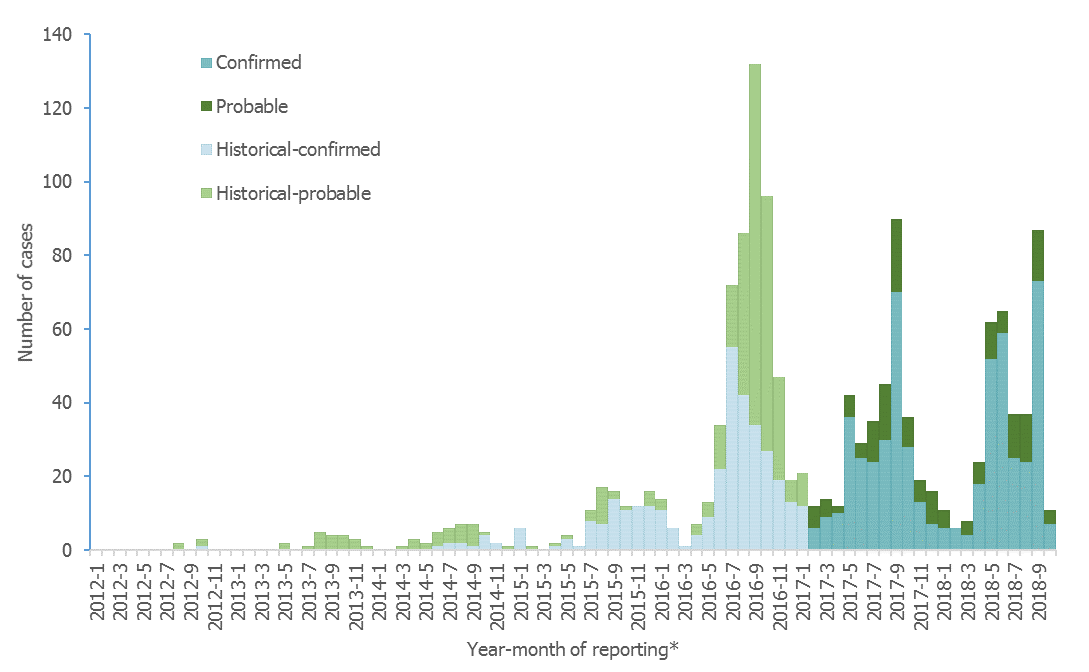
Most outbreak cases were reported during the summer months (Figure 1). Due to reporting delays, additional cases are expected to be reported with onset in recent months.

A total of 112 confirmed or historical-confirmed cases were reported with travel history in an EU country during the incubation period and therefore were likely infected there. Countries where infections likely took place were Poland (25 cases identified from 2016 to 2018), Bulgaria (22 cases from 2015 to 2018), Cyprus (14 cases in 2016 and 2018), Portugal (11 cases from 2015 to 2017) and Hungary (10 cases from 2016 to 2018). Additional travel-associated cases were also reported (<10 cases per country) with travel history to Austria, Belgium, Greece, Italy, the Netherlands, Romania, Slovenia and Spain.

Figure 1. Distribution of cases by month of onset* and case classification (n=1 412; 4 cases missing any date of report), EU/EEA, January 2012 to October 2018, as of 12 November 2018

Salmonella Enteritidis - Distribution of cases by month of onset* and case classification (n=1 412; 4 cases missing any date of report), EU/EEA, January 2012 to October 2018, as of 12 November 2018
 *: month of sampling or month of receipt by the reference laboratory if month of onset is not available.

The 2016 and 2017 European outbreak investigations identified eggs originating from Poland as the vehicle of infection in this outbreak (ECDC/EFSA rapid outbreak assessments published in March and December 2017). Outbreak-confirmed cases belong to four different WGS clusters.

Assessment

As reported in the previous ECDC/EFSA rapid outbreak assessment, in 2016 and 2017, evidence from epidemiological, microbiological, environmental and tracing investigations identified eggs originating from Poland as the vehicle of infections in this multi-strain outbreak. Control measures were implemented following these investigations. However, new outbreak cases were notified in 2017 and in 2018 with similar magnitude and temporal patterns. Based on the analysis of the travel-associated cases, it is likely that more countries where molecular typing is not performed routinely for human S. Enteritidis isolates are affected by the outbreak, including Bulgaria, Cyprus and Portugal.

Actions

ECDC monitors the occurrence of human cases associated with this threat and offers sequencing services for countries reporting probable cases of human S. Enteritidis isolates with MLVA profile 2-9-7-3-2 or 2-9-6-3-2 or
2-9-10-3-2 or 2-10-6-3-2 or 2-10-8-3-2 or 2-11-8-3-2. EU/EEA countries should consider interviewing new outbreak-confirmed cases.

Information – Campylobacteriosis – Annual Epidemiological Report for 2017

ECDC

campy2

Image CDC

Campylobacteriosis is the most commonly reported gastrointestinal disease in the EU/EEA.  In 2017, 29 EU/EEA countries reported 250 161 confirmed cases of campylobacteriosis.

Europe – Surveillance of Six Priority Food- and Waterborne Diseases in the EU/EEA 2006 -2009

ECDC

The European Centre for Disease Prevention and Control (ECDC) is an EU agency [1] with a mandate to operate surveillance networks and to identify, assess, and communicate current and emerging threats to human health from communicable diseases. The agency became operational in 2005. Initially, data were collected for 49 diseases (2008), with three more added in 2012. All data are entered in ECDC’s database system, known as the European Surveillance System (TESSy). Epidemiological overviews of all diseases are provided in the ECDC’s Annual Epidemiological Report. The surveillance of salmonellosis, campylobacteriosis and Shiga toxin/verotoxin-producing Escherichia coli (STEC/VTEC) infection was carried out until 2007 by an EU-funded dedicated surveillance network, Enter-net, which was hosted by the Health Protection Agency in the United Kingdom. In October 2007, the coordination of Enter-net was transferred to ECDC and Enter-net is now under the auspices of the Programme of Food- and Waterborne Diseases and Zoonoses (FWD). After the transfer, the scope was broadened to also cover listeriosis, yersiniosis and shigellosis. For the six priority diseases, surveillance was developed further in close collaboration with nominated disease experts, epidemiologists and microbiologists. This report is the first dedicated epidemiological report on these six diseases, offering a detailed analysis for the years 2006 to 2009. The intended readership includes public health and food safety professionals, policymakers, scientists, and the general public.

Ireland – Hepatitis A in Frozen Berries

ECDCecdclogo

The ongoing outbreak of Hepatitis A virus (HAV) infection that has affected travellers to Italy from Germany, the Netherlands and Poland, as well as local residents in Italy, may now be affecting Ireland.

Three cases of HAV have been reported in Ireland, although none of the three has any travel history to Italy. Nor have they had any contact with other HAV cases. Isolates of the virus from the three Irish cases reveal an identical sequence to that found in the Italian outbreak.

Onset of illness in the Irish cases was April 2013. Additional case finding activity is currently underway. Exposure of cases in both Italy and Ireland suggests that the same contaminated vehicle of infection has been available in at least these two countries. In Italy, mixed frozen berries have been indicated as the most likely vehicle of infection by epidemiological, microbiological and environmental investigations. In late May, an Italian distributor withdrew mixed frozen berries from the market following identification of a package contaminated with virus identical to the outbreak strain.

The most recent cases in the ongoing HAV infection outbreak have been reported by Italy. The onset of symptoms in these cases was recorded in June 2013. Due to the long shelf life of frozen berries and to the average length of approximately one month for incubation of HAV, more cases are expected to be reported.

While there is evidence pointing towards mixed frozen berries as the vehicle of infection, the specific berry type has not yet been identified. The point of contamination remains unknown at this time and as a result it is not yet possible to exclude the occurrence of associated cases in other EU Member States.

RASFF Alerts – Hepatitis A – Frozen Berries

RASFF – Hepatitis A virus in frozen berries mix from Italy, with raw material from Canada, Serbia, Bulgaria and Poland, via Switzerland in Italy

RASFF – Hepatitis A virus (presence) in frozen berries mix from Italy, with raw material from Romania, Poland and Bulgaria

EFSA – Hepatitis A

Europe – ECDC – Antimicrobial resistance continues to be found in Salmonella and Campylobacter

ECDCSalmonella

Antimicrobial resistance continues to be found in Salmonella and Campylobacter, the latest joint report from the European Food Safety Authority and the European Centre for Disease Prevention and Control reveals.

The EU Summary Report on antimicrobial resistance in zoonotic and indicator bacteria from humans, animals and food    reveals that a high proportion of Campylobacter bacteria were resistant to ciprofloxacin, a critically important antimicrobial. However, there was low resistance to erythromycin and co-resistance to important antimicrobials remains low.

Multidrug resistance was higher in Salmonella bacteria, the report reveals. Despite this, co-resistance to critically important antimicrobials remains low. High levels of antimicrobial resistance were found in Salmonella bacteria from humans and food animals, in particular turkeys and pigs.

Dr Marc Sprenger, ECDC Director, said: ‘With harmonised surveillance of antimicrobial resistance in isolates from humans and animals, we can inform effective actions to prevent further spread of antimicrobial resistance in humans.’


Research – EFSA – ECDC – The European Union Summary Report on Trends and Sources of Zoonoses, Zoonotic Agents

EFSA

The European Food Safety Authority and the European Centre for Disease Prevention and Control analysed the information submitted by 27 European Union Member States on the occurrence of zoonoses and food-borne outbreaks in 2011. Campylobacteriosis was the most commonly reported zoonosis with 220,209 confirmed human cases. The occurrence of Campylobacter continued to be high in broiler meat at EU level.

The decreasing trend in confirmed salmonellosis cases in humans continued with a total of 95,548 cases in 2011. Most Member States met their Salmonella reduction targets for poultry, and Salmonella is declining in these populations. In foodstuffs, Salmonella was most often detected in meat and products thereof.

The number of confirmed human listeriosis cases decreased to 1,476. Listeria was seldom detected above the legal safety limit from ready-to-eat foods.

A total of 9,485 confirmed verotoxigenic Escherichia coli (VTEC) infections were reported. This represents an increase of 159.4 % compared with 2010 as a result of the large STEC/VTEC outbreak that occurred in 2011 in the EU, primarily in Germany. VTEC was also reported from food and animals.

The number of human yersiniosis cases increased to 7,017 cases. Yersinia enterocolitica was isolated also from pig meat and pigs; 132 cases of Mycobacterium bovis and 330 cases of brucellosis in humans were also reported. The prevalence of bovine tuberculosis in cattle increased, and the prevalence of brucellosis decreased in cattle and sheep and goat populations.

Trichinellosis and echinococcosis caused 268 and 781 human cases, respectively and these parasites were mainly detected in wildlife. The numbers of alveolar and of cystic echinococcosis respectively increased and decreased in the last five years. One imported human case of rabies was reported. The number of rabies cases in animals continued to decrease.

Most of the 5,648 reported food-borne outbreaks were caused by Salmonella, bacterial toxins, Campylobacter and viruses, and the main food sources were eggs, mixed foods and fish and fishery products.


© European Food Safety Authority, 2013