Category Archives: E.coli

USA – Summary of Possible Multistate Enteric (Intestinal) Disease Outbreaks in 2021

CDC

Outbreak Investigations At A Glance

Possible Multistate Outbreaks
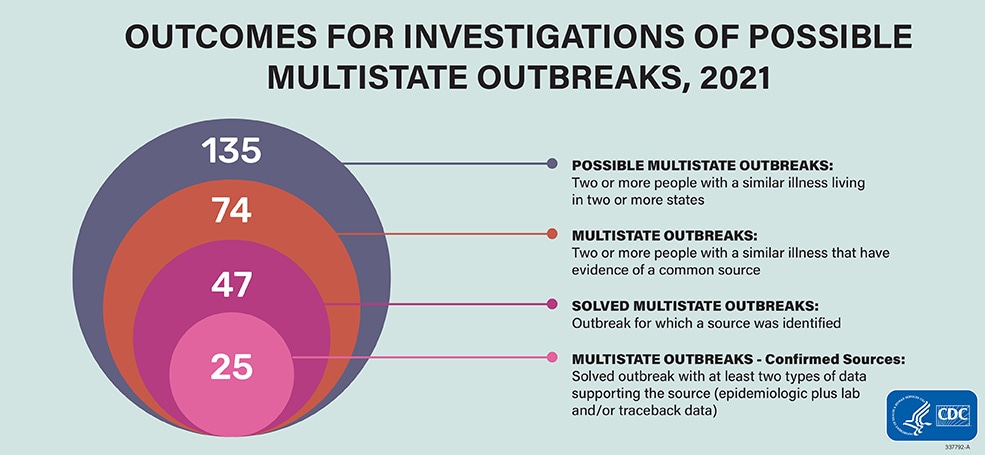
This analysis includes 135 possible multistate outbreak investigations during 2021.

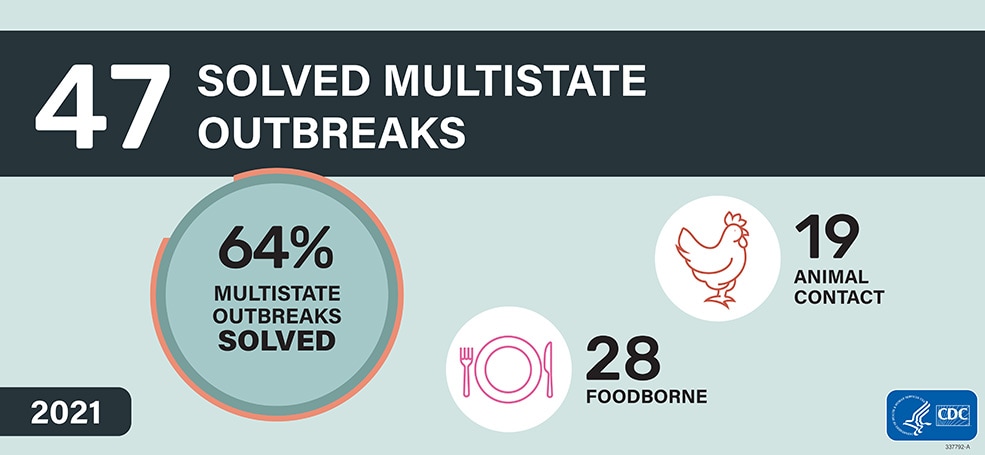
This analysis includes 135 investigations of possible multistate enteric (intestinal) outbreaks during 2021. Some possible outbreaks were excluded from this report because they were determined to be single state or because they were linked to international travel. After investigation, 74 (55%) of these were determined to be multistate outbreaks, and investigators solved 47 (64%) of these outbreaks.

Multistate Outbreaks
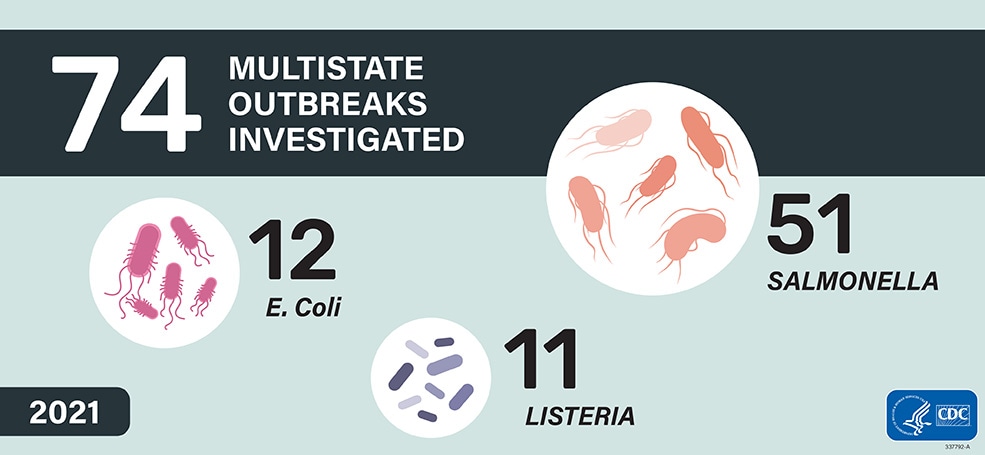
74 (55%) of the 135 investigations were determined to be multistate outbreaks.

The number of outbreaks increased from 2020 but was lower than the 82 investigated outbreaks in 2019. The number of outbreaks investigated in 2021 was likely lower than that in 2019 due in part to continued effects of the COVID-19 pandemic on enteric disease outbreak detection and investigation (e.g., decreased resources at local, state, and federal public health agencies, changes in healthcare-seeking behavior, and changed restaurant dining and grocery shopping patterns.) Additionally, changing diagnostic testing practices likely continued to affect enteric disease surveillance and the ability to identify possible outbreaks.
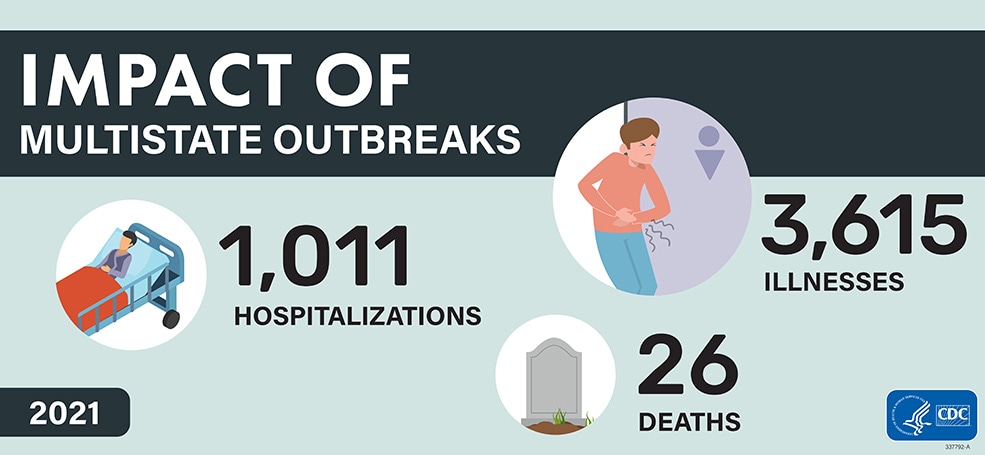
The 74 investigated multistate outbreaks resulted in 3,615 illnesses, 1,011 hospitalizations, and 26 deaths

Solved Multistate Outbreaks

Among the 74 investigated multistate outbreaks, 47 (64%) were solved, including 25 outbreaks with confirmed sources and 22 with suspected sources.

Among the 74 multistate outbreaks, 47 (64%) were solved, meaning a confirmed or suspected source of the outbreak was identified, including 25 (53%) outbreaks with confirmed sources and 22 (47%) with suspected sources. Among the 47 solved outbreaks, 28 (60%) were linked to contaminated foods, and 19 (40%) were linked to animal contact.

Solved multistate outbreaks caused at least 2,047 illnesses. Solved multistate outbreaks linked to contaminated food caused 1,740 illnesses, 496 hospitalizations, and 15 deaths, while multistate outbreaks linked to animal contact caused 1,307 illnesses, 329 hospitalizations, and 3 deaths.
USA – Cheese curds sold in Iowa recalled because of elevated Coliform count and E. coli

Food Safety News

Moore Family Farms Creamery of Maquoketa, IA, is recalling various cheese curds because they may contain an elevated coliform count and generic E. coli.

According to the details posted by the FDA, the recall was initiated on July 28, 2023 is ongoing.

Though products are past their expiration dates, there is always concern consumers have already consumed the product and become ill or they could have product in their freezers.

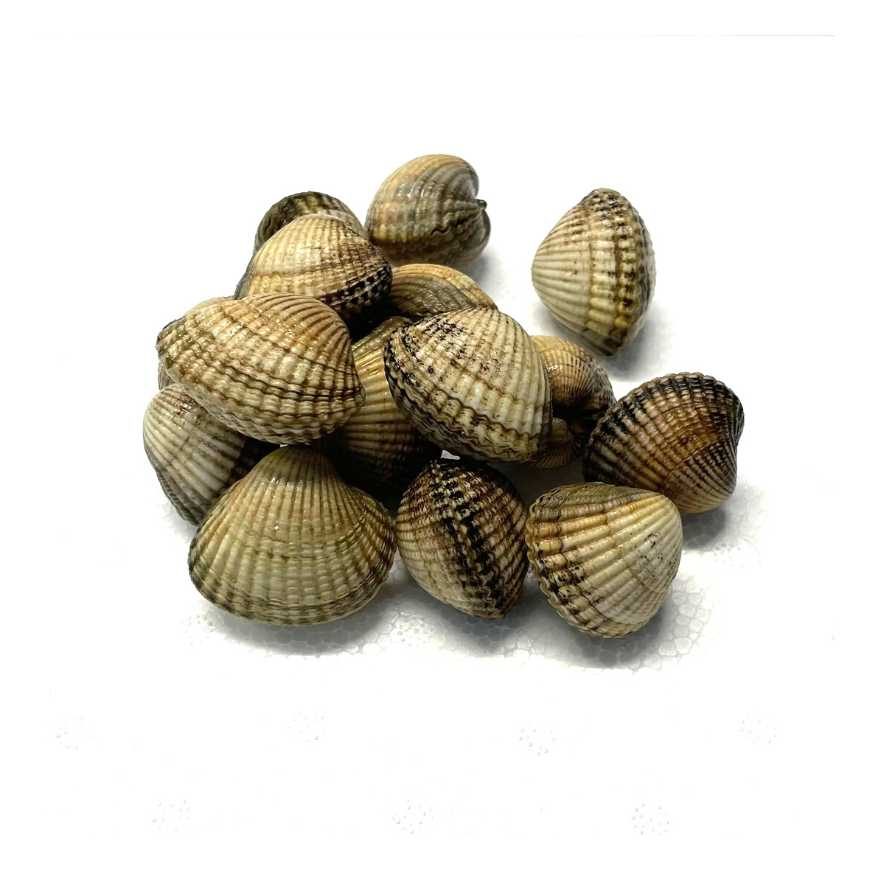
France – Medium Cockles – E.coli

Gov france

  • Product category Food
  • Product subcategory Fishery and aquaculture products
  • Product brand name
  • Model names or references Medium cockles sold in the fish counter
  • Identification of products
    Batch
    Products sold in the TRAD section between 23/08/23 and 26/08/23
  • Marketing start/end date From 08/23/2023 to 08/26/2023
  • Storage temperature Product to be stored in the refrigerator
  • Geographic area of ​​sale Regions: Auvergne-Rhône-Alpes, , , Bourgogne-Franche-Comté, , , Brittany, , , Grand-Est, , , Hauts-de-France, , , Nouvelle-Aquitaine, , , Occitanie, , , Pays-de- la-Loire, , , Provence-Alpes-Côte d’Azur
  • Distributors Intermarché

USA – University of Arkansas officials report E. coli outbreak

Food Safety News

State and federal public health officials are working with the University of Arkansas on what appears to be an outbreak of E. Coli infections.

During a news conference this afternoon, a spokesman from the Arkansas Department of Health said four people were hospitalized. Also, about 100 students from the university responded to an email saying they currently have or have recently had symptoms.

The total number of confirmed outbreak patients has not been released.

The spokesman said the outbreak seems limited to the Northeast part of the state. He also said the state department and university officials are working with the U.S. Centers for Disease Control and Prevention to investigate the outbreak.

The spokesman said health officials believe the outbreak started about a week ago.

Luxembourg – Medium Cockle shells sold at the stall at Auchan – E.coli

SAP

The following product is recalled in Luxembourg:

Name Medium hulls
Brand sold at the stall
Sale period from 08/22/2023 to 08/25/2023

Danger  : Presence of Escherichia coli

Among the  Escherichia coli  some can cause food poisoning which can occur within a week after consumption and result in gastrointestinal disorders often accompanied by cramps. These symptoms may be aggravated in young children, immunocompromised subjects and the elderly. People who have consumed these products and have these symptoms are invited to consult a doctor and report this consumption to him.

Sale confirmed in Luxembourg by: Auchan.

A sale by other operators cannot be excluded.

Information Source: Recall Notification

Research – Internalization of Salmonella in Leafy Vegetables during Postharvest Conditions

MDPI

Abstract

The consumption of fresh produce is increasing due to its role in promoting a healthy and balanced diet. However, this trend is accompanied by increased foodborne disease cases associated with pathogens such as EscherichiaListeria, and Salmonella. Previous studies provided evidence that the internalization of foodborne pathogens in fresh produce may be a potential contamination route and may pose a public health risk. This study investigates the combination effects of storage temperature and humidity on Salmonella internalization in six types of leafy greens (iceberg lettuce, romaine lettuce, red lettuce, green onion, spinach, and kale) during the storage stage. The results indicated that temperature plays a critical role in Salmonella internalization, with higher concentrations observed in samples stored at 25 °C compared to those stored at 7 °C. The mean concentration of internalized Salmonella in the iceberg lettuce sample was the highest and that in the green onion sample was the lowest (iceberg lettuce > red lettuce > romaine lettuce > spinach > kale > green onion). Mist conditions also had an impact on internalization. The group treated with mist showed an increase in Salmonella internalization of about 10–30% rather than the group without mist treatment. This research emphasizes the importance of understanding the factors influencing bacterial internalization in fresh produce and highlights the need for proper storage conditions to minimize the risk of contamination and ensure food safety.

USA – Lehi E. coli Outbreak now stands at 12

Food Poison Journal

An ongoing investigation into recent E. coli cases in Lehi led to the detection of E. coli O157 in samples collected from pressurized irrigation (PI) water sources in Lehi. Samples were taken from a PI reservoir and nine exposure sites on Monday, August 14. E. coli O157 was found in the sediment of the tested reservoir and at five of the exposure sites.

The investigation linked the source of the outbreak to using pressurized irrigation for drinking and recreation, such as running through sprinklers or playing on slip-n-slides. Currently, the Utah County Health Department has reported a total of 12 cases of E. coli. Pressurized irrigation water, unlike culinary water, is not treated, leaving it susceptible to contamination by harmful bacteria, including E. coli. The effects of E. coli can be severe, leading to a range of health issues. Pressurized irrigation water is not connected to the city culinary drinking water system. Using culinary water to water the lawn should not be used as an alternative water source.

USA – Potential E. coli contamination prompts supplement recall

Food Safety News

Global Vitality Inc. of Chandler, AZ, is recalling Food Research International brand “Uro Kid Support Capsules” and “Serious Brain Enhancer Capsules” because of potential E. coli contamination.

According to the details posted online by the FDA, the recall was initiated on July 13, 2023, and is ongoing.

The product was distributed to a single consignee in California. The consignee was not disclosed.

Recalled products:

Food Research International – Serious Brain Enhancer Capsules

  • Packaged in glass bottle
  • 90 capsules per bottle
  • 12 bottles per case
  • Product Quantity: 2975 bottles total
  • Code Information: Item # B6506,  Lot #9231, Product # DRR6506-90VC, Best By 10/25

Food Research International – Uro Kid Support Capsules

  • Packaged in glass bottle
  • 90 capsules per bottle
  • 12 bottles per case
  • Product Quantity: 2975 bottles total
  • Code Information: Item # B6517, Lot #9237, Product # DRR6517-90VC, Best By 01/26

Anyone who purchased the recalled product should immediately dispose of it and not consume it.

Research – 12 Mistakes You Might Be Making When Defrosting Meat

The Daily Meal

Storing meat can be pretty tricky. As a perishable substance, meat doesn’t last long once you get it home from the store, and some types, like chicken pieces or ground beef, may only have a day or two in your refrigerator before they start to spoil. To take advantage of the affordability of buying meat in bulk, turn to your freezer

But handling meat — defrosted or otherwise — can be a tricky business. Meat can be a host for multiple different kinds of bacteria, including E. coli, Salmonella, and Bacillus cereus, all of which can cause food poisoning.

Read More at the link above

Research – The Effect of Different Organic Acids and Their Combination on the Cell Barrier and Biofilm of Escherichia coli

MDPI

Abstract

Organic acids are natural antimicrobial compounds commonly used in the food industry. In this study, acetic, lactic, butyric, citric, and malic acid at minimum inhibitory concentrations and their combinations at optimal inhibition concentrations were used to treat E. coli, and the effects on the cell barrier and biofilm of E. coli were evaluated. Acetic acid showed the highest membrane-damaging effect, while citric acid and malic acid could specifically damage the cell wall of E. coli, leading to alkaline phosphatase leakage. The RT-qPCR results showed that organic acids upregulated the membrane-protein-related genes of E. coli, and the combination of organic acids had a wider range of effects than single organic acid treatment. Moreover, organic acids inhibited the formation of E. coli biofilm and cellular activity within the biofilm. This study showed that the combination of organic acids plays a synergistic inhibitory role mainly through multiple destructive effects on the cell barrier and exhibited synergistic anti-biofilm effects. The three–three combination of acetic, lactic acid, and a third organic acid (butyric, citric, or malic) can play a better synergistic antibacterial effect than the two-pair combination of acetic and lactic acid. These findings have implications for the usage, development, and optimization of organic acid combinations.