Category Archives: Clostridium botulinum

Quebec – Notice not to consume various seafood products packaged in glass jars prepared and sold by the company Fruits de mer Fougère – Clostridium botulinum

Quebec

QUEBEC CITY , July 19. 2023 /CNW/ – The Ministry of Agriculture, Fisheries and Food (MAPAQ), advises the population not to consume the products indicated in the table below, because they have not been prepared and packaged to ensure their safety. Indeed, these products could promote the proliferation of the  Clostridium botulinum bacterium .

Product name

Format

Affected batch

Mussels in oil

All sizes

Units sold
until July 19
, 2023

Smelt

lobster meat

Lobster paste

Clams

The products that are the subject of this warning were offered for sale until July 19, 2023, by Fruits de mer Fougère, located at 1189, route 199, in the Îles-de- Madeleine. The products were packaged in glass jars with a metal lid. They were sold at room temperature. The products do not have a label.

MAPAQ is issuing this warning as a precaution. In addition, people who have any of these products in their possession are advised not to consume it and to throw it away.

Even if the affected products show no signs of tampering or suspicious odors, they could be contaminated with Clostridium botulinum bacteria . Foods contaminated with the toxin of this bacterium can cause, when ingested, the following symptoms: facial paralysis, non-reactive or fixed pupils, difficulty swallowing, droopy eyelids, vision and speech disorders. In severe cases, the disease can cause death.

It should be noted that no case of illness associated with the consumption of these foods has been reported to MAPAQ to date.
Catalonia – More information on botulism cases

ACSA

Information on botulism cases is expanded. There are 5 confirmed cases and 2 possible with the common link of consumption in the previous days of packaged potato tortilla.

The Palacios Alimentación Business Group has issued a statement in which it informs of the voluntary withdrawal, as a precaution, from the shelves of the points of sale of the fresh packaged potato tortilla produced in the Mudrian factory, and of the temporary stoppage of its manufacture.

Although up to now it has not been possible to establish evidence, neither in the products nor in the processes, that relates cause and effect, the Palacios group asks all those people who have purchased any of these products (Palacios, Chef Select, Auchan, Eroski, Unide, Consum, DIA, the potato tortilla with onion ESSENTIALS 600 g. from Ametller (see statement from Ametller Origin), Condis, El Corte Inglés, Carrefour, Alipende, IFA i Rikissimo Group) refrain from consuming it and proceed to return it at the point of sale.

The Spanish Agency for Food Safety and Nutrition (AESAN) has transferred this information to the autonomous communities and cities, through the Coordinated System for Rapid Information Exchange (SCIRI) in order to verify the withdrawal of affected products from marketing channels.

When additional information is available, it will be updated.

Canada – Delusional Sauce Co. brand Chili Garlic Confit recalled due to potential presence of dangerous bacteria – Clostridium botulinum

CFIA

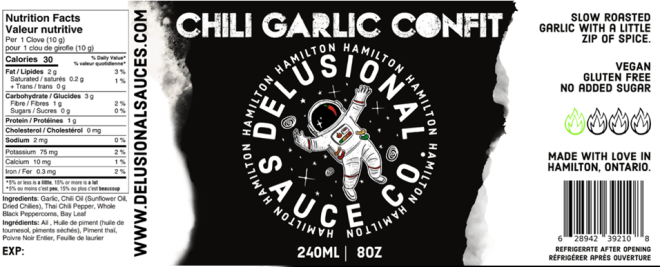
Delusional Sauce Co. - Chili Garlic Confit - 240 mL - Label

Product
Chili Garlic Confit
Issue
Food – Microbial Contamination – Clostridium botulinum
What to do

Do not consume, use, sell, serve, or distribute recalled products

Distribution
Ontario

Issue

The affected product is being recalled from the marketplace because it may permit the growth of Clostridium botulinum.

What you should do

  • If you think you became sick from consuming a recalled product, contact your healthcare provider
  • Check to see if you have recalled products
  • Do not consume, serve, use, sell, or distribute recalled products
  • Recalled products should be thrown out or returned to the location where they were purchased

Food contaminated with Clostridium botulinum toxin may not look or smell spoiled but can still make you sick. Symptoms in adults can include facial paralysis or loss of facial expression, unreactive or fixed pupils, difficulty swallowing, drooping eyelids, blurred or double vision, difficulty speaking, including slurred speech, and a change in sound of voice, including hoarseness. Symptoms of foodborne botulism in children can include difficulty swallowing, slurred speech, generalized weakness and paralysis. In all cases, botulism does not cause a fever. In severe cases of illness, people may die.

Catalonia – Information on cases of botulism

ACSA

4 cases of botulism have been confirmed and 2 probable with a common link of consumption in the previous days of packaged potato omelet purchased from different supermarkets. The cases have occurred in several autonomous communities.

The public health services of the communities and autonomous cities are informed to strengthen early detection in the event of the appearance of new cases with suspicion of botulism should they occur.

The Spanish Food Safety Agency (AESAN) has transferred all the available information to the contact points of the autonomous communities so that they can carry out the relevant investigations in relation to the products that could have been consumed in some of the cases.

In at least three of the confirmed cases and one of the probable ones, the company that makes the tortillas is the same. To date, no evidence has been established, neither in the products nor in the processes, that relate cause and effect. However, investigations are continuing with the collaboration of the production company.

Investigations are being carried out in relation to the possibility that there is any product on the market that is not safe or if there are deviations in the processes of production, distribution, storage or transport that justify the existence of this risk.

It is public knowledge that some distribution chain, applying the precautionary principle and in the face of the lack of certainties, has decided to withdraw from sale the products to which the epidemiological surveys have pointed, while waiting for the investigations to progress.

In any case, we want to remind consumers of the importance, especially at this time of year due to the heat, of preserving food products at the storage temperatures indicated on the labeling and following the instructions for use indicated by the manufacturers, already which guarantee the safety of products for which an expiration date is established.

The case of packaged potato tortillas is particularly important, as one can get the false impression that they are like canned foods, which have thermal stability, and keeping them unrefrigerated at the current room temperature can lead to health problems after consumption

When new information becomes available in relation to this matter, this news will be updated.

Quebec- Notice not to consume marinated garlic flowers prepared and sold by Jardins du Témis – Clostridium botulinum

Quebec

QUEBEC CITY , July 12. 2023 /CNW/ – The Ministry of Agriculture, Fisheries and Food (MAPAQ), in collaboration with the company Jardins du Témis, located at 656, rang Notre-Dame-des-Champs, in Pohénégamook , advises the population not to consume the product indicated in the table below, because it has not been prepared and packaged in such a way as to ensure its harmlessness. Indeed, this product could promote the proliferation of the bacterium  Clostridium botulinum .

Product name

Format

Affected lot


“MARINATED Garlic Flower”


250ml

Batches 0001 and 0002

The product that is the subject of this warning was offered for sale on July 9, 2023, at the public market located at 1171, avenue de l’Accueil, in Dégelis, as well as in several establishments in the Bas-Saint-Laurent region. The product was packaged in a glass jar and sold at room temperature. The product label includes, in addition to its name, the mention “Jardins du Témis”.

The operator is voluntarily recalling the product in question. It has agreed with MAPAQ to issue this warning as a precautionary measure. In addition, people who have this product in their possession are advised not to consume it. They must return it to the establishment where they bought it or throw it away.

Even if the affected product shows no sign of tampering or suspicious odor, it could be contaminated with  Clostridium botulinum bacteria . Foods contaminated with the toxin of this bacterium can cause, when ingested, the following symptoms: facial paralysis, non-reactive or fixed pupils, difficulty swallowing, droopy eyelids, vision and speech disorders. In severe cases, the disease can cause death.

It should be noted that no case of illness associated with the consumption of this food has been reported to MAPAQ to date.

Additional information

The Ministry publishes various information documents concerning food safety. Interested persons can consult the FoodThis link will open in a new window. section  of the Government of Quebec website. They also have the possibility of registering online to receive, by e-mail, the food recallThis link will open in a new window. press releases published by the Ministry. Finally, it is possible to follow “MAPAQfoods” on Twitter at the following address: www.twitter.com/MAPAQfoodsThis link will open in a new window. .

Hazard Classification: Class 1
Reference Number: 4764

Source:
Media relations
Direction des communications
Ministry of Agriculture, Fisheries
and Food
Tel. : 418 380-2100, extension 3512
www.mapaq.gouv.qc.caThis link will open in a new window.

Quebec – Notice not to consume garlic flower pesto prepared and sold by the company François Lambert.One inc. – Clostridium botulinum

Quebec

QUEBEC CITY , July 7. 2023 /CNW/ – The Ministry of Agriculture, Fisheries and Food (MAPAQ), advises the population not to consume the product indicated in the table below, because it has not been prepared and packaged to ensure its safety. Indeed, this product could promote the proliferation of the bacterium  Clostridium botulinum . The product was sold by FrançoisLambert.One inc., located at 1270, Montée Sainte-Madeleine , in Notre-Dame-de-la-Paix .

Product name

Format

Affected lot

“GARLIC FLOWER PESTO”

250ml  _

Units sold until

July 6, 2023

The product that is the subject of this warning was offered for sale until July 6, 2023, only through the online store of the company named above. The product was packaged in a glass jar and sold at room temperature.

In addition, people who have this product in their possession are advised not to consume it. They must return it to the establishment where they bought it or throw it away.

Even if the affected product shows no sign of tampering or suspicious odor, it could be contaminated with Clostridium botulinum bacteria . Foods contaminated with the toxin of this bacterium can cause, when ingested, the following symptoms: facial paralysis, non-reactive or fixed pupils, difficulty swallowing, droopy eyelids, vision and speech disorders. In severe cases, the disease can cause death.

It should be noted that no case of illness associated with the consumption of this food has been reported to MAPAQ to date.

Research – Case Study: Clostridium botulinum Poisoning Caused by Canned Pate

Food Safety.Com

Ten cases of Clostridium botulinum poisoning occurred from mid-July to mid-August of 2020, according to the Food Safety Department of Vietnam. All ten victims were treated in the hospital, with two exhibiting severe symptoms. The two elderly victims with severe symptoms of Clostridium botulinum poisoning reported having eaten canned, plant-based pate. Samples of the leftover pate were analyzed by two separate institutions and found to contain Clostridium botulinum toxin, which can be fatal when ingested in a quantity of less than 0.1 mg. 

The Food Safety department convened an urgent meeting with the manufacturer of the pate. The pate was confirmed to have become contaminated with Clostridium botulinum during production. Product recall notices, consumer recommendations, and written requests for handling the case were issued in quick succession. 

RASFF Alert – Clostridium botulinum – Tinned Chillies

RASFF

Strong suspicion of botulism following consumption of tinned chillies in France

Research – Strategies to Reduce Clostridium botulinum Risk in Fresh-Cut Produce

food safety.com

The risks associated with Clostridium botulinum and low-acid canned foods, meats, seafood, and temperature-abused foods are generally well-established. However, there has been increasing consideration toward C. botulinum and its potential as a pathogen of concern for fresh-cut vegetables, fruits, and mushrooms.

For an industry segment beleaguered by recent outbreaks of Shiga toxin-producing Escherichia coliSalmonella enterica, and Listeria monocytogenes, consideration of a bacterial pathogen with vastly different growth characteristics—one that is less traditionally associated with fresh produce—may seem burdensome. However, recent incidences of C. botulinum in packaged mushrooms,1 increased characterization of the growth conditions required by nonproteolytic C. botulinum, widespread industry adoption of modified atmosphere packaging (MAP), and even increasing fuel costs may necessitate a second look at this pathogen’s association with fresh produce.

France sees a rise in outbreaks in 2021

Food Safety News

The number of outbreaks in France went up in 2021 but was still below 2018 and 2019 levels.

Figures from Santé publique France show there were 1,309 outbreaks affecting 11,056 people in 2021. A total of 512 people went to hospitals and 16 died.

Reported outbreaks rose from 1,010 in 2020 when figures were strongly impacted by the COVID-19 pandemic, according to officials.

For 327 incidents in 2021, a pathogen could be microbiologically confirmed in food or in at least one sick person per outbreak. A pathogen was suspected without microbiological confirmation for 734 outbreaks.

16 deaths in outbreaks
The most frequently microbiologically confirmed pathogen was Salmonella 147 times. It was mostly Salmonella Enteritidis, followed by monophasic Salmonella Typhimurium but the type was not known in 92 incidents. Confirmed Salmonella outbreaks were responsible for 935 patients and 166 hospitalizations.

Campylobacter caused 52 outbreaks with 178 patients and Bacillus cereus had 46 with 665 patients. Nineteen norovirus outbreaks sickened 493 and 11 histamine outbreaks affected 35 people.

Seven outbreaks were due to E. coli, six to Yersinia enterocolitica, four to Shiga toxin-producing E. coli (STEC), and one each because of Listeria monocytogenes, Clostridium botulinum, and Shigella.

The pathogen was identified in patients for 208 outbreaks, of which 143 were confirmed with Salmonella. Identification of the agent took place in food samples for 89 epidemics with 67 confirmed as Bacillus cereus, Staphylococcus aureus and Clostridium perfringens.

The top suspected pathogens based on epidemiological and clinical information, but not microbiologically confirmed, were the toxins Bacillus cereus, Staphylococcus aureus and Clostridium perfringens. For these three pathogens, 3,787 patients and 169 hospital trips were recorded.