Category Archives: CDC

USA -CDC – List of Multistate Foodborne Outbreak Notices

CDC

The link above shows multistate foodborne outbreaks for which CDC led the investigation and issued outbreak notices since 2006.

For information on all foodborne outbreaks reported to CDC since 1998, use the National Outbreak Reporting System (NORS) Dashboard.

Research – Preliminary Incidence and Trends of Infections Caused by Pathogens Transmitted Commonly Through Food

Medscape

Abstract and Introduction

Introduction

Each year, infections from major foodborne pathogens are responsible for an estimated 9.4 million illnesses, 56,000 hospitalizations, and 1,350 deaths in the United States.[1] To evaluate progress toward prevention of enteric infections in the United States, the Foodborne Diseases Active Surveillance Network (FoodNet) conducts surveillance for laboratory-diagnosed infections caused by eight pathogens transmitted commonly through food at 10 U.S. sites. During 2020–2021, FoodNet detected decreases in many infections that were due to behavioral modifications, public health interventions, and changes in health care–seeking and testing practices during the COVID-19 pandemic. This report presents preliminary estimates of pathogen-specific annual incidences during 2022, compared with average annual incidences during 2016–2018, the reference period for the U.S. Department of Health and Human Services’ Healthy People 2030 targets.[2] Many pandemic interventions ended by 2022, resulting in a resumption of outbreaks, international travel, and other factors leading to enteric infections. During 2022, annual incidences of illnesses caused by the pathogens CampylobacterSalmonellaShigella, and Listeria were similar to average annual incidences during 2016–2018; however, incidences of Shiga toxin-producing Escherichia coli (STEC), YersiniaVibrio, and Cyclospora illnesses were higher. Increasing culture-independent diagnostic test (CIDT) usage likely contributed to increased detection by identifying infections that would have remained undetected before widespread CIDT usage. Reducing pathogen contamination during poultry slaughter and processing of leafy greens requires collaboration among food growers and processors, retail stores, restaurants, and regulators.

USA – The top 3 food safety agencies work in collaboration on foodborne illness sources

Food Safety News

The Centers for Disease Control and Prevention, the U.S. Food and Drug Administration, and the Food Safety and Inspection Service of the United States Department of Agriculture—teamed up in 2011 to create the Interagency Food Safety Analytics Collaboration (IFSAC).

By bringing together the science  from CDC, FDA and FSIS, and by developing sound analytical methods, IFSAC’s goal was to improve estimates of the sources of foodborne illness.

IFSAC this week announced its priorities for 2024 to 2028

During 2024 – 2028 IFSAC will focus on generating the most accurate and actionable estimates for foodborne illness source attribution in the United States by leveraging the latest science, data, and methods, and will communicate these estimates to stakeholders in government, industry, academia, and consumer organizations.

IFSAC

Research – Foodborne Botulism, Canada, 2006–2021

CDC

Abstract

During 2006–2021, Canada had 55 laboratory-confirmed outbreaks of foodborne botulism, involving 67 cases. The mean annual incidence was 0.01 case/100,000 population. Foodborne botulism in Indigenous communities accounted for 46% of all cases, which is down from 85% of all cases during 1990–2005. Among all cases, 52% were caused by botulinum neurotoxin type E, but types A (24%), B (16%), F (3%), and AB (1%) also occurred; 3% were caused by undetermined serotypes. Four outbreaks resulted from commercial products, including a 2006 international outbreak caused by carrot juice. Hospital data indicated that 78% of patients were transferred to special care units and 70% required mechanical ventilation; 7 deaths were reported. Botulinum neurotoxin type A was associated with much longer hospital stays and more time spent in special care than types B or E. Foodborne botulism often is misdiagnosed. Increased clinician awareness can improve diagnosis, which can aid epidemiologic investigations and patient treatment.

USA – Summary of Possible Multistate Enteric (Intestinal) Disease Outbreaks in 2021

CDC

Outbreak Investigations At A Glance

Possible Multistate Outbreaks

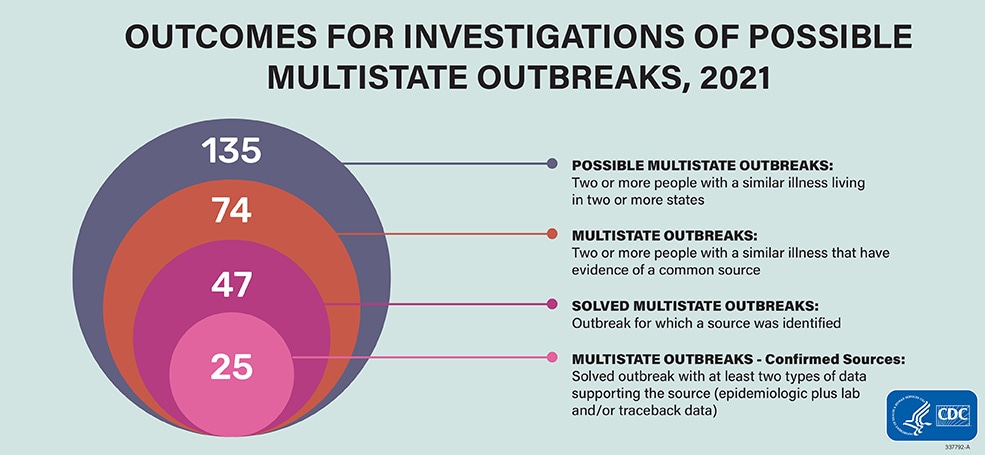
This analysis includes 135 possible multistate outbreak investigations during 2021.

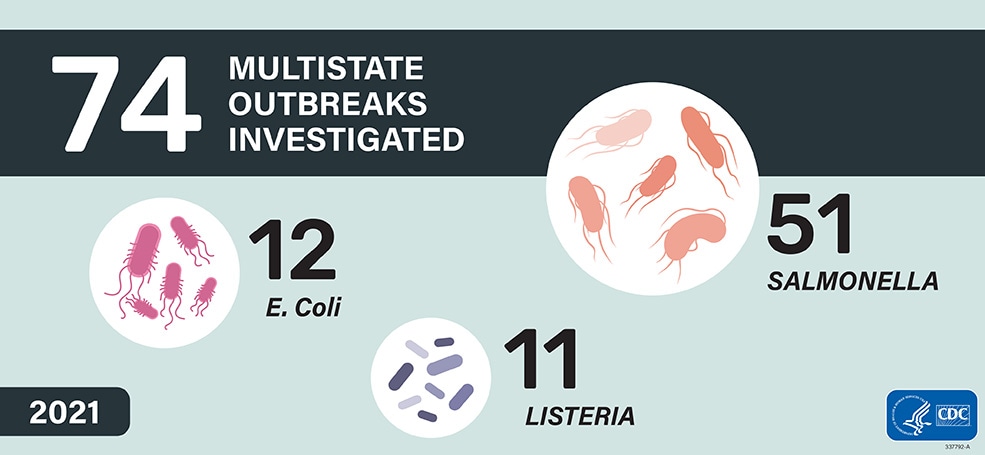
This analysis includes 135 investigations of possible multistate enteric (intestinal) outbreaks during 2021. Some possible outbreaks were excluded from this report because they were determined to be single state or because they were linked to international travel. After investigation, 74 (55%) of these were determined to be multistate outbreaks, and investigators solved 47 (64%) of these outbreaks.

Multistate Outbreaks

74 (55%) of the 135 investigations were determined to be multistate outbreaks.

The number of outbreaks increased from 2020 but was lower than the 82 investigated outbreaks in 2019. The number of outbreaks investigated in 2021 was likely lower than that in 2019 due in part to continued effects of the COVID-19 pandemic on enteric disease outbreak detection and investigation (e.g., decreased resources at local, state, and federal public health agencies, changes in healthcare-seeking behavior, and changed restaurant dining and grocery shopping patterns.) Additionally, changing diagnostic testing practices likely continued to affect enteric disease surveillance and the ability to identify possible outbreaks.

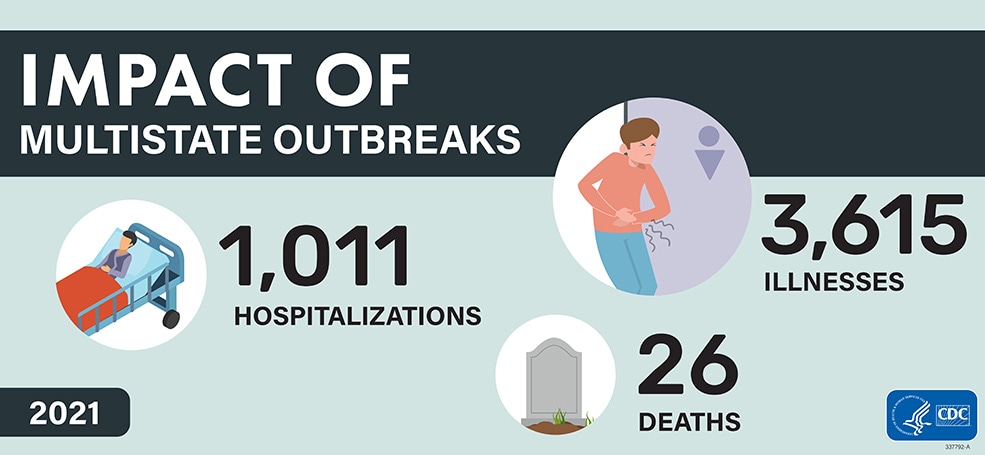
The 74 investigated multistate outbreaks resulted in 3,615 illnesses, 1,011 hospitalizations, and 26 deaths

Solved Multistate Outbreaks

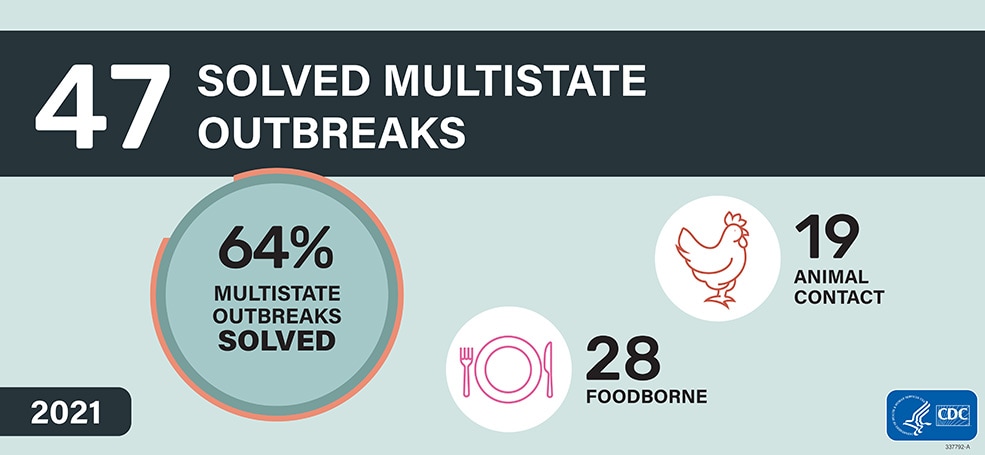
Among the 74 investigated multistate outbreaks, 47 (64%) were solved, including 25 outbreaks with confirmed sources and 22 with suspected sources.

Among the 74 multistate outbreaks, 47 (64%) were solved, meaning a confirmed or suspected source of the outbreak was identified, including 25 (53%) outbreaks with confirmed sources and 22 (47%) with suspected sources. Among the 47 solved outbreaks, 28 (60%) were linked to contaminated foods, and 19 (40%) were linked to animal contact.

Solved multistate outbreaks caused at least 2,047 illnesses. Solved multistate outbreaks linked to contaminated food caused 1,740 illnesses, 496 hospitalizations, and 15 deaths, while multistate outbreaks linked to animal contact caused 1,307 illnesses, 329 hospitalizations, and 3 deaths.

USA – Listeria Outbreak Linked to Ice Cream

CDC

Fast Facts
  • Illnesses: 2
  • Hospitalizations: 2
  • Deaths: 0
  • States: 2
  • Recall: Yes
  • Investigation status: Active

Various types of ice cream in small cups.

Recalled Food

“Soft Serve On The Go” Ice Cream Cups

  • Flavors include:
    • Vanilla chocolate
    • Caramel
    • Parve vanilla chocolate
    • Peanut butter lite
    • Razzle
    • Sorbet strawberry mango
  • Sold nationwide at many types of stores, including:
    • Grocery stores
    • Convenience stores
    • Canteens
  • Distributed by Real Kosher Ice Cream to businesses and institutions, including:
    • Long-term care facilities
    • Nursing homes
    • Schools
    • Camps
  • Distributed internationally to:
    • Belgium
    • Brazil
    • Canada
    • Mexico
    • United Kingdom

On August 9, Real Kosher Ice Cream recalled all flavors of their “Soft Serve On The Go” ice cream cups.

Listeria was found in a “Soft Serve On The Go” ice cream cup collected from a sick person’s freezer, and laboratory scientists are working to determine if it is the outbreak strain of Listeria.

What You Should Do
  • Do not eat “Soft Serve On The Go” ice cream cups.
    • Check your freezers. Listeria can survive at freezing temperatures.
    • Throw them away or return them to where you bought them for a refund.
    • If you have any questions, contact the company at 845-668-4346 or info@softserveonthego.com (Monday to Friday, 9am to 5 pm EST).
  • Call a healthcare provider right away if you have these symptoms after eating the ice cream:
    • Pregnant people usually have fever, muscle aches, and tiredness.
    • People who are not pregnant usually have fever, muscle aches, and tiredness. They may also get a headache, stiff neck, confusion, loss of balance, or seizures.
What Businesses and Institutions Should Do
  • Businesses and institutions, including long-term care facilities, hospitals, school, and camps, should not sell or serve “Soft Serve On The Go” ice cream cups.
    • Many of your patients or clients could be at higher risk for Listeria illness (65 years or older, have a weakened immune system, or are pregnant).

CDC monitoring long-running Listeria strain behind 12 deaths

Food Safety News

TORONTO – Monitoring of related Listeria infections over multiple years has seen more than 80 cases and a dozen deaths, according to the Centers for Disease Control and Prevention.

Michael Vasser, from the CDC, gave details about the reoccurring, emerging and persisting (REP) strain during a recent presentation at the International Association for Food Protection.

Research – A Novel Foodborne Illness Detection and Web Application Tool Based on Social Media

MDPI

Abstract

Foodborne diseases and outbreaks are significant threats to public health, resulting in millions of illnesses and deaths worldwide each year. Traditional foodborne disease surveillance systems rely on data from healthcare facilities, laboratories, and government agencies to monitor and control outbreaks. Recently, there is a growing recognition of the potential value of incorporating social media data into surveillance systems. This paper explores the use of social media data as an alternative surveillance tool for foodborne diseases by collecting large-scale Twitter data, building food safety data storage models, and developing a novel frontend foodborne illness surveillance system. Descriptive and predictive analyses of the collected data were conducted in comparison with ground truth data reported by the U.S. Centers for Disease Control and Prevention (CDC). The results indicate that the most implicated food categories and the distributions from both Twitter and the CDC were similar. The system developed with Twitter data could complement traditional foodborne disease surveillance systems by providing near-real-time information on foodborne illnesses, implicated foods, symptoms, locations, and other information critical for detecting a potential foodborne outbreak.

USA – CDC – Cyclosporiasis Illnesses in the United States, 2023

CDC

CDC, along with state and federal health and regulatory officials, monitor cases of cyclosporiasis acquired in the United States in the spring and summer months to detect outbreaks linked to a common food source. Cyclosporiasis is a diarrheal illness caused by a parasite called Cyclospora cayetanensis.

Fast Facts

  • Illnesses: 581
  • Hospitalizations: 55
  • Deaths: 0
  • States reporting cases: 31
  • Investigation status: Active (first posted on May 25, 2023)

Cyclosporiasis illnesses are reported year-round in the United States. However, during the spring and summer months there is often an increase in cyclosporiasis acquired in the United States. The exact timing and duration of these seasonal increases in cyclosporiasis can vary, but reports tend to increase starting in May. This year, cases were reported starting in April. It is too soon to tell if this timing indicates a change in the seasonality of cyclosporiasis in the United States.

In previous years, the reported number of cases peaked between June and July, although cases can be reported as late as September. The number of infections or hospitalizations and the number of identified outbreaks linked to a common source also vary from season to season.

USA – How the FDA Uses Traceback to Respond to Foodborne Illness Outbreaks

FDA

Every year the FDA responds to dozens of foodborne outbreaks, but what does that mean? What are the steps the FDA and other public health agencies take to determine the source of a foodborne illness outbreak and protect public health?

In a video and infographic, the FDA provides an overview of the traceback process used to examine the complex path of food as it travels through the supply chain. Typically, in a traceback investigation, investigators trace food that ill people report eating all the way back to a farm or production facility. Finding commonalities in the supply chains of foods eaten by ill people helps investigators zero in on a potential source of the outbreak. Traceback is one tool used by FDA investigators during the many steps taken by the agency along with the Centers for Disease Control and Prevention (CDC) and local, state, and international public health authorities to respond to outbreaks in FDA-regulated food products.

The video explores how the CDC works with public health authorities to learn more about what might be making consumers sick, and then if an FDA-regulated food product is identified, how the FDA investigates the cause of the outbreak and works with industry to remove any potentially contaminated product from store shelves. The FDA, CDC, and local and state partners also work together to warn the public, as appropriate, and to help prevent additional illnesses.

Infographic (PDF)