Author Archives: KSW

Image

Happy Christmas and (Food Safe) Holidays to All.

Food Microbiology

Research – A Critical Review of Risk Assessment Models for Listeria monocytogenes in Dairy Products

MDPI

Abstract

A review of the published quantitative risk assessment (QRA) models of L. monocytogenes in dairy products was undertaken in order to identify and appraise the relative effectiveness of control measures and intervention strategies implemented at primary production, processing, retail, and consumer practices. A systematic literature search retrieved 18 QRA models, most of them (9) investigated raw and pasteurized milk cheeses, with the majority covering long supply chains (4 farm-to-table and 3 processing-to-table scopes). On-farm contamination sources, either from shedding animals or from the broad environment, have been demonstrated by different QRA models to impact the risk of listeriosis, in particular for raw milk cheeses. Through scenarios and sensitivity analysis, QRA models demonstrated the importance of the modeled growth rate and lag phase duration and showed that the risk contribution of consumers’ practices is greater than in retail conditions. Storage temperature was proven to be more determinant of the final risk than storage time. Despite the pathogen’s known ability to reside in damp spots or niches, re-contamination and/or cross-contamination were modeled in only two QRA studies. Future QRA models in dairy products should entail the full farm-to-table scope, should represent cross-contamination and the use of novel technologies, and should estimate L. monocytogenes growth more accurately by means of better-informed kinetic parameters and realistic time–temperature trajectories.

Research – Machine learning is set to speed up the detection of contamination in food factories

Techcrunch

The factories that process our food and beverages (newsflash: no, it doesn’t come straight from a farm) have to be kept very clean, or we’d all get very ill, to be blunt. Ensuring that usually entails deploying petri-dish-based microbiological monitoring, hardware and waiting for tests to return from labs. A new startup has plans to use deep-learning algorithms to speed up this process.

Spore.Bio is a French startup that has developed a new pathogen-detection methodology. It works by shining an optical light on surfaces where clean food has been, and doing the same with unclean food. It then compares the two datasets to detect when a surface is not clean.

Off the back of this solution, it’s now raised €8 million in pre-seed funding led by London’s LocalGlobe VC. Also participating was EmergingTech Ventures, No Label Ventures, Famille C (Clarins Family Office), Better Angle, Plug & Play Ventures, Entrepreneur First, Kima Ventures, Raise Sherpas, Fair Equity, Sharpstone Capital and angels.

UP researchers caution against parasites in raw vegetables, seafood – Toxoplasma

UPD

Scientists from the University of the Philippines (UP) are gently reminding the public to thoroughly wash and cook their market-bought fresh produce and seafood as a precautionary measure against parasites.

The parasite that causes toxoplasmosis, called Toxoplasma gondii (T. gondii), is one of the most infectious parasites in the world: it affects almost a third of the world’s population, most especially vulnerable groups such as the pregnant and immunocompromised. While most people infected with the disease do not present any symptoms, some may suffer flu-like symptoms, such as fever, headache, and muscle aches. But in severe cases, toxoplasmosis can cause inflammation of the brain and blurry vision. Infected parents’ newborn infants may suffer from excessive fluid in the brain and developmental issues. Fortunately, treatments are available for toxoplasmosis, hence symptomatic individuals are advised to seek timely medical attention.

Cielo Emar M. Paraoan, Ren Mark D. Villanueva, and Marie Christine M. Obusan of the UP Diliman College of Science’s Institute of Biology (UPD-CS IB) found that T. gondii is fairly common in vegetables and oysters that they sampled from local markets in Central Luzon. Among the vegetables tested were lettuce, cabbage, carrots, cauliflower, and mung bean sprouts.


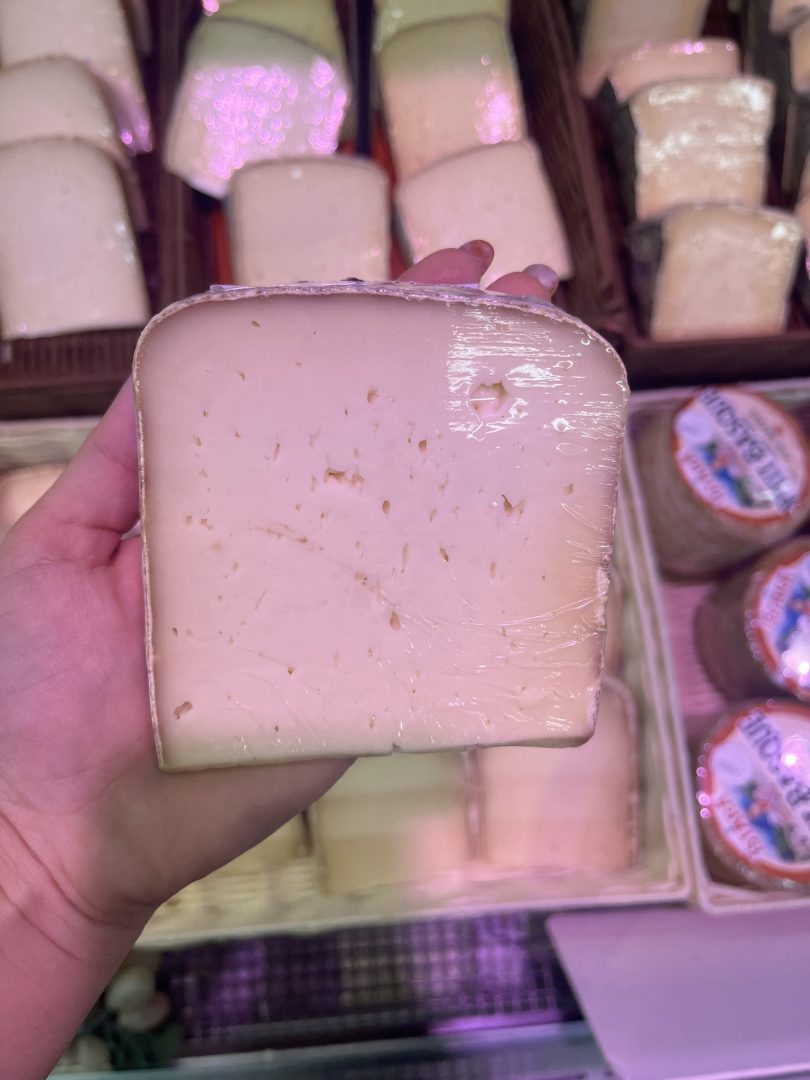
France – TOMME OF BAZAS – Listeria monocytogenes

Gov France

Product category
Food
Product subcategory
Milk and dairy products
Product brand name
TOMME OF BAZAS
Model names or references
portions of tomme de bazas sold in the packaged fresh cheese section during the period from 11/25/2023 to 12/10/2023
Product identification
GTIN Date
0200531000000 Use-by date 10/12/2023
Packaging
portions of approximately 200g
Start/end date of marketing
Of 11/25/2023 At 10/12/2023
Storage temperature
Product to keep in the refrigerator
Further information
Portions sold only in the fresh-packaged cheese section between 11/25/2023 and 12/10/2023
Geographical sales area
Intermarché of Saint-Symphorien 33113
Distributors
Only the Intermarché store in Saint-Symphorien Route de Sore 33113

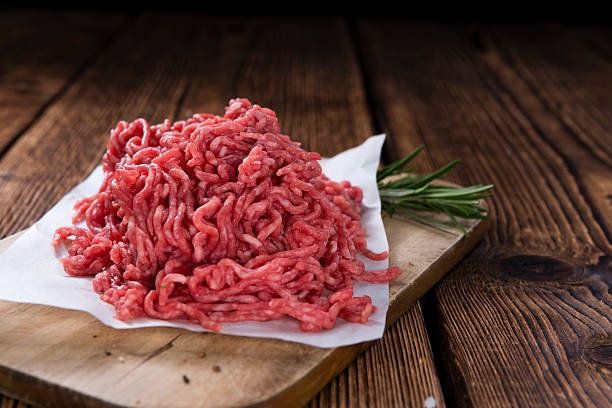
France – Minced meat on demand – Listeria monocytogenes

Gov France

Product category
Food
Product subcategory
Meats
Product brand name
SVA JEAN ROZE
Model names or references
Minced meat SVA JEAN ROZE on request
Product identification
Batch
B146000005810
Packaging
BULK BUTCHER
Start/end date of marketing
Of 11/21/2023 At 07/12/2023
Storage temperature
Product to keep in the refrigerator
Geographical sales area
INTERMARCHE SELONCOURT
Distributors
INTERMARCHE 28 RUE DU GENERAL LECLERC 25230 SELONCOURT

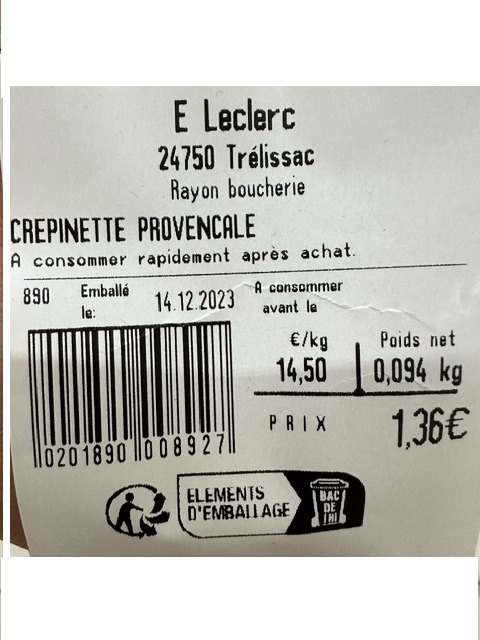
France – Provencal Pork Crepinette – Salmonella

Gov France

Product category
Food
Product subcategory
Meats
Product brand name
On-site manufacturing
Model names or references
Provencal pork crepinette
Product identification
GTIN
0201890000000
Packaging
Product sold individually in the Traditional butcher section
Start/end date of marketing
Of 08/12/2023 At 09/12/2023
Storage temperature
Product to keep in the refrigerator
Further information
Raw Provencal pork crepinette
Geographical sales area
Leclerc Trélissac
Distributors
Leclerc Trélissac

USA – Sushi 9 may be linked to 240 Norovirus cases

Food Poison Journal

Norovirus Food Safety kswfoodworld

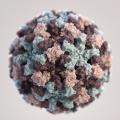
WRAL News reports that as of today there are now 241 complaints from people who ate at Sushi Nine since November28, the date the first customers became ill. Since WRAL News first reported the outbreak on Nov. 30, three stool samples collected from complainants have tested positive for norovirus, a contagious virus that causes vomiting, diarrhea, nausea and stomach pain, among other symptoms.

RASFF Alert – Campylobacter – Oysters

RASFF

Campylobacter in oysters from the Netherlands in Belgium

RASFF Alert – Mycotoxins – Pistachios

RASFF

Mycotoxins in pistachios from the USA, via Germany in the Netherlands